Have you ever wondered how charities in Canada get their special status? Charities play a crucial role in helping people, animals, and the environment. However, to do their work effectively, they often need to register with the government. Let’s explore the process of registering a charity in Canada and what it means to be a registered charity.
1. Deciding to become a Registered Charity:
Registered charity versus a not-for-profit:
Having an understanding of the distinction between a charity and a not-for-profit is crucial for their operations. Charities have to concentrate on charitable activities to maintain their status, and they can issue receipts to donors for their contributions, which helps them with tax deductions. Not-for-profits have more flexibility in their activities, but they cannot issue tax receipts to their donors. Recognizing these differences is vital in determining how these organizations can function within the rules.
Advantages and obligations of becoming a registered charity:
Becoming a registered charity has its perks! You don’t have to pay certain taxes, and you can receive donations from other charities. Plus, you gain credibility in your community. But remember, with great status comes great responsibility. You’ll need to spend your resources on charitable activities, keep accurate records, and follow specific rules set by the government.
Factors that prevent an organization from becoming a charity:
Not every organization can become a charity. If your group engages in illegal activities or doesn’t have charitable purposes, you might not be eligible. It’s essential to understand these factors before applying for registration.
2. Steps Before Applying:
Charitable purposes:
Before diving into the registration process, it’s crucial to ensure that your organization’s mission aligns with charitable purposes. These purposes, such as alleviating poverty or advancing education, form the foundation of your charity’s work. Activities undertaken by your organization should aim to achieve these charitable goals and benefit the public or a significant section of it.
Preparing your governing document:
Your organization’s governing document serves as its roadmap, outlining its purpose, structure, and internal processes. Whether it’s a bylaws, articles of incorporation, or trust document, this document defines your charity’s identity and operations. It’s essential to ensure that your governing document reflects your organization’s charitable objectives and complies with legal requirements.
Types of registered charities:
Understanding the different types of registered charities helps you choose the most suitable structure for your organization:
Charitable Organizations: These entities primarily conduct their charitable activities and receive funding from multiple donors. They must have more than 50% of their directors or officials at arm’s length, ensuring independence from undue influence.
Public Foundations: Public foundations distribute a significant portion of their income to other registered charities or qualified donees while also conducting charitable activities of their own. They, too, require a majority of directors or officials to be at arm’s length.
Private Foundations: Unlike public foundations, private foundations may have a single director or official who controls the charity. They can engage in their charitable activities or support other qualified recipients. Understanding these distinctions helps you choose the most appropriate structure for your organization’s goals and operations.
Head body versus internal division:
When considering your organization’s structure, you must decide whether to apply as a head body or an internal division:
Head Body: As a head body, your organization exercises authority over internal divisions, ensuring consistent governance and oversight. Your governing documents must demonstrate control over internal divisions, including the ability to create or dissolve them, allocate resources, and set strategic direction.
Internal Division: Alternatively, an internal division operates within an existing registered charity. While retaining autonomy over certain activities, it remains subject to the overarching governance and policies of the head body. Internal divisions must provide documentation demonstrating their relationship with the head body, including letters of good standing and relevant governing documents.
Understanding these structural options enables you to make informed decisions about your organization’s registration process, ensuring alignment with your charitable objectives and legal requirements.
3. Applying for Registration:
Required documents:
When applying, you’ll need to submit various documents, including your governing document and financial statements. Depending on your organization, you may also need to provide descriptions of your activities and any partnerships or contracts.
Describing activities:
Describe in detail the activities your organization plans to undertake. Include information like the activity name, description, start date, location, and purpose. This helps the government determine if your activities are genuinely charitable.
Submitting your application:
Once you’ve gathered all the necessary documents, you can submit your application online. The process varies depending on whether you’re applying for the first time or reapplying after a previous denial.
4. Application Review Process:
Review for Completion:
The government will first check to ensure your application is complete. If it is, they’ll assign it to an officer for review. If not, they may request additional information from you.
Review for Registration Status:
During this step, an officer will review your application to ensure your organization’s purposes and activities are genuinely charitable. If approved, you’ll receive notice of your registration status and any accompanying responsibilities.
Appeals:
If your application is denied, you have the right to appeal the decision within a certain timeframe. However, failing to provide the requested information may result in your file being closed, making an appeal impossible.
5. Dissolving your Registration:
Consequences of Charity Dissolution:
If you decide to dissolve your charity and not-for-profit status, you’ll lose certain privileges, such as tax exemptions and the ability to issue official donation receipts. You’ll also need to transfer any remaining assets to eligible recipients.
Registering a charity in Canada is a significant step toward making a positive impact on your community. By understanding the process and requirements involved, you can ensure your organization operates effectively and fulfills its charitable mission.
Ready for better nonprofit reporting?
At Northfield & Associates, we have a team of professional bookkeepers and accountants to help your organization manage the books so that you can breeze through tax season.
We’re often asked by prospective clients what our Bookkeeping Service covers? People want to know what specific tasks we do, and what their responsibility is. This brief explainer page will answer that question. This is by no means an exhaustive list, but covers the most frequently asked questions.
Getting Started
Review your existing books for needed corrections or back-work
Chart of accounts setup or amendment
Assistance with setting up bank feeds
Limited assistance* with setting up payroll (QBO or Gusto only)
Your books brought current and reconciled if needed
Ongoing Monthly Bookkeeping
After-the-fact transaction recording
Post to general ledger
Post to other ledgers (as needed)
Bank account reconciliation
Monthly financial statements
Other bookkeeping services, as required
Best-practice bookkeeping advice and counsel
Year End
Assistance with 1099-NEC preparation*
Assistance with 1099-MISC preparation*
Year-end financial statements and period-end closing
What We Don’t Do
Pay bills
We do not offer bill-pay services at this time, nor do we manage Accounts Payable (AP) or Accounts Receivable (AR).
Payroll tax responsibility
Our bookkeepers can assist you in setting up your initial payroll service in QBO or Gusto. We are not responsible for entering payroll hours/salary, accruing payroll taxes, nor the transmittal of payroll taxes to the IRS or the state. Your full-service payroll provider (QBO, Gusto, or whatever other service a client uses) will be the responsible party for payroll and payroll tax compliance.
*Payroll deductions and benefits
We provide assistance with setting up a payroll account in either Quickbooks Online or Gusto, including entry of employee data. We do not assist in state registrations, benefits, or advise on deductions. Those service areas are provided directly by either QBO or Gusto.
Preparation of W2s
Similar to the last item, your full-service payroll provider (QBO/Gusto) is responsible for preparation of Form W2 for employees.
Sales tax reporting
For those nonprofits that sell taxable goods and/or services, your bookkeeper will assist in accounting for sales taxes collected and transmitted, but we do not prepare state sales tax reports.
Donation recording
We do not provide individual donation data entry into your neither your donor CRM nor Quickbooks Online, nor do we prepare year-end donor acknowledgements.
Administrative tasks
We cannot provide administrative services unrelated to our bookkeeping function.
Attend board meetings
Due to the constraints of time and distance, we are unable to be present, physically nor virtually, at a meeting of a client’s board of directors.*May incur additional fee per 1099-NEC or 1099-MISC.
Let’s Collaborate & Make a Difference!
Partner with us to amplify your mission. Whether it’s Charity accounting, financial transparency, or strategic growth—we’re here to help you create meaningful impact. Let’s work together to build a better future!
In this evolving economic landscape, collaboration with our firm offers clients a strategic advantage. With Cambodia’s reform-driven investment environment and Canada’s expanding footprint in Southeast Asia, our team of experienced consultants and legal advisors provides tailored guidance to help businesses navigate cross-border opportunities. We focus in developing comprehensive legal strategies, structuring international partnerships, and ensuring compliance in emerging markets.
By leveraging our regional insight and international expertise, you benefit from a trusted partner dedicated to helping you capitalize on growth potential in Cambodia and beyond.
Your Trusted Partner in International Bilateral Relations
At Northfield & Associates are focus in Foreign Direct Investment (FDI), international trade missions, and cross-border legal strategy. Our team of experienced consultants and legal advisors offers tailored guidance and strategic insight to help you navigate the complexities of international partnerships and development opportunities.
Whether you choose to meet in person at one of our offices or connect virtually, we provide flexible and accessible consultation options. During your session, we’ll assess your goals, review key documentation, and guide you through every stage of your FDI or trade mission engagement.
Let us help you take the next step with confidence supported by trusted legal and strategic counsel every step of the way.
Northfield & Associates
Advancing Global Partnerships, Together.
Take the First Step Today
If you believe you may be eligible for legal relief or simply need sound legal advice, we’re here to help. Contact us today to book your consultation. Let us provide the clarity, strategy, and peace of mind you need to move forward.
Disclaimer: The information contained in this article is provided for general information purposes only and does not constitute legal or other professional advice. Readers should seek tailored legal advice in relation to their personal circumstances.
We serve our clients in English, Cambodian, Vietnamese, Mandarin and Cantonese, especially in Asian clients.
If you or anybody that you know, think that you meet the requirements and wish to receive further information.
We can help you start the application process and confirm eligibility requirements to participate.
We Offer Consultations & Meetings by Phone & Virtually. Affordable Fees.
Book a Consultation Today
Contact Northfield & Associates today to schedule a consultation with an experienced Consultant.
Northfield & Associates International Corporation is a global consulting firm serving private enterprises, public institutions, not-for-profit organizations, and institutional capital providers. Operating across Cambodia, Canada, and global markets, the firm supports capital deployment, regulatory navigation, and enterprise decision-making in complex economic and geopolitical environments. Northfield & Associates delivers customized, execution-focused advisory solutions that drive measurable transformation, strengthen competitiveness, and enhance long-term highest value opportunities. The firm incorporates consulting, legal, regulatory, financial, and risk expertise to enable disciplined capital allocation, strong governance, and operational resilience. Northfield & Associates upholds a culture of applied insight and innovation, supporting clients across digital transformation, growth strategy, and organizational capability building. The firm advises individual, leading global corporations, midsize enterprises, government agencies, and mission-driven organizations through long-term partnerships. Enterprise-wide risk management, professional ethics, and fiduciary standards are embedded across all operations. Northfield & Associates’ diverse, globally unified teams are committed to execution certainty and sustainable, risk-adjusted returns aligned with ESG and stakeholder objectives.
Forward-Looking Information
This news release contains forward-looking information. All statements, other than statements of historic fact, that address activities, events or developments that the Company believes, expects or anticipates will or may occur in the future constitute forward-looking information.
This forward-looking information reflects the current expectations or beliefs of the Company based on information currently available to the Company.
Forward-looking information is subject to a number of risks and uncertainties that may cause the actual results of the Company to differ materially from those discussed in the forward-looking information, and even if such actual results are realized or substantially realized, there can be no assurance that they will have the expected consequences to, or effects on the Company. Factors that could cause actual results or events to differ materially from current expectations include, among other things: the failure to finalize negotiations concerning the increase of the Loan or to close such transaction and the failure of the Company to complete the acquisition of the Company Facility; operating performance of facilities; environmental and safety risks; delays in obtaining or failure to obtain necessary permits and approvals from government authorities; unavailability of plant, equipment or labour; inability to retain key management and personnel; changes to regulations or policies affecting the Company’s activities; and the other risks disclosed under the heading “Risk Factors” and elsewhere in the Company’s amended annual information.
Forward-looking information speaks only as of the date on which it is made and, except as may be required by applicable securities laws, the Company disclaims any intent or obligation to update any forward-looking information, whether as a result of new information, future events or results or otherwise. Although the Company believes that the assumptions inherent in the forward-looking information are reasonable, forward-looking information is not a guarantee of future performance and accordingly undue reliance should not be put on such information due to the inherent uncertainty therein.
Questions?
info@northfied.biz
Within Corporate Newsroom
Media Contact:
media@northfied.biz
Press contact
PR consultants press@northfied.biz
NOT LEGAL ADVICE. Information made available on this website in any form is for information purposes only. It is not, and should not be taken as, legal advice. You should not rely on, or take or fail to take any action based upon this information. Never disregard professional legal advice or delay in seeking legal advice because of something you have read on this website. Northfield & Associates professionals will be pleased to discuss resolutions to specific legal concerns you may have.
Handling Conflicts of Interest on the Board of a Charity
Handling Conflicts of Interest
Are you involved in decision-making or representing a non-profit organization? This could mean holding the position of executive director or being a member of the board, among others. If that’s the case, it’s crucial to manage conflicts of interest effectively and prioritize the use of the non-profit’s resources towards achieving its mission. Upholding the organization’s best interests should always be your primary responsibility when carrying out tasks on behalf of the non-profit.
Effectively manage conflicts of interest
Identifying conflicts of interest can be a nuanced process, and avoidance may not always be possible. Here are the signs to look for and the actions to take if you come across one.
How to recognize conflicts of interest
A conflict of interest arises when an external observer could question whether your decisions on behalf of the non-profit were influenced by interests other than those of the organization. This encompasses situations where your personal interests or those of individuals you have a connection with, such as a spouse, employer, company you own shares in, or another organization you are involved with, could potentially sway your actions.
For instance, let’s consider a scenario where a non-profit’s board needs to purchase insurance for the organization. One of the directors on the board serves as an insurance advisor. If the non-profit chooses to buy insurance through this director, the director will receive a commission, thereby creating a conflict of interest.
While it’s advisable to avoid conflicts of interest, it may not always be feasible. In such cases, you must take the required actions to address the conflict of interest.
Steps directors must take when faced with a conflict of interest
Directors of Canadian non-profit organizations are required to promptly inform their fellow directors about any potential conflicts of interest they may have.
During the first board meeting, directors must disclose any interests they hold in another business or organization that could potentially conflict with the non-profit’s interests. If a new conflict of interest arises subsequently, it must be disclosed at the next board meeting.
If a director intends to enter into an agreement with the non-profit, specific rules must be followed. For instance, if a director wishes to purchase a property that the non-profit is selling, a conflict of interest arises. In such cases, the other directors must evaluate the offer’s alignment with the organization’s interests, and the conflicted director cannot take part in the discussion or vote on the matter.
In exceptional circumstances, conflicted directors may decide their own remuneration, but the amount must be reasonable. The meeting minutes must include information on any conflicts of interest and details of who participated in the decision-making or voting process.
Steps for executive directors to take when confronted with a conflict of interest
Executive directors of Canadian non-profit organizations must adhere to specific regulations when entering into an agreement with their organization. For instance, if an executive director wishes to sell something that the non-profit requires for its operations.
Despite usually being responsible for authorizing such agreements, an executive director with a conflict of interest cannot do so in such a scenario. The board must evaluate whether the offer aligns with the non-profit’s interests and authorize the executive director to enter into an agreement with the organization.
Utilize the resources of the non-profit organization to accomplish its mission
Non-profit organizations possess resources such as funding, property, or information, all of which are owned by the organization. It is necessary to utilize these resources towards fulfilling the non-profit’s mission.
Before utilizing these resources for a different purpose, it is essential to obtain consent from the individual or group to whom you are accountable. In the case of an executive director of a Canadian non-profit organization, the board’s approval is necessary, whereas board members must seek permission from the non-profit’s members.
Authorization is required to undertake activities such as:
Withdrawing funds from the non-profit’s bank accounts or utilizing its credit cards to pay for personal expenses, even if it is temporary.
Utilizing the assets of the non-profit for personal purposes.
Loaning the non-profit’s assets or money to someone or another organization with whom you have a relationship.
Utilizing confidential information about the non-profit or its operations to benefit yourself or any other person or organization.
If the person or people you ask for permission determine that your request is in the non-profit’s best interest, they can approve it. For instance, the non-profit could gain from leasing some of its vacant space to you for a fair rent.
Not following these regulations may lead to possible repercussions
If you fail to adhere to these rules, you could face severe consequences. If you act on behalf of the non-profit in a situation where you have a conflict of interest or misuse its resources without permission, the non-profit may take legal action against you. In such cases, the non-profit may ask the court to nullify your actions and require you to pay for any harm or profit incurred without permission.
In certain circumstances, other individuals may also take legal action against you. If you mishandle a conflict of interest and cause harm to someone, you could be held personally accountable for the damages.
Additionally, misusing a non-profit’s resources may constitute a crime, such as fraud, if you take money from the organization without authorization.
Lastly, the non-profit may remove you from your position as a director or executive director. If you have been found guilty of defrauding an organization or repeatedly violating non-profit laws, a court may even prohibit you from serving on any non-profit board for up to five years.
At Northfield & Associates our expert teams guidance on compliance requirements. Our team understands Canadian charity law and can help ensure your organisation follows proper procedures.
In this evolving economic landscape, collaboration with our firm offers clients a strategic advantage. With Cambodia’s reform-driven investment environment and Canada’s expanding footprint in Southeast Asia, our team of experienced consultants and legal advisors provides tailored guidance to help businesses navigate cross-border opportunities. We focus in developing comprehensive legal strategies, structuring international partnerships, and ensuring compliance in emerging markets.
By leveraging our regional insight and international expertise, you benefit from a trusted partner dedicated to helping you capitalize on growth potential in Cambodia and beyond.
Book a Consultation with Northfield & Associates
Your Trusted Partner in International Bilateral Relations
At Northfield & Associates are focus in Foreign Direct Investment (FDI), international trade missions, and cross-border legal strategy. Our team of experienced consultants and legal advisors offers tailored guidance and strategic insight to help you navigate the complexities of international partnerships and development opportunities.
Whether you choose to meet in person at one of our offices or connect virtually, we provide flexible and accessible consultation options. During your session, we’ll assess your goals, review key documentation, and guide you through every stage of your FDI or trade mission engagement.
Let us help you take the next step with confidence supported by trusted legal and strategic counsel every step of the way.
Take the First Step Today
If you believe you may be eligible for legal relief or simply need sound legal advice, we’re here to help. Contact us today to book your consultation. Let us provide the clarity, strategy, and peace of mind you need to move forward.
We serve our clients in English, Cambodian, Vietnamese, Mandarin and Cantonese, especially in Asian clients.
If you or anybody that you know, think that you meet the requirements and wish to receive further information.
We can help you start the application process and confirm eligibility requirements to participate.
We Offer Consultations & Meetings by Phone & Virtually. Affordable Fees.
Disclaimer:
The information contained in this article is provided for general information purposes only and does not constitute legal or other professional advice. Readers should seek tailored legal advice in relation to their personal circumstances.
Northfield & Associates International Corporation is a global consulting firm serving private enterprises, public institutions, not-for-profit organizations, and institutional capital providers. Operating across Cambodia, Canada, and global markets, the firm supports capital deployment, regulatory navigation, and enterprise decision-making in complex economic and geopolitical environments. Northfield & Associates delivers customized, execution-focused advisory solutions that drive measurable transformation, strengthen competitiveness, and enhance long-term highest value opportunities. The firm incorporates consulting, legal, regulatory, financial, and risk expertise to enable disciplined capital allocation, strong governance, and operational resilience. Northfield & Associates upholds a culture of applied insight and innovation, supporting clients across digital transformation, growth strategy, and organizational capability building. The firm advises individual, leading global corporations, midsize enterprises, government agencies, and mission-driven organizations through long-term partnerships. Enterprise-wide risk management, professional ethics, and fiduciary standards are embedded across all operations. Northfield & Associates’ diverse, globally unified teams are committed to execution certainty and sustainable, risk-adjusted returns aligned with ESG and stakeholder objectives.
Forward-Looking Information
This news release contains forward-looking information. All statements, other than statements of historic fact, that address activities, events or developments that the Company believes, expects or anticipates will or may occur in the future constitute forward-looking information.
This forward-looking information reflects the current expectations or beliefs of the Company based on information currently available to the Company.
Forward-looking information is subject to a number of risks and uncertainties that may cause the actual results of the Company to differ materially from those discussed in the forward-looking information, and even if such actual results are realized or substantially realized, there can be no assurance that they will have the expected consequences to, or effects on the Company. Factors that could cause actual results or events to differ materially from current expectations include, among other things: the failure to finalize negotiations concerning the increase of the Loan or to close such transaction and the failure of the Company to complete the acquisition of the Company Facility; operating performance of facilities; environmental and safety risks; delays in obtaining or failure to obtain necessary permits and approvals from government authorities; unavailability of plant, equipment or labour; inability to retain key management and personnel; changes to regulations or policies affecting the Company’s activities; and the other risks disclosed under the heading “Risk Factors” and elsewhere in the Company’s amended annual information.
Forward-looking information speaks only as of the date on which it is made and, except as may be required by applicable securities laws, the Company disclaims any intent or obligation to update any forward-looking information, whether as a result of new information, future events or results or otherwise. Although the Company believes that the assumptions inherent in the forward-looking information are reasonable, forward-looking information is not a guarantee of future performance and accordingly undue reliance should not be put on such information due to the inherent uncertainty therein.
Questions?
info@northfied.biz
Within Corporate Newsroom
Media Contact:
media@northfied.biz
Press contact
PR consultants press@northfied.biz
NOT LEGAL ADVICE. Information made available on this website in any form is for information purposes only. It is not, and should not be taken as, legal advice. You should not rely on, or take or fail to take any action based upon this information. Never disregard professional legal advice or delay in seeking legal advice because of something you have read on this website. Northfield & Associates professionals will be pleased to discuss resolutions to specific legal concerns you may have.
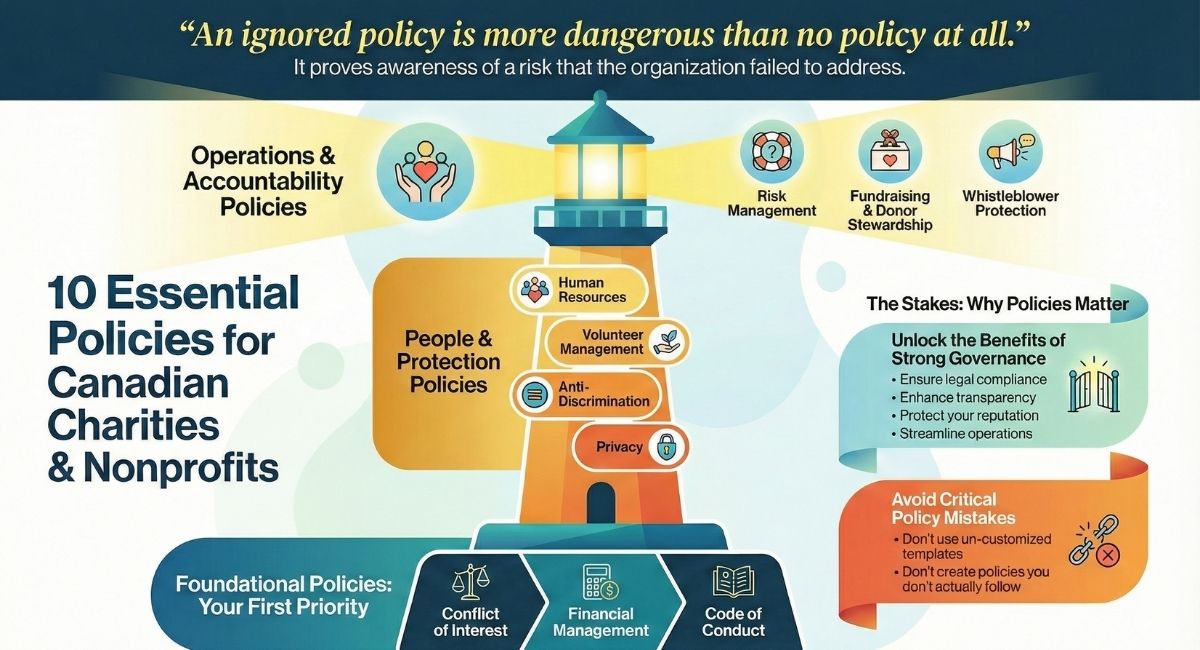
10 Essential Policies for Canadian Charities & Nonprofits
Operating a charity or nonprofit in Canada means more than just fulfilling a mission; it also involves managing the legal, financial, and ethical responsibilities that come with running an organization. One of the most important ways to ensure smooth operations and compliance with Canadian laws is by implementing clear, comprehensive policies. These policies help establish trust, protect the organization’s assets, and maintain transparency with the public, donors, and employees.
Quick Policy Checklist: Does Your Charity Have These?
Use this checklist to assess your organization’s policy readiness. A well-governed charity should have all of these policies documented and accessible to board members, staff, and volunteers.
Code of Conduct Policy – Ethical standards for everyone in your organization
Conflict of Interest Policy – Disclosure and management of personal interests
Financial Management Policy – Budgeting, expenses, and financial controls
Privacy and Confidentiality Policy – Protection of personal and sensitive data
Human Resources Policies – Fair employment practices and workplace standards
Whistleblower Protection Policy – Safe reporting of misconduct
Anti-Discrimination Policy – Prevention of harassment and discrimination
Risk Management Policy – Identification and mitigation of organizational risks
Volunteer Management Policy – Recruitment, training, and support for volunteers
Fundraising and Donor Stewardship Policy – Ethical fundraising practices
Missing more than 3 policies? Your organization may be at risk for compliance issues or operational challenges. Read on to understand why each policy matters and how to implement them effectively.
Are Policies Important for Charities and Nonprofits?
Policies are essential for any organization, as they establish clear expectations for behavior, processes, and decision-making. For Canadian charities and nonprofits, whether registered in Toronto, Ontario (which has the highest amount of registered charities in the country) or across this great nation, these policies ensure compliance with laws such as the Canada Not-for-Profit Corporations Act (CNCA) and regulations from the Canada Revenue Agency (CRA).
For Ontario-incorporated charities, the Ontario Not-for-Profit Corporations Act (ONCA), which came into effect on October 19, 2021, governs corporate operations and includes specific requirements for conflict of interest policies and audit procedures.
By implementing appropriate policies, organizations can prevent internal issues like misconduct and financial mismanagement while also promoting a culture of transparency and accountability.
Understanding Policies vs. Procedures
Many charities confuse policies with procedures, but understanding the difference is crucial for effective governance.
Policies define the “what” and “why” – they establish rules, principles, and guidelines that govern your organization’s operations. Policies are broad statements that reflect your organization’s values and legal obligations. For example, a conflict of interest policy states that board members must disclose potential conflicts and that decisions must be made in the organization’s best interest.
Procedures define the “how” – they are step-by-step instructions for implementing policies. Procedures are detailed and specific. For example, a conflict of interest procedure would outline exactly how a board member completes a disclosure form, when they must recuse themselves from discussions, and how the board documents the conflict resolution.
Think of it this way: Your financial management policy establishes that expenses over $5,000 require board approval. Your financial management procedure explains the exact steps to submit an expense request, who reviews it, the timeline for approval, and how the decision is recorded.
Most organizations need both policies and procedures, but policies should be established first as they provide the framework for developing effective procedures.
Provincial Considerations for Canadian Charities
While federal law governs all registered Canadian charities through the Income Tax Act and CRA regulations, provincial laws may also affect your organization’s policies, particularly in these areas:
Employment Standards: Each province has its own employment standards legislation that affects HR policies. For example, Ontario’s Employment Standards Act sets minimum requirements for vacation time, termination notice, and workplace rights that must be reflected in your HR policies.
Privacy Laws: While PIPEDA applies federally and in most provinces, British Columbia (PIPA), Alberta (PIPA), and Quebec (Law 25) have their own privacy legislation. Charities operating in these provinces must ensure their privacy policies comply with provincial requirements.
Fundraising Regulations: Charitable fundraising is regulated at the provincial level. Some provinces require registration before conducting fundraising activities or have specific rules about lottery licenses, gaming events, or door-to-door solicitation.
Corporate Governance: If your charity is incorporated provincially (such as under Ontario’s Not-for-Profit Corporations Act, 2010), your governance policies must align with provincial corporate law requirements in addition to federal charity regulations.
Ontario-incorporated charities should note that ONCA contains specific requirements for conflict of interest policies, director duties, and audit procedures that must be reflected in organizational policies.
Public Policy and Advocacy Activities: Understanding your charity’s ability to engage in advocacy is crucial for policy development. As of 2018, the CRA abolished the previous 10% limit on non-partisan political activities. Under current CRA guidance (CG-027), registered charities can now engage in unlimited Public Policy Dialogue and Development Activities (PPDDAs), provided these activities are non-partisan and further a charitable purpose. This means your policies should not restrict advocacy activities based on outdated percentage limits. Instead, governance policies should ensure that any public policy activities remain non-partisan, subordinate to charitable purposes, and properly documented. Organizations involved in advocacy work should develop clear policies outlining how they ensure compliance with these requirements while maximizing their ability to influence public policy in their areas of charitable work.
When developing policies, organizations should consult both federal CRA guidelines and relevant provincial legislation to ensure comprehensive compliance.
10 Policies Every Canadian Charity & Nonprofit Should Have
Every Canadian charity and nonprofit needs clear, effective policies to operate legally and responsibly. Here are 10 essential policies every organisation should have in place.
1. Code of Conduct Policy
A Code of Conduct and Ethics Policy lays out the expectations for how all members of the organization, from board members to volunteers, should behave. It promotes a positive work environment where integrity, respect, and transparency are prioritized.
Why it’s important: This policy helps set the ethical framework for your organization, guiding decisions and actions.
What it includes: Guidelines for ethical behavior, reporting procedures for violations, and how to handle conflicts of interest.
Real-World Example: A youth mentorship charity discovered that one of its volunteer mentors was using their position to promote their private tutoring business to program participants. Because the organization had a clear code of conduct that prohibited using volunteer roles for personal business gain, they were able to address the situation immediately and remove the volunteer while documenting the proper handling of the issue.
2. Conflict of Interest Policy
To maintain trust with stakeholders, including donors and the public, charities and nonprofits need to prevent conflicts of interest that could affect their decision-making. A Conflict of Interest Policy outlines how board members, staff, and volunteers should disclose any personal interests that may interfere with the organization’s objectives.
For Ontario-incorporated charities, ONCA requires directors and officers to disclose conflicts and comply with specific procedural requirements when conflicts arise.
Why it’s important: This ensures that decisions are made in the best interest of the organization, not for personal gain.
What it includes: Clear examples of conflicts of interest, how to disclose conflicts, and steps to resolve potential issues.
3. Financial Management Policy
Charities and nonprofits must maintain financial transparency, especially when managing donations, grants, and other funds. A Financial Management Policy outlines the management of finances, ensuring the responsible use of funds while adhering to legal standards.
Why it’s important: This policy helps ensure proper handling of donations and grants, keeping the organization in good standing with the CRA.
What it includes: Budgeting processes, expense management, approval procedures, and financial reporting requirements.
Real-World Example: A community arts charity implements a financial management policy requiring two signatures on all cheques over $1,000 and board approval for any expenses exceeding $5,000. When their executive director wants to purchase new sound equipment costing $7,500, they must present a proposal to the board showing quotes from three suppliers, demonstrating fair market value, and explaining how the purchase aligns with the charity’s programs. This process prevents impulsive spending and ensures board oversight of significant financial decisions.
4. Privacy and Confidentiality Policy
Handling sensitive information is part of running a charity or nonprofit, from donor details to client data. A Privacy and Confidentiality Policy ensures that personal and sensitive data is collected, stored, and used in compliance with privacy laws likePIPEDA (Personal Information Protection and Electronic Documents Act).
Why it’s important: Protecting the privacy of donors, clients, and employees helps build trust and ensures compliance with Canadian privacy laws.
What it includes: Data collection practices, access controls, and breach protocols.
Real-World Example: A homeless shelter charity collects sensitive personal information from clients, including health conditions, addiction histories, and government identification numbers needed to access social services. Their privacy policy clearly outlines what information is collected, why it’s necessary, how long it’s retained, who can access it, and how it’s secured both physically (locked filing cabinets) and digitally (password-protected databases with limited user access). When a client requests to review their file or asks that certain historical information be removed, the policy provides clear procedures for honoring these requests while maintaining records required for funding compliance.
5. Human Resources Policies
For charities and nonprofits that employ staff, HR policies are crucial for setting expectations and ensuring fair treatment. These policies outline how employees are hired, trained, evaluated, and treated throughout their employment.
Why it’s important: HR policies ensure that all employees are treated fairly and legally in accordance with Canadian employment laws.
What it includes: Hiring practices, anti-discrimination policies, workplace safety measures, and employee conduct expectations.
Real-World Example: An immigrant settlement services charity develops comprehensive HR policies covering recruitment (requiring diverse hiring panels to reduce bias), onboarding (including cultural sensitivity training), performance management (with clear evaluation criteria and regular feedback), and termination procedures (ensuring proper documentation and compliance with employment standards). When they need to terminate an underperforming program coordinator, the HR policy requires documentation of performance issues, a performance improvement plan with specific goals, regular check-ins, and a clear timeline. This protects both the employee’s rights and the organization from potential wrongful dismissal claims.
6. Whistleblower Protection Policy
A Whistleblower Protection Policy allows individuals to report misconduct or unethical behavior without fear of retaliation. For charities and nonprofits, this is vital for maintaining transparency and accountability.
Why it’s important: It protects the individuals who come forward and helps maintain a transparent and ethical environment.
What it includes: How to report issues, assurance of confidentiality, and protection against retaliation.
Real-World Example: A health advocacy charity establishes a whistleblower policy that provides multiple reporting channels: an anonymous tip line, a confidential email address monitored by the board chair, and the option to report directly to an external lawyer. When a staff member discovers that the executive director is submitting inflated expense reports, they can report this anonymously through the tip line. The policy requires the board to investigate all reports within 30 days, prohibits any retaliation against the whistleblower (including subtle actions like workload changes or exclusion from meetings), and outlines the consequences for anyone who retaliates. This encouraged the staff member to report the fraud early, preventing more significant financial losses.
7. Anti-Discrimination Policy
An Anti-Harassment and Discrimination Policy is essential for creating a safe, respectful environment for everyone involved in your charity or nonprofit. This policy outlines acceptable behaviors and the steps for handling complaints of harassment or discrimination.
Why it’s important: It helps prevent and address harassment or discrimination, ensuring a positive and inclusive environment.
What it includes: Definitions of harassment and discrimination, reporting procedures, and disciplinary actions for violations.
Real-World Example: A multicultural community services charity develops a comprehensive anti-discrimination policy that defines discrimination and harassment based on all protected grounds under human rights legislation (race, ethnicity, religion, gender, sexual orientation, age, disability, etc.). When a volunteer complains that another volunteer made repeated comments about their accent and suggested they “learn to speak properly,” the policy provides a clear investigation process. A designated harassment officer (trained in investigations) interviews both parties confidentially, reviews any witnesses or documentation, and determines whether discrimination occurred. The policy outlines progressive discipline, which in this case resulted in mandatory diversity training for the offending volunteer and a written warning. The policy also requires the organization to examine whether systemic issues contributed to the incident and to implement preventive measures.
8. Risk Management Policy
Every organization faces risks, whether financial, operational, or reputational. A Risk Management Policy helps charities and nonprofits identify potential risks and develop strategies to manage them effectively.
Why it’s important: This policy allows the organization to be prepared for unexpected situations, minimizing negative impacts.
What it includes: Risk identification, assessment, and mitigation strategies, along with emergency response plans.
Real-World Example: An outdoor education charity that runs summer camps for children develops a comprehensive risk management policy. They conduct an annual risk assessment identifying potential hazards: severe weather events, medical emergencies, transportation accidents, child safety incidents, financial risks (enrollment shortfalls), and reputational risks (social media crises). For each risk, they document the likelihood and potential impact, then establish mitigation strategies – maintaining insurance coverage, training all staff in first aid, implementing strict child supervision ratios, conducting background checks, diversifying funding sources, and creating a crisis communication protocol. When a severe thunderstorm hits during a camp session, staff follow the emergency weather protocol, ensure all children are accounted for and sheltered safely, notify parents promptly, and document the incident. Because risks were identified and planned for, a potentially dangerous situation was managed effectively.
9. Volunteer Management Policy
Volunteers are often the backbone of charities and nonprofits, and a Volunteer Management Policy helps ensure that volunteers are properly recruited, trained, and managed. This policy also provides clear expectations and roles for volunteers.
Why it’s important: It helps charities effectively manage volunteer resources, ensuring they feel supported and valued.
What it includes: Recruitment procedures, training, safety measures, and how to evaluate volunteer performance.
Real-World Example: A food bank charity develops a comprehensive volunteer management policy. Recruitment includes a simple application process, an interview to assess skills and interests, a criminal background check for volunteers handling cash or working unsupervised, and reference checks for volunteers in leadership positions. New volunteers complete an orientation covering the organization’s mission, confidentiality expectations, safety procedures, and their specific role responsibilities. The policy establishes that volunteers receive the same anti-harassment protections as staff, are covered by the organization’s liability insurance, and can access expense reimbursement for pre-approved costs. Regular volunteer recognition (thank you events, milestone celebrations, volunteer spotlights in newsletters) is built into the policy. When a volunteer’s behavior becomes problematic – repeatedly arriving late or being rude to clients – the policy provides a progressive approach similar to staff management: informal coaching, written expectations, and if necessary, ending the volunteer relationship.
10. Fundraising and Donor Stewardship Policy
This policy outlines how a charity or nonprofit solicits donations and stewards donor relationships. It ensures that fundraising practices are transparent, ethical, and in line with Canadian laws governing charitable fundraising.
Why it’s important: It protects the integrity of fundraising efforts, ensuring donors trust that their contributions are being used as intended.
What it includes: Fundraising guidelines, donor recognition practices, and how to handle restricted funds.
Real-World Example: An animal rescue charity implements a comprehensive fundraising policy. It establishes that all fundraising materials must clearly state the charity’s registration number and accurately describe how funds will be used. When a donor makes a $10,000 contribution specifically for a new veterinary clinic, the policy requires the charity to track this restricted donation separately, use it only for the designated purpose, and provide the donor with updates on the project’s progress. The policy prohibits percentage-based fundraising (where fundraisers keep a percentage of donations raised) and requires written agreements with any professional fundraisers outlining compensation structure and ethical standards. Donor information is kept confidential and never sold or shared. The charity maintains a gift acceptance policy declining donations that don’t align with their mission – when someone offers to donate exotic animals that the charity can’t properly care for, they respectfully decline.
The policy also addresses legacy giving and estate donations, ensuring proper procedures when the charity is named as a beneficiary. In Ontario, where the correct legal term is “estate trustee” rather than “executor” under the Succession Law Reform Act, the policy uses appropriate terminology and outlines how the charity works with estate trustees to receive bequests properly.
Recognition practices are outlined: donations under $500 receive a donation receipt and thank you letter; donations over $500 also receive a personal phone call; major donors are invited to special events.
Common Policy Mistakes to Avoid
Even organizations with policies in place can undermine their effectiveness through these frequent errors:
1. Creating Policies That Aren’t Actually Followed
The most dangerous policy situation is having written policies that exist only to satisfy compliance requirements but aren’t actually implemented. This demonstrates governance failure and creates greater liability than having no policy at all. When problems arise, having an ignored policy proves the board knew about the risk and failed to address it. Ensure policies reflect your organization’s actual practices, not idealized versions of what you wish you did.
2. Failing to Distinguish Between Policies and Procedures
Many organizations create documents that confuse policies with detailed procedures. Policies should be relatively stable governance documents approved by the board that outline principles and parameters. Procedures are operational documents that can be updated by management as processes evolve. When you combine them, you force the board to approve minor procedural changes constantly, or you find that your board-approved policies quickly become outdated because the actual steps have changed.
3. Using Template Policies Without Customization
Downloading a policy template from the internet or copying another charity’s policies might seem efficient, but it creates significant problems. Templates don’t reflect your organization’s size, programs, jurisdiction, or specific risks. A policy designed for a large multi-staff charity won’t work for a small volunteer-run organization. Provincial laws vary, so an Alberta charity can’t simply adopt Ontario-specific policies. Customize every policy to your actual context, and ensure language reflects what your organization actually does.
4. Not Tailoring Policies to Organization Size
Small charities often feel overwhelmed trying to implement policies designed for large organizations, while large charities sometimes rely on informal practices suitable only for small groups. A charity with three staff members doesn’t need the same elaborate HR infrastructure as one with 50 employees, but it still needs basic written policies. Conversely, large organizations can’t rely on informal understanding and personal relationships – they need documented systems.
5. Neglecting Policy Training and Communication
Creating policies and filing them away doesn’t achieve anything. Board members must receive training on governance policies during orientation and annually thereafter. Staff and volunteers need training on policies relevant to their roles. Make policies accessible – keep them on your shared drive, in your volunteer handbook, or on your internal website. When policies are updated, communicate the changes clearly and provide refresher training if needed.
6. Creating Policies But Failing to Enforce Them
Selective enforcement of policies destroys trust and creates liability. If your expense policy requires receipts for all reimbursements but you waive this requirement for the executive director, you’ve created a problematic double standard. If your conflict of interest policy requires annual disclosures but you only ask for them when convenient, the policy becomes meaningless. Enforce policies consistently across all people and situations, or change the policy to reflect what you’ll actually do.
7. Forgetting to Review and Update Policies Regularly
Laws change, organizational contexts evolve, and policies need regular review. A policy created in 2015 before remote work was common won’t address current needs. Review all policies at least annually, and immediately when there are legal changes, regulatory updates, or organizational restructuring. Assign responsibility for policy review to a specific board committee (usually governance committee) with a defined schedule.
Policy Implementation Timeline: A Practical Approach
Implementing all essential policies at once can overwhelm organizations, particularly smaller charities with limited capacity. Here’s a realistic timeline for developing and implementing comprehensive policies:
Phase 1: Foundation Policies (Months 1-2)
Priority policies that protect your organization from immediate risk:
Conflict of Interest Policy – Prevents governance problems and is scrutinized by CRA
Financial Management Policy – Ensures proper handling of charitable funds
Code of Conduct Policy – Establishes ethical framework for operations
These three policies address the most common areas of compliance failure and should be your first priority. Even basic versions of these policies provide more protection than having none. The board should approve these policies before moving to the next phase.
Phase 2: People Management Policies (Months 3-4)
Policies that govern how you work with people:
Human Resources Policies (if you have employees)
Volunteer Management Policy (if you have volunteers)
Anti-Discrimination Policy (essential for all organizations)
Privacy and Confidentiality Policy (required for handling personal information)
These policies protect both your organization and the people involved in it. They address legal requirements under employment law, human rights legislation, and privacy law. Develop these policies after your foundation is established.
Phase 3: Operational Policies (Months 5-6)
Policies that strengthen operations and risk management:
Risk Management Policy – Identifies and mitigates organizational risks
Fundraising and Donor Stewardship Policy – Ensures ethical fundraising practices
These policies move you from basic compliance to operational excellence. While important, they can be implemented after core policies are in place.
Ongoing: Review and Refinement (Every 6-12 months)
Continuous improvement process:
Review each policy annually, even if no changes are needed
Update policies immediately when laws change or organizational context shifts
Collect feedback from staff, volunteers, and board members about policy effectiveness
Document all policy revisions with version dates and track changes
Provide refresher training when policies are updated
Tips for Successful Implementation:
Start with what you can manage: A simple, clear policy that’s actually used is better than a comprehensive policy that sits in a drawer
Get input: Involve people affected by policies in their development – staff input on HR policies, volunteers input on volunteer policies
Assign responsibility: Designate someone (board committee, executive director, governance lead) responsible for driving policy development forward
Use existing resources: Many provincial nonprofit associations, community foundations, and legal clinics offer policy templates specific to Canadian charities
Document board approval: All policies should be formally approved by board resolution, with the date recorded in minutes
Communicate clearly: Once approved, ensure everyone affected knows the policy exists and where to find it
For very small organizations (all-volunteer boards with no staff), consider developing fewer, more comprehensive policies that combine related areas. For example, a single “Governance Policy” might incorporate code of conduct, conflict of interest, and board operations rather than three separate documents.
The Importance of Regular Policy Reviews
While having policies in place is critical, they should also be reviewed and updated regularly. Changes in the law, evolving organizational needs, and feedback from staff or volunteers may require adjustments. A regular review schedule, ideally once a year, ensures that policies stay relevant and effective.
Review Process: Review policies at least annually, and consider conducting additional reviews when there are changes to the law or organizational structure.
Get Expert Advice: Consult legal experts or professionals in nonprofit law to ensure policies are up-to-date and comply with current regulations.
Key Benefits of Having Clear Policies
Implementing and adhering to policies offers several key benefits for Canadian charities and nonprofits, including:
Ensuring Legal Compliance: Policies help ensure that your organization complies with Canadian laws like the CNCA (or ONCA for Ontario-incorporated charities) and CRA guidelines for registered charities.
Enhancing Transparency: Clear policies build trust with donors, volunteers, and the public, demonstrating your commitment to ethical practices.
Protecting Your Organization: Well-crafted policies help protect the organization’s financial and reputational health by identifying potential risks and providing protocols to address them.
Streamlining Operations: Policies make it easier to manage day-to-day operations, improving efficiency and consistency.
Conclusion
For Canadian charities and nonprofits, policies are essential—not just guidelines. They play a crucial role in ensuring legal compliance, protecting the organization, and promoting transparency. By implementing these essential policies, your charity can establish a strong foundation for success, earn public trust, and concentrate on what matters most: making a positive impact in the community.
Need help developing or reviewing your charity’s policies?
Northfield & Associates specializes in helping Canadian charities establish governance frameworks that satisfy CRA requirements. Our experienced charity lawyers can review your existing policies, identify gaps, and create customized solutions for your organization.
to discuss how we can strengthen your governance framework and ensure CRA compliance.
to learn more about our services and access additional resources for Canadian charity leaders.
Frequently Asked Questions
What policies are legally required for Canadian charities?
The CRA doesn’t mandate specific policies but strongly expects conflict of interest policies. Charities must comply with the Income Tax Act and demonstrate proper governance. Provincial laws may require specific policies: employment standards affect HR policies, privacy laws require privacy policies, and provincial corporate laws (like ONCA for Ontario charities) include conflict of interest and audit requirements. Organizations serving vulnerable populations must comply with sector-specific regulations around child protection.
How often should charity policies be reviewed and updated?
Review policies at least annually. Update immediately when laws change, organizational structure shifts, or problems reveal gaps. Many organizations review different policies quarterly to avoid overwhelming board meetings.
What happens if a charity doesn’t have proper policies in place?
Absent policies create serious risks: CRA compliance issues threatening charitable status, increased liability, denied insurance claims, limited funding opportunities, potential board member liability, and reputational damage. The CRA can revoke charitable status for persistent governance failures.
Are nonprofit policies different from charity policies in Canada?
Yes. All registered charities are nonprofits, but not all nonprofits are registered charities.
Non-Profit Organizations (NPOs) under paragraph 149(1)(l) must meet strict annual tests. Unlike charities, NPOs aren’t fully tax-exempt and cannot issue donation receipts. NPO policies must ensure no proprietary interests are available to members.
Registered charities face additional CRA regulations requiring policies for conflict of interest, financial management, and fundraising practices.
What are the CRA’s requirements for charity policies?
The CRA doesn’t mandate specific policies but expects sound governance. During reviews, the CRA examines whether policies ensure charitable use of resources, prevent private benefit, maintain adequate records, and manage conflicts of interest. The CRA wants proof policies are followed through minutes showing disclosures and recusals. Absent governance policies can contribute to charitable status revocation.
Can charities engage in political or advocacy activities?
Yes. Since 2018, the CRA abolished the 10% limit. Under CRA Guidance CG-027, charities can engage in unlimited Public Policy Dialogue and Development Activities (PPDDAs) if they’re non-partisan and further charitable purposes. Policies must ensure activities remain non-partisan and properly documented.
In this evolving economic landscape, collaboration with our firm offers clients a strategic advantage. With Cambodia’s reform-driven investment environment and Canada’s expanding footprint in Southeast Asia, our team of experienced consultants and legal advisors provides tailored guidance to help businesses navigate cross-border opportunities. We focus in developing comprehensive legal strategies, structuring international partnerships, and ensuring compliance in emerging markets.
By leveraging our regional insight and international expertise, you benefit from a trusted partner dedicated to helping you capitalize on growth potential in Cambodia and beyond.
Book a Consultation with Northfield & Associates
Your Trusted Partner in International Bilateral Relations
At Northfield & Associates are focus in Foreign Direct Investment (FDI), international trade missions, and cross-border legal strategy. Our team of experienced consultants and legal advisors offers tailored guidance and strategic insight to help you navigate the complexities of international partnerships and development opportunities.
Whether you choose to meet in person at one of our offices or connect virtually, we provide flexible and accessible consultation options. During your session, we’ll assess your goals, review key documentation, and guide you through every stage of your FDI or trade mission engagement.
Let us help you take the next step with confidence supported by trusted legal and strategic counsel every step of the way.
Take the First Step Today
If you believe you may be eligible for legal relief or simply need sound legal advice, we’re here to help. Contact us today to book your consultation. Let us provide the clarity, strategy, and peace of mind you need to move forward.
We serve our clients in English, Cambodian, Vietnamese, Mandarin and Cantonese, especially in Asian clients.
If you or anybody that you know, think that you meet the requirements and wish to receive further information.
We can help you start the application process and confirm eligibility requirements to participate.
We Offer Consultations & Meetings by Phone & Virtually. Affordable Fees.
Disclaimer:
The information contained in this article is provided for general information purposes only and does not constitute legal or other professional advice. Readers should seek tailored legal advice in relation to their personal circumstances.
Northfield & Associates International Corporation is a global consulting firm serving private enterprises, public institutions, not-for-profit organizations, and institutional capital providers. Operating across Cambodia, Canada, and global markets, the firm supports capital deployment, regulatory navigation, and enterprise decision-making in complex economic and geopolitical environments. Northfield & Associates delivers customized, execution-focused advisory solutions that drive measurable transformation, strengthen competitiveness, and enhance long-term highest value opportunities. The firm incorporates consulting, legal, regulatory, financial, and risk expertise to enable disciplined capital allocation, strong governance, and operational resilience. Northfield & Associates upholds a culture of applied insight and innovation, supporting clients across digital transformation, growth strategy, and organizational capability building. The firm advises individual, leading global corporations, midsize enterprises, government agencies, and mission-driven organizations through long-term partnerships. Enterprise-wide risk management, professional ethics, and fiduciary standards are embedded across all operations. Northfield & Associates’ diverse, globally unified teams are committed to execution certainty and sustainable, risk-adjusted returns aligned with ESG and stakeholder objectives.
Forward-Looking Information
This news release contains forward-looking information. All statements, other than statements of historic fact, that address activities, events or developments that the Company believes, expects or anticipates will or may occur in the future constitute forward-looking information.
This forward-looking information reflects the current expectations or beliefs of the Company based on information currently available to the Company.
Forward-looking information is subject to a number of risks and uncertainties that may cause the actual results of the Company to differ materially from those discussed in the forward-looking information, and even if such actual results are realized or substantially realized, there can be no assurance that they will have the expected consequences to, or effects on the Company. Factors that could cause actual results or events to differ materially from current expectations include, among other things: the failure to finalize negotiations concerning the increase of the Loan or to close such transaction and the failure of the Company to complete the acquisition of the Company Facility; operating performance of facilities; environmental and safety risks; delays in obtaining or failure to obtain necessary permits and approvals from government authorities; unavailability of plant, equipment or labour; inability to retain key management and personnel; changes to regulations or policies affecting the Company’s activities; and the other risks disclosed under the heading “Risk Factors” and elsewhere in the Company’s amended annual information.
Forward-looking information speaks only as of the date on which it is made and, except as may be required by applicable securities laws, the Company disclaims any intent or obligation to update any forward-looking information, whether as a result of new information, future events or results or otherwise. Although the Company believes that the assumptions inherent in the forward-looking information are reasonable, forward-looking information is not a guarantee of future performance and accordingly undue reliance should not be put on such information due to the inherent uncertainty therein.
Questions?
info@northfied.biz
Within Corporate Newsroom
Media Contact:
media@northfied.biz
Press contact
PR consultants press@northfied.biz
NOT LEGAL ADVICE. Information made available on this website in any form is for information purposes only. It is not, and should not be taken as, legal advice. You should not rely on, or take or fail to take any action based upon this information. Never disregard professional legal advice or delay in seeking legal advice because of something you have read on this website. Northfield & Associates professionals will be pleased to discuss resolutions to specific legal concerns you may have.
This module covers basic information on how to issue proper tax donation receipts for a fundraising dinner. The module answers questions such as: Split receipting and fundraising dinners – what is involved? What do we need to know to issue a proper tax receipt for a dinner event? What steps should be taken to determine Fair Market Value (FMV), the Intention to Make a Gift Threshold, and De Minimus? What would a sample receipt look like for a dinner event?
Introduction
This module covers basic information on how to issue proper tax donation receipts for a fundraising dinner.
The module answers questions such as:
Split receipting and fundraising dinners – what is involved?
What do we need to know to issue a proper tax receipt?
What steps should be taken to determine FMV, the Intention to Make a Gift Threshold, and De Minimus?
What would a sample receipt look like?
Receipting and Fundraising Dinners
Generally, fundraising dinners involve food, complimentary prizes and other activities. It is considered a fun way to raise money for charities. The participants pay a price higher than the value of the meal and prizes to have fun and to support the charity. It is a win-win situation.
When planning a fundraising dinner, it is very important to determine in the early stages:
the eligible amount of the official donation receipt for each participant;
and
for the donors of complimentary prizes – the Fair Market Value (FMV) of the prizes (if any) so that they can be issued official donation receipts.
In many cases, fundraising dinners also include auctions. The issue of receipting for auctions is discussed at www.charitycentral.ca/site/?q=node/89
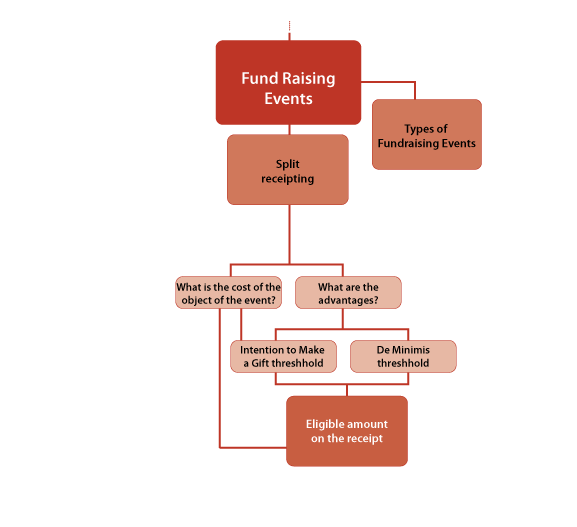
To determine the eligible amount for the receipt, the charity has to apply the rules of split receipting.
See the chart on the following page.
Split Receipting Process Chart
Example
Charity WYZ plans to sell 500 tickets for a fundraising dinner at $130 per ticket. Each ticket comes with a donated book and the dinner. As well, raffle tickets will be sold during the dinner @ $20 each for three prizes with a total value of $2,000.
The fundraising committee wants to know the eligible amount for the official donation receipt, in order to include it in their promotional materials.
The Four Steps
There are four steps in determining the eligible amount for the tax receipt:
Determine the fair market value (FMV) of the book and the dinner.
Book – it can be purchased from bookstores at $20 each, so the FMV is $20
Dinner – a comparable dinner is priced at $45
Determine the Intention to Make a Gift threshold
Will the ticket holder be receiving advantages?
Yes, the dinner and the book.
Does the advantage exceed 80% of the ticket value?
No. 80% of $130 is $104.
To summarize:
FMV of the Dinner = $45
FMV of the Book = $20
Total advantages = $65
$65 is less than $104, so it passes the Intention to Make a Gift
Note: Raffle tickets are sold separately and therefore are not included in the calculation.
Determine if the advantage is De Minimis (minimal)
The object of the event should not be included in determining De Minimis. In this case, the event is a dinner, so the value of the meal ($45) is not included.
Is the advantage (benefit) more than either 10% of the value of the donation (i.e. the ticket), or $75?
Calculation: 10% of $130 is $13, and the advantage of the book is $20
The advantage (the book) exceeds the De Minimis threshold; therefore it should be included in determining the eligible amount on the official donation receipts.
Determine the eligible amount on the official donation receipt.
Calculation:
Value of the ticket
$130
Less the value of the dinner
($ 45)
Less the value of the book
($ 20)
Eligible amount
$ 65
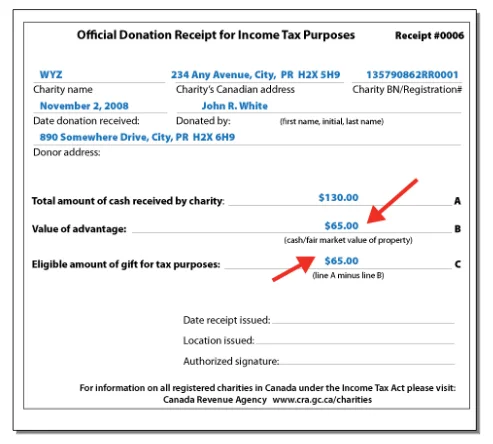
Each participant can be issued an official donation receipt for $65.
Sample Receipt
Notice
Information in this module is provided for general educational purposes and not as legal or accounting advice. Consult a lawyer or accountant for professional advice.
Information is accurate as of January, 2009.
For changes after this date, consult Canada Revenue Agency.
In this evolving economic landscape, collaboration with our firm offers clients a strategic advantage. With Cambodia’s reform-driven investment environment and Canada’s expanding footprint in Southeast Asia, our team of experienced consultants and legal advisors provides tailored guidance to help businesses navigate cross-border opportunities. We focus in developing comprehensive legal strategies, structuring international partnerships, and ensuring compliance in emerging markets.
By leveraging our regional insight and international expertise, you benefit from a trusted partner dedicated to helping you capitalize on growth potential in Cambodia and beyond.
Book a Consultation with Northfield & Associates
Your Trusted Partner in International Bilateral Relations
At Northfield & Associates are focus in Foreign Direct Investment (FDI), international trade missions, and cross-border legal strategy. Our team of experienced consultants and legal advisors offers tailored guidance and strategic insight to help you navigate the complexities of international partnerships and development opportunities.
Whether you choose to meet in person at one of our offices or connect virtually, we provide flexible and accessible consultation options. During your session, we’ll assess your goals, review key documentation, and guide you through every stage of your FDI or trade mission engagement.
Let us help you take the next step with confidence supported by trusted legal and strategic counsel every step of the way.
Take the First Step Today
If you believe you may be eligible for legal relief or simply need sound legal advice, we’re here to help. Contact us today to book your consultation. Let us provide the clarity, strategy, and peace of mind you need to move forward.
We serve our clients in English, Cambodian, Vietnamese, Mandarin and Cantonese, especially in Asian clients.
If you or anybody that you know, think that you meet the requirements and wish to receive further information.
We can help you start the application process and confirm eligibility requirements to participate.
We Offer Consultations & Meetings by Phone & Virtually. Affordable Fees.
Disclaimer:
The information contained in this article is provided for general information purposes only and does not constitute legal or other professional advice. Readers should seek tailored legal advice in relation to their personal circumstances.
Northfield & Associates International Corporation is a global consulting firm serving private enterprises, public institutions, not-for-profit organizations, and institutional capital providers. Operating across Cambodia, Canada, and global markets, the firm supports capital deployment, regulatory navigation, and enterprise decision-making in complex economic and geopolitical environments. Northfield & Associates delivers customized, execution-focused advisory solutions that drive measurable transformation, strengthen competitiveness, and enhance long-term highest value opportunities. The firm incorporates consulting, legal, regulatory, financial, and risk expertise to enable disciplined capital allocation, strong governance, and operational resilience. Northfield & Associates upholds a culture of applied insight and innovation, supporting clients across digital transformation, growth strategy, and organizational capability building. The firm advises individual, leading global corporations, midsize enterprises, government agencies, and mission-driven organizations through long-term partnerships. Enterprise-wide risk management, professional ethics, and fiduciary standards are embedded across all operations. Northfield & Associates’ diverse, globally unified teams are committed to execution certainty and sustainable, risk-adjusted returns aligned with ESG and stakeholder objectives.
Forward-Looking Information
This news release contains forward-looking information. All statements, other than statements of historic fact, that address activities, events or developments that the Company believes, expects or anticipates will or may occur in the future constitute forward-looking information.
This forward-looking information reflects the current expectations or beliefs of the Company based on information currently available to the Company.
Forward-looking information is subject to a number of risks and uncertainties that may cause the actual results of the Company to differ materially from those discussed in the forward-looking information, and even if such actual results are realized or substantially realized, there can be no assurance that they will have the expected consequences to, or effects on the Company. Factors that could cause actual results or events to differ materially from current expectations include, among other things: the failure to finalize negotiations concerning the increase of the Loan or to close such transaction and the failure of the Company to complete the acquisition of the Company Facility; operating performance of facilities; environmental and safety risks; delays in obtaining or failure to obtain necessary permits and approvals from government authorities; unavailability of plant, equipment or labour; inability to retain key management and personnel; changes to regulations or policies affecting the Company’s activities; and the other risks disclosed under the heading “Risk Factors” and elsewhere in the Company’s amended annual information.
Forward-looking information speaks only as of the date on which it is made and, except as may be required by applicable securities laws, the Company disclaims any intent or obligation to update any forward-looking information, whether as a result of new information, future events or results or otherwise. Although the Company believes that the assumptions inherent in the forward-looking information are reasonable, forward-looking information is not a guarantee of future performance and accordingly undue reliance should not be put on such information due to the inherent uncertainty therein.
Questions?
info@northfied.biz
Within Corporate Newsroom
Media Contact:
media@northfied.biz
Press contact
PR consultants press@northfied.biz
NOT LEGAL ADVICE. Information made available on this website in any form is for information purposes only. It is not, and should not be taken as, legal advice. You should not rely on, or take or fail to take any action based upon this information. Never disregard professional legal advice or delay in seeking legal advice because of something you have read on this website. Northfield & Associates professionals will be pleased to discuss resolutions to specific legal concerns you may have.
This module looks at the basic rule of De Minimis. The module answers the questions: What is De Minimis? What are the rules? Can you give me an example of applying the De Minimis rule? Are there exceptions to the De Minimis rule? What are the exceptions?
Introduction
This module looks at the basic rule of De Minimis.
What is De Minimis?
What are the rules?
Can you give me an example of applying the De Minimis rule?
Are there exceptions to the De Minimis rule?
What are the exceptions?
De Minimis Threshold
The De Minimis rule allows a donor to receive an official donation receipt for the full amount of their donation, when the advantage is too minimal to affect the value of the gift.
The rule states that if the total advantage does not exceed $75 or 10 per cent of the amount of the gift (whichever is less), the advantage is not included in the calculation of the eligible amount on the receipt.
Note: In the case of fundraising events, the object of the event is not included in determining the De Minimis.
Example
A museum gives small tokens of appreciation to acknowledge donations of certain amounts:
For a $150 donation, donors receive a calendar worth $14
For a $200 donation, donors receive a tote bag worth $25
For a $1,000 donation, donors receive a pen worth $100
Can the museum issue donation receipts for these gifts?
The $14 calendar is worth less than the lesser of $75 or $15 (10% of the $150 donation). The advantage is too small (de minimis).
An official receipt can be issued for $150
The $25 tote bag is worth more than the lesser of $75 or $20 (10% of the $200 donation) and must be considered an advantage.
An official receipt can be issued for $175.
The $100 pen is worth more than the lesser of $75 or $100 (10% of the $1,000 donation) and must be considered an advantage.
An official receipt can be issued for $900.
Exception to De Minimis
The De Minimis rule does not apply to cash or near cash equivalents such as redeemable gift certificates, coupons, or vouchers.
This means that any advantages are to be included in the total amount of the advantages, and deducted from the value of the gift, to determine the eligible amount of the tax receipt.
Notice
Information in this module is provided for general educational purposes and not as legal or accounting advice. Consult a lawyer or accountant for professional advice.
Information is accurate as of 2019.
For changes after this date, consult Canada Revenue Agency.
In this evolving economic landscape, collaboration with our firm offers clients a strategic advantage. With Cambodia’s reform-driven investment environment and Canada’s expanding footprint in Southeast Asia, our team of experienced consultants and legal advisors provides tailored guidance to help businesses navigate cross-border opportunities. We focus in developing comprehensive legal strategies, structuring international partnerships, and ensuring compliance in emerging markets.
By leveraging our regional insight and international expertise, you benefit from a trusted partner dedicated to helping you capitalize on growth potential in Cambodia and beyond.
Book a Consultation with Northfield & Associates
Your Trusted Partner in International Bilateral Relations
At Northfield & Associates are focus in Foreign Direct Investment (FDI), international trade missions, and cross-border legal strategy. Our team of experienced consultants and legal advisors offers tailored guidance and strategic insight to help you navigate the complexities of international partnerships and development opportunities.
Whether you choose to meet in person at one of our offices or connect virtually, we provide flexible and accessible consultation options. During your session, we’ll assess your goals, review key documentation, and guide you through every stage of your FDI or trade mission engagement.
Let us help you take the next step with confidence supported by trusted legal and strategic counsel every step of the way.
Take the First Step Today
If you believe you may be eligible for legal relief or simply need sound legal advice, we’re here to help. Contact us today to book your consultation. Let us provide the clarity, strategy, and peace of mind you need to move forward.
We serve our clients in English, Cambodian, Vietnamese, Mandarin and Cantonese, especially in Asian clients.
If you or anybody that you know, think that you meet the requirements and wish to receive further information.
We can help you start the application process and confirm eligibility requirements to participate.
We Offer Consultations & Meetings by Phone & Virtually. Affordable Fees.
Disclaimer:
The information contained in this article is provided for general information purposes only and does not constitute legal or other professional advice. Readers should seek tailored legal advice in relation to their personal circumstances.
Northfield & Associates International Corporation is a global consulting firm serving private enterprises, public institutions, not-for-profit organizations, and institutional capital providers. Operating across Cambodia, Canada, and global markets, the firm supports capital deployment, regulatory navigation, and enterprise decision-making in complex economic and geopolitical environments. Northfield & Associates delivers customized, execution-focused advisory solutions that drive measurable transformation, strengthen competitiveness, and enhance long-term highest value opportunities. The firm incorporates consulting, legal, regulatory, financial, and risk expertise to enable disciplined capital allocation, strong governance, and operational resilience. Northfield & Associates upholds a culture of applied insight and innovation, supporting clients across digital transformation, growth strategy, and organizational capability building. The firm advises individual, leading global corporations, midsize enterprises, government agencies, and mission-driven organizations through long-term partnerships. Enterprise-wide risk management, professional ethics, and fiduciary standards are embedded across all operations. Northfield & Associates’ diverse, globally unified teams are committed to execution certainty and sustainable, risk-adjusted returns aligned with ESG and stakeholder objectives.
Forward-Looking Information
This news release contains forward-looking information. All statements, other than statements of historic fact, that address activities, events or developments that the Company believes, expects or anticipates will or may occur in the future constitute forward-looking information.
This forward-looking information reflects the current expectations or beliefs of the Company based on information currently available to the Company.
Forward-looking information is subject to a number of risks and uncertainties that may cause the actual results of the Company to differ materially from those discussed in the forward-looking information, and even if such actual results are realized or substantially realized, there can be no assurance that they will have the expected consequences to, or effects on the Company. Factors that could cause actual results or events to differ materially from current expectations include, among other things: the failure to finalize negotiations concerning the increase of the Loan or to close such transaction and the failure of the Company to complete the acquisition of the Company Facility; operating performance of facilities; environmental and safety risks; delays in obtaining or failure to obtain necessary permits and approvals from government authorities; unavailability of plant, equipment or labour; inability to retain key management and personnel; changes to regulations or policies affecting the Company’s activities; and the other risks disclosed under the heading “Risk Factors” and elsewhere in the Company’s amended annual information.
Forward-looking information speaks only as of the date on which it is made and, except as may be required by applicable securities laws, the Company disclaims any intent or obligation to update any forward-looking information, whether as a result of new information, future events or results or otherwise. Although the Company believes that the assumptions inherent in the forward-looking information are reasonable, forward-looking information is not a guarantee of future performance and accordingly undue reliance should not be put on such information due to the inherent uncertainty therein.
Questions?
info@northfied.biz
Within Corporate Newsroom
Media Contact:
media@northfied.biz
Press contact
PR consultants press@northfied.biz
NOT LEGAL ADVICE. Information made available on this website in any form is for information purposes only. It is not, and should not be taken as, legal advice. You should not rely on, or take or fail to take any action based upon this information. Never disregard professional legal advice or delay in seeking legal advice because of something you have read on this website. Northfield & Associates professionals will be pleased to discuss resolutions to specific legal concerns you may have.
This module covers basic information on the legal concept of split receipting. The information covered includes: What is split receipting and what are the rules? How are the rules applied? What role does Fair Market Value, Intention to Make a Gift, and De Minimus have in split receipting? Are there exceptions to the rule? A chart that illustrates the steps in split receipting?
Introduction
This module covers basic information on the legal concept of split receipting.
The information covered includes:
What is split receipting and what are the rules?
How are the rules applied?
What role does Fair Market Value, Intention to Make a Gift, and De Minimis have in split receipting?
Are there exceptions to the rule?
A chart that illustrates the steps in split receipting?
Split Receipting – The Basics
Split receipting is a legislative concept in which a donor can receive something in return (an advantage) for a gift, and still be eligible for a tax receipt.
From the charity’s perspective, the gift is split into two parts:
the portion that the charity can issue a receipt (the eligible amount)
and
the portion for which the charity cannot issue a receipt (the advantage)
The Rules
Split receipting rules govern how the eligible amount for a tax receipt is determined. It allows your Charity to give a donor certain advantages within the limits allowed by CRA.
Split receipting applies to all types of gifts (cash or gifts-in-kind) with advantages.
Applying the Rules
When you apply the rules of split receipting to determine the eligible amount on a receipt for a gift with an advantage, you’ll need to consider three elements:
Fair Market Value (FMV) of the advantage (benefit received by the donor)
Intention to Make a Gift Threshold
De Minimis Threshold
Advantage and Fair Market Value
In simple terms, fair market value (FMV) is the price that you, as a consumer, would have to pay for the property in an open market.
Importance of FMV and Advantage
If the FMV of the advantage cannot be determined, official donation receipts cannot be issued.
Intention to Make a Gift
In the case of a gift with advantages, an official donation receipt can only be issued if the FMV of the advantages is not more than 80% of the FMV of the gift. This is known as the Intention to Make a Gift threshold.
Example
A donor gives $500 to Charity MNO and receives 3 complimentary concert tickets with a fair market value of $150 each for a total value of $450.
The Intention to Make a Gift threshold, in this case, is $400 (80% of $500).
The FMV of the advantage is $450 (3 x $150)
The advantage exceeds the Intention to Make a Gift
Therefore a receipt cannot be issued.
Note: Even if Charity MNO did not pay for the concert tickets, the FMV still has to be used in determining the Intention to Make a Gift threshold.
De Minimis Threshold
The De Minimis rule allows a donor to receive an official donation receipt for the full amount of their donation, when the advantage is too minimal to affect the value of the gift. The rule states that if the total advantage does not exceed the lesser of $75 or 10 per cent of the amount of the gift, it is not included in the calculation of the eligible amount on the receipt.
Example of De Minimis Threshold
A museum gives small tokens of appreciation to acknowledge donations of certain amounts:
For a $150 donation, donors receive a calendar worth $14
For a $200 donation, donors receive a tote bag worth $25
For a $1,000 donation, donors receive a gift certificate worth $100
Can the museum issue donation receipts for these gifts?
The $14 calendar is worth less than the lesser of $75 or $15 (10 per cent of the $150 donation) and is therefore not considered an advantage. The advantage is too small (deminimis). An official receipt can be issued for $150.
The $25 tote bag is worth more than the lesser of $75 or $20 (10 per cent of the $200 donation) and must be considered an advantage. An official receipt can be issued for $175.
The $100 gift certificate is worth more than the lesser of $75 or $100 (10 per cent of the $1,000 donation) and must be considered an advantage. An official receipt can be issued for $900.
Exception to De Minimis
The De Minimis rule does not apply to cash or near cash equivalents such as redeemable gift certificates, coupons, vouchers.
This means that any advantages are to be included in the total amount of the advantages, and to be deducted from the value of the gift when determining the eligible amount for the tax receipt.
Steps in Split Receipting
Notice
Information in this module is provided for general educational purposes and not as legal or accounting advice. Consult a lawyer or accountant for professional advice.
Information is accurate as of 2019
For changes after this date, consult Canada Revenue Agency.
In this evolving economic landscape, collaboration with our firm offers clients a strategic advantage. With Cambodia’s reform-driven investment environment and Canada’s expanding footprint in Southeast Asia, our team of experienced consultants and legal advisors provides tailored guidance to help businesses navigate cross-border opportunities. We focus in developing comprehensive legal strategies, structuring international partnerships, and ensuring compliance in emerging markets.
By leveraging our regional insight and international expertise, you benefit from a trusted partner dedicated to helping you capitalize on growth potential in Cambodia and beyond.
Book a Consultation with Northfield & Associates
Your Trusted Partner in International Bilateral Relations
At Northfield & Associates are focus in Foreign Direct Investment (FDI), international trade missions, and cross-border legal strategy. Our team of experienced consultants and legal advisors offers tailored guidance and strategic insight to help you navigate the complexities of international partnerships and development opportunities.
Whether you choose to meet in person at one of our offices or connect virtually, we provide flexible and accessible consultation options. During your session, we’ll assess your goals, review key documentation, and guide you through every stage of your FDI or trade mission engagement.
Let us help you take the next step with confidence supported by trusted legal and strategic counsel every step of the way.
Take the First Step Today
If you believe you may be eligible for legal relief or simply need sound legal advice, we’re here to help. Contact us today to book your consultation. Let us provide the clarity, strategy, and peace of mind you need to move forward.
We serve our clients in English, Cambodian, Vietnamese, Mandarin and Cantonese, especially in Asian clients.
If you or anybody that you know, think that you meet the requirements and wish to receive further information.
We can help you start the application process and confirm eligibility requirements to participate.
We Offer Consultations & Meetings by Phone & Virtually. Affordable Fees.
Disclaimer:
The information contained in this article is provided for general information purposes only and does not constitute legal or other professional advice. Readers should seek tailored legal advice in relation to their personal circumstances.
Northfield & Associates International Corporation is a global consulting firm serving private enterprises, public institutions, not-for-profit organizations, and institutional capital providers. Operating across Cambodia, Canada, and global markets, the firm supports capital deployment, regulatory navigation, and enterprise decision-making in complex economic and geopolitical environments. Northfield & Associates delivers customized, execution-focused advisory solutions that drive measurable transformation, strengthen competitiveness, and enhance long-term highest value opportunities. The firm incorporates consulting, legal, regulatory, financial, and risk expertise to enable disciplined capital allocation, strong governance, and operational resilience. Northfield & Associates upholds a culture of applied insight and innovation, supporting clients across digital transformation, growth strategy, and organizational capability building. The firm advises individual, leading global corporations, midsize enterprises, government agencies, and mission-driven organizations through long-term partnerships. Enterprise-wide risk management, professional ethics, and fiduciary standards are embedded across all operations. Northfield & Associates’ diverse, globally unified teams are committed to execution certainty and sustainable, risk-adjusted returns aligned with ESG and stakeholder objectives.
Forward-Looking Information
This news release contains forward-looking information. All statements, other than statements of historic fact, that address activities, events or developments that the Company believes, expects or anticipates will or may occur in the future constitute forward-looking information.
This forward-looking information reflects the current expectations or beliefs of the Company based on information currently available to the Company.
Forward-looking information is subject to a number of risks and uncertainties that may cause the actual results of the Company to differ materially from those discussed in the forward-looking information, and even if such actual results are realized or substantially realized, there can be no assurance that they will have the expected consequences to, or effects on the Company. Factors that could cause actual results or events to differ materially from current expectations include, among other things: the failure to finalize negotiations concerning the increase of the Loan or to close such transaction and the failure of the Company to complete the acquisition of the Company Facility; operating performance of facilities; environmental and safety risks; delays in obtaining or failure to obtain necessary permits and approvals from government authorities; unavailability of plant, equipment or labour; inability to retain key management and personnel; changes to regulations or policies affecting the Company’s activities; and the other risks disclosed under the heading “Risk Factors” and elsewhere in the Company’s amended annual information.
Forward-looking information speaks only as of the date on which it is made and, except as may be required by applicable securities laws, the Company disclaims any intent or obligation to update any forward-looking information, whether as a result of new information, future events or results or otherwise. Although the Company believes that the assumptions inherent in the forward-looking information are reasonable, forward-looking information is not a guarantee of future performance and accordingly undue reliance should not be put on such information due to the inherent uncertainty therein.
Questions?
info@northfied.biz
Within Corporate Newsroom
Media Contact:
media@northfied.biz
Press contact
PR consultants press@northfied.biz
NOT LEGAL ADVICE. Information made available on this website in any form is for information purposes only. It is not, and should not be taken as, legal advice. You should not rely on, or take or fail to take any action based upon this information. Never disregard professional legal advice or delay in seeking legal advice because of something you have read on this website. Northfield & Associates professionals will be pleased to discuss resolutions to specific legal concerns you may have.
What is a Charitable Benefit, and Why Does It Matter When Applying to Become a Charity?
Are you thinking about registering your organization as a charity in Canada? Understanding charitable benefits is essential for CRA approval.
Many nonprofit leaders assume good intentions are enough. The Canada Revenue Agency requires proof that your work creates a real, measurable public benefit.
This guide explains what charitable benefits are, why they matter, and how to demonstrate them in your charity application.
Understanding Charitable Benefits in Canadian Charity Law
What is a Charitable Benefit?
A charitable benefit is the actual positive outcome your organization produces through its activities. It’s different from your charitable purpose, which is what you aim to achieve.
Think of it this way: your purpose is your goal, and your benefit is the result. For example, if your purpose is “advancing education,” your benefit might be “students gaining literacy skills.”
The CRA evaluates whether your activities will actually produce these benefits. They want to see concrete outcomes, not just hopeful plans.
Why Charitable Benefit Matters for Your Charity Application
The CRA rejects many charity applications because organizations can’t clearly explain their benefits. Vague descriptions like “helping people” or “making a difference” aren’t enough.
Your application must show how your work creates measurable, positive change. This requirement protects the public by ensuring charities deliver real value.
Once registered, you’ll need to report on these benefits annually. The CRA can revoke charitable status if your activities don’t align with your stated benefits.
The Three Essential Requirements for a Valid Charitable Benefit
1. Recognizable and Tangible Benefits
Your charitable benefit must be something people can see, measure, or objectively verify. Abstract or spiritual benefits alone won’t satisfy CRA requirements.
Consider a charity that provides meals to homeless individuals. The tangible benefit is clear: people receive food and nutrition.
An educational program shows tangible benefits through improved test scores or acquired skills. A health clinic demonstrates benefit through medical services delivered and patients treated.
What the CRA considers insufficient:
Vague claims about “raising awareness”
Benefits that can’t be measured or observed
Outcomes that are purely subjective
You need to describe specific, observable results. Show the CRA exactly what changes because of your work.
2. Socially Useful Benefits
Your benefit must serve the public good, not just private interests. The CRA calls this “public benefit.”
A charity that provides scholarships to low-income students creates a public benefit. Society gains educated citizens who can contribute to their communities.
Private benefit happens when activities primarily help the organization’s founders, their families, or a closed group. This disqualifies your organization from charitable status.
Common public benefit examples:
Community health programs that serve anyone in need
Environmental conservation that improves shared spaces
Arts programs that enrich cultural life for all
Food banks that help anyone facing hunger
The key question is: Does your work make society better? If yes, you’re likely creating public benefit.
3. Benefits Related to Your Organization’s Charitable Purpose
Everything you do must connect directly to your stated charitable purpose. Random good deeds don’t count.
If your purpose is animal welfare, running a pet adoption program relates directly. Hosting unrelated fundraising events might support your work, but they’re not the charitable benefit itself.
The CRA wants to see logical connections. Your activities should be necessary and reasonable ways to achieve your purpose.
This shows a clear, direct connection between purpose, activity, and benefit.
How to Demonstrate Charitable Benefits in Your CRA Application
Describing Your Means of Providing Charitable Benefits
The “means” are your specific programs and activities. You need to explain exactly how you’ll operate.
Don’t just say “we’ll help sick people.” Say “we’ll operate a free medical clinic providing primary care services to uninsured patients.”
Be specific about:
What services or programs will you offer
Who will benefit from them
How you’ll deliver these services
Where and when activities will occur
The more concrete your description, the easier it is for CRA to approve your application.
Documenting Tangible Outcomes
New organizations should provide realistic projections. Established groups should include actual data from past activities.
Useful metrics include:
Number of people served
Hours of service provided
Items distributed (meals, books, supplies)
Skills taught or qualifications earned
Environmental improvements measured
You don’t need complex research studies. Simple, honest tracking of your work is sufficient.
Create systems to measure your impact from day one. This helps with your annual charity returns later.
Proving Social Value and Public Benefit
Identify who benefits from your work. Be specific about your target population.
Show that your beneficiary group is large enough to constitute “the public.” One family doesn’t count, but “low-income families in Toronto” do.
Demonstrate community need through:
Statistics about the problem you’re addressing
Letters of support from community partners
Research showing demand for your services
Gaps in existing services that you’ll fill
The CRA needs to understand why your work matters to society.
Common Charitable Benefit Examples Across Different Categories
Relief of Poverty
Poverty relief charities address immediate needs like food, shelter, and clothing. They also provide pathways out of poverty.
Tangible benefits include:
Meals provided to hungry individuals
Emergency shelter beds occupied
Rent assistance preventing homelessness
Job training leading to employment
These outcomes are easy to measure and clearly serve the public.
Advancement of Education
Educational charities help people gain knowledge and skills. The benefit must go beyond entertainment or casual interest.
Examples of educational benefits:
Students achieving literacy
Graduates earning recognized credentials
Learners acquiring job-ready skills
Research advancing human knowledge
Libraries, schools, tutoring programs, and scholarship funds all fit this category.
Advancement of Religion
Religious charities serve spiritual needs while also providing community value. Public benefit is key here.
Acceptable benefits include:
Religious services open to the public
Spiritual counselling available to community members
Religious education programs
Community gathering spaces
Your religious activities must benefit society broadly, not just your congregation.
Other Purposes Beneficial to the Community
This fourth category covers everything else that helps society. It includes environmental, cultural, and community development work.
Examples across this category:
Environmental groups restoring natural habitats
Arts organizations making culture accessible
Animal welfare groups operating shelters
Community centres providing public programs
These benefits must be substantial and clearly serve the public interest.
What Doesn’t Qualify as a Charitable Benefit
Private Benefit vs. Public Benefit
If your organization primarily benefits founders, board members, or their families, it’s not charitable. Some private benefit is acceptable as a side effect, but it can’t be your main purpose.
A scholarship fund that only helps the founder’s grandchildren isn’t charitable. One that helps any qualifying student in a community is.
Political Purposes and Advocacy Limitations
Charities can do some advocacy, but it must support their charitable purpose. You can’t exist primarily to promote political views.
Acceptable: An environmental charity advocating for pollution regulations. Not acceptable: A charity existing mainly to support a political party.
Your benefits must come from actual programs, not political activity.
Activities That Don’t Produce Measurable Social Value
Vague activities without clear outcomes won’t qualify. “Promoting awareness” alone isn’t a charitable benefit.
The CRA wants to see concrete change. What happens because your charity exists? Who is better off?
Benefits That Are Too Indirect or Speculative
Your benefits must be direct results of your activities. Future possibilities don’t count.
Claiming your work “might eventually lead to positive change” isn’t sufficient. Show what actually happens when you operate your programs.
Charitable Benefit vs. Charitable Purpose: Understanding the Difference
Your charitable purpose is your goal. Your charitable benefit is what you actually achieve.
Purpose: What you’re trying to accomplish
Benefit: The positive outcome that results
Think of a charity focused on youth development. The purpose might be “advancing education and building life skills among at-risk youth.”
The benefits would be:
Youth completing high school
Participants gaining employment skills
Young people avoiding criminal activity
Students earning post-secondary credentials
Both elements must appear clearly in your application. They should align perfectly with each other.
How CRA Evaluates Charitable Benefits During the Registration Process
The CRA reviews every application carefully. Officers look for clear, specific descriptions of benefits.
Common questions they ask:
Who exactly will benefit from your work?
How will you measure success?
Why is this work needed in your community?
How do your activities produce these benefits?
Red flags that trigger scrutiny:
Vague or overly broad benefit descriptions
Benefits that seem to favour private individuals
Activities unrelated to stated purposes
Unrealistic projections without supporting plans
The review process typically takes several months. Clear benefit descriptions help speed approval.
Tips for Strengthening the Charitable Benefit Section of Your Application
Be specific and concrete. Replace “help people” with “provide 500 hot meals monthly to homeless individuals in Vancouver.”
Use measurable language. Include numbers, timeframes, and observable outcomes whenever possible.
Provide realistic examples. Describe typical scenarios showing how your programs work.
Address tracking methods. Explain how you’ll measure and report on benefits.
Connect activities to purpose. Draw clear lines between what you’ll do and why it achieves your charitable goals.
Think like a CRA reviewer reading hundreds of applications. Make your case obvious and compelling.
Maintaining Charitable Benefits After Registration
Registration is just the beginning. You must continue delivering the benefits you promised.
Ongoing Reporting Requirements
Every registered charity files an annual T3010 return. This form asks detailed questions about your activities and their results.
You’ll report:
Programs operated during the year
Number of people served
Resources spent on charitable activities
How your work advanced your charitable purposes
Keep good records throughout the year. Don’t try to reconstruct everything at filing time.
What Happens If Your Activities Change
Charities can evolve, but major changes require CRA approval. If you want to add new programs or shift focus, consult charity law experts first.
Operating outside your registered purposes risks your charitable status. The CRA can impose penalties or revoke registration.
Ensuring Continued Alignment
Review your activities annually. Ask whether everything you do produces charitable benefits related to your purposes.
Cut programs that don’t serve your mission. Focus resources on activities that deliver measurable public benefit.
This discipline keeps you compliant and effective.
Need Help with Your Charity Application?
Understanding charitable benefits is complex. Many organizations struggle to articulate their benefits in a way that satisfies the CRA.
B.I.G. Charity Law Group specializes in Canadian charity registration and compliance. We help nonprofits clearly define their charitable benefits and prepare successful applications.
Our team understands exactly what the CRA looks for. We’ll ensure your application demonstrates tangible, socially useful benefits directly related to your charitable purpose.
Ready to start your charity application?
Navigating director compensation rules can be complex.
At Northfield & Associates our expert teams guidance on compliance requirements. Our team understands Canadian charity law and can help ensure your organisation follows proper procedures.
At Northfield & Associates expert help with your charity registration. We’ll guide you through every step of the registration process.
Frequently Asked Questions
When you apply to become a registered charity in Canada, the Canada Revenue Agency reviews whether your organization provides a public charitable benefit. Understanding what qualifies as a charitable benefit can help you submit a stronger application and improve your chances of approval. These FAQs cover key questions about demonstrating public benefit in the registration process.
What is meant by a “charitable benefit” in the context of applying to become a registered charity?
A charitable benefit is a tangible, measurable, and socially useful impact that is directly related to the organization’s charitable purpose. It must be recognizable and have a demonstrable positive effect on society.
Why is proving a charitable benefit important for an organization seeking charitable status?
Showing a charitable benefit is essential because it demonstrates that the organization’s activities have a real, positive impact on the public or community, which is a legal requirement for being recognized as a charity.
What kinds of benefits are considered socially useful in the charity application process?
Benefits that improve health, education, environmental conservation, community welfare, or other public goods are considered socially useful as they benefit a sufficient section of the public or society as a whole.
How should an organization express its charitable purpose to align with charitable benefit requirements?
An organization’s activities and purpose should clearly relate to providing tangible benefits and be aligned so that the benefits are a necessary and reasonably direct result of its charitable activities.
Can a charitable benefit include some incidental personal benefit?
Yes, incidental personal benefits can be permissible as long as they are necessary by-products of carrying out the charitable purpose and do not outweigh the overall public benefit.
You had a good time at a party with your friends, had a few drinks and now you got into your car and hoped to get home in 10 minutes. After your entire house is only 10 km away from the bar and there are usually no police cars patrolling at night. As soon as you leave the bar, at the intersection, you are pulled over by the R.I.D.E program. Uh oh. You start panicking as you should, because you had that extra drink that you should not have had in the first place. You are administered a roadside test and the result, as you expect is FAIL. You are put under arrest and sent to the station for 2 accurate tests and most likely will be charged with Care and Control and Over 80. Keep in mind that as soon as you are in contact with the police, you are being Audio and Video Recorded so act right and be mindful of the words coming out of your mouth.
The Law
On December 18, 2018 impaired driving (including cannabis related crime) penalties took effect and most of the impaired driving offences are now considered serious crimes in Canada. This means that the maximum penalty for most impaired driving offences increased from 5 to 10 years.
Immigration Status Crisis
If you are a temporary resident (visitor, international student, foreign worker, refugee claimant) or a permanent resident and you are charged with impaired driving, you may be facing significant immigration implications. If convicted with impaired driving or cannabis- related crime, you may be found inadmissible to Canada for serious criminality. It is important to note that it doesn’t matter if the crime happened inside or outside of Canada.
The negative consequences are as follows:
1. You may lose your status as Canadian permanent resident and must leave the country;
2. As a temporary resident you may not be able to stay or enter Canada;
3. As a refugee claimant you may not be able to have your claim refereed to the Immigration Refugee Board for a hearing;
4. If you have been charged with impaired driving in another jurisdiction outside of Canada, it is important to have applied for a Pardon or Record Suspension (depending on the foreign jurisdiction) prior to entrance to Canada.
The price to pay for an extra drink or a desire to get high and drive, may cause you your future immigration status in Canada. Be Smart and Retain Northfield & Associates.
Disclaimer: The information contained in this article is provided for general information purposes only and does not constitute legal or other professional advice. Readers should seek tailored legal advice in relation to their personal circumstances.
We serve our clients in English, Cambodian, Vietnamese, Mandarin and Cantonese, especially in Asian clients.
If you or anybody that you know, think that you meet the requirements and wish to receive further information.
We can help you start the application process and confirm eligibility requirements to participate.
We Offer Consultations & Meetings by Phone & Virtually. Affordable Fees.
Book a Consultation Today
Contact Northfield & Associates today to schedule a consultation with an experienced Consultant.
Northfield & Associates International Corporation is a global strategic advisory and consulting firm partnering with private equity, sovereign, and institutional investors to deploy capital, manage regulatory, supporting senior leadership, boards, and capital providers across Cambodia, Canada, and international markets operating in complex regulatory, economic, and geopolitical environments, and drive enterprise value creation across complex global markets.
We advise boards, executives, entrepreneurs, and public-sector decision-makers on business strategy, institutional transformation, and high-stakes market challenges requiring disciplined judgment, capital efficiency, and execution certainty. Our work is concentrated across priority global sectors, including agribusiness, aviation and automotive, energy and natural resources, financial services, healthcare, infrastructure, real estate, immigration, education, and information technology.
Our platform integrates sector-specific intelligence with multidisciplinary advisory capabilities. Clients benefit from coordinated access to consulting, legal and regulatory counsel, financial management, risk assessment, real estate advisory, immigration, education, and technology expertise. This integrated model supports informed capital allocation, regulatory-compliant investment structuring, and execution-ready strategies designed to optimise returns, preserve downside protection, and enhance risk-adjusted performance.
Northfield combines consulting rigor with legal and regulatory judgment to support capital markets-aligned decision-making in complex, regulated, and rapidly evolving environments. We partner with private enterprises, institutional investors, family offices, and public-sector entities to structure, deploy, and manage capital effectively; strengthen governance; mitigate regulatory and geopolitical risk; and drive sustainable enterprise value creation.
Our engagements span strategy formulation, operational optimisation, organisational design, and change execution. We deliver measurable outcomes that improve financial performance, support disciplined growth, enhance valuation, and generate durable returns on investment for investors, shareholders, and institutional stakeholders. We operate with independence, precision, and accountability, aligned with long-term value creation and fiduciary standards.
Forward-Looking Information
This news release contains forward-looking information. All statements, other than statements of historic fact, that address activities, events or developments that the Company believes, expects or anticipates will or may occur in the future constitute forward-looking information.
This forward-looking information reflects the current expectations or beliefs of the Company based on information currently available to the Company.
Forward-looking information is subject to a number of risks and uncertainties that may cause the actual results of the Company to differ materially from those discussed in the forward-looking information, and even if such actual results are realized or substantially realized, there can be no assurance that they will have the expected consequences to, or effects on the Company. Factors that could cause actual results or events to differ materially from current expectations include, among other things: the failure to finalize negotiations concerning the increase of the Loan or to close such transaction and the failure of the Company to complete the acquisition of the Company Facility; operating performance of facilities; environmental and safety risks; delays in obtaining or failure to obtain necessary permits and approvals from government authorities; unavailability of plant, equipment or labour; inability to retain key management and personnel; changes to regulations or policies affecting the Company’s activities; and the other risks disclosed under the heading “Risk Factors” and elsewhere in the Company’s amended annual information.
Forward-looking information speaks only as of the date on which it is made and, except as may be required by applicable securities laws, the Company disclaims any intent or obligation to update any forward-looking information, whether as a result of new information, future events or results or otherwise. Although the Company believes that the assumptions inherent in the forward-looking information are reasonable, forward-looking information is not a guarantee of future performance and accordingly undue reliance should not be put on such information due to the inherent uncertainty therein.
Questions?
info@northfied.biz
Within Corporate Newsroom
Media Contact:
media@northfied.biz
Press contact
PR consultants press@northfied.biz
NOT LEGAL ADVICE. Information made available on this website in any form is for information purposes only. It is not, and should not be taken as, legal advice. You should not rely on, or take or fail to take any action based upon this information. Never disregard professional legal advice or delay in seeking legal advice because of something you have read on this website. Northfield & Associates professionals will be pleased to discuss resolutions to specific legal concerns you may have.
Starting A Non-Profit Society in British Columbia: A Complete Guide
Starting a non-profit society in British Columbia involves navigating complex registration requirements and legal obligations. We know how challenging it can be to understand the incorporation process for charitable organizations.
We start a non-profit society in BC by gathering at least three directors, choosing a unique name, creating bylaws, filing incorporation documents with BC Registry Services, and paying the $30 fee. The process takes 10-20 business days and creates a legally recognized society that can operate for charitable or community purposes.
Just a heads-up, things in the non-profit world shift. The Societies Act got a refresh as of May 4, 2023. You can find the summary on the changes here: BC Government Societies Act Amendments. This guide focuses specifically on British Columbia-specific rules.
Your Step-by-Step Timeline for Starting a BC Society
Before we dive into the details, here’s what your timeline will look like from start to finish. Understanding this roadmap helps you plan your time and resources effectively.
During the first two weeks, you’ll gather your founding directors and draft your purpose statement. This is when you’ll have those important conversations about why your society exists and what you want to accomplish. Take your time here because a clear purpose makes everything else easier.
In weeks three and four, you’ll work on creating your bylaws and reserving your society name. The bylaws take some thought because they’re your organization’s rulebook. You can start with the provincial template and customize it to fit your needs. While you’re working on bylaws, you can reserve your chosen name online, which protects it while you finish your paperwork.
Weeks five and six are when you’ll file your incorporation documents with BC Registry Services. Once you submit everything online with the $30 filing fee, the registry reviews your application. Most societies receive their certificate of incorporation within 10-20 business days, though it can take longer if there are questions about your name or bylaws.
In weeks seven and eight, after receiving your certificate, you’ll open a bank account for your society. Bring your incorporation documents to the bank, and make sure at least two directors are available to sign. Banks typically require two signing officers for nonprofit accounts.
If you’re planning to apply for charitable status with the Canada Revenue Agency, that happens in months three through six or even longer. The CRA takes time to review applications, often six to twelve months, so start this process as soon as your society is established and operating. You’ll need to show a track record of activities that align with your charitable purposes.
Throughout your first year and every year after, you’ll have ongoing compliance requirements. Annual reports must be filed with BC Registry Services, annual general meetings must be held, and financial statements must be prepared. If you become a registered charity, you’ll also file annual T3010 returns with the CRA. Mark these dates on your calendar now so you don’t miss important deadlines.
Step 1: Building Your Core Team – Officers and Directors
First things first, you need people to run the show. Think of it like this:
Officers: They’re the hands-on folks, handling day-to-day operations. If you get funding, they’re the ones who might hire staff or contractors.
Directors: They’re the big-picture strategists. They set the direction and make sure everything’s running smoothly.
Now, in smaller non-profits, these roles often overlap, and that’s okay. Especially when you’re just starting out and budgets are tight. You’ll need at least three directors, unless you’re a member-funded society, then one is enough.
Think about who you’re bringing on board. You want people with different skills. Someone good with finances, someone who knows fundraising, maybe someone with marketing experience. Each director should bring something valuable.
You’ll need their full names and addresses for the incorporation paperwork. And each director has to give their written okay to take on the role. It doesn’t have to be fancy; a simple note saying, “I agree to act as a director for [society name],” signed and dated, will do. You don’t have to name your officers when you incorporate.
BC Society vs. Federal Nonprofit Corporation: Which Should You Choose?
Before you start the incorporation process, you need to decide whether to incorporate provincially under the BC Societies Act or federally under the Canada Not-for-Profit Corporations Act. This choice affects your costs, governance requirements, and where you can operate.
If your nonprofit plans to operate mainly in British Columbia, a BC society makes the most sense. The incorporation fee is just $30, which is significantly cheaper than federal incorporation. The process is straightforward, and you can complete everything online through BC Registry Services. Most community groups, sports clubs, and local charities choose this route because it’s simple and affordable.
A BC society is incorporated under the BC Societies Act and must follow provincial regulations. You’ll file annual reports with the provincial registry and follow BC’s governance rules. If you later want to operate in other provinces, you can register extra-provincially, which means registering your BC society in other provinces where you’re active. This adds some paperwork and fees, but it’s manageable if you’re only in a few provinces.
Federal incorporation makes sense if you plan to operate across Canada from the start. A federal nonprofit corporation can operate in any province without extra-provincial registration. The Canada Not-for-Profit Corporations Act provides a consistent framework across the country, which some national organizations prefer. However, federal incorporation costs more upfront and has more complex governance requirements.
The governance differences matter too. Federal nonprofits follow the rules in the Canada Not-for-Profit Corporations Act, which has specific requirements for member meetings, voting, and record keeping. BC societies follow the BC Societies Act, which has different rules, especially around member-funded versus non-member-funded structures. You’ll need to understand which set of rules fits your organization better.
For most groups just starting out in British Columbia, we recommend provincial incorporation as a BC society. It’s cheaper, simpler, and perfectly adequate if you’re focused on serving your local community. You can always expand later if needed. If you’re planning national operations from day one, or if you’re setting up a branch of a national organization, then federal incorporation might be worth the extra cost and complexity. For more information on registering a federal nonprofit in BC, see our guide on extra-provincial registration for federal nonprofits in British Columbia.
Step 2: Picking and Reserving Your Society’s Name
Your name is your first impression, so make it count. Here’s how:
Make it unique: Do a quick Google search to make sure no one else is using it. You don’t want any confusion.
Make it descriptive: Your name should give people an idea of what your society does. If you’re a birdwatching group, include words like “birds” or “nature.”
End it right: Your name has to end with either “Society,” “Association,” or “Club.” Those are the rules.
Watch out for restricted words: Some words, especially those related to government, hospitals, or locations, might need extra approvals. To be safe, give the provincial registrar a call at 1-877-526-1526. They can tell you if you need any special permissions.
Once you’ve got a few names you like, you can reserve one online. It costs a small fee, so have your credit card ready. You can also do it by mail or in person at a Service BC centre, but it’ll take longer.
Step 3: Defining Your Society’s Purpose
While you’re waiting for your name to be approved, get clear on why your society exists. Write it down as a “focus statement.” It’s a quick summary of what you’re all about.
“To provide an amateur softball league for elementary school children in Saanich.”
“To encourage and foster responsible exotic pet ownership in the Lower Mainland of British Columbia.”
If you need more than one sentence to explain it, that’s fine. Just make sure it’s clear and to the point.
Step 4: Crafting Your Society’s Bylaws
Think of your bylaws as your society’s rulebook. They cover everything from how members join to how meetings are run.
Here’s what they should include:
The rights and duties of members.
How directors are elected (and if they get paid).
How the society manages its money (can you borrow money?).
How meetings are conducted.
The provincial registrar provides a model set of bylaws, which is a great starting point. But you’ll probably want to tweak them to fit your society’s specific needs.
Remember, you can always change your bylaws later, but it takes time, effort, and approval from your members. And there might be fees involved. So, it’s best to get them right from the start.
Also, be sure to fully understand the difference between Member funded, and non member funded societies. This will impact the rules your society will need to follow. [BC Government Member Funded Societies]
Understanding Member-Funded vs. Non-Member-Funded Societies
BC has a unique feature in its Societies Act that other provinces don’t have. You need to choose whether your society will be member-funded or non-member-funded, and this choice affects your governance structure significantly.
A member-funded society is one where members provide the majority of the society’s funding through membership fees, dues, or assessments. Think of it like a sports club where members pay annual fees, or a professional association where members pay dues. In a member-funded society, the members have more control because they’re the primary funders. Member-funded societies can have just one director, though most choose to have more. Members in these societies typically have strong voting rights and direct say in how the organization runs.
A non-member-funded society is one where funding comes mainly from sources other than membership fees. This includes donations, grants, fundraising events, government contracts, or investment income. Most charities and community service organizations are non-member-funded because they rely on donations and grants rather than membership fees. Non-member-funded societies must have at least three directors, and the governance rules are more structured to ensure accountability to the public rather than just to members.
How do you decide which structure fits your organization? Think about your funding model. If you’re running a club where members pay substantial fees and that’s your main revenue source, you’re probably member-funded. If you’re planning to fundraise from the public, apply for grants, and offer free or low-cost services, you’re probably non-member-funded.
The distinction affects more than just the number of directors. Member-funded societies have different rules about member meetings, voting, and financial disclosure. Non-member-funded societies have stricter transparency requirements because they’re often seeking public donations or applying for charitable status. If you plan to become a registered charity later, you’ll almost certainly need to be non-member-funded because charities typically receive donations from the public.
You can change from one type to another later if your funding model changes, but it requires amending your bylaws and filing a notice with BC Registry Services. It’s easier to choose the right structure from the beginning. If you’re not sure, most organizations default to non-member-funded because it gives you more flexibility and is required if you want charitable status.
Your bylaws must clearly state which type of society you are. This is one of the required provisions in your bylaws, and the registry checks this when reviewing your incorporation application. Make sure your bylaws align with your choice and include all the provisions required for your society type.
Director Responsibilities and Liabilities: What You’re Signing Up For
Before you finalize your list of directors, make sure everyone understands what they’re taking on. Being a nonprofit director in British Columbia comes with real responsibilities and potential liabilities. It’s important to go into this with eyes open.
Directors have fiduciary duties, which is a legal term meaning they must put the society’s interests ahead of their own. This means making decisions that benefit the society and its purposes, not decisions that benefit the directors personally. If a director has a conflict of interest, they must disclose it and often must not vote on that matter.
The standard of care required of directors is acting honestly and in good faith with a view to the best interests of the society, and exercising the care, diligence, and skill that a reasonably prudent person would exercise in comparable circumstances. This doesn’t mean directors need to be experts in everything, but it does mean they need to pay attention, ask questions, and make informed decisions.
Personal liability risks exist for directors in certain situations. While the society itself usually shields directors from liability for ordinary activities, directors can be personally liable for specific things. Directors can be personally liable for unremitted source deductions like employee income tax and CPP contributions. They can be liable for GST/HST that the society collected but didn’t remit to the government. They can be liable for environmental violations if the society owned property with contamination. These specific statutory liabilities cut through the corporate shield.
Directors can also be liable if they breach their fiduciary duties, meaning if they act fraudulently, dishonestly, or with gross negligence. If a director steals from the society or deliberately makes decisions that harm the organization, they can be personally sued and held liable for damages.
Protection through insurance and proper governance is available and important. Most societies should purchase directors and officers liability insurance, often called D&O insurance. This insurance covers legal defence costs and damages if directors are sued. It’s not terribly expensive for small nonprofits, often just a few hundred dollars per year, and it gives directors peace of mind.
Indemnification clauses in your bylaws provide another layer of protection. These clauses say the society will pay for a director’s legal defence if they’re sued for actions taken in good faith as a director. Combined with insurance, this makes the risk manageable for directors who are acting properly.
Minimum director requirements depend on whether you’re member-funded or non-member-funded. As we discussed earlier, non-member-funded societies must have at least three directors. Member-funded societies need only one, though most choose to have more because shared decision-making is generally better governance.
Residency requirements, or actually the lack thereof, might surprise you. BC societies do not require directors to be Canadian citizens or residents. Your directors can live anywhere in the world. Their addresses may be outside Canada. However, if you later register as a charity with the Canada Revenue Agency, the CRA requires that the charity’s management and control be in Canada, which usually means a majority of directors should be Canadian residents. But for just incorporating a BC society, there’s no residency requirement.
Make sure potential directors know they should keep good records, attend meetings regularly, read the materials provided before meetings, ask questions when they don’t understand something, and recuse themselves from decisions where they have a conflict of interest. Being a director isn’t just a title. It’s an active responsibility that requires ongoing engagement.
Step 5: Filing for Incorporation Online
Once your name is reserved, you can start the incorporation process online. You’ll need:
A copy of your purpose statement.
Your bylaws.
The names and addresses of your directors.
Information on if you are member funded, or non member funded.
A credit card to pay the filing fee.
You’ll get an email confirming your name reservation. Use that to start the online process. Once you’re done, you’ll get your incorporation documents by email or mail.
What Does Incorporating Actually Cost: Beyond the $30 Fee
Everyone focuses on the $30 incorporation fee, and yes, that’s the official cost to file with BC Registry Services. But being realistic about your total startup costs helps you plan better and avoid surprises.
Name reservation is an additional $30 if you choose to reserve your name before incorporating. Some people skip this step and just include their preferred name in their incorporation application, taking the risk that the name might not be approved. Reserving the name first adds a bit of cost but gives you certainty that your name is available before you invest time in preparing all the other documents.
Legal fees might apply if you use a lawyer for reviewing or drafting your bylaws. Many societies use the model bylaws from BC Registry Services and customize them without legal help, which keeps costs down. But if your society will have complex operations, significant assets, or unusual governance needs, spending $500 to $1,500 for legal advice on your bylaws can prevent much bigger problems later. Think of it as insurance against governance disputes down the road.
Accounting software or bookkeeping costs should be budgeted from day one. Even small societies need to track income and expenses, prepare financial statements, and provide records to directors and members. Basic accounting software like Wave is free for nonprofits. QuickBooks for nonprofits costs around $20 per month. Or you might pay a bookkeeper $50 to $150 per month to handle your books, depending on your transaction volume.
Insurance costs, particularly directors and officers liability insurance, should be in your budget. D&O insurance for a small nonprofit typically costs $500 to $1,500 per year, depending on your budget size and activities. General liability insurance, if you’re running events or programs where people might get injured, adds another $500 to $2,000 per year. Some societies also need property insurance if they own equipment or rent space for activities.
Annual filing fees with BC Registry Services are currently $40 per year for the annual report. This report is due every year and keeps your society in good standing. Missing this filing can lead to your society being struck off the registry, so budget for this recurring cost.
Professional fees for CRA charity application can be significant if you decide to pursue charitable status. Some societies complete the application themselves, which is free but time-consuming and has a high rejection rate. Hiring a charity lawyer to handle the application typically costs $3,000 to $8,000, depending on the complexity of your organization. The lawyer prepares all the required documentation, liaises with the CRA, and responds to any questions or concerns the CRA raises during the review process.
Estimated total startup costs for a basic BC society with no complications might be around $500 to $1,000, including the incorporation fee, insurance, initial accounting setup, and basic office supplies. For a society planning to apply for charitable status and wanting legal help with bylaws and the charity application, budget $5,000 to $10,000 for your first year. This might sound like a lot, but it’s an investment in building a solid foundation.
The point isn’t to discourage you with these costs. The point is to plan realistically. A society that budgets properly from the start has a much better chance of success than one that runs into unexpected expenses and can’t cover them. Talk with your founding directors about these costs and make sure everyone understands the financial commitment involved in starting a nonprofit.
Step 6: Opening a Bank Account for Your Society
Now that you’re officially incorporated, you’ll need a bank account. Take your incorporation documents to a bank or credit union.
Before you go, have a discussion with your board about internal controls. Ask yourselves:
Who will have access to the account?
How many signatures are needed for transactions?
Is there a dollar limit for single signatures?
Typically, only directors or officers can sign on the account, and they’ll need two pieces of ID.
Understanding Annual Compliance Requirements: Staying in Good Standing
Getting incorporated is just the beginning. BC societies have ongoing compliance requirements that you must meet every year to stay in good standing with BC Registry Services and, if applicable, the Canada Revenue Agency.
Annual report filing with BC Registry Services is required for every society. This report updates your society’s information, including current directors’ names and addresses, your registered office address, and confirmation that your society is still active. The annual report is due once per year, and you can file it online through BC Registry Services. The fee is currently $40. If you miss this filing, your society can be struck off the registry, which means you lose your legal status and all the benefits that come with being an incorporated society.
The due date for your annual report is based on the month you incorporated. If you incorporated in June, your annual report is due every year in June. BC Registry Services sends reminder emails to the email address on file, but it’s your responsibility to track this deadline. Put it on your calendar with reminders starting a month before the due date so you don’t forget.
Annual general meeting requirements depend on whether you’re member-funded or non-member-funded and what your bylaws say. Most societies must hold an annual general meeting with members once per year. At this meeting, you typically present financial statements, elect directors, and discuss the society’s activities and plans. Your bylaws specify how much notice members must receive, what constitutes quorum, and what business must be conducted.
Financial statement preparation is required even if you’re a small society with a modest budget. You need to prepare a statement of revenues and expenses and a statement of assets and liabilities at least once per year. For societies with revenues over $50,000 per year, many funders and regulatory bodies expect financial statements prepared by a professional accountant. For smaller societies, internally prepared financial statements may be sufficient, but they still need to be accurate and complete.
If you’re a registered charity, T3010 filing requirements apply to you. The T3010 is the annual information return that all registered charities must file with the Canada Revenue Agency. It’s due within six months of your fiscal year-end. The T3010 asks for detailed information about your revenues, expenses, directors, activities, and charitable programs. Most charities need professional help preparing this form because it’s complex and errors can lead to CRA sanctions or even loss of charitable status.
Penalties for non-compliance can be serious. If you fail to file your annual report with BC Registry Services, late fees apply, and eventually, your society can be struck off the registry. If you’re a registered charity and fail to file your T3010, the CRA can revoke your charitable status, which means you lose the ability to issue tax receipts and you lose your tax-exempt status. These penalties aren’t just theoretical. The CRA revokes charitable status for nonprofits that don’t comply, and BC Registry Services strikes off societies that don’t file annual reports.
Timeline considerations matter for planning purposes. Your annual report to BC Registry Services is due in the month you incorporated. Your annual general meeting should typically be held within a few months of your fiscal year-end so you can present annual financial statements to members. If you’re a registered charity, your T3010 is due six months after your fiscal year-end. Juggling these different deadlines requires planning and organization.
Good calendar management prevents compliance problems. At the start of each year, sit down with your board and map out all your compliance deadlines. Put them in a shared calendar with reminders at 60 days, 30 days, and 7 days before each deadline. Assign responsibility for each task to a specific director or officer so nothing falls through the cracks.
Charitable Tax Status: A Separate Process
Getting charitable tax status is different from incorporating. It’s an additional application process through the Canada Revenue Agency, and it comes with significant benefits and significant responsibilities. Understanding this process helps you decide if charitable status makes sense for your society.
Let’s be clear about the distinction. Incorporation does not equal charitable status. When you incorporate a BC society, you create a legal entity that can enter contracts, own property, and sue or be sued. But incorporation alone doesn’t give you any tax benefits. Your society still pays taxes on any income it earns, and donors can’t get tax receipts for their donations. To get those benefits, you need charitable status from the CRA.
Eligibility criteria for charitable purposes are strict. The CRA recognizes only certain purposes as charitable. These include relief of poverty, advancement of education, advancement of religion, and other purposes beneficial to the community. Each of these categories has specific meanings developed through hundreds of years of legal decisions. Relief of poverty means providing necessities to people who can’t afford them. Advancement of education means teaching or training with educational content, not just any activity involving learning. Advancement of religion means promoting religious worship or instruction in religious doctrine. Other purposes beneficial to the community is the catch-all category that includes things like amateur sports, environmental protection, animal welfare, and cultural activities, but only if they provide a clear public benefit.
The application process starts with the Application to Register a Charity, which is the CRA’s detailed form for applying for charitable status. You complete this application, providing information about your purposes, activities, directors, finances, and governance. The CRA wants to see that your purposes are exclusively charitable, your activities will achieve those purposes, you have proper governance in place to protect charitable assets, and you’re likely to be able to operate sustainably.
Timeline for the application is typically six to twelve months, though it can be longer if the CRA has questions or concerns. Some applications get approved faster, especially if they’re straightforward and all the documentation is complete. Complex applications, or applications where the CRA has doubts about whether the purposes are truly charitable, can take eighteen months or even longer. During this time, the CRA may ask follow-up questions, request additional documentation, or ask you to clarify aspects of your application.
Common rejection reasons include purposes that aren’t exclusively charitable, activities that don’t align with the stated purposes, inadequate governance structures, unrealistic budgets or financial projections, and conflicts of interest among directors. The CRA rejects about 60% to 65% of charity applications, so getting it right the first time is important. Many societies hire charity lawyers to prepare their applications because of the high rejection rate.
CRA compliance requirements once registered are substantial. You must file an annual T3010 information return within six months of your fiscal year-end. You must issue donation receipts in the exact format specified by the CRA, including all required information. You must maintain proper books and records showing all receipts, expenditures, assets, and charitable activities. You must ensure at least 90% of your directors deal at arm’s length with each other, meaning they can’t all be family members or business partners. You must devote your resources exclusively to charitable activities, which means you can’t operate a business unless the business is integral to your charitable purposes.
Benefits of charitable status are significant. You can issue official donation receipts that donors can claim on their income taxes, which dramatically increases your fundraising potential. Most donors prefer to support registered charities because of this tax benefit. Your charity is tax-exempt on most types of income, which means you don’t pay income tax on donations, grants, or investment income. You become eligible for grants and funding that are only available to registered charities. Many foundations, corporations, and government programs only fund registered charities, so this opens doors that are closed to regular nonprofits.
When charitable status makes sense depends on your organization’s goals and capacity. If you’re planning to fundraise significantly from the public, charitable status is almost essential because donors want tax receipts. If you’re applying for grants from major funders who only support charities, you’ll need charitable status. If you’ll be generating investment income or business income, tax exemption can save substantial money. But if you’re a small member-funded club that doesn’t need outside donations, the compliance burden of charitable status might not be worth it.
The Canada Revenue Agency (CRA) has all the details: CRA Charities and Giving. You’ll need to show that your society’s purpose is charitable. Also, review resources from Canadian charity law experts, such as those found at charitylawgroup.ca.
Key Considerations for Long-Term Success
Record-keeping: Keep accurate records of everything – meetings, finances, etc.
Regular reviews: Your bylaws and purpose might need updates over time.
Legal advice: Don’t hesitate to seek legal advice if you’re unsure about anything.
Volunteer management: If you use volunteers, have clear policies for recruitment and training.
Communication: Keep your members and stakeholders informed.
Additional Compliance Considerations:
Privacy legislation compliance is required even though many societies don’t realize it. British Columbia’s Personal Information Protection Act (PIPA) or, in some cases, federal privacy legislation (PIPEDA) applies to nonprofits that collect personal information. This means having privacy policies, obtaining consent before collecting information, securing personal information properly, and allowing people to access their information. Privacy breaches can result in significant penalties, so understanding your obligations under privacy law is important.
Employment standards compliance kicks in if you hire staff. If your society grows to the point of hiring employees or contractors, you need to understand employment standards legislation. This includes things like minimum wage, vacation entitlements, termination notice, and employment contracts. Many societies start with contractors to keep things simple, but make sure you understand the difference between employees and contractors. Misclassifying an employee as a contractor can result in penalties and back taxes.
HST and GST registration might be required depending on your revenue. Most charities are exempt from charging GST/HST on their services, but if you’re selling goods or running businesses as part of your activities, you might need to register for GST/HST. The threshold for mandatory registration is $50,000 in taxable supplies per year, but voluntary registration might make sense sooner if you’re paying GST/HST on purchases and want to claim input tax credits.
Fundraising regulations in BC aren’t particularly onerous compared to some provinces, but you still need to follow the rules. If you’re soliciting donations from the public, you need to be truthful in your fundraising materials and use donations for the purposes described. If you’re running raffles or lotteries, you’ll need a gaming licence. The Gaming Policy and Enforcement Branch regulates gaming in BC, and running an unlicensed raffle can result in fines.
Gaming licences are required if you’re running raffles, bingos, or other games of chance. Many societies run raffles as fundraisers without realizing they need a licence. The Gaming Policy and Enforcement Branch issues licences for different types of gaming activities. Application processes and fees vary depending on what type of gaming you’re doing. Getting a licence isn’t difficult, but you need to plan ahead because applications take time to process.
Accessible BC Act compliance is relatively new but important. The Accessible British Columbia Act requires organizations to take steps to identify, remove, and prevent barriers to accessibility. This includes barriers related to physical access, communication, receipt of information, and employment. Accessibility requirements will increase over time, so staying informed about your obligations helps ensure your programs and services are inclusive.
Anti-spam legislation compliance applies if you send commercial electronic messages, which includes fundraising appeals by email. Canada’s Anti-Spam Legislation (CASL) requires obtaining consent before sending commercial electronic messages, including an unsubscribe mechanism, and properly identifying your organization in all messages. Violations of CASL carry significant penalties, so if you’re doing email fundraising or marketing, make sure you understand and comply with these rules.
Setting up a non-profit takes time and effort, but it’s a rewarding experience. Just follow these steps, and you’ll be well on your way.
Common Mistakes to Avoid When Starting Your BC Society
Learning from others’ mistakes is cheaper than learning from your own. Here are the most common problems new BC societies run into and how you can avoid them.
Confusing incorporation with charitable status is probably the most frequent mistake. People think that incorporating automatically means they can issue tax receipts. It doesn’t. Incorporation and charitable status are completely separate processes. Incorporation creates your legal entity under the BC Societies Act. Charitable status comes from the Canada Revenue Agency and requires a separate application. Many societies incorporate and never become charities because charitable status isn’t necessary for their work. Understanding this distinction from the beginning prevents frustration and helps you plan appropriately.
Not maintaining proper records causes problems years later when you need information and can’t find it. Minutes that were never written, financial records that weren’t kept, member lists that weren’t updated—these oversights seem minor at the time but create major headaches. Board members change, memories fade, and suddenly no one remembers what was decided or why. Keep proper records from day one, even if your society is small and informal. Future you will be grateful.
Missing annual filing deadlines with BC Registry Services or the CRA results in penalties and potentially losing your good standing. Set calendar reminders, assign responsibility to specific people, and check on these deadlines regularly. An annual report that costs $40 and takes 15 minutes to file online seems trivial until you forget it and your society gets struck off the registry. Then you have to pay reinstatement fees and file all the missed reports, which is far more work than just filing on time.
Inadequate financial controls lead to fraud, errors, or disputes. Not requiring dual signing authority on large cheques, giving too many people access to the bank account, not reconciling bank statements monthly, or not reviewing financial reports regularly—these lapses create opportunities for problems. Even if no one intends to steal, poor financial controls lead to mistakes that are hard to catch and fix. Implement basic controls from the beginning, even if your budget is small.
Poor conflict of interest management damages trust and can lead to legal problems. Directors who vote on matters where they have personal interests, societies that contract with companies owned by directors without proper disclosure, or directors who take opportunities for themselves that should belong to the society—these conflicts poison governance and can result in personal liability for directors. Have a clear conflict of interest policy, require directors to disclose conflicts, and make sure conflicted directors don’t vote on matters where they’re conflicted.
Not updating bylaws when circumstances change creates confusion and governance problems. Your bylaws are from your early days when you had different needs. As your society grows, you might need different governance structures, different meeting procedures, or different financial authorities. Bylaws that don’t match your current reality lead to disputes and make decision-making harder. Review your bylaws every few years and update them as needed through proper member approval processes.
Operating outside your stated purposes risks losing charitable status if you’re registered, or can cause problems with funders who gave you money for specific purposes. Your purposes statement defines what you can do. Activities that don’t fit within your purposes are ultra vires, meaning beyond your powers. If you want to expand into new areas, amend your purposes first rather than just doing it and hoping no one notices.
Failing to maintain minimum board requirements can result in your society being unable to function. If your bylaws require three directors and you drop to two because someone resigned and you didn’t replace them, you might not have quorum for meetings. Board vacancies should be filled promptly. If you’re having trouble recruiting directors, that’s a red flag that you need to address by making board service more appealing, expanding your recruitment efforts, or reconsidering whether your society is sustainable.
These mistakes are all preventable with proper planning, good governance practices, and attention to detail. Take the time to do things right from the beginning, and you’ll avoid most of the problems that plague struggling nonprofits.
Do you need help setting up your Society in British Columbia?
Schedule a free 15 minute free consultation with our team, or contact us at:
We’ve answered the most common questions about incorporating non-profit societies in BC. These responses cover the essential information you need to get started.
How to start a nonprofit organization in British Columbia?
We gather at least three directors, choose a unique name, and create bylaws for our society. We file incorporation documents online with BC Registry Services, pay the $30 fee, and receive our certificate of incorporation. After that, we open a bank account and apply for charitable status if needed.
How much does it cost to register a society in BC?
We pay $30 to incorporate a society through BC Registry Services. This is the basic registration fee. We might have additional costs for name reservation or legal help with bylaws, but the core incorporation fee is just $30.
What is the difference between a society and a non-profit in BC?
We use “society” as the legal term in BC for non-profit organizations. A society is incorporated under the BC Societies Act and operates for charitable or community purposes. All societies are non-profit, but some non-profits use different legal structures like federal incorporation.
What are the steps to legally start a non-profit society in British Columbia?
We follow these steps: gather founding directors, reserve our society name, create bylaws, file incorporation documents online, pay the registration fee, and receive our certificate. Then we open a bank account and handle additional requirements like charitable status applications.
What are the rules and regulations governing non-profit organizations in Canada, specifically in British Columbia?
We follow the BC Societies Act for incorporation and ongoing operations. This covers director responsibilities, meeting requirements, and annual reporting. For charitable status, we also follow Canada Revenue Agency rules. The Societies Act was updated in May 2023 with new requirements.
Can non-residents of Canada be directors of a BC society?
Yes, BC societies do not require directors to be Canadian citizens or residents. Your directors can live anywhere in the world, and their addresses may be outside Canada. However, if you later register as a charity with the Canada Revenue Agency, the CRA requires that the charity’s management and control be in Canada, which usually means a majority of directors should be Canadian residents.
How do I dissolve a non-profit society in BC?
Dissolving a BC society requires a special resolution passed by members at a general meeting. You must pay all debts, distribute remaining assets to another qualified organization with similar purposes (not to members or directors), and file dissolution paperwork with BC Registry Services. If you’re a registered charity, you must also notify the Canada Revenue Agency and follow their requirements for distributing charitable assets.
In this evolving economic landscape, collaboration with our firm offers clients a strategic advantage. With Cambodia’s reform-driven investment environment and Canada’s expanding footprint in Southeast Asia, our team of experienced consultants and legal advisors provides tailored guidance to help businesses navigate cross-border opportunities. We focus in developing comprehensive legal strategies, structuring international partnerships, and ensuring compliance in emerging markets.
By leveraging our regional insight and international expertise, you benefit from a trusted partner dedicated to helping you capitalize on growth potential in Cambodia and beyond.
Book a Consultation with Northfield & Associates
Your Trusted Partner in International Bilateral Relations
At Northfield & Associates are focus in Foreign Direct Investment (FDI), international trade missions, and cross-border legal strategy. Our team of experienced consultants and legal advisors offers tailored guidance and strategic insight to help you navigate the complexities of international partnerships and development opportunities.
Whether you choose to meet in person at one of our offices or connect virtually, we provide flexible and accessible consultation options. During your session, we’ll assess your goals, review key documentation, and guide you through every stage of your FDI or trade mission engagement.
Let us help you take the next step with confidence supported by trusted legal and strategic counsel every step of the way.
Take the First Step Today
If you believe you may be eligible for legal relief or simply need sound legal advice, we’re here to help. Contact us today to book your consultation. Let us provide the clarity, strategy, and peace of mind you need to move forward.
We serve our clients in English, Cambodian, Vietnamese, Mandarin and Cantonese, especially in Asian clients.
If you or anybody that you know, think that you meet the requirements and wish to receive further information.
We can help you start the application process and confirm eligibility requirements to participate.
We Offer Consultations & Meetings by Phone & Virtually. Affordable Fees.
Disclaimer:
The information contained in this article is provided for general information purposes only and does not constitute legal or other professional advice. Readers should seek tailored legal advice in relation to their personal circumstances.
Northfield & Associates International Corporation is a global consulting firm serving private enterprises, public institutions, not-for-profit organizations, and institutional capital providers. Operating across Cambodia, Canada, and global markets, the firm supports capital deployment, regulatory navigation, and enterprise decision-making in complex economic and geopolitical environments. Northfield & Associates delivers customized, execution-focused advisory solutions that drive measurable transformation, strengthen competitiveness, and enhance long-term highest value opportunities. The firm incorporates consulting, legal, regulatory, financial, and risk expertise to enable disciplined capital allocation, strong governance, and operational resilience. Northfield & Associates upholds a culture of applied insight and innovation, supporting clients across digital transformation, growth strategy, and organizational capability building. The firm advises individual, leading global corporations, midsize enterprises, government agencies, and mission-driven organizations through long-term partnerships. Enterprise-wide risk management, professional ethics, and fiduciary standards are embedded across all operations. Northfield & Associates’ diverse, globally unified teams are committed to execution certainty and sustainable, risk-adjusted returns aligned with ESG and stakeholder objectives.
Forward-Looking Information
This news release contains forward-looking information. All statements, other than statements of historic fact, that address activities, events or developments that the Company believes, expects or anticipates will or may occur in the future constitute forward-looking information.
This forward-looking information reflects the current expectations or beliefs of the Company based on information currently available to the Company.
Forward-looking information is subject to a number of risks and uncertainties that may cause the actual results of the Company to differ materially from those discussed in the forward-looking information, and even if such actual results are realized or substantially realized, there can be no assurance that they will have the expected consequences to, or effects on the Company. Factors that could cause actual results or events to differ materially from current expectations include, among other things: the failure to finalize negotiations concerning the increase of the Loan or to close such transaction and the failure of the Company to complete the acquisition of the Company Facility; operating performance of facilities; environmental and safety risks; delays in obtaining or failure to obtain necessary permits and approvals from government authorities; unavailability of plant, equipment or labour; inability to retain key management and personnel; changes to regulations or policies affecting the Company’s activities; and the other risks disclosed under the heading “Risk Factors” and elsewhere in the Company’s amended annual information.
Forward-looking information speaks only as of the date on which it is made and, except as may be required by applicable securities laws, the Company disclaims any intent or obligation to update any forward-looking information, whether as a result of new information, future events or results or otherwise. Although the Company believes that the assumptions inherent in the forward-looking information are reasonable, forward-looking information is not a guarantee of future performance and accordingly undue reliance should not be put on such information due to the inherent uncertainty therein.
Questions?
info@northfied.biz
Within Corporate Newsroom
Media Contact:
media@northfied.biz
Press contact
PR consultants press@northfied.biz
NOT LEGAL ADVICE. Information made available on this website in any form is for information purposes only. It is not, and should not be taken as, legal advice. You should not rely on, or take or fail to take any action based upon this information. Never disregard professional legal advice or delay in seeking legal advice because of something you have read on this website. Northfield & Associates professionals will be pleased to discuss resolutions to specific legal concerns you may have.
What is Director and Officer Liability for Charities in Canada?
In Canada, individuals who serve as directors and officers for charities play a vital role in ensuring the organization runs smoothly and adheres to legal and ethical guidelines. However, many people don’t realize that these roles come with potential personal liabilities. Understanding director and officer liability is crucial for anyone involved in running a charity, as failure to comply with regulations can lead to personal legal consequences.
Who Are the Directors and Officers?
Directors are the individuals who sit on the board of a charity. They are responsible for making high-level decisions, setting policies, and overseeing the organization’s activities. Officers, on the other hand, are typically appointed by the board to handle the charity’s day-to-day operations, such as a CEO, CFO, or Executive Director.
In many cases, directors and officers are volunteers who serve out of passion for the cause. However, the responsibilities they carry can put them at risk for personal liability if the organization fails to comply with the law.
The Legal Obligations of Directors and Officers
Directors and officers must fulfill several legal duties under Canadian law:
Duty of Care: Directors and officers must act prudently and diligently. This means they must make informed decisions and consider the best interests of the charity at all times. For example, a director should attend board meetings regularly and actively participate in decision-making.
Duty of Loyalty: They must avoid conflicts of interest and always put the charity’s interests first. For instance, if a director has a business that could benefit from a charity’s decision, they must disclose this conflict and avoid participating in related decisions.
Duty of Obedience: Directors and officers must ensure the charity complies with all applicable laws and regulations, including maintaining its charitable status. This involves following the rules set by federal and provincial governments as well as adhering to the charity’s bylaws.
Financial Mismanagement: Directors and officers may be held personally liable for unpaid taxes, including GST/HST, or for failing to remit employee payroll deductions. For example, if a charity does not send the appropriate tax payments to the Canada Revenue Agency (CRA), directors could be personally responsible for the debt.
Non-Compliance with Laws: Charities must adhere to a range of federal and provincial regulations, including those related to employment, privacy, and health and safety. If the charity violates these laws, directors and officers may face fines or other penalties.
Improper Use of Charitable Funds: Directors and officers must ensure that funds are used for the charity’s stated mission. If funds are misused, such as being spent on activities unrelated to the charity’s objectives, directors could be held accountable.
Negligence or Breach of Duty: Directors can be held liable for failing to meet their duties of care, loyalty, or obedience. For example, if a director fails to supervise the organization’s activities and this leads to harm (such as mismanagement of funds), they could face personal lawsuits.
How Can Directors and Officers Protect Themselves?
Understanding the potential liabilities is the first step in protecting oneself as a director or officer of a charity. Here are some practical ways to mitigate these risks:
Education and Training: Directors and officers should undergo training to fully understand their legal obligations. Many organizations, like Capacity Canada, provide workshops on governance, compliance, and risk management for charities.
Board Governance Best Practices: It is crucial to establish clear policies and procedures. This involves setting up systems for financial oversight, holding regular board meetings, and maintaining detailed records of decisions.
D&O Insurance: Directors and officers can safeguard themselves from personal liability by obtaining Directors and Officers (D&O) insurance. This insurance type helps cover legal costs and damages resulting from lawsuits or claims of misconduct.
Legal and Financial Expertise: It is advisable for charities to involve legal and financial professionals who can offer guidance on complying with federal and provincial laws. This includes regular audits and legal reviews to ensure the charity is fulfilling all its obligations.
Conflict of Interest Policies: Implementing a clear conflict of interest policy can help prevent situations where directors or officers could be liable for decisions that benefit themselves over the charity.
How Do Canadian Laws Affect Charity Directors and Officers?
In Canada, charity directors and officers are subject to both federal and provincial laws, depending on where the charity operates. For example, the Canada Not-for-Profit Corporations Act (CNCA) governs federally incorporated charities, while provinces like Ontario have their own laws, such as the Ontario Not-for-Profit Corporations Act (ONCA). These laws outline the specific responsibilities of directors and officers and the penalties for failing to meet them.
It’s important for charity leaders to be aware of which laws apply to their organization. For example, federally incorporated charities must file annual returns with the CRA, while provincially incorporated charities may have different filing requirements. Understanding these differences is key to avoiding penalties and staying compliant.
Serving as a director or officer for a charity in Canada is a rewarding experience, but it comes with significant responsibilities and potential liabilities. Directors and officers must fulfill their legal duties, ensure compliance with laws, and protect the charity’s resources. By staying informed, implementing best practices, and securing appropriate insurance, charity leaders can minimize their risk and continue to support their cause with confidence.
In this evolving economic landscape, collaboration with our firm offers clients a strategic advantage. With Cambodia’s reform-driven investment environment and Canada’s expanding footprint in Southeast Asia, our team of experienced consultants and legal advisors provides tailored guidance to help businesses navigate cross-border opportunities. We focus in developing comprehensive legal strategies, structuring international partnerships, and ensuring compliance in emerging markets.
By leveraging our regional insight and international expertise, you benefit from a trusted partner dedicated to helping you capitalize on growth potential in Cambodia and beyond.
Book a Consultation with Northfield & Associates
Your Trusted Partner in International Bilateral Relations
At Northfield & Associates are focus in Foreign Direct Investment (FDI), international trade missions, and cross-border legal strategy. Our team of experienced consultants and legal advisors offers tailored guidance and strategic insight to help you navigate the complexities of international partnerships and development opportunities.
Whether you choose to meet in person at one of our offices or connect virtually, we provide flexible and accessible consultation options. During your session, we’ll assess your goals, review key documentation, and guide you through every stage of your FDI or trade mission engagement.
Let us help you take the next step with confidence supported by trusted legal and strategic counsel every step of the way.
Take the First Step Today
If you believe you may be eligible for legal relief or simply need sound legal advice, we’re here to help. Contact us today to book your consultation. Let us provide the clarity, strategy, and peace of mind you need to move forward.
We serve our clients in English, Cambodian, Vietnamese, Mandarin and Cantonese, especially in Asian clients.
If you or anybody that you know, think that you meet the requirements and wish to receive further information.
We can help you start the application process and confirm eligibility requirements to participate.
We Offer Consultations & Meetings by Phone & Virtually. Affordable Fees.
Disclaimer:
The information contained in this article is provided for general information purposes only and does not constitute legal or other professional advice. Readers should seek tailored legal advice in relation to their personal circumstances.
Northfield & Associates International Corporation is a global consulting firm serving private enterprises, public institutions, not-for-profit organizations, and institutional capital providers. Operating across Cambodia, Canada, and global markets, the firm supports capital deployment, regulatory navigation, and enterprise decision-making in complex economic and geopolitical environments. Northfield & Associates delivers customized, execution-focused advisory solutions that drive measurable transformation, strengthen competitiveness, and enhance long-term highest value opportunities. The firm incorporates consulting, legal, regulatory, financial, and risk expertise to enable disciplined capital allocation, strong governance, and operational resilience. Northfield & Associates upholds a culture of applied insight and innovation, supporting clients across digital transformation, growth strategy, and organizational capability building. The firm advises individual, leading global corporations, midsize enterprises, government agencies, and mission-driven organizations through long-term partnerships. Enterprise-wide risk management, professional ethics, and fiduciary standards are embedded across all operations. Northfield & Associates’ diverse, globally unified teams are committed to execution certainty and sustainable, risk-adjusted returns aligned with ESG and stakeholder objectives.
Forward-Looking Information
This news release contains forward-looking information. All statements, other than statements of historic fact, that address activities, events or developments that the Company believes, expects or anticipates will or may occur in the future constitute forward-looking information.
This forward-looking information reflects the current expectations or beliefs of the Company based on information currently available to the Company.
Forward-looking information is subject to a number of risks and uncertainties that may cause the actual results of the Company to differ materially from those discussed in the forward-looking information, and even if such actual results are realized or substantially realized, there can be no assurance that they will have the expected consequences to, or effects on the Company. Factors that could cause actual results or events to differ materially from current expectations include, among other things: the failure to finalize negotiations concerning the increase of the Loan or to close such transaction and the failure of the Company to complete the acquisition of the Company Facility; operating performance of facilities; environmental and safety risks; delays in obtaining or failure to obtain necessary permits and approvals from government authorities; unavailability of plant, equipment or labour; inability to retain key management and personnel; changes to regulations or policies affecting the Company’s activities; and the other risks disclosed under the heading “Risk Factors” and elsewhere in the Company’s amended annual information.
Forward-looking information speaks only as of the date on which it is made and, except as may be required by applicable securities laws, the Company disclaims any intent or obligation to update any forward-looking information, whether as a result of new information, future events or results or otherwise. Although the Company believes that the assumptions inherent in the forward-looking information are reasonable, forward-looking information is not a guarantee of future performance and accordingly undue reliance should not be put on such information due to the inherent uncertainty therein.
Questions?
info@northfied.biz
Within Corporate Newsroom
Media Contact:
media@northfied.biz
Press contact
PR consultants press@northfied.biz
NOT LEGAL ADVICE. Information made available on this website in any form is for information purposes only. It is not, and should not be taken as, legal advice. You should not rely on, or take or fail to take any action based upon this information. Never disregard professional legal advice or delay in seeking legal advice because of something you have read on this website. Northfield & Associates professionals will be pleased to discuss resolutions to specific legal concerns you may have.
NorthfieldAssistant
Northfield
Welcome to Our Chat!
Let's get started. Enter your email to begin chatting with us.