
Categories
Business News Government Contracting & Public Sector Legal News Northfield News

What’s the difference between charity or social enterprise in Canada?

What’s the difference between charity or social enterprise in Canada?

Many people confuse charities and social enterprises because both aim to create positive social change. The key difference lies in how they operate and fund their activities.

A charity is a not-for-profit organisation that relies mainly on donations and grants. A social enterprise uses business activities to generate income and can be for-profit or not-for-profit.

Charities focus on a specific public benefit, such as relieving poverty or protecting the environment. They must reinvest any surplus to support their cause.

Social enterprises blend purpose with commerce. They use profits from selling goods or services to fund their mission, sometimes sharing profits with investors.

Understanding these distinctions helps organisations choose the right model for their goals and funding strategies. This knowledge also clarifies legal requirements, tax benefits, and how each structure affects governance and sustainability.

How does a nonprofit organization differ from a charity?

While these phrases are often used interchangeably in everyday speech, the Canada Revenue Agency (CRA) provides a useful chart that highlights the distinctions between their legal definitions under the Income Tax Act.

In Canada, the term “nonprofit” is typically used to describe organizations that fall into one of three categories:

Registered Charity

Charities differ from not-for-profit corporations in that they operate programs that fulfill the charitable activities specified by the Charities Directorate of the Canada Revenue Agency. These organizations are subject to registration and regulation by the CRA, and they possess the authority to provide tax receipts to contributors.

Foundation

Canadian foundations are a specific type of registered charity whose primary purpose is to allocate funds to qualified donees. These entities may provide grants (donations) to other charities, function as a funding source for another charitable organization (such as hospital foundations), or engage in their own charitable initiatives.

Nonprofit corporation

Incorporated as a distinct legal entity apart from its directors and members, some organizations may decide against registering as a charity with the CRA. While they are permitted to generate profits, any earnings are utilized to advance their corporate objectives and are not distributed among shareholders, members, or directors.

Which option is suitable for you?

The choice of which option to pursue is contingent upon the nature of your planned activities. While charities offer certain advantages, such as the ability to provide tax receipts to donors, favorable income tax treatment, and a high level of public confidence, not-for-profit corporations and social enterprises encounter fewer regulatory restrictions when it comes to generating revenue through events, fundraising, and product sales. Here are some alternatives to establishing a charity:

Collaborating with an established charitable organization

Utilize online platforms like CanadaHelps, CharityData, or the CRA’s registry of approved charities to investigate established charitable organizations that offer comparable services or advocate for the same cause.

Functioning as a nonprofit organization

In situations where your goals involve both charitable and non-charitable activities, establishing a nonprofit corporation may be more suitable. Nonprofits have more flexibility in their operations, despite not being able to provide tax receipts. Compared to charities, nonprofits face less stringent rules in the following areas:

  • Political involvement (charities have limitations)
  • Organizing fundraising events and other types of events (charities are required to follow receipting protocols)
  • Charging user fees (charities are required to follow receipting protocols, which nonprofits are not bound by).

Operating as a social enterprise or commercial entity

If your program or service is beneficial to both the community and the participants, and the fees or sales from related products generate revenue that surpasses the cost of running the program(s), establishing a social enterprise could be a viable option. In addition, commercial enterprises can recover all of the GST/HST/QST they pay through input tax credits, while charities receive only approximately half of the tax rebate.

Legal Structures and Registration

Legal structures shape how organisations operate, raise funds, and meet regulations. Different forms suit charities and social enterprises based on their goals and financial activities.

Registration with government authorities is a key step to gain legal recognition and follow the right rules.

Common Legal Structures for Charities

Charities often use structures like company limited by guaranteeincorporated association, or charitable trust.

company limited by guarantee is popular as it limits liability for members and provides a clear governance framework. It must comply with the Charities Act and register on the relevant charities register.

An incorporated association suits smaller groups. It is easier to manage but is mainly for local operation and has limits on fundraising scope.

Charitable trusts involve holding assets for a charitable purpose. They require trustees and follow strict rules on asset use.

All these structures must register with a charities register and meet reporting and operational requirements under Canadian law.

Common Legal Structures for Social Enterprises

Social enterprises can use for-profit or not-for-profit legal forms depending on their mission and funding model.

Common choices include:

  • For-profit corporations, sometimes structured as a social purpose business under corporate law.
  • Co-operative corporations, which focus on member control and community benefit.
  • Nonprofit corporations, which reinvest profits back into the mission.

Social enterprises must ensure their legal form supports social goals. Their structure influences marketing, governance, and tax requirements.

Unlike charities, social enterprises are not always required to register on a charities register. They must comply with corporate regulations.

Business Registration Requirements

Registration depends on the structure and jurisdiction.

Charities must register with the Canada Revenue Agency (CRA) to receive charitable status and tax benefits.

They also register with provincial charities registers when applicable.

Social enterprises often register with corporate regulators such as Corporations Canada or provincial bodies like ASIC (in provinces using Australian terms) or their Canadian equivalents.

Registration requires submitting governance documents, mission statements, and financial plans. It also triggers ongoing reporting, such as annual financial statements and compliance with governance standards.

Proper registration protects organisations and builds trust with donors, partners, and customers.

Tax Concessions and Financial Benefits

Tax treatment and financial advantages differ significantly between charities and social enterprises. Access to exemptions and special status affects funding options, reporting obligations, and eligibility for government grants.

Understanding these elements helps organisations choose the best structure for financial efficiency and compliance.

Tax Exemptions for Charities

Charities registered with the Canada Revenue Agency (CRA) often qualify for income tax exemptions. They do not pay tax on income directly related to their charitable activities.

Charities must apply for and maintain this status through the CRA and follow strict rules about their operations and financial reporting.

Registered charities may also receive exemptions on certain provincial taxes and property taxes, depending on local regulations. These tax reliefs reduce operating costs and free up resources to advance their mission.

Charities must file annual returns with the CRA to retain their tax-exempt status. Failure to meet compliance requirements can result in penalties or loss of exemption.

Tax Treatment of Social Enterprises

Social enterprises do not automatically receive tax exemptions like registered charities. They are typically subject to ordinary business taxes, including income tax and, where applicable, GST/HST.

Social enterprises can sometimes benefit from specific tax concessions if they operate under certain nonprofit legal structures or reinvest profits to advance social goals. They have flexibility in how they use and distribute profits.

Social enterprises that focus on trading activities must comply with standard business tax rules. This includes filing regular tax returns and maintaining proper financial records.

Tax advantages depend on the entity type and activities rather than a broad exemption.

Deductible Gift Recipient Status

Deductible Gift Recipient (DGR) status allows donors to claim income tax deductions for donations. Only registered charities usually qualify for DGR status in Canada.

This status enhances fundraising capacity because donors receive financial incentives to give. DGR can be crucial for charities relying on philanthropy and government grants.

Social enterprises generally do not have DGR status. This limits their ability to attract tax-deductible donations unless they form an affiliated charitable arm or register as a charity themselves.

The presence or absence of DGR affects the type and source of funding available to organisations.

Fundraising and Income Sources

Fundraising and income generation differ significantly between charities and social enterprises. Charities rely mainly on donations and grants, enjoying certain tax advantages.

Social enterprises focus on revenue from selling goods or services, which supports their social goals while covering costs.

Fundraising Models

Charities primarily raise money through donations, grants, and public fundraising events. These activities often benefit from tax concessions, allowing donors to receive tax receipts, which encourages giving.

Government grants are also a key funding source, supporting activities that provide public benefit or aid.

Social enterprises may accept donations but focus less on traditional fundraising. Their income mainly comes from customers who buy their products or services.

This approach offers more flexibility but generally does not offer the same tax receipt benefits as charities.

Trading and Commercial Activities

Social enterprises operate by trading goods or services that directly support their social missions. This business model allows them to generate reliable income and become sustainable without depending solely on external funding.

Charities can engage in commercial activities but face more rules and limits. Any profits must be reinvested into charitable programs.

Charities only receive partial recovery on sales taxes paid (like GST/HST), while social enterprises can usually recover these taxes fully.

Grant and Donation Eligibility

Charities have access to a wider range of government grants due to their registered status and clear public benefit focus. Being a registered charity also allows them to issue official tax receipts, which helps attract donations.

Nonprofits and social enterprises often have fewer opportunities for grants and cannot provide tax receipts. They face fewer restrictions when delivering services or charging user fees, allowing them to combine business activities with social impact.

Governance, Compliance, and Regulation

Charities and social enterprises must follow specific rules and standards to operate legally and effectively. These rules ensure they manage resources responsibly and maintain public trust.

Different bodies and regulations set these requirements and oversee compliance. Proper governance is essential to meet these obligations and align with public policy.

Key Regulatory Bodies

In Canada, registered charities fall under the Canada Revenue Agency (CRA), which regulates their status, tax benefits, and public reporting. The CRA enforces the Charities Act, which outlines rules for charitable activities and fundraising.

Social enterprises structured as corporations often register under provincial laws or as companies limited by guarantee. In some provinces, the Office of the Superintendent of Bankruptcy or provincial corporate registries oversee these entities.

The Australian Charities and Not-for-profits Commission (ACNC) is not relevant in Canada but may be mentioned for comparison. Canadian charities do not report to ACNC but must comply with the CRA’s rigorous standards.

Agencies like the Australian Securities and Investments Commission (ASIC) govern for-profit companies and some social enterprises internationally. Canadian social enterprises may be subject to provincial securities regulators if they raise capital.

Reporting and Compliance Obligations

Registered charities must file an annual T3010 Registered Charity Information Return with the CRA. This report details finances, donors, and programs.

Failure to file can lead to penalties or loss of charitable status.

Social enterprises, especially those legally structured as non-profits, have varying reporting needs. Non-profits often submit annual returns to provincial authorities detailing their activities and finances.

For-profit social enterprises file corporate documents with bodies like Industry Canada or provincial registries, alongside tax filings.

Both types must follow fundraising rules under the Charities Act and maintain transparency in spending and governance. Regular audits or reviews may be required to ensure compliance.

Governance Standards

Charities require a board focused on strategic direction, ethical practice, and compliance with the Charities Act and CRA guidelines. Boards must avoid conflicts of interest and supervise use of funds efficiently.

Social enterprises may have more flexible governance depending on their structure. For not-for-profit organizations, the board’s role resembles that of a charity, emphasizing accountability and mission focus.

If a social enterprise is a company limited by guarantee, governance aligns more with corporate law and regulations, including oversight by provincial authorities.

Regardless of structure, governance frameworks should support sustainability, legal compliance, and social impact goals to build trust with stakeholders.

Choosing the Right Model

Selecting the appropriate model depends on the organisation’s goals, funding sources, and how it plans to operate. The right choice influences legal obligations, tax status, and governance structures.

When to Choose a Charity Structure

A charity is best for organisations with a clear charitable purpose like poverty relief, education, or environmental protection. It must operate as a not-for-profit, reinvesting any surplus to further its mission rather than distributing profits.

Charities typically rely on grants, donations, and philanthropy. They benefit from tax exemptions and may qualify for status allowing donors to claim tax deductions.

However, they must meet strict regulations, including annual reporting to the Canadian Revenue Agency and following governance rules.

If an organisation wants to access these benefits, including public fundraising and formal oversight, a charity structure is the appropriate choice.

When a Social Enterprise is More Suitable

Social enterprises combine business activities with a social or environmental mission.

They generate income by selling goods or services and use profits to support their purpose.

Unlike charities, social enterprises can be for-profit or not-for-profit.

This flexibility allows different options for profit distribution and investment.

Organisations that want to scale impact through commercial means and face fewer financial restrictions often choose this model.

Social enterprises follow business laws, including consumer protection and tax rules.

They do not need to register as charities unless they meet specific criteria.

This approach suits mission-driven organisations that want to use commercial strategies.

Hybrid and Group Models

Some organisations use a hybrid approach to balance social impact and financial sustainability.

For example, a charity may own a for-profit company to carry out commercial activities.

The for-profit company can support the charity’s work with its profits while protecting the charity’s status.

A for-profit company might also put a mission lock in its constitution, limiting profit distribution and keeping focus on social goals.

These models need clear legal agreements and governance to separate roles and money flow.

They work well for organisations that need to manage risk and use both charitable support and business growth.

Conclusion

Charities and social enterprises both aim to make a positive difference in society, but they use different methods.

Charities rely on donations and grants, while social enterprises use business methods to create lasting impact.

Understanding these differences helps people choose the right approach for their goals.

For advice on starting or managing a charity or social enterprise, contact Northfield & Associates.

We offer expert guidance on legal and operational matters.

Reach out

Our experience can help organisations make a lasting social impact.

Frequently Asked Questions

This section explains how social enterprises and charities differ in their structure, funding, and purpose.

It also covers the definitions and qualifications of these entities under Canadian law.

What is the difference between a social enterprise and a charity?

A social enterprise generates income by selling goods or services and uses profits to support its social goals.

A charity relies mainly on donations and grants to fund its activities and provide services.

Social enterprises focus on business sustainability while addressing social problems.

Charities depend on external funding and must follow strict rules about their operations.

What is a social enterprise in Canada?

In Canada, a social enterprise is a business that aims to create social or environmental benefits through its commercial activities.

It earns revenue from sales or fees and reinvests profits to further its social mission.

Social enterprises balance financial performance and social impact.

They are not regulated like charities and can operate as for-profit or nonprofit entities.

What qualifies as a charity in Canada?

A charity in Canada must register with the Canada Revenue Agency (CRA) and operate only for charitable purposes such as poverty relief, education, or other community benefits.

Charities can issue tax receipts to donors and must follow strict regulations for their activities and financial reporting.

What qualifies as a social enterprise?

A social enterprise qualifies by combining business activities with a commitment to social goals.

It must generate revenue that covers its costs and direct profits toward social causes.

This model can take different legal forms but always focuses on sustainability through income generation linked to its mission.

Is a social enterprise an NGO?

Not always. Some social enterprises operate as nonprofit organisations or NGOs, but many are for-profit businesses.

The main difference is that social enterprises use business methods to achieve social impact.

NGOs usually rely on donations and grants, while social enterprises earn revenue through market activities.

What is the difference between a social enterprise and a nonprofit organization?

A nonprofit organization does not distribute profits to members or shareholders. It relies on donations, grants, or fees to support its activities.

Some nonprofits engage in commercial activities, but this is not always the case.

A social enterprise earns income through business operations. It focuses on social impact and often has more flexibility in generating revenue than traditional nonprofits.


Contact To Action

Contact us today to schedule your consultation.

Northfield & Associates

Advancing Global Partnerships, Together.

Working with Our Firm

In this evolving economic landscape, collaboration with our firm offers clients a strategic advantage. With Cambodia’s reform-driven investment environment and Canada’s expanding footprint in Southeast Asia, our team of experienced consultants and legal advisors provides tailored guidance to help businesses navigate cross-border opportunities. We focus in developing comprehensive legal strategies, structuring international partnerships, and ensuring compliance in emerging markets.

By leveraging our regional insight and international expertise, you benefit from a trusted partner dedicated to helping you capitalize on growth potential in Cambodia and beyond.

Book a Consultation with Northfield & Associates

Your Trusted Partner in International Bilateral Relations

At Northfield & Associates are focus in Foreign Direct Investment (FDI), international trade missions, and cross-border legal strategy. Our team of experienced consultants and legal advisors offers tailored guidance and strategic insight to help you navigate the complexities of international partnerships and development opportunities.

Whether you choose to meet in person at one of our offices or connect virtually, we provide flexible and accessible consultation options. During your session, we’ll assess your goals, review key documentation, and guide you through every stage of your FDI or trade mission engagement.

Let us help you take the next step with confidence supported by trusted legal and strategic counsel every step of the way.

Take the First Step Today

If you believe you may be eligible for legal relief or simply need sound legal advice, we’re here to help. Contact us today to book your consultation. Let us provide the clarity, strategy, and peace of mind you need to move forward.

We serve our clients in English, Cambodian, Vietnamese, Mandarin and Cantonese, especially in Asian clients.

  • If you or anybody that you know, think that you meet the requirements and wish to receive further information.
  • We can help you start the application process and confirm eligibility requirements to participate.
  • We Offer Consultations & Meetings by Phone & Virtually. Affordable Fees.

Disclaimer:

The information contained in this article is provided for general information purposes only and does not constitute legal or other professional advice. Readers should seek tailored legal advice in relation to their personal circumstances.

Northfield & Associates

Advancing Global Partnerships, Together.

Book a Consultation Today

Contact Northfield & Associates today to schedule a FREE consultation with an experienced Consultant.

Join the community of Northfield & Associates

Connect with peers and community ambassadors to hear real experiences, tips, and advice about studying abroad.


About Northfield

Northfield & Associates International Corporation is a global consulting firm serving private enterprises, public institutions, not-for-profit organizations, and institutional capital providers. Operating across Cambodia, Canada, and global markets, the firm supports capital deployment, regulatory navigation, and enterprise decision-making in complex economic and geopolitical environments. Northfield & Associates delivers customized, execution-focused advisory solutions that drive measurable transformation, strengthen competitiveness, and enhance long-term highest value opportunities. The firm incorporates consulting, legal, regulatory, financial, and risk expertise to enable disciplined capital allocation, strong governance, and operational resilience. Northfield & Associates upholds a culture of applied insight and innovation, supporting clients across digital transformation, growth strategy, and organizational capability building. The firm advises individual, leading global corporations, midsize enterprises, government agencies, and mission-driven organizations through long-term partnerships. Enterprise-wide risk management, professional ethics, and fiduciary standards are embedded across all operations. Northfield & Associates’ diverse, globally unified teams are committed to execution certainty and sustainable, risk-adjusted returns aligned with ESG and stakeholder objectives.

Forward-Looking Information

This news release contains forward-looking information. All statements, other than statements of historic fact, that address activities, events or developments that the Company believes, expects or anticipates will or may occur in the future constitute forward-looking information.

This forward-looking information reflects the current expectations or beliefs of the Company based on information currently available to the Company.

Forward-looking information is subject to a number of risks and uncertainties that may cause the actual results of the Company to differ materially from those discussed in the forward-looking information, and even if such actual results are realized or substantially realized, there can be no assurance that they will have the expected consequences to, or effects on the Company. Factors that could cause actual results or events to differ materially from current expectations include, among other things: the failure to finalize negotiations concerning the increase of the Loan or to close such transaction and the failure of the Company to complete the acquisition of the Company Facility; operating performance of facilities; environmental and safety risks; delays in obtaining or failure to obtain necessary permits and approvals from government authorities; unavailability of plant, equipment or labour; inability to retain key management and personnel; changes to regulations or policies affecting the Company’s activities; and the other risks disclosed under the heading “Risk Factors” and elsewhere in the Company’s amended annual information.

Forward-looking information speaks only as of the date on which it is made and, except as may be required by applicable securities laws, the Company disclaims any intent or obligation to update any forward-looking information, whether as a result of new information, future events or results or otherwise. Although the Company believes that the assumptions inherent in the forward-looking information are reasonable, forward-looking information is not a guarantee of future performance and accordingly undue reliance should not be put on such information due to the inherent uncertainty therein.

Questions?

info@northfied.biz

Within Corporate Newsroom  

Media Contact:

media@northfied.biz

Press contact

PR consultants
press@northfied.biz

NOT LEGAL ADVICE. Information made available on this website in any form is for information purposes only. It is not, and should not be taken as, legal advice. You should not rely on, or take or fail to take any action based upon this information. Never disregard professional legal advice or delay in seeking legal advice because of something you have read on this website. Northfield & Associates professionals will be pleased to discuss resolutions to specific legal concerns you may have.

Categories
Business News Government Contracting & Public Sector Legal News Northfield News

CRA Compliance FAQ: Maintaining Your Charity’s Good Standing

CRA Compliance FAQ: Maintaining Your Charity’s Good Standing

Maintaining good standing with the Canada Revenue Agency (CRA) is essential for every registered charity in Canada. The consequences of non-compliance can range from administrative headaches to severe penalties or even revocation of charitable status.

Having guided numerous charities through CRA audits and compliance reviews, I’ve learned that prevention is infinitely better than cure. In this comprehensive FAQ, I’ll share practical insights on maintaining compliance, navigating reporting requirements, and addressing potential issues before they become serious problems.

Understanding CRA Charities Directorate Oversight

Let’s start by understanding how the CRA actually oversees registered charities.

The Role of the Charities Directorate

The Charities Directorate is the division of the CRA responsible for:

  • Reviewing and processing charity registration applications
  • Providing guidance and education to registered charities
  • Monitoring charity compliance with the Income Tax Act
  • Conducting audits and compliance reviews
  • Administering penalties and sanctions when necessary
  • Developing policy positions on charitable issues
  • Maintaining the public listings of registered charities

With oversight of more than 86,000 registered charities in Canada, the Directorate balances regulatory enforcement with education and support to promote voluntary compliance.

How the CRA Monitors Charity Compliance

The CRA uses several methods to monitor compliance:

  • T3010 screening: Reviewing annual information returns for errors, inconsistencies, or red flags
  • Risk-based audits: Targeting organizations with higher risk indicators
  • Random audits: Selecting charities regardless of risk factors to gauge general compliance
  • Complaint-driven reviews: Investigating concerns raised by the public or other agencies
  • Follow-up monitoring: Checking organizations that previously had compliance issues
  • Media monitoring: Tracking news reports involving registered charities
  • Data analysis: Identifying unusual patterns across charity filings
  • Public transparency: Making charity information public so others can identify concerns

This multi-faceted approach helps the CRA focus limited resources on areas of greatest risk.

Common Triggers for CRA Reviews

Several factors commonly trigger CRA reviews or audits:

  • Incomplete or late T3010 filings
  • Significant changes in financial reporting from year to year
  • Reported activities inconsistent with charitable purposes
  • High fundraising or administrative costs relative to charitable expenditures
  • Unusual transactions with directors or related parties
  • Complaints from the public or other organizations
  • Involvement in controversial activities or public scandals
  • Operating outside approved charitable purposes
  • Issuing inappropriate donation receipts
  • International activities without proper controls

Being aware of these triggers helps charities take preventive measures to avoid unwanted scrutiny.

The Education-First Approach

The CRA generally follows an education-first approach to compliance:

  • Initial focus on helping charities understand and meet requirements
  • Providing guidance materials, webinars, and direct advice
  • Using compliance agreements rather than penalties when possible
  • Offering opportunities to correct minor issues before escalation
  • Reserving severe sanctions for serious or repeated non-compliance
  • Providing written explanations of compliance concerns
  • Allowing reasonable time to address identified issues
  • Recognizing good faith efforts to comply

This approach reflects the reality that most compliance issues stem from misunderstanding rather than intentional wrongdoing. However, the CRA will escalate enforcement when education proves insufficient.

T3010 Annual Filing Requirements

The annual T3010 information return is your charity’s most important compliance obligation.

T3010 Filing Deadline and Extensions

Every registered charity must file Form T3010 (Registered Charity Information Return) annually:

  • Due within six months after the end of your fiscal year
  • Same deadline applies to all required attachments and schedules
  • No automatic extensions except in cases of natural disasters
  • Late filing can trigger penalties or even revocation
  • Filing early is permitted and recommended
  • Delivery date is based on when the CRA receives it, not when you mail it
  • Electronic filing is now available and preferred by the CRA
  • Paper filing remains an option if electronic filing isn’t feasible

Mark your filing deadline clearly in organizational calendars and set reminders well in advance of the due date.

Required Information and Schedules

A complete T3010 filing includes:

  • Form T3010 itself (core information return)
  • Form T1235 (Directors/Trustees Worksheet)
  • Form T1236 (Qualified Donees Worksheet) if you made gifts to qualified donees
  • Financial statements (must include notes to the financial statements)
  • Form T2081 (Excess Corporate Holdings Worksheet) for private foundations, if applicable
  • Form T1241 (Information Return for Related Business Activities), if applicable
  • Schedule 1 if you received gifts of securities
  • Schedule 2 if you have activities outside Canada
  • Schedule 3 if you compensate directors/trustees
  • Schedule 4 if you have confidential data
  • Schedule 5 for non-cash gifts
  • Schedule 6 for detailed financial information

Ensure you’re using the current version of all forms, as they’re updated periodically.

Common T3010 Errors to Avoid

Several common T3010 errors trigger CRA follow-up:

  • Mathematical errors and inconsistencies between sections
  • Failing to report all revenue and expenditures
  • Inconsistency between T3010 and financial statements
  • Incomplete director information or missing signatures
  • Failing to attach required financial statements or schedules
  • Reporting activities not aligned with approved purposes
  • Incorrect classification of expenditures
  • Unreported changes to governing documents
  • Incomplete information about fundraising activities
  • Incorrect donor information or gifting figures

Careful review before submission helps catch these errors and prevents compliance issues.

Consequences of Late or Incomplete Filing

Failing to file a complete T3010 on time has serious consequences:

  • Initial reminder letter from the CRA
  • Notice of intention to revoke if still not filed
  • Potential revocation of charitable status
  • Public listing as non-compliant
  • Difficulty regaining registration if revoked
  • Inability to issue donation receipts during non-compliance
  • Potential revocation tax (100% of remaining assets)
  • Damage to reputation with donors and funders

The CRA takes filing obligations seriously, with approximately 1,000 charities losing their registration each year due to non-filing.

Financial Compliance Requirements for CRA-Registered Charities

Financial management is central to CRA compliance.

Maintaining Proper Financial Records

Registered charities must maintain:

  • Complete financial records of all transactions
  • Records that allow verification of donation receipts issued
  • Clear tracking of charitable versus non-charitable expenditures
  • Documentation of all revenue sources
  • Records of assets and liabilities
  • Board-approved budgets and financial reports
  • Bank statements and reconciliations
  • Investment account statements
  • Evidence of appropriate financial controls
  • Appropriate segregation of duties

These records must be kept at your registered address or another location approved by the CRA and retained for the minimum required period (generally at least six years).

Disbursement Quota Obligations

The disbursement quota requires charities to spend a minimum amount on charitable activities or gifts to qualified donees:

  • Currently 3.5% of the average value of property not used directly in charitable activities or administration
  • Applies to property exceeding $25,000 for charitable organizations or $100,000 for foundations
  • Calculated based on the average value of applicable property in the 24 months immediately preceding the fiscal period
  • Excess expenditures can be carried forward five years
  • Deficiencies can be covered by excess expenditures from the immediately preceding five fiscal periods
  • Relief can be requested in exceptional circumstances

Failure to meet the quota can trigger compliance actions, so track your obligation carefully.

Acceptable vs. Unacceptable Expenditures

The CRA distinguishes between acceptable and unacceptable expenditures:

Acceptable expenditures include:

  • Direct program delivery costs
  • Reasonable administrative expenses
  • Necessary fundraising costs
  • Gifts to qualified donees
  • Program-related investments
  • Capital expenditures for charitable use

Unacceptable expenditures include:

  • Personal benefits to members, directors, or staff
  • Expenditures on non-charitable activities
  • Political contributions or partisan activities
  • Gifts to non-qualified donees without direction and control
  • Excessive or unreasonable expenses in any category
  • Accumulation of funds beyond reasonable reserves

All expenditures should be reasonable, documented, and clearly connected to your charitable purposes.

Investment Restrictions and Considerations

Registered charities face several investment restrictions:

  • Must invest prudently as per applicable trust or corporate law
  • Cannot make investments primarily to benefit related parties
  • Private foundations face additional restrictions on business holdings
  • Must track investment returns for disbursement quota calculations
  • Should maintain an investment policy approved by the board
  • Should regularly review investment performance
  • Must ensure investments align with charitable purposes
  • Cannot use investments to circumvent restrictions on activities

Investment activities should be governed by clear policies and appropriate oversight.

CRA Receipting Rules and Requirements

Donation receipting is a privilege of registered status but comes with strict rules.

Mandatory Elements of Donation Receipts

Official donation receipts must include:

  • Statement that it’s an “official receipt for income tax purposes”
  • Name and address of the charity as recorded with the CRA
  • Charity’s registration number
  • Serial number of the receipt
  • Place or locality where receipt issued
  • Day or year donation received
  • Day receipt issued if different from day donation received
  • Full name and address of donor
  • Amount of the gift (for cash donations)
  • Description of property and fair market value (for non-cash gifts)
  • Name and website address of the CRA
  • Name and signature of authorized person
  • Value and description of any advantage received by the donor

Missing any of these elements can invalidate the receipt for tax purposes.

Electronic Receipting Guidelines

Electronic receipts are permitted if they:

  • Contain all required information
  • Are legible when printed
  • Cannot be altered by the donor
  • Carry a secure electronic signature
  • Are issued in a non-alterable format (such as PDF)
  • Have adequate security features to prevent unauthorized issuance
  • Are provided directly to the donor
  • Meet all other CRA receipting requirements

Many charities use dedicated software to ensure electronic receipts meet all requirements.

Gift Eligibility Determination

Not all payments qualify for official receipts. Eligible gifts must be:

  • Voluntary transfers of property (cash or in-kind)
  • Made without consideration (nothing significant received in return)
  • Not directed to a specific person or family
  • Not primarily for the donor’s benefit
  • Not in fulfillment of a legal obligation
  • Properly valued (especially for non-cash gifts)
  • Actually received by the charity
  • Within the charity’s legal capacity to accept

Common payments that don’t qualify include:

  • Payments for services
  • Event tickets (except for the eligible portion above cost)
  • Membership fees providing substantial benefits
  • Donations of services (time, skills, efforts)
  • Loans or loan guarantees
  • Use of property

Careful gift eligibility screening prevents receipting errors.

Common Receipting Errors

Frequent receipting errors include:

  • Issuing receipts for ineligible gifts
  • Missing mandatory information
  • Incorrect valuation of non-cash gifts
  • Failing to disclose advantages received by donors
  • Backdating receipts to previous tax years
  • Issuing receipts for gifts directed to non-qualified donees
  • Issuing receipts for donations not actually received
  • Duplicate receipts without clear marking as duplicates
  • Receipts issued by unauthorized individuals
  • Failing to maintain copies of all receipts

These errors can trigger penalties ranging from 5% to 125% of the eligible amount, depending on the nature and repetition of the error.

Political Activities and Advocacy Under CRA Guidelines

The rules around political activities have evolved significantly in recent years.

Current Rules on Public Policy Dialogue

Recent legislative changes permit charities to engage in “public policy dialogue and development activities” (PPDDA) without limit, provided these activities:

  • Relate to and support the organization’s stated charitable purposes
  • Never directly or indirectly support or oppose a political party or candidate
  • Are based on factual information that is research-based and truthful
  • Do not constitute gifting resources to political entities

This represents a major shift from previous restrictions that limited political activities to 10% of a charity’s resources.

Prohibited Partisan Activities

While advocacy restrictions have relaxed, partisan activities remain strictly prohibited:

  • Direct or indirect support for or opposition to any political party or candidate
  • Donating resources to political campaigns
  • Allowing political use of charity premises, resources, or personnel
  • Making gifts to political parties or candidates
  • Explicit statements supporting or opposing candidates or parties
  • Linking charity positions to specific political parties
  • Partisan statements from charity representatives in their official capacity
  • Using charity resources to promote partisan messages

Even minor or incidental partisan activities can trigger serious compliance consequences.

Documenting Advocacy Activities

Proper documentation of advocacy activities should include:

  • Clear connection to charitable purposes
  • Board approval of advocacy strategies and positions
  • Evidence of factual basis for advocacy positions
  • Records of all advocacy expenditures
  • Copies of all materials distributed
  • Documentation of staff time devoted to advocacy
  • Screenshots of social media advocacy
  • Records of meetings with government officials
  • Evidence of non-partisan nature of all activities

Good documentation demonstrates both the charitable purpose of advocacy and its non-partisan character.

Reporting Advocacy on Your T3010

On the T3010, charities should:

  • Report all public policy dialogue and development activities
  • Describe how these activities relate to charitable purposes
  • Confirm all activities were non-partisan
  • Provide details as requested in the applicable sections
  • Ensure consistency with other public communications about advocacy
  • Detail any CRA communications about advocacy activities
  • Update reporting as CRA guidance evolves

While the 10% limit no longer applies, the CRA still monitors advocacy to ensure it supports charitable purposes and remains non-partisan.

Business Activities and Earned Income: CRA Compliance

Many charities generate earned income, but business activities face significant restrictions.

Related vs. Unrelated Business Activities

The CRA distinguishes between two types of business activities:

Related business activities are permitted and include:

  • Businesses substantially run by volunteers
  • Businesses linked to charitable purposes (like a museum gift shop)
  • Businesses that use excess capacity of charity assets
  • Businesses that are subordinate and integrated with charitable programs

Unrelated business activities generally aren’t permitted and include:

  • Commercial operations unconnected to charitable purposes
  • Activities primarily aimed at profit rather than mission
  • Businesses consuming substantial charity resources
  • Competitive commercial enterprises without clear charitable connection

The distinction often involves judgment calls, so seek professional advice when uncertain.

Income Tax Implications

The income tax treatment of business income depends on its classification:

  • Income from related businesses is tax-exempt
  • Income from unrelated businesses may be subject to income tax
  • Income from activities that aren’t considered businesses (cost-recovery, program fees) is generally exempt
  • Investment income is typically exempt but affects the disbursement quota
  • Substantial unrelated business may threaten charitable status entirely

Proper classification and tracking of different income streams is essential for tax compliance.

Documentation Requirements

Properly document business activities by:

  • Maintaining separate accounting for each business activity
  • Tracking all resources used in business operations
  • Documenting how business activities further charitable purposes
  • Keeping minutes of board decisions about business activities
  • Maintaining market research justifying pricing structures
  • Tracking volunteer involvement in business operations
  • Documenting the use of business proceeds for charitable activities
  • Maintaining any necessary business licenses or permits

These records demonstrate both the nature of the business and its relationship to your charitable purposes.

Structuring Compliant Business Activities

Consider these approaches to structure business activities compliantly:

  • Clearly link business activities to charitable purposes
  • Use volunteers wherever possible to run business operations
  • Limit resource allocation to business versus charitable activities
  • Consider separate but related entities for substantial commercial activities
  • Implement clear policies governing business operations
  • Regularly review business activities for mission alignment
  • Structure pricing to reflect charitable rather than commercial intent
  • Ensure business governance reflects charitable control and purpose

Thoughtful structuring prevents business activities from threatening charitable status.

Working with Non-Qualified Donees: CRA Requirements

Charities often want to work with organizations that aren’t qualified donees, which requires careful structuring.

Direction and Control Requirements

When working with non-qualified donees, charities must maintain “direction and control” by:

  • Conducting activities that remain the charity’s own
  • Making all key decisions about the activities
  • Maintaining control over the use of resources
  • Being able to modify or discontinue activities and arrangements
  • Ensuring activities further the charity’s own charitable purposes
  • Maintaining oversight throughout the activity’s duration
  • Receiving regular and detailed reporting
  • Maintaining books and records in Canada

Mere “conduit” funding (passing money to non-qualified donees) is strictly prohibited.

Agency Agreements and Structured Arrangements

Proper arrangements with intermediaries typically include:

  • Written agreement specifying the relationship (agency, contract, joint venture)
  • Clear description of activities to be carried out
  • Detailed budget with specific line items
  • Reporting and monitoring requirements
  • Provisions for fund transfers and accounting
  • Specified duration and termination provisions
  • Provisions for site visits and direct oversight
  • Compliance with local and Canadian laws
  • Dispute resolution mechanisms
  • Specific deliverables and timelines

The agreement should clearly establish the charity’s ongoing direction and control.

Documentation and Reporting Obligations

When working through intermediaries, maintain:

  • Original signed copies of all agreements
  • Detailed descriptions of all activities
  • Comprehensive budgets and financial reports
  • Progress reports from intermediaries
  • Evidence of review and approval of reports
  • Documentation of monitoring activities
  • Proof of fund transfers
  • Evidence of results achieved
  • Communication records with intermediaries
  • Board approvals for significant arrangements

These records demonstrate both the charitable nature of activities and the charity’s ongoing direction and control.

International Operations Considerations

International activities face additional requirements:

  • Enhanced due diligence on foreign partners
  • Compliance with anti-terrorism financing laws
  • Currency exchange documentation
  • Tracking of funds across international borders
  • Local legal compliance documentation
  • Translation of key documents
  • Documentation of international wire transfers
  • Enhanced risk assessment and mitigation
  • Country-specific knowledge and expertise
  • Evidence of results achieved internationally

Given heightened scrutiny of international activities, documentation standards are particularly stringent. For detailed guidance on international operations, see our article on common questions about starting a Canadian charity.

Changes Requiring CRA Charities Directorate Notification

Certain organizational changes require prompt CRA notification.

Address and Contact Information Updates

Promptly notify the CRA of changes to:

  • Mailing address
  • Physical location of the charity
  • Physical location of books and records
  • Authorized representative contact information
  • Phone numbers
  • Email addresses
  • Website addresses

Use Form RC232 or update through the CRA’s online portal for timely changes.

Legal Name or Purposes Changes

Significant changes requiring pre-approval include:

  • Legal name changes
  • Changes to charitable purposes
  • Amendments to formal objects in governing documents
  • Addition of new charitable purposes
  • Revision of existing purposes
  • Changes affecting designation (charitable organization vs. foundation)

These changes require formal CRA approval before implementation. For information on governing documents, see our guide on ONCA compliance.

Program Activity Modifications

Notify the CRA when:

  • Adding significant new programs
  • Substantially modifying existing programs
  • Discontinuing major programs
  • Changing program focus or beneficiaries
  • Adding international activities
  • Changing program delivery methods substantially
  • Shifting resource allocation significantly between programs
  • Undertaking new business activities

While not all program changes require pre-approval, significant changes should be communicated to prevent compliance questions.

Governance Structure Alterations

Report governance changes including:

  • Changes to fiscal year-end (requires advance approval)
  • Changes in designation (public vs. private foundation)
  • Amalgamation with another organization
  • Changes to governing documents beyond name and purposes
  • Significant changes to bylaws affecting charitable operations
  • Fundamental changes to membership structure
  • Plans for voluntary revocation or winding up

Many of these changes require formal CRA approval or registration amendments.

CRA Charity Audit Preparation

Being prepared for a potential audit saves significant stress and resources.

Creating an Audit-Ready Organization

Develop audit readiness through:

  • Regular self-assessment using CRA guidance
  • Internal compliance reviews or mock audits
  • Clear assignment of compliance responsibilities
  • Written policies for key operational areas
  • Regular board education on compliance requirements
  • Prompt addressing of potential issues
  • Professional review of high-risk areas
  • Regular financial and program audits
  • Contemporaneous documentation practices
  • Compliance management systems

An audit-ready organization maintains compliance as part of regular operations, not just when auditors arrive.

Documentation Best Practices

Implement documentation best practices:

  • Create records at the time of transactions or decisions
  • Use consistent filing and retention systems
  • Maintain both digital and physical backup systems
  • Document board decisions thoroughly
  • Keep signed originals of all important documents
  • Maintain clear audit trails for financial transactions
  • Document the charitable purpose of expenditures
  • Use standardized documentation formats
  • Implement documentation quality controls
  • Train staff on documentation requirements

Good documentation is your best defense during a CRA audit.

Books and Records Requirements

CRA requirements for books and records include:

  • Maintaining records at your Canadian address or approved alternative location
  • Keeping records for the minimum required period (generally 6 years, but longer for many documents)
  • Ensuring records are legible, complete, and accurate
  • Making records available to CRA upon request
  • Including source documents (invoices, receipts, vouchers)
  • Maintaining electronic records in accessible, readable formats
  • Ensuring proper backup and security for all records
  • Preserving board minutes and governance records
  • Keeping detailed donor and gift records
  • Maintaining program activity documentation

Inadequate books and records can trigger penalties even if other aspects of operations are compliant. For detailed registration requirements, review our complete guide to Canadian charity registration.

Staff and Board Preparation

Prepare your people for potential audits by:

  • Educating board and staff about CRA requirements
  • Conducting compliance training for key personnel
  • Establishing an audit response team and procedures
  • Clarifying roles during an audit process
  • Developing communication protocols for audit periods
  • Creating document retrieval systems for quick access
  • Maintaining institutional knowledge about past operations
  • Preparing summaries of complex activities or transactions
  • Ensuring key personnel understand the organization’s history
  • Developing relationships with professional advisors before audits occur

Well-prepared people respond more effectively and with less stress during audit processes.

Addressing CRA Compliance Concerns

Even well-run charities may face compliance questions. How you respond matters greatly.

How to Respond to CRA Administrative Notices

When receiving CRA correspondence:

  • Respond within the timeframe provided
  • Answer all questions specifically and completely
  • Provide requested documentation in organized form
  • Maintain a professional, cooperative tone
  • Ask for clarification if questions are unclear
  • Document all communications with the CRA
  • Consider professional assistance for complex matters
  • Follow up if you don’t receive acknowledgment
  • Keep copies of all materials submitted
  • Track response deadlines carefully

Prompt, thorough responses often resolve issues at the administrative level before escalation.

Voluntary Disclosure of Non-compliance

If you discover compliance issues:

  • Document the nature and extent of the problem
  • Determine how and why it occurred
  • Develop a correction plan
  • Consider voluntary disclosure to the CRA
  • Implement safeguards to prevent recurrence
  • Consult professional advisors about disclosure strategy
  • Prepare thorough documentation of the issue and correction
  • Be prepared to implement additional compliance measures
  • Document board awareness and response to the issue
  • Maintain records of all remedial actions

Voluntary disclosure often results in more favorable treatment than issues discovered during CRA reviews.

Correcting Past Errors

To effectively correct compliance errors:

  • Identify the full scope of the problem
  • Document when and how the error occurred
  • Quantify any financial implications
  • Implement immediate corrective measures
  • Establish systems to prevent recurrence
  • Consider whether the error affects past filings
  • Prepare amended returns if necessary
  • Document all correction steps taken
  • Communicate corrections appropriately to stakeholders
  • Review related areas for similar issues

Thorough correction demonstrates good faith and commitment to compliance.

When to Seek Professional Assistance

Consider professional help when:

  • Responding to formal CRA audits or investigations
  • Facing potential revocation or serious sanctions
  • Addressing complex compliance issues
  • Implementing major organizational changes
  • Conducting international activities
  • Undertaking unusual transactions or arrangements
  • Responding to notices of non-compliance
  • Developing remediation plans for serious issues
  • Navigating appeals or objection processes
  • Conducting due diligence for mergers or collaborations

Professional guidance often saves substantial time, stress, and resources while improving outcomes. For guidance on charity structures, see our article on private vs. public foundations.

Ready to ensure your registered charity maintains perfect compliance with CRA requirements?

Work with Northfield & Associates for experienced and focused guidance on reporting obligations, governance best practices, and proactive compliance strategies tailored to your organization’s specific needs.

Get professional support today

to discuss your specific circumstances and receive expert assistance throughout the reinstatement process with our experienced legal team.


Contact To Action

Contact us today to schedule your consultation.

Northfield & Associates

Advancing Global Partnerships, Together.

Working with Our Firm

In this evolving economic landscape, collaboration with our firm offers clients a strategic advantage. With Cambodia’s reform-driven investment environment and Canada’s expanding footprint in Southeast Asia, our team of experienced consultants and legal advisors provides tailored guidance to help businesses navigate cross-border opportunities. We focus in developing comprehensive legal strategies, structuring international partnerships, and ensuring compliance in emerging markets.

By leveraging our regional insight and international expertise, you benefit from a trusted partner dedicated to helping you capitalize on growth potential in Cambodia and beyond.

Book a Consultation with Northfield & Associates

Your Trusted Partner in International Bilateral Relations

At Northfield & Associates are focus in Foreign Direct Investment (FDI), international trade missions, and cross-border legal strategy. Our team of experienced consultants and legal advisors offers tailored guidance and strategic insight to help you navigate the complexities of international partnerships and development opportunities.

Whether you choose to meet in person at one of our offices or connect virtually, we provide flexible and accessible consultation options. During your session, we’ll assess your goals, review key documentation, and guide you through every stage of your FDI or trade mission engagement.

Let us help you take the next step with confidence supported by trusted legal and strategic counsel every step of the way.

Take the First Step Today

If you believe you may be eligible for legal relief or simply need sound legal advice, we’re here to help. Contact us today to book your consultation. Let us provide the clarity, strategy, and peace of mind you need to move forward.

We serve our clients in English, Cambodian, Vietnamese, Mandarin and Cantonese, especially in Asian clients.

  • If you or anybody that you know, think that you meet the requirements and wish to receive further information.
  • We can help you start the application process and confirm eligibility requirements to participate.
  • We Offer Consultations & Meetings by Phone & Virtually. Affordable Fees.

Disclaimer:

The information contained in this article is provided for general information purposes only and does not constitute legal or other professional advice. Readers should seek tailored legal advice in relation to their personal circumstances.

Northfield & Associates

Advancing Global Partnerships, Together.

Book a Consultation Today

Contact Northfield & Associates today to schedule a FREE consultation with an experienced Consultant.

Join the community of Northfield & Associates

Connect with peers and community ambassadors to hear real experiences, tips, and advice about studying abroad.


About Northfield

Northfield & Associates International Corporation is a global consulting firm serving private enterprises, public institutions, not-for-profit organizations, and institutional capital providers. Operating across Cambodia, Canada, and global markets, the firm supports capital deployment, regulatory navigation, and enterprise decision-making in complex economic and geopolitical environments. Northfield & Associates delivers customized, execution-focused advisory solutions that drive measurable transformation, strengthen competitiveness, and enhance long-term highest value opportunities. The firm incorporates consulting, legal, regulatory, financial, and risk expertise to enable disciplined capital allocation, strong governance, and operational resilience. Northfield & Associates upholds a culture of applied insight and innovation, supporting clients across digital transformation, growth strategy, and organizational capability building. The firm advises individual, leading global corporations, midsize enterprises, government agencies, and mission-driven organizations through long-term partnerships. Enterprise-wide risk management, professional ethics, and fiduciary standards are embedded across all operations. Northfield & Associates’ diverse, globally unified teams are committed to execution certainty and sustainable, risk-adjusted returns aligned with ESG and stakeholder objectives.

Forward-Looking Information

This news release contains forward-looking information. All statements, other than statements of historic fact, that address activities, events or developments that the Company believes, expects or anticipates will or may occur in the future constitute forward-looking information.

This forward-looking information reflects the current expectations or beliefs of the Company based on information currently available to the Company.

Forward-looking information is subject to a number of risks and uncertainties that may cause the actual results of the Company to differ materially from those discussed in the forward-looking information, and even if such actual results are realized or substantially realized, there can be no assurance that they will have the expected consequences to, or effects on the Company. Factors that could cause actual results or events to differ materially from current expectations include, among other things: the failure to finalize negotiations concerning the increase of the Loan or to close such transaction and the failure of the Company to complete the acquisition of the Company Facility; operating performance of facilities; environmental and safety risks; delays in obtaining or failure to obtain necessary permits and approvals from government authorities; unavailability of plant, equipment or labour; inability to retain key management and personnel; changes to regulations or policies affecting the Company’s activities; and the other risks disclosed under the heading “Risk Factors” and elsewhere in the Company’s amended annual information.

Forward-looking information speaks only as of the date on which it is made and, except as may be required by applicable securities laws, the Company disclaims any intent or obligation to update any forward-looking information, whether as a result of new information, future events or results or otherwise. Although the Company believes that the assumptions inherent in the forward-looking information are reasonable, forward-looking information is not a guarantee of future performance and accordingly undue reliance should not be put on such information due to the inherent uncertainty therein.

Questions?

info@northfied.biz

Within Corporate Newsroom  

Media Contact:

media@northfied.biz

Press contact

PR consultants
press@northfied.biz

NOT LEGAL ADVICE. Information made available on this website in any form is for information purposes only. It is not, and should not be taken as, legal advice. You should not rely on, or take or fail to take any action based upon this information. Never disregard professional legal advice or delay in seeking legal advice because of something you have read on this website. Northfield & Associates professionals will be pleased to discuss resolutions to specific legal concerns you may have.

Categories
Business News Government Contracting & Public Sector Legal News Northfield News

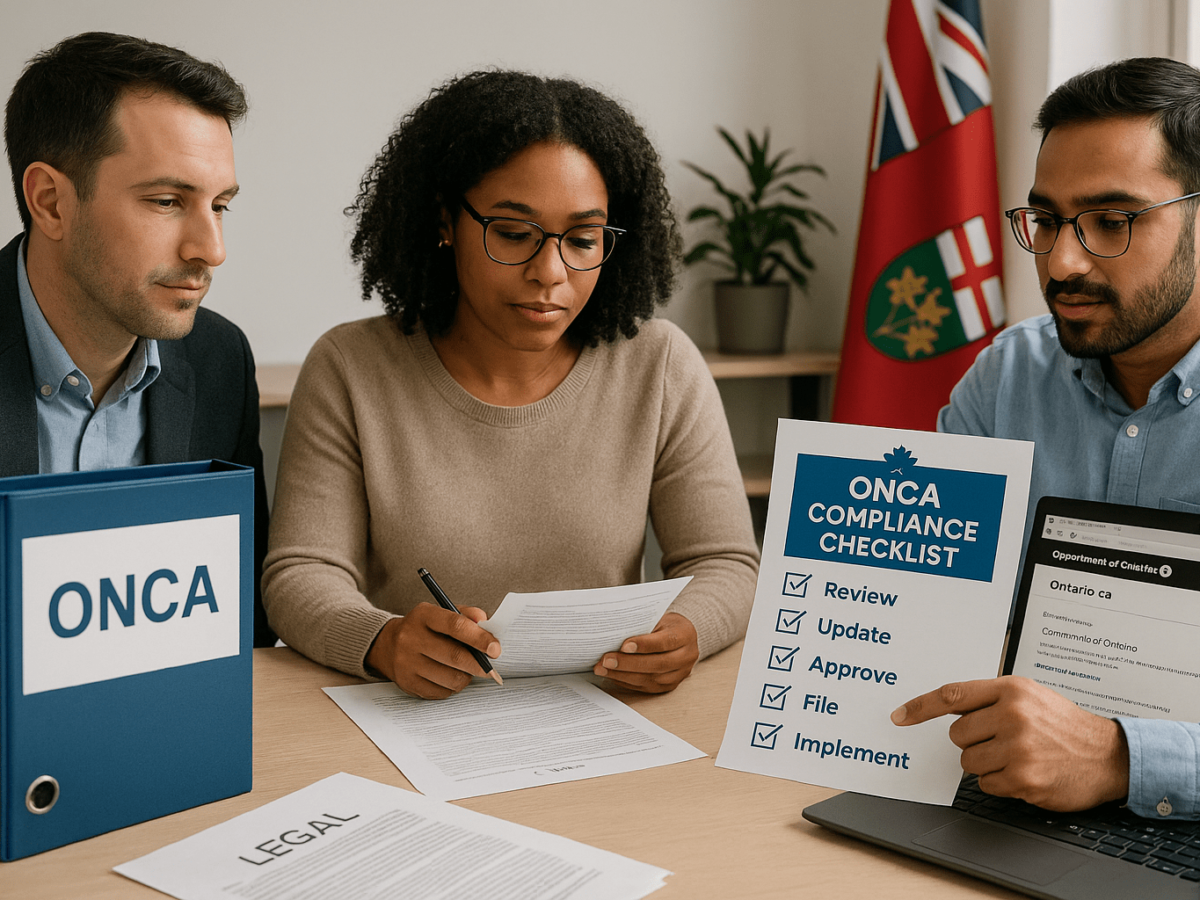
ONCA Compliance: Step-by-Step Implementation Guide for Ontario Nonprofits

ONCA Compliance: Step-by-Step Implementation Guide for Ontario Nonprofits

If you’re running a nonprofit or charity in Ontario, you’ve likely heard about the Ontario Not-for-Profit Corporations Act (ONCA). This legislation represents the biggest change to the nonprofit sector in decades, and navigating compliance can feel overwhelming. I’ve helped dozens of organizations through this transition, and I can tell you that with the right approach, it’s entirely manageable.

In this comprehensive guide, I’ll walk you through each step of ONCA compliance, from understanding the basic requirements to implementing specific changes to your governance structure. Whether you’re just starting the process or trying to finish up your compliance efforts, this resource will help you navigate the path forward.

Understanding the Ontario Not-for-Profit Corporations Act (ONCA)

Before diving into compliance steps, it’s essential to understand what ONCA is and why it matters.

Overview and Purpose of ONCA

The Ontario Not-for-Profit Corporations Act (ONCA) is modern legislation designed to:

  • Replace the outdated Corporations Act (OCA) that previously governed Ontario nonprofits
  • Provide more flexibility and simplicity for nonprofit operations
  • Enhance corporate governance and accountability
  • Increase membership rights and remedies
  • Better protect directors and officers from liability
  • Simplify the incorporation process

ONCA finally came into force on October 19, 2021, after nearly a decade of delays. It aims to create a more modern legal framework that addresses the unique needs of Ontario’s diverse nonprofit sector.

Key Changes from Previous Legislation

ONCA introduces several significant changes from the previous Corporations Act:

  • Enhanced member rights: Members gain more rights, including access to financial statements, proposal rights, and remedies for issues like oppression
  • Simplified incorporation: The process requires only one incorporator rather than three and uses articles of incorporation instead of letters patent
  • Public Benefit Corporation designation: Creates a special category for charities and organizations receiving more than $10,000 in public funding or donations
  • Updated director and officer provisions: More clarity on duties, liabilities, and conflict of interest rules
  • Modern voting and participation: Allows electronic meetings and voting in most cases
  • Clearer corporate record requirements: Specific requirements for maintaining corporate records
  • Default by-law provisions: If bylaws aren’t filed within 60 days of incorporation or don’t address required matters, default rules apply

These changes aim to bring nonprofit governance into the 21st century while creating more consistency and clarity.

Who Needs to Comply with ONCA

ONCA applies to:

  • All nonprofit corporations incorporated under Ontario law
  • Social clubs, professional associations, charities, service organizations, and more
  • Both existing organizations and newly formed nonprofits

ONCA does NOT apply to:

  • Federally incorporated nonprofits (governed by the Canada Not-for-profit Corporations Act)
  • For-profit corporations (governed by the Ontario Business Corporations Act)
  • Insurance corporations under Part V of the Corporations Act
  • Nonprofits incorporated in other provinces or territories

If you’re incorporated under Ontario law and operate as a nonprofit, ONCA compliance is mandatory.

Ontario Nonprofit ONCA Compliance Timeline

Understanding the compliance timeline helps you plan your transition process effectively.

Current Deadlines for Compliance

ONCA came into effect on October 19, 2021, with the following timeline:

  • October 19, 2021: ONCA officially in force
  • October 19, 2024: Deadline for existing nonprofits to transition and file Articles of Amendment
  • Until transition: Existing organizations continue under OCA with their current letters patent and by-laws, except where specific ONCA provisions automatically apply

The three-year transition period gives organizations time to review their governing documents and make necessary changes.

Extension Possibilities

Currently, there are no announced plans to extend the October 19, 2024 deadline. However, based on past practice with similar legislation:

  • The government might consider extensions if significant numbers of organizations are struggling to comply
  • Individual extensions are unlikely to be granted
  • Organizations should plan to meet the current deadline rather than counting on potential extensions

Monitor the Ontario government’s announcements for any changes to compliance deadlines.

Consequences of Non-compliance

Failing to transition by the deadline has significant consequences:

  • Your organization will not be dissolved automatically
  • Your documents will be deemed to comply with ONCA, potentially creating internal governance conflicts
  • The government may later require your organization to update documents
  • You may face challenges when filing other changes with the government
  • Banks, funders, and partners may question your compliance status
  • Legal issues could arise from unclear governance provisions

It’s far better to proactively comply than to deal with these potential complications.

If you’re navigating ONCA compliance and need a quick refresher on the responsibilities of nonprofit officers in Ontario, check out ONCA 101: Rules for Officers of Ontario Nonprofits — a clear and concise video guide to help you stay compliant.

Step 1: Gathering Your Current Governance Documents for ONCA Review

The first practical step in ONCA compliance is collecting all your current governance documents.

Required Organizational Documents

You’ll need to gather:

  • Letters Patent (your incorporation document)
  • Supplementary Letters Patent (if any)
  • All current bylaws and amendments
  • Governance policies
  • Board structure documentation
  • Membership rules and procedures
  • Organizational chart
  • Minutes documenting bylaw changes

These documents form the foundation of your current governance structure and will need to be assessed against ONCA requirements.

How to Locate Missing Documents

If you’re missing key documents:

  • Letters Patent: Request copies from the Ontario Ministry (Services Ontario)
  • Bylaws: Check board minute books, past secretary records, lawyer files
  • Board policies: Review past board minutes and policy manuals
  • Membership records: Contact long-time members, check membership committee files

If documents truly cannot be found, you may need to create new ones as part of your ONCA compliance process.

Creating an Inventory of Existing Materials

Organize your documents by:

  • Creating a spreadsheet listing all documents with dates of approval
  • Noting any inconsistencies between documents
  • Identifying the most current version of each document
  • Flagging documents that will likely need updates
  • Creating a central digital and physical repository
  • Assigning someone to maintain this inventory throughout the compliance process

A comprehensive inventory prevents confusion and ensures no important provisions are overlooked.

Step 2: Review of Current Articles of Incorporation Under ONCA

Your core incorporation document needs careful review against ONCA requirements.

Identifying Elements Requiring Updates

Review your Letters Patent (soon to be Articles) for:

  • Corporate name (check if still appropriate and available)
  • Corporate purposes (assess for clarity and compliance)
  • Special provisions (review for ONCA compatibility)
  • Membership classes (evaluate if structure still serves your needs)
  • Number of directors (check if range is appropriate)
  • Head office location (confirm if still accurate)
  • Dissolution provisions (ensure they meet current requirements)

Mark each element that appears outdated or non-compliant with ONCA.

Common Areas Needing ONCA Alignment

The most frequently updated areas include:

  • Purposes: Often need modernizing or clarifying
  • Special provisions: May contain outdated references to previous legislation
  • Membership provisions: Often lack clarity about rights and responsibilities
  • Director provisions: May not reflect ONCA’s flexibility regarding term lengths and removal
  • Dissolution clauses: May need updating, especially for public benefit corporations

These areas typically require careful attention during the review process.

Drafting Compliant Revisions

When revising your Articles:

  • Use plain, clear language
  • Ensure consistency with your planned bylaw revisions
  • Consider future flexibility needs
  • For registered charities, ensure CRA compliance (see our articles on charity registration and foundation types for more information)
  • Verify that any special provisions are necessary and properly worded
  • Draft using the government’s required forms and formats
  • Consider consulting with a nonprofit lawyer for complex revisions

Well-drafted revisions prevent future governance challenges and compliance issues.

Step 3: ONCA Bylaw Review and Amendments

Your bylaws likely need significant updates to align with ONCA requirements.

Mandatory Bylaw Provisions Under ONCA

ONCA requires bylaws to address:

  • Conditions for membership
  • Rights of members, including voting
  • How membership transfers or terminates
  • Notice requirements for member meetings
  • Quorum for member meetings
  • Proxy voting rules (if permitted)
  • How directors are elected or appointed
  • How officers are appointed
  • Banking arrangements
  • Financial year end

If your bylaws don’t address these areas, ONCA’s default provisions will apply.

Optional Provisions to Consider

Beyond mandatory elements, consider including:

  • Detailed membership classes and qualifications
  • Member discipline and termination procedures
  • Electronic participation in meetings
  • Absentee voting methods beyond proxies
  • Director qualifications and disqualifications
  • Director term limits
  • Officer roles beyond those required
  • Executive committee provisions
  • Other committee structures
  • Conflict of interest procedures
  • Indemnification provisions
  • Detailed notice requirements

These provisions help customize your governance to your organization’s needs.

Process for Amending Bylaws

ONCA bylaws amendments typically follow this process:

  1. Draft new or amended bylaws
  2. Board approval of proposed bylaws
  3. Member approval (usually by special resolution requiring ⅔ majority)
  4. Filing with the Ministry (not mandatory but recommended)

For ONCA transition, bylaws should be updated alongside your Articles of Amendment and approved by members in a single process.

Step 4: Membership Structure Review for ONCA Compliance

Membership structures require careful review under ONCA’s enhanced member rights framework.

Classes of Membership Under ONCA

ONCA allows for flexible membership structures:

  • You can have single or multiple membership classes
  • Each class must have conditions for membership clearly defined
  • If you have multiple classes, Articles must outline voting rights for each class
  • Non-voting members gain new rights under ONCA, including voting on changes affecting their class
  • All members have rights to financial statements and certain corporate records

Review your current structure to determine if it still serves your organizational needs.

Voting Rights Considerations

ONCA introduces important voting rights changes:

  • All members, including “non-voting” members, can vote on:

    • Changes affecting their class rights or conditions
    • Amalgamation
    • Sale of significant assets
    • Liquidation or dissolution
  • Each member typically gets one vote (unless Articles specify otherwise)
  • Organizations can permit proxy voting, voting by mail, or electronic voting
  • Voting rights must be clearly documented in Articles or bylaws

Consider whether these enhanced voting rights affect your governance approach.

Transitioning Membership Structures

When updating membership structures:

  • Consider simplifying overly complex structures
  • Clearly define each class and its rights
  • Ensure proper notice to all members about structural changes
  • Plan for how existing members will transition to any new structure
  • Prepare communication materials explaining changes
  • Consider how changes align with your organizational mission and values
  • Document the transition process for future reference

Member transitions require careful planning and communication to avoid confusion or resistance.

Step 5: ONCA-Compliant Board Structure and Governance

Your board structure and governance practices need alignment with ONCA’s requirements.

Director Qualifications and Restrictions

ONCA establishes basic director requirements:

  • Minimum age of 18
  • Not declared incapable by court
  • Not bankrupt
  • Individual (not corporation)
  • No requirement to be a member of the corporation (unless bylaws specify)
  • No requirement to be a resident of Ontario or Canada (unless bylaws specify)

Your bylaws can add additional qualifications but cannot remove these basic requirements.

Officer Requirements

ONCA has flexible officer provisions:

  • No specific officers are required by the Act
  • Common officers include Chair/President, Secretary, and Treasurer
  • One person can hold multiple offices (except for charities, which require separation)
  • Officers don’t have to be directors (unless bylaws require it)
  • Officer duties should be clearly defined in bylaws
  • Officers appointed by board resolution (unless Articles or bylaws specify otherwise)

Review your officer structure for clarity and compliance.

Meeting and Decision-making Procedures

ONCA modernizes meeting procedures:

  • Electronic participation in meetings is permitted unless bylaws specify otherwise
  • Notice requirements for board and member meetings are specified
  • Written resolutions require unanimous consent of directors (no partial written resolutions)
  • Proxy voting for director meetings is prohibited
  • Detailed quorum requirements for member meetings
  • Clear rules for calling special meetings

Update your procedures to take advantage of ONCA’s flexibility while maintaining good governance.

Step 6: Filing ONCA Articles of Amendment

Once your documents are prepared, they must be properly filed with the Ontario government.

Required Documentation

To file Articles of Amendment, you’ll need:

  • Form 5271E (Articles of Amendment)
  • Supporting documentation (board and member resolutions)
  • Copy of your current Letters Patent
  • NUANS name search report (if changing corporate name)
  • Cover letter explaining the purpose of the filing

Ensure all documents are complete and accurate before submission.

Filing Process with the Ontario Government

The filing process typically involves:

  1. Preparing all required documents
  2. Filing through the new Ontario Business Registry online portal
  3. Paying the required fee
  4. Receiving confirmation of filing
  5. Downloading your Certificate of Amendment and amended Articles

The online portal has streamlined the process compared to the previous paper-based system.

Fees and Processing Timelines

Current filing information:

  • Filing fee: $130 (subject to change)
  • Processing time: Usually 3-5 business days for electronic filings
  • Expedited service: Generally not available for most nonprofit filings
  • Additional fees may apply for name searches or other services

Budget for these costs and timelines in your compliance planning.

Step 7: ONCA Member and Board Approval Process

Proper approval is essential for valid ONCA transition.

Required Meetings and Notices

The approval process typically requires:

  • Board meeting to approve proposed changes (with proper notice)
  • Member meeting to approve Articles of Amendment and new/amended bylaws (with proper notice)
  • Special resolution of members (typically ⅔ majority)
  • Proper documentation of all meetings and decisions
  • For multiple member classes, possible separate class votes

Follow notice periods specified in your current bylaws or ONCA’s default provisions.

Voting Thresholds for Approval

ONCA requires specific approval levels:

  • Articles of Amendment: Special resolution (⅔ of votes cast)
  • Fundamental changes: Special resolution (⅔ of votes cast)
  • Bylaw amendments: Ordinary resolution (simple majority) unless Articles, bylaws, or ONCA specify otherwise
  • For multiple membership classes, separate class votes may be required

Verify quorum requirements to ensure valid meetings and votes.

Documentation of Decisions

Properly document all decisions:

  • Detailed meeting minutes showing proper procedure
  • Record of actual vote counts
  • Copies of resolutions passed
  • Evidence of proper notice
  • Attendance records
  • Copies of all approved documents in final form

This documentation may be required by the Ministry and provides important organizational history.

Ongoing ONCA Compliance Requirements

ONCA compliance doesn’t end with the transition process.

Annual Filings and Reports

Ongoing requirements include:

  • Annual corporate information return
  • Financial statements prepared according to appropriate standards
  • Reports to members at annual meetings
  • Registered charity returns (if applicable)
  • Other filings based on your specific organization type

Calendar these requirements to ensure timely compliance.

Record-keeping Obligations

ONCA requires maintaining:

  • Articles, bylaws, and their amendments
  • Minutes of member and board meetings
  • All resolutions
  • Membership register
  • Director register
  • Officer register
  • Debt obligation register
  • Financial records
  • Proper accounting records

These records must be kept at your registered office or another location specified by the directors.

Financial Review Requirements

ONCA establishes tiered financial review requirements:

  • Public Benefit Corporations:
    • Annual revenue up to $100,000: Members may waive audit/review by extraordinary resolution (80%)
    • Annual revenue $100,001 to $500,000: May waive audit but must have review engagement (extraordinary resolution)
    • Annual revenue over $500,000: Must have audit
  • Other Corporations:
    • Annual revenue up to $500,000: Members may waive audit/review by extraordinary resolution (80%)
    • Annual revenue over $500,000: May waive audit but must have review engagement (extraordinary resolution)

Financial review planning should be incorporated into your annual budget and governance cycle.

Special ONCA Considerations for Ontario Charities

Registered charities face additional requirements when transitioning to ONCA.

Coordination with CRA Requirements

Ontario charities must balance ONCA and CRA requirements:

  • Charitable purposes must meet both ONCA and CRA standards
  • Any purpose changes require CRA approval
  • Public Benefit Corporation provisions align with charity requirements
  • Director remuneration restrictions are more stringent for charities
  • Articles should include appropriate dissolution clauses for charities

Ensure your ONCA changes don’t create CRA compliance issues. For more guidance, see our article on Canadian charity registration.

Additional Reporting Obligations

Charities have layered reporting requirements:

  • ONCA corporate filings
  • T3010 annual charity return
  • Public disclosure requirements
  • Fundraising reporting in some cases
  • Grant reporting to funders
  • Municipal reporting for property tax exemptions

Create a comprehensive compliance calendar to track all obligations.

Ensuring Dual Compliance

To maintain both ONCA and charity compliance:

  • Review all documents from both ONCA and charity perspectives
  • Consider having CRA review proposed purpose changes before filing
  • Ensure bylaws address both corporate and charity requirements
  • Maintain clear separation of duties for officers and directors
  • Follow more stringent requirements when ONCA and CRA differ
  • Keep detailed records of compliance with both regimes

When in doubt, the more restrictive requirement typically applies. For more on the distinction between charities and foundations, see our guide on private foundations vs. public charities.

Ready to bring your Ontario nonprofit into ONCA compliance?

Work with Northfield & Associates for expert guidance through every step of the transition process, ensuring your organization meets all requirements while maintaining effective governance.


Contact To Action

Contact us today to schedule your consultation.

Northfield & Associates

Advancing Global Partnerships, Together.

Working with Our Firm

In this evolving economic landscape, collaboration with our firm offers clients a strategic advantage. With Cambodia’s reform-driven investment environment and Canada’s expanding footprint in Southeast Asia, our team of experienced consultants and legal advisors provides tailored guidance to help businesses navigate cross-border opportunities. We focus in developing comprehensive legal strategies, structuring international partnerships, and ensuring compliance in emerging markets.

By leveraging our regional insight and international expertise, you benefit from a trusted partner dedicated to helping you capitalize on growth potential in Cambodia and beyond.

Book a Consultation with Northfield & Associates

Your Trusted Partner in International Bilateral Relations

At Northfield & Associates are focus in Foreign Direct Investment (FDI), international trade missions, and cross-border legal strategy. Our team of experienced consultants and legal advisors offers tailored guidance and strategic insight to help you navigate the complexities of international partnerships and development opportunities.

Whether you choose to meet in person at one of our offices or connect virtually, we provide flexible and accessible consultation options. During your session, we’ll assess your goals, review key documentation, and guide you through every stage of your FDI or trade mission engagement.

Let us help you take the next step with confidence supported by trusted legal and strategic counsel every step of the way.

Take the First Step Today

If you believe you may be eligible for legal relief or simply need sound legal advice, we’re here to help. Contact us today to book your consultation. Let us provide the clarity, strategy, and peace of mind you need to move forward.

We serve our clients in English, Cambodian, Vietnamese, Mandarin and Cantonese, especially in Asian clients.

  • If you or anybody that you know, think that you meet the requirements and wish to receive further information.
  • We can help you start the application process and confirm eligibility requirements to participate.
  • We Offer Consultations & Meetings by Phone & Virtually. Affordable Fees.

Disclaimer:

The information contained in this article is provided for general information purposes only and does not constitute legal or other professional advice. Readers should seek tailored legal advice in relation to their personal circumstances.

Northfield & Associates

Advancing Global Partnerships, Together.

Book a Consultation Today

Contact Northfield & Associates today to schedule a FREE consultation with an experienced Consultant.

Join the community of Northfield & Associates

Connect with peers and community ambassadors to hear real experiences, tips, and advice about studying abroad.


About Northfield

Northfield & Associates International Corporation is a global consulting firm serving private enterprises, public institutions, not-for-profit organizations, and institutional capital providers. Operating across Cambodia, Canada, and global markets, the firm supports capital deployment, regulatory navigation, and enterprise decision-making in complex economic and geopolitical environments. Northfield & Associates delivers customized, execution-focused advisory solutions that drive measurable transformation, strengthen competitiveness, and enhance long-term highest value opportunities. The firm incorporates consulting, legal, regulatory, financial, and risk expertise to enable disciplined capital allocation, strong governance, and operational resilience. Northfield & Associates upholds a culture of applied insight and innovation, supporting clients across digital transformation, growth strategy, and organizational capability building. The firm advises individual, leading global corporations, midsize enterprises, government agencies, and mission-driven organizations through long-term partnerships. Enterprise-wide risk management, professional ethics, and fiduciary standards are embedded across all operations. Northfield & Associates’ diverse, globally unified teams are committed to execution certainty and sustainable, risk-adjusted returns aligned with ESG and stakeholder objectives.

Forward-Looking Information

This news release contains forward-looking information. All statements, other than statements of historic fact, that address activities, events or developments that the Company believes, expects or anticipates will or may occur in the future constitute forward-looking information.

This forward-looking information reflects the current expectations or beliefs of the Company based on information currently available to the Company.

Forward-looking information is subject to a number of risks and uncertainties that may cause the actual results of the Company to differ materially from those discussed in the forward-looking information, and even if such actual results are realized or substantially realized, there can be no assurance that they will have the expected consequences to, or effects on the Company. Factors that could cause actual results or events to differ materially from current expectations include, among other things: the failure to finalize negotiations concerning the increase of the Loan or to close such transaction and the failure of the Company to complete the acquisition of the Company Facility; operating performance of facilities; environmental and safety risks; delays in obtaining or failure to obtain necessary permits and approvals from government authorities; unavailability of plant, equipment or labour; inability to retain key management and personnel; changes to regulations or policies affecting the Company’s activities; and the other risks disclosed under the heading “Risk Factors” and elsewhere in the Company’s amended annual information.

Forward-looking information speaks only as of the date on which it is made and, except as may be required by applicable securities laws, the Company disclaims any intent or obligation to update any forward-looking information, whether as a result of new information, future events or results or otherwise. Although the Company believes that the assumptions inherent in the forward-looking information are reasonable, forward-looking information is not a guarantee of future performance and accordingly undue reliance should not be put on such information due to the inherent uncertainty therein.

Questions?

info@northfied.biz

Within Corporate Newsroom  

Media Contact:

media@northfied.biz

Press contact

PR consultants
press@northfied.biz

NOT LEGAL ADVICE. Information made available on this website in any form is for information purposes only. It is not, and should not be taken as, legal advice. You should not rely on, or take or fail to take any action based upon this information. Never disregard professional legal advice or delay in seeking legal advice because of something you have read on this website. Northfield & Associates professionals will be pleased to discuss resolutions to specific legal concerns you may have.

Categories
Business News Government Contracting & Public Sector Legal News Northfield News

What is the Importance of Art Form and Artistic Merit Criteria in Gaining Charitable Status in Canada?

What is the Importance of Art Form and Artistic Merit Criteria in Gaining Charitable Status in Canada?

Understanding how art organizations can meet the art form and artistic merit criteria in Canada is essential for gaining charitable status and ensuring their activities are recognized and supported. Let’s break down the steps and requirements for meeting these criteria.

What Are Art Forms and Styles?

Art Form: This refers to the broad categories of art such as literature, dance, visual arts, theatre, and music. For instance:

  • Dance includes styles like ballet, modern, jazz, and tap.
  • Music includes styles like classical, choral, chamber, and jazz.
  • Literature includes prose and poetry.

Style: Within each art form, there are different disciplines or methods of expression. For example, within the dance art form, styles include ballet, modern, jazz, and tap.


Establishing Common or Widespread Acceptance

To be recognized, an art organization must demonstrate that both the form and style of art they represent are widely accepted within the Canadian arts community. This can be done through:

  1. Educational Evidence:
    • The art form and style are taught or studied at accredited Canadian institutions like colleges and universities.
    • Providing course curricula or syllabi as proof.
  2. Recognition by Arts Bodies:
    • The art form and style have been recognized by national or provincial/territorial arts bodies in Canada.
    • This includes funding, exhibition, presentation, or performance recognition.
    • Supporting documentation of such recognition is essential.
  3. Academic and Arts Publications:
    • Recognition by established Canadian academic arts journals or arts publications.
    • Providing articles from these publications as evidence.

Evidence from several sources is typically more persuasive, such as:

  • Permanent exhibits in national galleries.
  • Grants from provincial/territorial arts bodies.

Organizations must ensure that all supporting documents not in French or English are translated into one of these languages.

Demonstrating Artistic Merit

Artistic Merit: This refers to the quality of exhibitions, presentations, or performances. To meet the artistic merit criterion, organizations need to show that their activities are of high quality and provide public value.

  1. Detailed Descriptions:
    • Provide a comprehensive description of the exhibition, presentation, or performance.
    • Explain how each will be exhibited, presented, or performed.
  2. Objective Evidence:
    • Evidence of the required quality through:
      • Open, unbiased selection processes for artists and artworks.
      • Calls for auditions or selection processes.
      • Lists of artists or works considered.
      • Names and qualifications of decision-makers.
      • Standards and procedures applied in the process.
  3. Impartial Reviews:
    • Materials from established academic journals, arts publications, or professional arts reviews.
    • Reviews or critiques from mainstream media with established qualifications of the reviewer or critic.
  4. Expert Submissions:
    • Submissions from independent experts with relevant qualifications or work experience.
    • Provide biographical information about the artists, including training, previous performances, awards, and grants.
  5. Professional Memberships:
    • Certification that artists or organizations are members of professional associations with quality standards.
  6. Curated Selections:
    • Evidence that the artwork or artist has been chosen as part of a curated exhibition, presentation, or performance.


Maintaining Compliance

Organizations must continue to meet the artistic merit criteria even after registration. This involves:

  • Ensuring ongoing compliance with established standards.
  • Providing evidence of artistic merit as required.
  • Being assessed based on location, size, nature, and other relevant circumstances.


If artistic merit cannot be established through Canadian sources, international equivalents will be considered. By following these guidelines, art organizations can effectively meet the art form and artistic merit criteria, ensuring their activities are recognized and supported within the Canadian arts community.


Contact To Action

Contact us today to schedule your consultation.

Northfield & Associates

Advancing Global Partnerships, Together.

Working with Our Firm

In this evolving economic landscape, collaboration with our firm offers clients a strategic advantage. With Cambodia’s reform-driven investment environment and Canada’s expanding footprint in Southeast Asia, our team of experienced consultants and legal advisors provides tailored guidance to help businesses navigate cross-border opportunities. We focus in developing comprehensive legal strategies, structuring international partnerships, and ensuring compliance in emerging markets.

By leveraging our regional insight and international expertise, you benefit from a trusted partner dedicated to helping you capitalize on growth potential in Cambodia and beyond.

Book a Consultation with Northfield & Associates

Your Trusted Partner in International Bilateral Relations

At Northfield & Associates are focus in Foreign Direct Investment (FDI), international trade missions, and cross-border legal strategy. Our team of experienced consultants and legal advisors offers tailored guidance and strategic insight to help you navigate the complexities of international partnerships and development opportunities.

Whether you choose to meet in person at one of our offices or connect virtually, we provide flexible and accessible consultation options. During your session, we’ll assess your goals, review key documentation, and guide you through every stage of your FDI or trade mission engagement.

Let us help you take the next step with confidence supported by trusted legal and strategic counsel every step of the way.

Take the First Step Today

If you believe you may be eligible for legal relief or simply need sound legal advice, we’re here to help. Contact us today to book your consultation. Let us provide the clarity, strategy, and peace of mind you need to move forward.

We serve our clients in English, Cambodian, Vietnamese, Mandarin and Cantonese, especially in Asian clients.

  • If you or anybody that you know, think that you meet the requirements and wish to receive further information.
  • We can help you start the application process and confirm eligibility requirements to participate.
  • We Offer Consultations & Meetings by Phone & Virtually. Affordable Fees.

Disclaimer:

The information contained in this article is provided for general information purposes only and does not constitute legal or other professional advice. Readers should seek tailored legal advice in relation to their personal circumstances.

Northfield & Associates

Advancing Global Partnerships, Together.

Book a Consultation Today

Contact Northfield & Associates today to schedule a FREE consultation with an experienced Consultant.

Join the community of Northfield & Associates

Connect with peers and community ambassadors to hear real experiences, tips, and advice about studying abroad.


About Northfield

Northfield & Associates International Corporation is a global consulting firm serving private enterprises, public institutions, not-for-profit organizations, and institutional capital providers. Operating across Cambodia, Canada, and global markets, the firm supports capital deployment, regulatory navigation, and enterprise decision-making in complex economic and geopolitical environments. Northfield & Associates delivers customized, execution-focused advisory solutions that drive measurable transformation, strengthen competitiveness, and enhance long-term highest value opportunities. The firm incorporates consulting, legal, regulatory, financial, and risk expertise to enable disciplined capital allocation, strong governance, and operational resilience. Northfield & Associates upholds a culture of applied insight and innovation, supporting clients across digital transformation, growth strategy, and organizational capability building. The firm advises individual, leading global corporations, midsize enterprises, government agencies, and mission-driven organizations through long-term partnerships. Enterprise-wide risk management, professional ethics, and fiduciary standards are embedded across all operations. Northfield & Associates’ diverse, globally unified teams are committed to execution certainty and sustainable, risk-adjusted returns aligned with ESG and stakeholder objectives.

Forward-Looking Information

This news release contains forward-looking information. All statements, other than statements of historic fact, that address activities, events or developments that the Company believes, expects or anticipates will or may occur in the future constitute forward-looking information.

This forward-looking information reflects the current expectations or beliefs of the Company based on information currently available to the Company.

Forward-looking information is subject to a number of risks and uncertainties that may cause the actual results of the Company to differ materially from those discussed in the forward-looking information, and even if such actual results are realized or substantially realized, there can be no assurance that they will have the expected consequences to, or effects on the Company. Factors that could cause actual results or events to differ materially from current expectations include, among other things: the failure to finalize negotiations concerning the increase of the Loan or to close such transaction and the failure of the Company to complete the acquisition of the Company Facility; operating performance of facilities; environmental and safety risks; delays in obtaining or failure to obtain necessary permits and approvals from government authorities; unavailability of plant, equipment or labour; inability to retain key management and personnel; changes to regulations or policies affecting the Company’s activities; and the other risks disclosed under the heading “Risk Factors” and elsewhere in the Company’s amended annual information.

Forward-looking information speaks only as of the date on which it is made and, except as may be required by applicable securities laws, the Company disclaims any intent or obligation to update any forward-looking information, whether as a result of new information, future events or results or otherwise. Although the Company believes that the assumptions inherent in the forward-looking information are reasonable, forward-looking information is not a guarantee of future performance and accordingly undue reliance should not be put on such information due to the inherent uncertainty therein.

Questions?

info@northfied.biz

Within Corporate Newsroom  

Media Contact:

media@northfied.biz

Press contact

PR consultants
press@northfied.biz

NOT LEGAL ADVICE. Information made available on this website in any form is for information purposes only. It is not, and should not be taken as, legal advice. You should not rely on, or take or fail to take any action based upon this information. Never disregard professional legal advice or delay in seeking legal advice because of something you have read on this website. Northfield & Associates professionals will be pleased to discuss resolutions to specific legal concerns you may have.

Categories
Business News Government Contracting & Public Sector Legal News Northfield News

Soliciting vs Non-Soliciting Corporation Canada: Key Differences

Soliciting vs Non-Soliciting Corporation Canada: Key Differences

If a Canadian not-for-profit corporation receives more than $10,000 from public sources in a single financial year, it becomes a soliciting corporation and must follow stricter rules.

Non-soliciting corporations stay below this threshold and have more flexibility in how they operate.

The difference between these two types affects board size and financial reporting.

The distinction between soliciting and non-soliciting status determines key requirements like the minimum number of directors needed, what kind of financial review is required, and whether the organization must file financial statements with Corporations Canada.

These requirements exist because soliciting corporations receive public funds and need to maintain transparency and accountability to the public.

Understanding which category applies to a corporation helps directors and officers meet their legal obligations under the Canada Not-for-profit Corporations Act.

This article explains the criteria for each status, outlines the specific requirements soliciting corporations must follow, and covers how these rules affect day-to-day operations and long-term planning.

Defining Soliciting vs Non-Soliciting Corporations

The Canada Not-for-profit Corporations Act classifies not-for-profit corporations into two categories based on their funding sources and amounts.

This classification determines the regulatory requirements each corporation must follow.

Soliciting Corporation Definition

soliciting corporation receives more than $10,000 from public sources in a single financial year.

Public sources include three main types of income.

The first type covers donations or gifts from people who are not members, directors, officers, or employees of the corporation. Under the CNCA Regulations, this also excludes “prescribed persons” — individuals related to the corporation by blood, marriage, common-law partnership, or adoption. This includes spouses, children, parents, siblings, and anyone who resides with a member, director, officer, or employee of the corporation.

The second type includes grants or similar financial assistance from federal, provincial, or municipal governments or their agencies.

The third type involves donations or gifts from another corporation or entity that itself received more than $10,000 from public sources in its most recent financial year.

The status takes effect at the annual meeting following the financial year when the corporation exceeded the $10,000 threshold.

This gives the corporation time to make necessary changes to comply with additional requirements.

Non-Soliciting Corporation Definition

A non-soliciting corporation receives no public funds or less than $10,000 in public funds during its previous financial years.

These corporations typically operate on membership fees, investment income, or private donations from members and their families.

A corporation is considered soliciting if it received more than $10,000 in public funds in any single financial year within its last three years. However, once a corporation becomes soliciting, it must remain below this threshold for two consecutive financial years before it can return to non-soliciting status.

Non-soliciting corporations face fewer regulatory requirements and less government oversight.

They do not need to file financial statements with Corporations Canada unless specifically requested by the Director.

Determining Status under the Canada Not-for-profit Corporations Act

Not-for-profit corporations must calculate their total public funding at each financial year-end to determine their status.

The calculation includes all three types of public sources outlined in the Act.

The $10,000 threshold applies to the combined total from all public sources, not each source individually.

Corporations should track donations, government grants, and transfers from other publicly funded organizations separately throughout the year.

Corporations Canada provides an assistance tool to help organizations determine whether they are soliciting or non-soliciting.

Directors and officers should review their funding sources carefully, as misclassification can lead to non-compliance with statutory requirements.

Legal or professional advice may be necessary when circumstances are unclear or complex.

Criteria and Thresholds for Soliciting Status

A corporation’s soliciting status depends on whether it receives more than $10,000 from public sources in a single financial year.

The timing of when this threshold is met and what counts as public funding determines the specific requirements a corporation must follow.

Public Funding Threshold and Timeframe

The public funding threshold sits at $10,000 per financial year.

A corporation becomes soliciting when its annual public funding exceeds this amount during any single financial period.

The calculation happens at the corporation’s financial year-end.

The requirements don’t take effect immediately when a corporation crosses the threshold.

They apply starting at the annual meeting of members following the financial year-end where the corporation exceeded $10,000 in public funds.

This timing gives the corporation a chance to make necessary changes to its governance structure.

A corporation remains soliciting until it stays below the $10,000 threshold for two consecutive financial years.

Only after two full years under the limit can it return to non-soliciting status.

Sources of Public Funding

Public sources include three main categories of income.

The first category covers donations and gifts from people who are not members, directors, officers, or employees of the corporation. Under the CNCA Regulations, the definition of “prescribed persons” (who are not considered public donors) includes individuals related to the corporation by blood, marriage, common-law partnership, or adoption. This encompasses spouses, children, parents, siblings, and anyone who resides with a member, director, officer, or employee of the corporation.

The second category includes government grants and similar financial assistance.

This covers funding from federal, provincial, or municipal governments and their agencies.

The third category involves donations or gifts from other corporations that themselves received more than $10,000 from public sources in their most recent financial year.

This creates a flow-through effect where public funding from one organization counts as public funding for the receiving organization.

Income that does not count as public funding:

  • Membership fees from members
  • Business income from regular operations
  • Investment income from assets
  • Donations from prescribed persons (family members and household residents of members, directors, officers, and employees)
  • Private foundations (unless they received public funds)
  • Corporate donations from companies without public funding

Calculating Gross Annual Revenue

Gross annual revenue serves two purposes in determining a corporation’s obligations.

First, it combines with soliciting status to set financial review requirements.

Second, it establishes the type of audit or review a corporation must conduct.

For soliciting corporations:

  • Those with gross annual revenue under $50,000 default to a review engagement, but members can waive this requirement by unanimous resolution
  • Corporations between $50,000 and $250,000 must have an audit by default, but members can opt for a review engagement instead through a special resolution
  • Above $250,000, an audit becomes mandatory with no option to choose a review engagement

For non-soliciting corporations:

  • Those with gross annual revenue under $1 million default to a review engagement, but members can waive this requirement by unanimous resolution
  • Corporations with $1 million or more in gross annual revenue must have either an audit or a review engagement (members can choose by unanimous resolution), but cannot waive having a public accountant entirely

The gross annual revenue calculation includes all income sources, not just public funding.

This means membership fees, business income, investment income, donations, gifts, and government grants all factor into the total.

The financial year determines the period for measuring both the public funding threshold and gross annual revenue.

Transitioning Between Statuses

The transition from non-soliciting to soliciting status requires specific governance changes.

The corporation must increase its board to at least three directors, with two who are not officers or employees.

If the corporation’s articles are silent on the distribution of property upon liquidation, the Canada Not-for-profit Corporations Act automatically requires that any remaining property be distributed to a qualified donee under the Income Tax Act. While amending the articles to explicitly include this provision is not legally required, it is considered a best practice for clarity and transparency.

Filing requirements change at the first annual meeting after crossing the threshold.

The corporation must begin sending financial statements and any public accountant reports to Corporations Canada.

It must also eliminate any unanimous member agreement if one exists.

Moving from soliciting to non-soliciting status takes longer.

The corporation must stay below the $10,000 public funding threshold for two complete financial years.

During this time, it continues to meet all soliciting corporation requirements.

Only after the second consecutive year below the threshold can it adopt the less stringent non-soliciting requirements.

Some corporations may qualify for an exemption through a Director’s decision.

This allows a soliciting corporation to be deemed non-soliciting in exceptional circumstances where meeting the full requirements would not serve the public interest.

Legal Obligations and Reporting Requirements

Soliciting and non-soliciting corporations face different levels of scrutiny with financial reporting and public disclosure.

Soliciting corporations must file detailed financial statements with Corporations Canada and meet strict deadlines, while non-soliciting corporations have fewer requirements but still need to maintain basic compliance.

Filing Financial Statements

Soliciting corporations must prepare and file complete financial statements with Corporations Canada every year.

These statements need to include a balance sheet, income statement, statement of changes in net assets, and cash flow statement.

A qualified public accountant must conduct either an audit or review engagement of these documents before filing.

Non-soliciting corporations do not have to file their financial statements publicly.

They still need to prepare financial statements for their members and keep proper financial records, but these documents stay internal.

The organization can choose whether to hire an accountant to review their books.

The type of financial review required depends on the corporation’s soliciting status and annual revenue:

For soliciting corporations:

  • Under $50,000: Review engagement (members can waive by unanimous resolution)
  • $50,000 to $250,000: Audit required (members can opt for review engagement by special resolution)
  • Over $250,000: Audit mandatory

For non-soliciting corporations:

  • Under $1 million: Review engagement (members can waive by unanimous resolution)
  • Over $1 million: Audit or review engagement required (members can choose by unanimous resolution, but cannot waive having a public accountant)

This creates higher compliance costs for soliciting corporations across all revenue levels.

Financial Reporting Deadlines

Soliciting corporations must send their financial statements to members at least 21 days before their annual meeting.

For the Director of Corporations Canada, the requirements are more detailed: financial statements must be sent not less than 21 days before the annual meeting. If members sign a resolution in lieu of holding a meeting, the corporation must send the financial statements to the Director as soon as possible after the resolution is signed. In all cases, statements must be filed no later than 15 months after the preceding annual meeting and within six months of the financial year-end.

Since the annual meeting must be held within six months (approximately 180 days) of the fiscal year-end, many organizations aim to file their statements within 160 days as a best practice. This gives adequate time for the public accountant to complete their work and still meet the 21-day requirement before the meeting.

If a corporation’s fiscal year ends on December 31, 2025, and they plan to hold their annual meeting in late June 2026, they would need to submit their statements to the Director by early June 2026 to meet the 21-day advance notice requirement, and in any event no later than mid-June 2026 (six months after year-end).

The filing happens through Corporations Canada’s online portal.

Non-soliciting corporations still need to hold annual meetings and present financial information to their members.

However, they don’t face the same strict filing deadlines with Corporations Canada.

They set their own internal timelines based on their bylaws and member needs.

Disclosure to Corporations Canada and the Public

Corporations Canada makes all soliciting corporation financial statements available to the public through their online database.

Anyone can request and view these documents.

This creates public accountability for organizations that receive donations, grants, or other public funds.

The public can see how the organization spends money and manages its resources.

The financial statements must show detailed revenue sources, expenses by category, and any significant transactions.

Soliciting corporations also need to disclose compensation paid to directors and officers if it exceeds certain thresholds.

This transparency helps maintain public trust in the non-profit sector.

Non-soliciting corporations keep their financial information private except to their own members.

They don’t appear in public databases unless someone specifically requests their corporate records through a formal process.

This gives them more privacy but also means less public oversight.

Penalties for Non-Compliance

Corporations Canada enforces compliance through administrative consequences rather than daily financial penalties.

Soliciting corporations that fail to file their financial statements on time will not receive a Certificate of Compliance.

Without this certificate, the corporation cannot demonstrate good standing, which can affect its ability to receive grants, enter contracts, or maintain relationships with funders.

More seriously, consistent failure to meet reporting requirements can lead to administrative dissolution.

If a corporation is more than one year late in filing its Annual Return, Corporations Canada can strike the corporation off the registry.

This means the organization can no longer operate legally, accept donations, or maintain its bank accounts.

The Canada Revenue Agency tracks compliance separately for charitable status purposes.

Organizations that are both soliciting corporations and registered charities need to meet requirements from both Corporations Canada and CRA.

Failing to comply with one can affect standing with the other.

Corporations Canada offers an assistance tool on their website to help organizations determine if they are soliciting or non-soliciting.

Using this tool doesn’t provide legal protection, but it helps organizations understand their obligations before problems arise.

Many corporations mistakenly classify themselves as non-soliciting and then face consequences when Corporations Canada discovers the error during a review.

Audit and Financial Review Standards

The level of financial scrutiny required for a not-for-profit corporation depends on whether it qualifies as soliciting or non-soliciting and its gross annual revenues.

Both types face distinct audit requirements designed to ensure financial transparency and proper financial controls.

Audit Requirements for Soliciting Corporations

Soliciting corporations face stricter financial review standards because they receive public funds.

The requirements change based on annual revenues.

Corporations with annual revenues over $250,000 must have their financial statements audited by a public accountant.

This audit provides assurance that the financial statements comply with Canadian accounting standards for not-for-profit organizations.

For soliciting corporations with revenues between $50,000 and $250,000, an audit is required by default. However, members can pass a special resolution to opt for a review engagement instead.

A review engagement offers moderate assurance rather than the comprehensive examination that an audit provides.

Soliciting corporations with revenues under $50,000 default to a review engagement, but members can waive this requirement by passing a unanimous resolution.

Even when a review is waived, the corporation must still maintain proper financial records and submit financial statements to Corporations Canada.

These heightened requirements exist to safeguard public funds and ensure accountability to donors and the broader community.

Audit Requirements for Non-Soliciting Corporations

Non-soliciting corporations face less stringent financial review standards because they do not receive significant public funding.

The thresholds for required financial oversight are much higher for these organizations.

Corporations with annual revenues of $1 million or more must have a public accountant conduct either an audit or a review engagement. Members can choose between these options by passing a unanimous resolution, but they cannot waive having a public accountant entirely at this revenue level.

Corporations with revenues under $1 million default to a review engagement, but members can waive this requirement by passing a unanimous resolution.

Members can also choose to require a full audit even when revenues are below the mandatory threshold.

This tiered approach recognizes that non-soliciting corporations operate with private funds and need less regulatory oversight while still maintaining some accountability at higher revenue levels.

Role of Public Accountant and Review Engagements

A public accountant conducts both audits and review engagements, but the scope is different for each service.

An audit involves detailed testing of financial controls, verification of assets and liabilities, and examination of transactions.

The public accountant provides positive assurance that financial statements are accurate and complete.

A review engagement is less intensive.

The public accountant performs analytical procedures and asks questions but does not verify information as thoroughly as in an audit.

This service provides moderate assurance, rather than a conclusive opinion.

Both services improve financial transparency and help organizations show accountability to members, donors, and regulators.

The public accountant’s report must be submitted with financial statements to the Director of Corporations Canada when required.

Governance and Board Structure

Soliciting and non-soliciting corporations have different governance requirements under Canadian corporate law.

The main differences relate to the number of directors, who can serve, and what agreements members can make.

Minimum Number of Directors

Non-soliciting corporations need at least one director to operate legally.

This allows small organizations to keep simple corporate structures.

Soliciting corporations must have at least three directors.

This rule applies after the corporation receives more than $10,000 from public sources in a financial year.

The higher threshold exists because soliciting corporations manage public funds and need broader oversight.

A corporation determines its status at the end of each financial year.

If it crosses the $10,000 threshold, it has until its next annual meeting to add the required directors.

Board Composition and Independence

Non-soliciting corporations have no restrictions on who serves as directors.

All board members can be employees, officers, or connected to the organization.

Soliciting corporations must keep independence within their board.

At least two of the minimum three directors cannot be officers or employees of the corporation or its affiliates.

This means a soliciting corporation can have only one director who is also an employee or officer.

The independence requirement prevents conflicts of interest and ensures objective oversight.

It gives donors confidence that someone outside the organization monitors how funds are used.

Restrictions on Unanimous Member Agreements

A unanimous member agreement lets members transfer some or all powers from directors to members.

Non-soliciting corporations can use these agreements to change governance as members choose.

Soliciting corporations cannot have a unanimous member agreement.

This rule protects public accountability by keeping authority with the board of directors.

Organizations that become soliciting corporations must end any existing unanimous member agreement.

They need to pass a resolution to make this change, depending on what their bylaws require.

Articles and Bylaws Requirements

If a soliciting corporation’s articles are silent on the distribution of property upon liquidation or dissolution, the Canada Not-for-profit Corporations Act automatically requires that any remaining property be distributed to a qualified donee under the Income Tax Act, not to members.

While corporations are not legally required to amend their articles to explicitly include this provision, doing so is considered a best practice. It provides clarity for directors, members, and stakeholders, and ensures compliance is transparent.

If a corporation chooses to amend its articles to include this provision explicitly, changes typically require a special resolution, usually approved by two-thirds of voting members.

Non-soliciting corporations have no such automatic restrictions in their articles and bylaws.

They can structure their documents as needed without mandatory asset distribution clauses, unless they are also registered charities (which have separate CRA requirements).

Impacts of Soliciting Status on Operations and Compliance

Soliciting status affects how nonprofits raise funds, report to stakeholders, and keep their charitable registration.

Organizations face different compliance costs, accountability standards, and options depending on their classification under the Canada Not-for-profit Corporations Act.

Funding Flexibility and Fundraising Methods

Soliciting corporations can pursue public fundraising without restrictions.

They can run campaigns for community donors, apply for government grants, and accept funding from other soliciting organizations.

Non-soliciting corporations have a strategic limit.

Any public fundraising that brings in more than $10,000 in a year changes their status.

Organizations must either limit public appeals or prepare for the compliance requirements of soliciting status.

Organizations that want to stay non-soliciting often focus on:

  • Member dues and fees
  • Private donations from prescribed persons (family members and household residents of board members)
  • Revenue from selling goods or services
  • Grants from private family foundations
  • Investment income from endowments

This limits fundraising reach but keeps administrative costs lower.

Organizations planning public fundraising must budget for audit fees, reporting systems, and extra governance procedures before launching campaigns.

Public Accountability and Donor Confidence

Soliciting corporations must make their financial statements available to anyone who asks.

This transparency builds donor confidence but requires good financial systems and professional accounting support.

Public donors expect to see how their contributions are used.

Organizations that provide clear reporting build stronger relationships with supporters.

The audit or review engagement requirements for soliciting corporations give donors independent checks on management of funds.

Registered charities face extra accountability through the Income Tax Act.

Charitable registration requires meeting standards set by the Canada Revenue Agency regardless of soliciting status.

Soliciting charities benefit from alignment between NFP Act requirements and CRA expectations for transparency.

Organizations listed as qualified donees under the Income Tax Act must keep public trust to maintain their status.

Proper financial reporting helps show compliance with both the NFP Act and charitable registration rules.

Transitioning Back to Non-Soliciting Status

Organizations can return to non-soliciting status by keeping public funding under $10,000 for two consecutive financial years.

The transition requires careful tracking of all revenue.

Organizations must monitor donations from public donors, government funding, and grants from other soliciting corporations.

Even one year over the threshold during the two-year period keeps soliciting status.

Some organizations reduce public fundraising to lower compliance costs.

They might decline government grants, limit donation campaigns, or focus only on private funding sources.

This strategy works for smaller organizations with steady private funding.

The decision should consider long-term sustainability.

Giving up public funding sources may limit growth and community impact.

Implications for Charitable Registration and Taxation

Soliciting status under the NFP Act is separate from charitable registration under the Income Tax Act.

An organization can be a registered charity without being a soliciting corporation if it keeps public funding under $10,000 each year.

Most registered charities go over the soliciting threshold through their fundraising.

Charitable registration lets organizations issue tax receipts to donors, which usually leads to public donations over $10,000 quickly.

Registered charities that are soliciting corporations must comply with both:

  • CRA requirements: Annual T3010 filing, proper receipting, spending quotas
  • NFP Act requirements: Financial statement audits, public disclosure, governance standards

The compliance burden is higher but necessary for organizations relying on public support.

Non-soliciting registered charities are rare because most charities depend on public funding sources above the threshold.

Organizations should match their corporate structure to their fundraising strategy before seeking charitable registration.

The combined requirements affect budgeting for professional fees, accounting systems, and administrative staff time.

Conclusion

Knowing whether an organization is a soliciting or non-soliciting corporation shapes every part of compliance under the Canada Not-for-profit Corporations Act.

The $10,000 threshold from public sources determines reporting requirements, governance standards, and how much transparency is owed to donors and the public.

Organizations need to track public funding carefully across multiple years and set up the right financial controls based on their classification.

Navigating these requirements can be complex, especially when funding sources change or the organization nears the soliciting threshold.

Getting the classification wrong can create serious compliance risks, including administrative consequences and possible director liability.

Professional guidance helps organizations understand their obligations and set up proper systems from the start.

B.I.G. Charity Law Group helps Canadian charities and nonprofits determine their correct status and meet all regulatory requirements.

Our firm offers practical advice on compliance, governance, and strategic planning for organizations of all sizes.

Contact us at dov.goldberg@charitylawgroup.ca or call 416-488-5888 to discuss your organization’s situation.

Visit CharityLawGroup.ca or schedule a free consultation for expert support on soliciting versus non-soliciting corporation requirements.

Frequently Asked Questions

Non-profit corporations in Canada have specific requirements based on whether they receive public funding.

The $10,000 threshold determines which rules apply to a corporation’s governance and reporting.

What is a non-solicitation corporation in Canada?

A non-soliciting corporation receives less than $10,000 in public funds during its previous financial years.

Public funds include donations from non-members (excluding prescribed persons), government grants, and money from other corporations that also received public funding.

Prescribed persons include individuals related to the corporation’s members, directors, officers, or employees by blood, marriage, common-law partnership, or adoption — such as spouses, children, parents, siblings, and anyone residing with them.

These corporations need only one director to operate.

They do not have to file financial statements with Corporations Canada, though they must still prepare them for their members.

Non-soliciting corporations can create unanimous member agreements.

They also have no automatic restrictions on where their property goes if they dissolve, unless they are registered charities.

How does the receipt of public funds affect the classification of corporations in Canada?

The $10,000 threshold is the dividing line between soliciting and non-soliciting corporations.

A corporation becomes soliciting when it receives more than this amount from public sources in a single financial year.

Public sources include three types of income.

The first is donations from people who are not members, directors, officers, employees, or prescribed persons (family members and household residents related by blood, marriage, common-law partnership, or adoption).

The second is grants from federal, provincial, or municipal governments or their agencies.

The third is donations from other corporations that received more than $10,000 in public funds during their most recent year.

A corporation must calculate its total public funding at the end of each financial year to determine its status.

What are the different financial reporting requirements for soliciting and non-soliciting corporations in Canada?

Soliciting corporations must file their financial statements with Corporations Canada each year.

Non-soliciting corporations do not need to file unless the Director specifically requests them.

The type of financial review depends on soliciting status and revenue levels.

Non-soliciting corporations with under $1 million in gross annual revenues default to a review engagement but members can waive this by unanimous resolution.

Those with $1 million or more must have either an audit or a review engagement (members can choose by unanimous resolution), but they cannot waive having a public accountant entirely.

Soliciting corporations follow stricter rules.

Those with under $50,000 in gross annual revenues default to a review engagement but members can waive this by unanimous resolution.

Corporations with revenues between $50,000 and $250,000 must have an audit by default but members can opt for a review engagement instead through a special resolution.

Soliciting corporations with over $250,000 in gross annual revenues must have an audit with no option to choose otherwise.

They must also send their financial statements and the public accountant’s report to the Director.

What are the implications of being a soliciting corporation for corporate governance practices in Canada?

Soliciting corporations must have at least three directors on their board.

At least two of these directors cannot be officers or employees of the corporation or its affiliates.

These corporations cannot enter into unanimous member agreements.

This rule ensures that decision-making power stays with the board rather than being transferred to members.

If a soliciting corporation’s articles are silent on the distribution of property upon dissolution, the Canada Not-for-profit Corporations Act automatically requires that any remaining property go to a qualified donee under the Income Tax Act.

While not legally required to amend the articles, doing so explicitly is considered a best practice for clarity and transparency.

This restriction does not automatically apply to non-soliciting corporations unless they are registered charities.

How does the transition from a non-soliciting to a soliciting corporation affect an entity’s obligations under the Canada Not-for-profit Corporations Act?

The new requirements do not take effect immediately when a corporation receives more than $10,000 in public funds.

The corporation determines the total amount of public funding at its financial year-end.

If the total exceeds $10,000, the soliciting requirements apply when the corporation holds its next annual meeting of members.

This gives the corporation time to make changes to comply with the new requirements.

The requirements continue to apply until the corporation stays below the $10,000 threshold for two consecutive financial years.

The corporation must assess its revenue at each annual members’ meeting.

What steps must be taken to change the status of a corporation from non-soliciting to soliciting under Canadian corporate law?

The corporation must first increase its board to at least three directors.

Two of these directors must be independent from employment or officer roles within the corporation or its affiliates.

If the corporation’s articles are silent on property distribution upon dissolution, the Act automatically applies the qualified donee requirement. While amending the articles to explicitly include this provision is not legally required, it is a best practice to provide clarity and ensure transparent compliance.

Any existing unanimous member agreement must be terminated.

The corporation must also arrange for the appropriate level of financial review based on its revenue.

The required documents should be sent to Corporations Canada.

These changes must be completed before the annual meeting following the financial year when the corporation exceeded the $10,000 threshold.

The corporation should consult legal counsel to ensure proper compliance with all requirements.

Legal Sources & References


Contact To Action

Contact us today to schedule your consultation.

Northfield & Associates

Advancing Global Partnerships, Together.

Working with Our Firm

In this evolving economic landscape, collaboration with our firm offers clients a strategic advantage. With Cambodia’s reform-driven investment environment and Canada’s expanding footprint in Southeast Asia, our team of experienced consultants and legal advisors provides tailored guidance to help businesses navigate cross-border opportunities. We focus in developing comprehensive legal strategies, structuring international partnerships, and ensuring compliance in emerging markets.

By leveraging our regional insight and international expertise, you benefit from a trusted partner dedicated to helping you capitalize on growth potential in Cambodia and beyond.

Book a Consultation with Northfield & Associates

Your Trusted Partner in International Bilateral Relations

At Northfield & Associates are focus in Foreign Direct Investment (FDI), international trade missions, and cross-border legal strategy. Our team of experienced consultants and legal advisors offers tailored guidance and strategic insight to help you navigate the complexities of international partnerships and development opportunities.

Whether you choose to meet in person at one of our offices or connect virtually, we provide flexible and accessible consultation options. During your session, we’ll assess your goals, review key documentation, and guide you through every stage of your FDI or trade mission engagement.

Let us help you take the next step with confidence supported by trusted legal and strategic counsel every step of the way.

Take the First Step Today

If you believe you may be eligible for legal relief or simply need sound legal advice, we’re here to help. Contact us today to book your consultation. Let us provide the clarity, strategy, and peace of mind you need to move forward.

We serve our clients in English, Cambodian, Vietnamese, Mandarin and Cantonese, especially in Asian clients.

  • If you or anybody that you know, think that you meet the requirements and wish to receive further information.
  • We can help you start the application process and confirm eligibility requirements to participate.
  • We Offer Consultations & Meetings by Phone & Virtually. Affordable Fees.

Disclaimer:

The information contained in this article is provided for general information purposes only and does not constitute legal or other professional advice. Readers should seek tailored legal advice in relation to their personal circumstances.

Northfield & Associates

Advancing Global Partnerships, Together.

Book a Consultation Today

Contact Northfield & Associates today to schedule a FREE consultation with an experienced Consultant.

Join the community of Northfield & Associates

Connect with peers and community ambassadors to hear real experiences, tips, and advice about studying abroad.


About Northfield

Northfield & Associates International Corporation is a global consulting firm serving private enterprises, public institutions, not-for-profit organizations, and institutional capital providers. Operating across Cambodia, Canada, and global markets, the firm supports capital deployment, regulatory navigation, and enterprise decision-making in complex economic and geopolitical environments. Northfield & Associates delivers customized, execution-focused advisory solutions that drive measurable transformation, strengthen competitiveness, and enhance long-term highest value opportunities. The firm incorporates consulting, legal, regulatory, financial, and risk expertise to enable disciplined capital allocation, strong governance, and operational resilience. Northfield & Associates upholds a culture of applied insight and innovation, supporting clients across digital transformation, growth strategy, and organizational capability building. The firm advises individual, leading global corporations, midsize enterprises, government agencies, and mission-driven organizations through long-term partnerships. Enterprise-wide risk management, professional ethics, and fiduciary standards are embedded across all operations. Northfield & Associates’ diverse, globally unified teams are committed to execution certainty and sustainable, risk-adjusted returns aligned with ESG and stakeholder objectives.

Forward-Looking Information

This news release contains forward-looking information. All statements, other than statements of historic fact, that address activities, events or developments that the Company believes, expects or anticipates will or may occur in the future constitute forward-looking information.

This forward-looking information reflects the current expectations or beliefs of the Company based on information currently available to the Company.

Forward-looking information is subject to a number of risks and uncertainties that may cause the actual results of the Company to differ materially from those discussed in the forward-looking information, and even if such actual results are realized or substantially realized, there can be no assurance that they will have the expected consequences to, or effects on the Company. Factors that could cause actual results or events to differ materially from current expectations include, among other things: the failure to finalize negotiations concerning the increase of the Loan or to close such transaction and the failure of the Company to complete the acquisition of the Company Facility; operating performance of facilities; environmental and safety risks; delays in obtaining or failure to obtain necessary permits and approvals from government authorities; unavailability of plant, equipment or labour; inability to retain key management and personnel; changes to regulations or policies affecting the Company’s activities; and the other risks disclosed under the heading “Risk Factors” and elsewhere in the Company’s amended annual information.

Forward-looking information speaks only as of the date on which it is made and, except as may be required by applicable securities laws, the Company disclaims any intent or obligation to update any forward-looking information, whether as a result of new information, future events or results or otherwise. Although the Company believes that the assumptions inherent in the forward-looking information are reasonable, forward-looking information is not a guarantee of future performance and accordingly undue reliance should not be put on such information due to the inherent uncertainty therein.

Questions?

info@northfied.biz

Within Corporate Newsroom  

Media Contact:

media@northfied.biz

Press contact

PR consultants
press@northfied.biz

NOT LEGAL ADVICE. Information made available on this website in any form is for information purposes only. It is not, and should not be taken as, legal advice. You should not rely on, or take or fail to take any action based upon this information. Never disregard professional legal advice or delay in seeking legal advice because of something you have read on this website. Northfield & Associates professionals will be pleased to discuss resolutions to specific legal concerns you may have.

Categories
Business News Government Contracting & Public Sector Legal News Northfield News

How Can Arts Organizations Qualify for Charitable Status in Canada?

How Can Arts Organizations Qualify for Charitable Status in Canada?

If you’re involved in an arts organization and want to qualify for charitable status, there are specific criteria you need to meet. These criteria ensure that your organization provides a public benefit through education, appreciation, or industry promotion in the arts. Let’s break down these requirements into understandable parts.

Advancing Education in the Arts

One way your arts organization can qualify for charitable status is by advancing education. This doesn’t just mean traditional classroom settings; it can include various educational activities, as long as they are structured and aimed at teaching or training.

According to the Vancouver Society decision, educational activities must have a legitimate and targeted attempt to educate others. This can be through formal or informal instruction, training, or even self-study plans. However, simply providing materials for self-education or pushing a particular viewpoint does not qualify.

Examples of educational activities include:

  • Organizing workshops and seminars on specific art forms or styles.
  • Providing classroom instruction on arts-related topics, such as marketing.
  • Offering opportunities for students or emerging artists to present their works or develop their skills publicly as part of a broader educational program.

Advancing Public Appreciation of the Arts

Your organization can also qualify by promoting public appreciation of the arts. This involves activities that help the public enjoy and understand artistic works. However, these activities should not be limited to education or industry promotion but can be part of a broader effort.

Examples include:

  • Producing high-quality public dance performances.
  • Curating and exhibiting high-quality public art exhibitions.

Promoting the Commerce or Industry of the Arts

Another pathway to charitable status is by enhancing an art form or style within the arts industry for the public’s benefit. This is more about improving the arts industry as a whole rather than benefiting individuals within the industry.

Activities under this category might include:

  • Offering merit-based awards and prizes for theater productions.
  • Providing workshop facilities and tools for public use to enhance skills and craftsmanship in the arts.

The Public Benefit Requirement

A crucial aspect of qualifying for charitable status is proving that your organization delivers a public benefit. This involves a two-part test:

  1. Benefit: The benefit must be recognizable, provable, and socially useful. It can be tangible (like a workshop) or intangible (like an appreciation for the arts). Benefits that aren’t easily measurable need to be shown as valuable through common understanding and acceptance.
  2. Public: The benefit must be available to the public or a sufficient section of it. This means your activities should not just benefit a small, select group but should have a wider impact.


Proving Charitable Benefits

  • Advancing Education: Benefits from educational activities are usually tangible. If the educational value is unclear or disputed, the organization must prove the educational benefit.
  • Advancing Public Appreciation: Benefits are often intangible. Organizations need to show that their exhibitions or performances meet high standards of artistic merit.
  • Promoting Arts Industry: Benefits can be both tangible and intangible. Organizations need to demonstrate that their activities improve the arts industry and meet artistic standards.

For your arts organization to qualify for charitable status, you must clearly define how your activities advance education, public appreciation, or the commerce and industry of the arts. Your programs should be structured, targeted, and provide a recognizable public benefit. By meeting these criteria, your organization can help enrich the community through the arts while gaining the advantages of charitable status.


Contact To Action

Contact us today to schedule your consultation.

Northfield & Associates

Advancing Global Partnerships, Together.

Working with Our Firm

In this evolving economic landscape, collaboration with our firm offers clients a strategic advantage. With Cambodia’s reform-driven investment environment and Canada’s expanding footprint in Southeast Asia, our team of experienced consultants and legal advisors provides tailored guidance to help businesses navigate cross-border opportunities. We focus in developing comprehensive legal strategies, structuring international partnerships, and ensuring compliance in emerging markets.

By leveraging our regional insight and international expertise, you benefit from a trusted partner dedicated to helping you capitalize on growth potential in Cambodia and beyond.

Book a Consultation with Northfield & Associates

Your Trusted Partner in International Bilateral Relations

At Northfield & Associates are focus in Foreign Direct Investment (FDI), international trade missions, and cross-border legal strategy. Our team of experienced consultants and legal advisors offers tailored guidance and strategic insight to help you navigate the complexities of international partnerships and development opportunities.

Whether you choose to meet in person at one of our offices or connect virtually, we provide flexible and accessible consultation options. During your session, we’ll assess your goals, review key documentation, and guide you through every stage of your FDI or trade mission engagement.

Let us help you take the next step with confidence supported by trusted legal and strategic counsel every step of the way.

Take the First Step Today

If you believe you may be eligible for legal relief or simply need sound legal advice, we’re here to help. Contact us today to book your consultation. Let us provide the clarity, strategy, and peace of mind you need to move forward.

We serve our clients in English, Cambodian, Vietnamese, Mandarin and Cantonese, especially in Asian clients.

  • If you or anybody that you know, think that you meet the requirements and wish to receive further information.
  • We can help you start the application process and confirm eligibility requirements to participate.
  • We Offer Consultations & Meetings by Phone & Virtually. Affordable Fees.

Disclaimer:

The information contained in this article is provided for general information purposes only and does not constitute legal or other professional advice. Readers should seek tailored legal advice in relation to their personal circumstances.

Northfield & Associates

Advancing Global Partnerships, Together.

Book a Consultation Today

Contact Northfield & Associates today to schedule a FREE consultation with an experienced Consultant.

Join the community of Northfield & Associates

Connect with peers and community ambassadors to hear real experiences, tips, and advice about studying abroad.


About Northfield

Northfield & Associates International Corporation is a global consulting firm serving private enterprises, public institutions, not-for-profit organizations, and institutional capital providers. Operating across Cambodia, Canada, and global markets, the firm supports capital deployment, regulatory navigation, and enterprise decision-making in complex economic and geopolitical environments. Northfield & Associates delivers customized, execution-focused advisory solutions that drive measurable transformation, strengthen competitiveness, and enhance long-term highest value opportunities. The firm incorporates consulting, legal, regulatory, financial, and risk expertise to enable disciplined capital allocation, strong governance, and operational resilience. Northfield & Associates upholds a culture of applied insight and innovation, supporting clients across digital transformation, growth strategy, and organizational capability building. The firm advises individual, leading global corporations, midsize enterprises, government agencies, and mission-driven organizations through long-term partnerships. Enterprise-wide risk management, professional ethics, and fiduciary standards are embedded across all operations. Northfield & Associates’ diverse, globally unified teams are committed to execution certainty and sustainable, risk-adjusted returns aligned with ESG and stakeholder objectives.

Forward-Looking Information

This news release contains forward-looking information. All statements, other than statements of historic fact, that address activities, events or developments that the Company believes, expects or anticipates will or may occur in the future constitute forward-looking information.

This forward-looking information reflects the current expectations or beliefs of the Company based on information currently available to the Company.

Forward-looking information is subject to a number of risks and uncertainties that may cause the actual results of the Company to differ materially from those discussed in the forward-looking information, and even if such actual results are realized or substantially realized, there can be no assurance that they will have the expected consequences to, or effects on the Company. Factors that could cause actual results or events to differ materially from current expectations include, among other things: the failure to finalize negotiations concerning the increase of the Loan or to close such transaction and the failure of the Company to complete the acquisition of the Company Facility; operating performance of facilities; environmental and safety risks; delays in obtaining or failure to obtain necessary permits and approvals from government authorities; unavailability of plant, equipment or labour; inability to retain key management and personnel; changes to regulations or policies affecting the Company’s activities; and the other risks disclosed under the heading “Risk Factors” and elsewhere in the Company’s amended annual information.

Forward-looking information speaks only as of the date on which it is made and, except as may be required by applicable securities laws, the Company disclaims any intent or obligation to update any forward-looking information, whether as a result of new information, future events or results or otherwise. Although the Company believes that the assumptions inherent in the forward-looking information are reasonable, forward-looking information is not a guarantee of future performance and accordingly undue reliance should not be put on such information due to the inherent uncertainty therein.

Questions?

info@northfied.biz

Within Corporate Newsroom  

Media Contact:

media@northfied.biz

Press contact

PR consultants
press@northfied.biz

NOT LEGAL ADVICE. Information made available on this website in any form is for information purposes only. It is not, and should not be taken as, legal advice. You should not rely on, or take or fail to take any action based upon this information. Never disregard professional legal advice or delay in seeking legal advice because of something you have read on this website. Northfield & Associates professionals will be pleased to discuss resolutions to specific legal concerns you may have.

Categories
Business News Government Contracting & Public Sector Legal News Northfield News

Registered National Arts Service Organizations (RNASO)

Registered National Arts Service Organizations (RNASO)

There are 29 Registered National Arts Service Organizations (RNASO) in Canada.

Here is the current listing of Registered National Arts Service Organizations (RNASO).  You can obtain an up-to-date list from the Canada Revenue Agency by selecting the search category “NASO”.

  • ARTBRIDGES – REGISTERED 2018-10-15 TORONTO ON
  • ASSOCIATED DESIGNERS OF CANADA – REGISTERED 2019-03-26 TORONTO ON
  • ASSOCIATION OF CANADIAN WOMEN COMPOSERS (ACWC) L’ASSOCIATION DES FEMMES COMPOSITEURS CANADIENNES (AFCC) – REGISTERED 2019-02-27 TORONTO ON
  • CANADIAN AUTHORS ASSOCIATION – REGISTERED 1997-08-07 ORILLIA ON
  • CANADIAN COUNTRY MUSIC ASSOCIATION – REGISTERED 2011-01-25 TORONTO ON
  • CANADIAN GRAND MASTERS FIDDLING ASSOCIATION – REGISTERED 2010-02-10 OTTAWA ON
  • CHORAL CANADA/CANADA CHORAL – REGISTERED 2015-04-01 TORONTO ON
  • CANADIAN AMATEUR AND EDUCATIONAL THEATRE ASSOCIATION/ASSOCIATION CANADIENNE DU THEATRE AMATEUR ET SCOLAIRE – REGISTERED 2003-04-01 VANCOUVER BC
  • CANADIAN ARTISTS REPRESENTATION – LE FRONT DES ARTISTES CANADIENS – REGISTERED 2003-04-01 OTTAWA ON
  • CANADIAN ARTS PRESENTING ASSOCIATION – REGISTERED 1992-04-01 CHARLOTTETOWN PE
  • CANADIAN BOOKBINDERS AND BOOK ARTISTS GUILD – REGISTERED 1992-01-01 TORONTO ON
  • CANADIAN DANCE ASSEMBLY/L’ASSEMBLEE CANADIENNE DE LA DANSE – REGISTERED 2006-05-01 TORONTO ON
  • CANADIAN NON-THEATRICAL FILM AND VIDEO CORPORATION – REGISTERED 1992-04-01 FREDERICTON NB
  • CULTURAL HUMAN RESOURCES COUNCIL/LE CONSEIL DES RESSOURCES HUMAINES DU SECTEUR CULTUREL- REGISTERED 1997-04-01 OTTAWA ON
  • DANCER TRANSITION RESOURCE CENTRE/CENTRE DE RESSOURCES POUR DANSEURS EN TRANSITION – REGISTERED 1991-09-01 TORONTO ON
  • DOCUMENTARY ORGANIZATION OF CANADA/DOCUMENTARISTES DU CANADA – REGISTERED 2007-01-01 TORONTO ON
  • INDEPENDENT MEDIA ARTS ALLIANCE – REGISTERED 2010-12-14 MONTREAL QC
  • INDIGENOUS ARTS COLLECTIVE OF CANADA – REGISTERED 2021-06-17 MANOTICK ON
  • LEAGUE OF CANADIAN POETS – REGISTERED 1996-04-01 TORONTO ON
  • MASS CULTURE CANADA – REGISTERED 1993-10-16 TORONTO ON
  • PLAYWRIGHTS GUILD OF CANADA – REGISTERED 2011-04-01 TORONTO ON
  • PROFESSIONAL ASSOCIATION OF CANADIAN THEATRES / ASSOCIATION PROFESSIONNELLE DES THEATRES CANADIENS – REGISTERED 2011-06-06 TORONTO ON
  • PROFESSIONAL OPERA COMPANIES OF CANADA/COMPAGNIES D’OPERA PROFESSIONELLES DU CANADA – REGISTERED 2001-07-01 TORONTO ON
  • SONGWRITERS ASSOCIATION OF CANADA – REGISTERED 1999-01-01 TORONTO ON
  • STORYTELLERS OF CANADA/CONTEURS DU CANADA – REGISTERED 2000-01-19 TORONTO ON
  • THE SUNBURST AWARD SOCIETY – REGISTERED 2015-01-13 NORTHYORK ON
  • THE CANADIAN NETWORK OF DANCE PRESENTERS CANDANCE – CANDANSE LE RESEAU CANADIEN DES DIFFUSEURS DE DANSE – REGISTERED 2001-07-01 TORONTO ON
  • THE CANADIAN SOCIETY OF CHILDREN’S AUTHORS, ILLUSTRATORS AND PERFORMERS / LASOCIETE CANADIENNE DES AUTEURS, ILLUSTRATEURS ET ARTISTES POUR ENFANTS – REGISTERED 2008-04-14 TORONTO ON
  • THE WRITERS’ UNION OF CANADA – REGISTERED 1995-04-01 TORONTO ON

How to Apply for NASO Designation?

Arts organizations may apply to the Department of Canadian Heritage to be designated as a National Arts Service Organization (NASO) by the Government of Canada, and in turn, be considered by the Canada Revenue Agency for registration under the Income Tax Act.

The registration allows your organization to issue official receipts for gifts or donations received with the same benefits as registered charitable organizations. This in turn, provides an individual donor with a tax credit or a reduction of taxable income for a corporate donor. Registration also exempts your organization from paying income tax under Part I of the Income Tax Act.

Organizations need to apply only to Canadian Heritage. Once your organization qualifies for designation as a NASO, you will be informed and the necessary documentation will be forwarded to the Canada Revenue Agency for consideration.

To apply, complete the Application for Designation Form

Am I eligible for designation by Canadian Heritage?

Your organization must be a non-profit organization whose purpose is the promotion of the arts on a nation-wide basis through activities such as:

      · sponsoring arts exhibitions or performances

      · conducting workshops and development programs related to the arts

      · organizing and sponsoring conferences, competitions and special arts events

Your organization must demonstrate that it represents, in one or both official languages of Canada, the community of artists in one or more recognized sectors of the arts.

Am I eligible for registration by the Canada Revenue Agency?

Your organization must meet all criteria applicable to registered charitable organizations.

For more information on Registered National Arts Service Organizations (RNASO) in Canada see:

The CRA’s Website

Canadian Heritage’s Website:
Information on RNASO
Information on Designation and Registration


Contact To Action

Contact us today to schedule your consultation.

Northfield & Associates

Advancing Global Partnerships, Together.

Working with Our Firm

In this evolving economic landscape, collaboration with our firm offers clients a strategic advantage. With Cambodia’s reform-driven investment environment and Canada’s expanding footprint in Southeast Asia, our team of experienced consultants and legal advisors provides tailored guidance to help businesses navigate cross-border opportunities. We focus in developing comprehensive legal strategies, structuring international partnerships, and ensuring compliance in emerging markets.

By leveraging our regional insight and international expertise, you benefit from a trusted partner dedicated to helping you capitalize on growth potential in Cambodia and beyond.

Book a Consultation with Northfield & Associates

Your Trusted Partner in International Bilateral Relations

At Northfield & Associates are focus in Foreign Direct Investment (FDI), international trade missions, and cross-border legal strategy. Our team of experienced consultants and legal advisors offers tailored guidance and strategic insight to help you navigate the complexities of international partnerships and development opportunities.

Whether you choose to meet in person at one of our offices or connect virtually, we provide flexible and accessible consultation options. During your session, we’ll assess your goals, review key documentation, and guide you through every stage of your FDI or trade mission engagement.

Let us help you take the next step with confidence supported by trusted legal and strategic counsel every step of the way.

Take the First Step Today

If you believe you may be eligible for legal relief or simply need sound legal advice, we’re here to help. Contact us today to book your consultation. Let us provide the clarity, strategy, and peace of mind you need to move forward.

We serve our clients in English, Cambodian, Vietnamese, Mandarin and Cantonese, especially in Asian clients.

  • If you or anybody that you know, think that you meet the requirements and wish to receive further information.
  • We can help you start the application process and confirm eligibility requirements to participate.
  • We Offer Consultations & Meetings by Phone & Virtually. Affordable Fees.

Disclaimer:

The information contained in this article is provided for general information purposes only and does not constitute legal or other professional advice. Readers should seek tailored legal advice in relation to their personal circumstances.

Northfield & Associates

Advancing Global Partnerships, Together.

Book a Consultation Today

Contact Northfield & Associates today to schedule a FREE consultation with an experienced Consultant.

Join the community of Northfield & Associates

Connect with peers and community ambassadors to hear real experiences, tips, and advice about studying abroad.


About Northfield

Northfield & Associates International Corporation is a global consulting firm serving private enterprises, public institutions, not-for-profit organizations, and institutional capital providers. Operating across Cambodia, Canada, and global markets, the firm supports capital deployment, regulatory navigation, and enterprise decision-making in complex economic and geopolitical environments. Northfield & Associates delivers customized, execution-focused advisory solutions that drive measurable transformation, strengthen competitiveness, and enhance long-term highest value opportunities. The firm incorporates consulting, legal, regulatory, financial, and risk expertise to enable disciplined capital allocation, strong governance, and operational resilience. Northfield & Associates upholds a culture of applied insight and innovation, supporting clients across digital transformation, growth strategy, and organizational capability building. The firm advises individual, leading global corporations, midsize enterprises, government agencies, and mission-driven organizations through long-term partnerships. Enterprise-wide risk management, professional ethics, and fiduciary standards are embedded across all operations. Northfield & Associates’ diverse, globally unified teams are committed to execution certainty and sustainable, risk-adjusted returns aligned with ESG and stakeholder objectives.

Forward-Looking Information

This news release contains forward-looking information. All statements, other than statements of historic fact, that address activities, events or developments that the Company believes, expects or anticipates will or may occur in the future constitute forward-looking information.

This forward-looking information reflects the current expectations or beliefs of the Company based on information currently available to the Company.

Forward-looking information is subject to a number of risks and uncertainties that may cause the actual results of the Company to differ materially from those discussed in the forward-looking information, and even if such actual results are realized or substantially realized, there can be no assurance that they will have the expected consequences to, or effects on the Company. Factors that could cause actual results or events to differ materially from current expectations include, among other things: the failure to finalize negotiations concerning the increase of the Loan or to close such transaction and the failure of the Company to complete the acquisition of the Company Facility; operating performance of facilities; environmental and safety risks; delays in obtaining or failure to obtain necessary permits and approvals from government authorities; unavailability of plant, equipment or labour; inability to retain key management and personnel; changes to regulations or policies affecting the Company’s activities; and the other risks disclosed under the heading “Risk Factors” and elsewhere in the Company’s amended annual information.

Forward-looking information speaks only as of the date on which it is made and, except as may be required by applicable securities laws, the Company disclaims any intent or obligation to update any forward-looking information, whether as a result of new information, future events or results or otherwise. Although the Company believes that the assumptions inherent in the forward-looking information are reasonable, forward-looking information is not a guarantee of future performance and accordingly undue reliance should not be put on such information due to the inherent uncertainty therein.

Questions?

info@northfied.biz

Within Corporate Newsroom  

Media Contact:

media@northfied.biz

Press contact

PR consultants
press@northfied.biz

NOT LEGAL ADVICE. Information made available on this website in any form is for information purposes only. It is not, and should not be taken as, legal advice. You should not rely on, or take or fail to take any action based upon this information. Never disregard professional legal advice or delay in seeking legal advice because of something you have read on this website. Northfield & Associates professionals will be pleased to discuss resolutions to specific legal concerns you may have.

Categories
Business News Government Contracting & Public Sector Legal News Northfield News

What is a Public Benefit Corporation under ONCA?

What is a Public Benefit Corporation under ONCA?

In Ontario, determining whether your corporation falls under the category of a public benefit corporation involves understanding specific criteria and implications under the Ontario Not-for-Profit Corporations Act (ONCA). Let’s explore what defines a public benefit corporation, what obligations it entails, and how it differs from other types of corporations.

What is a Public Benefit Corporation?

A public benefit corporation under the ONCA is characterized by its commitment to serving public or charitable purposes. There are two primary criteria that define a corporation as a public benefit entity:

  1. Charitable Purposes: The corporation is incorporated with the primary goal of advancing education, relieving poverty, promoting religion, or supporting other charitable causes as defined in the ONCA.
  2. Financial Support: Alternatively, even if not primarily charitable, a corporation can qualify as a non-charitable public benefit corporation if it receives substantial financial support from external sources. Specifically, if it receives more than $10,000 in donations, gifts, or grants from non-members, directors, officers, employees, or governmental agencies within a financial year.

Determining Status

The determination of whether a corporation qualifies as a public benefit corporation is typically made at its first annual meeting in the subsequent financial year. This determination is crucial as it dictates the regulatory requirements and obligations the corporation must adhere to under the ONCA.

Additional Requirements for Public Benefit Corporations

Once identified as a public benefit corporation, certain specific rules and obligations apply:

  1. Director Composition: A public benefit corporation must ensure that no more than one-third of its directors are employees of the corporation or any of its affiliates. This rule aims to maintain independence and prevent conflicts of interest within the board.
  2. Financial Reporting: Public benefit corporations are subject to more stringent financial reporting requirements compared to other types of corporations. These requirements are designed to ensure transparency and accountability in financial management.
  3. Winding Up and Distributions: Public benefit corporations face different procedures and restrictions when winding up operations or distributing assets. These regulations are intended to safeguard the corporation’s assets and ensure they are used in accordance with their charitable or public benefit purposes.

Flexibility and Changes

It’s important to note that, except for charitable corporations, corporations in Ontario can switch between being public benefit and not-for-public benefit based on changing circumstances and compliance with the criteria set forth in the ONCA. This flexibility allows corporations to adapt their status as their operations and support structures evolve over time.

Understanding whether your corporation qualifies as a public benefit corporation is crucial for compliance with Ontario’s regulatory framework. By meeting the criteria laid out in the ONCA, your corporation can uphold its commitment to public service or charitable endeavors while navigating the additional responsibilities and obligations that come with this designation. Whether you’re starting a new corporation or considering a change in status, clarity on these distinctions ensures you operate within the legal framework that best suits your organizational goals and societal contributions.

Key Differences from Other Not-for-Profit Corporations

Public benefit corporations must follow stricter governance requirements than standard not-for-profit corporations.

The most significant difference involves board composition rules that limit employee representation.

Director Composition Rules:

  • Maximum one-third of directors can be employees
  • Applies to the corporation and its affiliates
  • Designed to prevent conflicts of interest
  • Maintains board independence

Financial reporting requirements are more stringent for public benefit corporations.

They must undergo enhanced financial reviews and maintain higher transparency standards than other not-for-profit entities.

Dissolution procedures also differ significantly.

When winding up operations, public benefit corporations face specific restrictions on asset distribution to ensure resources continue serving public purposes.

Criteria and Thresholds to Qualify

We determine public benefit corporation status using clear financial and purpose-based criteria.

Charitable corporations automatically qualify regardless of their funding sources or revenue levels.

Non-Charitable Corporation Thresholds:

  • Must receive more than $10,000 annually
  • Funding from non-members, non-directors, non-officers, or non-employees
  • Includes donations, gifts, and grants
  • Government funding also counts toward threshold

The $10,000 threshold applies to each financial year.

Corporations meeting this criteria in their first qualifying year make the determination at their next annual meeting.

Qualifying Revenue Sources:

  • Public donations and gifts
  • Foundation grants
  • Government funding and subsidies
  • Corporate sponsorships from external entities

Status can change based on annual funding levels.

Non-charitable corporations may move in and out of public benefit corporation classification as their external support fluctuates above or below the threshold.

Types of Public Benefit Corporations

Under ONCA, there are two distinct types of public benefit corporations.

One type includes organizations with charitable purposes, while the other covers non-charitable groups that receive significant external funding.

Charitable Public Benefit Corporations

Any corporation that operates for charitable purposes automatically qualifies as a public benefit corporation under ONCA.

We don’t need to meet any additional financial thresholds or requirements.

Charitable purposes include:

  • Advancing education
  • Relieving poverty
  • Promoting religion
  • Other causes recognized as charitable under Canadian law

Registered charities fall into this category by default.

These organizations receive their charitable status through Canada Revenue Agency registration and must follow both federal charity rules and ONCA requirements.

The charitable designation means we’re automatically subject to public benefit corporation rules.

This includes restrictions on director composition and enhanced financial reporting requirements.

We cannot change our status from charitable to non-charitable public benefit corporation.

Once we’re established with charitable purposes, we remain in this category throughout our existence.

Non-Charitable Public Benefit Corporations

Non-charitable corporations can become public benefit corporations based on their funding sources.

We qualify if we receive more than $10,000 in external support during a financial year.

Qualifying funding includes:

  • Donations from non-members
  • Gifts from external sources
  • Grants from government agencies
  • Financial support from foundations

We determine our status at the first annual meeting following each financial year.

If our external funding drops below $10,000, we may no longer qualify as a public benefit corporation.

This flexibility allows us to move between public benefit and regular not-for-profit status.

Our classification depends on our actual funding patterns rather than our original incorporation purposes.

We must track our funding sources carefully to determine our correct status each year.

Requirements and Compliance Obligations

Public benefit corporations must follow stricter rules than regular nonprofits.

These include specific board composition requirements and enhanced financial reporting standards.

Corporate Governance and By-Laws

PBCs face strict limits on employee representation on their boards.

Non-charitable PBCs cannot have more than one-third of directors who are employees or ex-officio directors.

Charitable PBCs have even tighter restrictions.

They cannot have any employee directors except in very limited situations that require court approval and consent from the Office of the Public Guardian and Trustee.

Our by-laws must reflect these governance requirements under ONCA.

We need to ensure our articles clearly state asset distribution rules upon dissolution.

Asset Distribution Requirements:

  • Charitable PBCs: Must distribute assets to registered charities with similar purposes, governments, or government agencies
  • Non-charitable PBCs: Must distribute assets to other PBCs with similar goals, governments, government agencies, or municipalities

We cannot distribute assets to members upon dissolution.

This restriction applies even if we were a PBC in any of the three previous financial years before closing.

Disclosure and Transparency

PBCs must maintain higher transparency standards than regular nonprofits.

We need to track our funding sources carefully to determine our PBC status each year.

Public funding includes grants, subsidies, and loans from federal, provincial, or municipal governments.

It also covers donations from non-members, non-directors, non-officers, and non-employees.

We must document these funding sources annually.

The $10,000 threshold applies to our previous financial year’s receipts from public sources.

Our status can change yearly if we’re not a charity.

We become a PBC at the next annual members’ meeting after crossing the threshold.

Filing and Reporting Responsibilities

PBCs must follow enhanced financial reporting requirements under ONCA.

We need to conduct financial audits or reviews when crossing the $10,000 threshold.

Our financial statements require more rigorous preparation and review processes.

These standards ensure proper accountability to the public and government funders.

We must file updated articles and by-laws that comply with PBC requirements.

Organizations incorporated before October 19, 2021 had until October 18, 2024 to update their governing documents.

Annual filings must reflect our current PBC status.

We need to report changes in funding levels that affect our classification as a public benefit corporation.

Financial Reporting and Records

Public benefit corporations face stricter financial reporting requirements than other non-profit corporations.

They must prepare comprehensive financial statements and provide broader access to corporate records.

Mandatory Financial Statements

Public benefit corporations must prepare audited financial statements annually.

These statements require review by an independent auditor licensed in Ontario.

The required financial statements include:

  • Statement of financial position
  • Statement of operations
  • Statement of changes in net assets
  • Statement of cash flows
  • Notes to the financial statements

We must file these audited statements with our annual return to the government.

The deadline is within 60 days of our annual meeting.

Smaller public benefit corporations may qualify for a review engagement instead of a full audit.

This applies when annual revenues are less than $500,000 and we meet other ONCA criteria.

The financial statements must follow Canadian accounting standards.

Most public benefit corporations use Accounting Standards for Not-for-Profit Organizations (ASNPO).

Access to Corporate Records

Members have enhanced rights to access corporate records compared to regular non-profit corporations.

We must make certain documents available for inspection during business hours.

Always accessible records include:

  • Articles and bylaws
  • Minutes of member meetings
  • Audited financial statements from the past six years
  • List of directors and officers

Members can examine these records at our registered office.

We cannot charge fees for basic inspection rights.

Additional records may be requested in writing.

These include accounting records, board meeting minutes, and member registers.

We have 21 days to respond to written requests.

We can refuse access if the request is not made in good faith or could harm the corporation’s interests.

Relationship with Registered Charities

All registered charities in Ontario automatically become public benefit corporations under ONCA, regardless of their funding levels.

These organizations face the strictest rules, including severe limits on employee directors and specific asset distribution requirements when dissolving.

Special Rules for Registered Charities

Registered charities face the most restrictive rules under ONCA as public benefit corporations.

We cannot have directors who are also employees except in very limited situations.

If we want an employee to serve as a director, we need a court order allowing this arrangement.

The Office of the Public Guardian and Trustee must also approve this court order.

This rule exists to prevent conflicts of interest.

It ensures that people who benefit financially from the charity don’t control its direction.

Asset distribution rules are also strict for charitable PBCs.

When we dissolve, we must distribute our assets to:

  • A registered charity with similar goals
  • A government
  • A government agency

We cannot distribute assets to our members under any circumstances.

This protects charitable assets for public benefit.

Transition and Compliance for Charities

Registered charities that incorporated before October 19, 2021, had until October 18, 2024, to update their governing documents.

We needed to review our bylaws and articles to ensure they follow ONCA rules.

Many existing bylaws may not comply with the new employee director restrictions.

We must update these documents to reflect the stricter standards.

If our current bylaws allow employee directors without court approval, we need to change them.

We also need to update asset distribution clauses if they don’t meet the new requirements.

Our charitable status means we’re always a PBC.

Unlike non-charitable organizations, we don’t move in and out of PBC status based on funding levels.

This provides certainty but requires ongoing compliance with the strictest rules.

Transitioning to ONCA as a Public Benefit Corporation

Organizations moving to ONCA face specific requirements and deadlines.

The transition involves updating key documents and following mandatory steps to maintain compliance.

Steps for Moving Under ONCA

The transition period for ONCA ended on October 18, 2024.

Organizations that missed this deadline must now act quickly to comply with the new regulations.

We need to file transition documents with the government.

These forms include our current by-laws and any required amendments.

This filing process keeps our organization operating legally under ONCA.

Key transition requirements include:

  • Filing transition forms within required timeframes
  • Paying applicable government fees
  • Confirming our public benefit corporation status
  • Meeting new director composition rules

Public benefit corporations must ensure no more than one-third of directors are employees.

This rule takes effect immediately upon transition.

We may need to adjust our board structure before filing.

The government decides our public benefit status based on our activities and funding.

Organizations receiving over $10,000 each year from external sources automatically qualify as public benefit corporations.

Updating Governance Documents

We must review our by-laws under ONCA.

The new act introduces different rules for meetings, voting, and director responsibilities.

We need to include these changes in our by-laws.

Essential by-law updates include:

  • Director qualifications – New independence requirements for public benefit corporations
  • Meeting procedures – Updated voting and notice requirements
  • Conflict of interest policies – Enhanced disclosure rules
  • Membership provisions – Revised member rights and obligations

We must align our by-laws with ONCA’s mandatory provisions.

Some previous by-law clauses may no longer be valid under the new act.

Our legal counsel should review all governance documents for compliance.

The Not-for-Profit Corporations Act requires specific language in certain by-law sections.

We cannot simply update existing clauses without ensuring they meet ONCA’s requirements.

Filing updated by-laws completes our transition process.

Once approved, we operate fully under ONCA’s public benefit corporation framework with all associated rights and responsibilities.

Conclusion

Understanding public benefit corporations under ONCA is essential for non-profit organizations in Ontario.

These corporations face specific rules about director composition, financial reporting, and asset distribution.

Whether your organization qualifies as a public benefit corporation depends on its charitable purposes or receiving more than $10,000 in external funding each year.

This classification brings both opportunities and obligations that require careful navigation.

We recommend consulting with experienced charity law professionals to ensure your organization meets all ONCA requirements.

At Northfield & Associates, we help non-profits understand their obligations and maintain compliance.

Get professional support today

to discuss your specific circumstances and receive expert assistance throughout the reinstatement process with our experienced legal team.

Frequently Asked Questions

Public benefit corporations under ONCA have specific rules about donations, directors, and charitable purposes.

Here are common questions about how these organizations work in Ontario.

What is a public benefit corporation in Ontario?

A public benefit corporation under ONCA is a nonprofit organization that serves public or charitable purposes.

These corporations fall into two main categories.

The first type includes charitable corporations.

These organizations focus on advancing education, relieving poverty, promoting religion, or supporting other charitable causes.

The second type covers non-charitable public benefit corporations.

These organizations receive more than $10,000 per year in donations, gifts, or grants from outside sources like non-members or government agencies.

What is the purpose of a public benefit corporation?

Public benefit corporations exist to serve the broader public good rather than private interests.

They work to advance charitable causes or provide services that benefit society.

These organizations must follow stricter rules than regular nonprofit corporations.

They face more requirements for financial reporting and board composition.

The purpose is to ensure transparency and accountability.

This helps protect public funds and donations that support these organizations.

What are PBC company examples?

Public benefit corporations in Ontario include registered charities like food banks and hospitals.

Educational institutions such as private schools and training centres also qualify.

Religious organizations that promote faith and community service fall under this category.

Environmental groups that receive significant donations work as public benefit corporations too.

Community centres and arts organizations often qualify when they receive substantial government grants or public donations.

Youth programs and senior services frequently operate as public benefit corporations.

What is an example of a public corporation?

A public corporation usually refers to government-owned entities or publicly-traded companies.

This differs from public benefit corporations under ONCA.

Examples include Crown corporations like Ontario Power Generation or TTC.

These organizations are owned by the government and serve public functions.

Publicly-traded companies like Canadian banks or telecommunications firms are also public corporations.

Their shares trade on stock exchanges and they report to shareholders.

What is the difference between a GOCC and a public corporation?

GOCC stands for Government-Owned and Controlled Corporation.

These are specific types of public corporations that governments create and control directly.

GOCCs operate under government oversight and serve specific public policy goals.

They often provide essential services like utilities or transportation.

Public corporations can include both GOCCs and publicly-traded companies.

The key difference is that GOCCs remain under government control while publicly-traded corporations have private shareholders.

What is another name for a public corporation?

People in Canada sometimes call public corporations “Crown corporations.” This term refers to entities owned by the government.

Publicly-traded companies may be called public companies. They are also known as listed companies.

These names describe corporations that sell shares to the public on stock exchanges.

Internationally, people use names like government enterprises or state-owned enterprises. In Ontario, people may also say public agencies or public bodies for government-controlled organizations.


Contact To Action

Contact us today to schedule your consultation.

Northfield & Associates

Advancing Global Partnerships, Together.

Working with Our Firm

In this evolving economic landscape, collaboration with our firm offers clients a strategic advantage. With Cambodia’s reform-driven investment environment and Canada’s expanding footprint in Southeast Asia, our team of experienced consultants and legal advisors provides tailored guidance to help businesses navigate cross-border opportunities. We focus in developing comprehensive legal strategies, structuring international partnerships, and ensuring compliance in emerging markets.

By leveraging our regional insight and international expertise, you benefit from a trusted partner dedicated to helping you capitalize on growth potential in Cambodia and beyond.

Book a Consultation with Northfield & Associates

Your Trusted Partner in International Bilateral Relations

At Northfield & Associates are focus in Foreign Direct Investment (FDI), international trade missions, and cross-border legal strategy. Our team of experienced consultants and legal advisors offers tailored guidance and strategic insight to help you navigate the complexities of international partnerships and development opportunities.

Whether you choose to meet in person at one of our offices or connect virtually, we provide flexible and accessible consultation options. During your session, we’ll assess your goals, review key documentation, and guide you through every stage of your FDI or trade mission engagement.

Let us help you take the next step with confidence supported by trusted legal and strategic counsel every step of the way.

Take the First Step Today

If you believe you may be eligible for legal relief or simply need sound legal advice, we’re here to help. Contact us today to book your consultation. Let us provide the clarity, strategy, and peace of mind you need to move forward.

We serve our clients in English, Cambodian, Vietnamese, Mandarin and Cantonese, especially in Asian clients.

  • If you or anybody that you know, think that you meet the requirements and wish to receive further information.
  • We can help you start the application process and confirm eligibility requirements to participate.
  • We Offer Consultations & Meetings by Phone & Virtually. Affordable Fees.

Disclaimer:

The information contained in this article is provided for general information purposes only and does not constitute legal or other professional advice. Readers should seek tailored legal advice in relation to their personal circumstances.

Northfield & Associates

Advancing Global Partnerships, Together.

Book a Consultation Today

Contact Northfield & Associates today to schedule a FREE consultation with an experienced Consultant.

Join the community of Northfield & Associates

Connect with peers and community ambassadors to hear real experiences, tips, and advice about studying abroad.


About Northfield

Northfield & Associates International Corporation is a global consulting firm serving private enterprises, public institutions, not-for-profit organizations, and institutional capital providers. Operating across Cambodia, Canada, and global markets, the firm supports capital deployment, regulatory navigation, and enterprise decision-making in complex economic and geopolitical environments. Northfield & Associates delivers customized, execution-focused advisory solutions that drive measurable transformation, strengthen competitiveness, and enhance long-term highest value opportunities. The firm incorporates consulting, legal, regulatory, financial, and risk expertise to enable disciplined capital allocation, strong governance, and operational resilience. Northfield & Associates upholds a culture of applied insight and innovation, supporting clients across digital transformation, growth strategy, and organizational capability building. The firm advises individual, leading global corporations, midsize enterprises, government agencies, and mission-driven organizations through long-term partnerships. Enterprise-wide risk management, professional ethics, and fiduciary standards are embedded across all operations. Northfield & Associates’ diverse, globally unified teams are committed to execution certainty and sustainable, risk-adjusted returns aligned with ESG and stakeholder objectives.

Forward-Looking Information

This news release contains forward-looking information. All statements, other than statements of historic fact, that address activities, events or developments that the Company believes, expects or anticipates will or may occur in the future constitute forward-looking information.

This forward-looking information reflects the current expectations or beliefs of the Company based on information currently available to the Company.

Forward-looking information is subject to a number of risks and uncertainties that may cause the actual results of the Company to differ materially from those discussed in the forward-looking information, and even if such actual results are realized or substantially realized, there can be no assurance that they will have the expected consequences to, or effects on the Company. Factors that could cause actual results or events to differ materially from current expectations include, among other things: the failure to finalize negotiations concerning the increase of the Loan or to close such transaction and the failure of the Company to complete the acquisition of the Company Facility; operating performance of facilities; environmental and safety risks; delays in obtaining or failure to obtain necessary permits and approvals from government authorities; unavailability of plant, equipment or labour; inability to retain key management and personnel; changes to regulations or policies affecting the Company’s activities; and the other risks disclosed under the heading “Risk Factors” and elsewhere in the Company’s amended annual information.

Forward-looking information speaks only as of the date on which it is made and, except as may be required by applicable securities laws, the Company disclaims any intent or obligation to update any forward-looking information, whether as a result of new information, future events or results or otherwise. Although the Company believes that the assumptions inherent in the forward-looking information are reasonable, forward-looking information is not a guarantee of future performance and accordingly undue reliance should not be put on such information due to the inherent uncertainty therein.

Questions?

info@northfied.biz

Within Corporate Newsroom  

Media Contact:

media@northfied.biz

Press contact

PR consultants
press@northfied.biz

NOT LEGAL ADVICE. Information made available on this website in any form is for information purposes only. It is not, and should not be taken as, legal advice. You should not rely on, or take or fail to take any action based upon this information. Never disregard professional legal advice or delay in seeking legal advice because of something you have read on this website. Northfield & Associates professionals will be pleased to discuss resolutions to specific legal concerns you may have.

Categories
Business News Government Contracting & Public Sector Legal News Northfield News

How to Start a Private Foundation in Toronto, Ontario

How to Start a Private Foundation in Toronto, Ontario

Foundations, whether private or public, play a significant role in supporting charitable causes across Canada. If you’re considering starting a foundation in Toronto, Ontario, or anywhere else in Canada, understanding the process, responsibilities, and differences between private and public foundations is crucial. This guide will walk you through the key steps and considerations, as well as highlight the benefits of establishing either type of foundation.

What Is a Private and Public Foundation in Canada?

In Canada, both private and public foundations are registered charities that provide financial support to other charitable organizations. The main difference between the two lies in their funding sources and operational models:

  • Private Foundation: Typically funded by a single individual, family, or corporation. It is managed by a small group of trustees or directors, often family members, who control the distribution of funds. Private foundations usually do not engage in active fundraising or solicit donations from the public.
  • Public Foundation: Funded by a broader group of individuals, corporations, and other foundations. Public foundations actively raise funds and often have a more diverse board of directors. They are more involved in public fundraising campaigns and may support a wider range of charitable initiatives.

Both types of foundations are tax-exempt when registered with the Canada Revenue Agency (CRA) and focus on supporting charitable causes either through grants or by conducting their own charitable activities.

How to Set Up a Public or Private Foundation in Canada?

Setting up a foundation in Canada lets you support causes you care about while getting tax benefits. The setup process is similar for both public and private foundations, but key differences affect your choice. Private foundations use your own money and give you more control. Public foundations collect donations from many sources and follow different rules.

Whether you’re setting up a private or public foundation, the process is similar, though certain elements will vary depending on the foundation type.

Determine the Legal Structure: Trust or Corporation

Foundations in Canada can be established either as a trust or a corporation. If setting up a trust, you will need to create a trust deed. If establishing a corporation, you will need to incorporate the foundation under provincial, territorial, or federal law. In Ontario, you would register your foundation under the Ontario Not-for-Profit Corporations Act (ONCA).

Incorporation and Name Selection

Choosing a unique name is an important step in the process. If the name includes a person’s name, written consent from the individual or family may be required. To ensure that your chosen name is unique, you can request a NUANS (Newly Upgraded Automated Name Search) report, which checks for similar business names across Canada.

Apply for Charitable Status with the CRA

After incorporation, the next step is applying for charitable status with the CRA. This is a crucial step because it allows your foundation to be tax-exempt and issue tax receipts to donors. The application process involves submitting detailed documentation, including a description of the foundation’s activities, governance structure, and charitable purposes.

The CRA will determine whether your foundation qualifies as a private foundationpublic foundation, or charitable organization based on factors such as funding sources, the relationship between directors or trustees, and the foundation’s operational goals. Public foundations must demonstrate a broader funding base and typically have more external directors than private foundations.

Board of Directors for Foundation

Both private and public foundations require a board of directors. In Ontario, at least three directors are required to incorporate a foundation. Each director must provide an original signature on the incorporation documents. Public foundations typically have a larger and more diverse board compared to private foundations, which are often family-run. Federally incorporated Private Foundations can suffice with just one director.

Apply for a Charitable Tax Number

Once your foundation is registered as a charity with the CRA, it can apply for a charitable tax number. This allows the foundation to issue tax receipts to donors, which can be a major incentive for contributions.

How Much Does It Cost to Start a Private or Public Foundation?

Starting a foundation in Canada involves some legal and administrative costs. If you choose to work with a lawyer expert in charity law, expect fees to range from $7,000 to $15,000 for comprehensive assistance throughout the setup process.

  • Incorporating a Foundation: Incorporation fees for a non-profit foundation (whether private or public) typically range between $2,000 and $3,000 in legal fees. Additionally, you’ll need to pay government filing fees, which can range between $200-$250, depending on which provincial (or federal) jurisdiction the Foundation is incorporating in. A typical foundation can be incorporated in as little as 1-3 business days.
  • Application for Charitable and Foundation Status: Applying for charitable and foundation registration can take 6-8 months, depending on the complexity of the foundation’s operations and the CRA’s review process. However, most Family and Private Foundations who are exclusively donating to other charities are registered within 3-4 months, on average.

What Are the Benefits of Starting a Foundation in Canada?

Both private and public foundations offer several advantages:

  1. Tax Benefits: Registered foundations are exempt from paying income tax in Canada. They can also issue tax receipts to donors, which provides significant tax relief through charitable tax credits.
  2. Philanthropic Legacy: Foundations, particularly private ones, offer families an opportunity to build a lasting legacy. They allow individuals or families to maintain control over how funds are distributed, ensuring that donations align with their philanthropic vision for generations to come.
  3. Control and Flexibility: Private foundations, in particular, offer control over decision-making and grant distribution. Public foundations, while more reliant on external donations, also benefit from having a wider reach and broader community support.
  4. Structured Giving: Foundations provide a structured and strategic approach to charitable giving. Whether through grants, scholarships, or direct donations to charities, foundations allow for more organized philanthropic efforts that align with long-term goals.

Is Starting a Private or Public Foundation Right for You?

Setting up a private or public foundation in Toronto can be a rewarding way to support charitable causes and leave a lasting philanthropic legacy. Both private and public foundations offer significant tax benefits, control over charitable giving, and the opportunity to make a lasting impact on communities and causes that matter most to you.

Before starting the process, it’s important to consult with experienced charity and not-for-profit lawyers to ensure that your foundation complies with all regulatory requirements and aligns with your charitable goals. Whether you’re setting up a private family foundation or a public foundation that reaches out to the wider community, the steps outlined above can help guide you through the process.

Set up a free call with our team

to discuss your specific circumstances and receive expert assistance throughout the reinstatement process with our experienced legal team.

Frequently Asked Questions

Get quick answers to common questions about setting up foundations in Canada.

What is the minimum amount to start a private foundation?

There’s no legal minimum amount required to start a private foundation in Canada. However, you should have enough funds to cover setup costs (typically $5,000-$15,000) plus ongoing operational expenses. Most experts recommend starting with at least $100,000 to make the foundation financially viable long-term.

How much does it cost to start a foundation in Canada?

Starting a foundation typically costs between $5,000 and $15,000. This includes legal fees for incorporation ($2,000-$8,000), application fees to Canada Revenue Agency, accounting setup, and initial administrative costs. Annual operating costs range from $3,000-$10,000 depending on the foundation’s size and activities.

What is the difference between a foundation and a private foundation?

A foundation is a general term for charitable organizations that distribute grants. A private foundation is a specific type funded primarily by one source (individual, family, or corporation) with more control over grant-making. Public foundations receive donations from multiple sources and have broader public involvement in their governance.

What is the alternative to a private foundation?

Main alternatives include donor-advised funds (simpler and cheaper to set up), charitable remainder trusts, direct giving to existing charities, or establishing a fund within a community foundation. Donor-advised funds offer similar tax benefits with less administrative burden and lower minimums.

What is the structure of a private foundation?

A private foundation operates as a non-profit corporation with a board of directors (minimum 3 members). The structure includes founding documents, bylaws, and policies for grant-making. The board oversees operations, approves grants, and ensures compliance with charitable regulations and annual disbursement requirements.

At Northfield & Associates our expert teams guidance on compliance requirements. Our team understands Canadian charity law and can help ensure your organisation follows proper procedures.

Get professional support today

to discuss your specific circumstances and receive expert assistance throughout the reinstatement process with our experienced legal team.


Contact To Action

Contact us today to schedule your consultation.

Northfield & Associates

Advancing Global Partnerships, Together.

Working with Our Firm

In this evolving economic landscape, collaboration with our firm offers clients a strategic advantage. With Cambodia’s reform-driven investment environment and Canada’s expanding footprint in Southeast Asia, our team of experienced consultants and legal advisors provides tailored guidance to help businesses navigate cross-border opportunities. We focus in developing comprehensive legal strategies, structuring international partnerships, and ensuring compliance in emerging markets.

By leveraging our regional insight and international expertise, you benefit from a trusted partner dedicated to helping you capitalize on growth potential in Cambodia and beyond.

Book a Consultation with Northfield & Associates

Your Trusted Partner in International Bilateral Relations

At Northfield & Associates are focus in Foreign Direct Investment (FDI), international trade missions, and cross-border legal strategy. Our team of experienced consultants and legal advisors offers tailored guidance and strategic insight to help you navigate the complexities of international partnerships and development opportunities.

Whether you choose to meet in person at one of our offices or connect virtually, we provide flexible and accessible consultation options. During your session, we’ll assess your goals, review key documentation, and guide you through every stage of your FDI or trade mission engagement.

Let us help you take the next step with confidence supported by trusted legal and strategic counsel every step of the way.

Take the First Step Today

If you believe you may be eligible for legal relief or simply need sound legal advice, we’re here to help. Contact us today to book your consultation. Let us provide the clarity, strategy, and peace of mind you need to move forward.

We serve our clients in English, Cambodian, Vietnamese, Mandarin and Cantonese, especially in Asian clients.

  • If you or anybody that you know, think that you meet the requirements and wish to receive further information.
  • We can help you start the application process and confirm eligibility requirements to participate.
  • We Offer Consultations & Meetings by Phone & Virtually. Affordable Fees.

Disclaimer:

The information contained in this article is provided for general information purposes only and does not constitute legal or other professional advice. Readers should seek tailored legal advice in relation to their personal circumstances.

Northfield & Associates

Advancing Global Partnerships, Together.

Book a Consultation Today

Contact Northfield & Associates today to schedule a FREE consultation with an experienced Consultant.

Join the community of Northfield & Associates

Connect with peers and community ambassadors to hear real experiences, tips, and advice about studying abroad.


About Northfield

Northfield & Associates International Corporation is a global consulting firm serving private enterprises, public institutions, not-for-profit organizations, and institutional capital providers. Operating across Cambodia, Canada, and global markets, the firm supports capital deployment, regulatory navigation, and enterprise decision-making in complex economic and geopolitical environments. Northfield & Associates delivers customized, execution-focused advisory solutions that drive measurable transformation, strengthen competitiveness, and enhance long-term highest value opportunities. The firm incorporates consulting, legal, regulatory, financial, and risk expertise to enable disciplined capital allocation, strong governance, and operational resilience. Northfield & Associates upholds a culture of applied insight and innovation, supporting clients across digital transformation, growth strategy, and organizational capability building. The firm advises individual, leading global corporations, midsize enterprises, government agencies, and mission-driven organizations through long-term partnerships. Enterprise-wide risk management, professional ethics, and fiduciary standards are embedded across all operations. Northfield & Associates’ diverse, globally unified teams are committed to execution certainty and sustainable, risk-adjusted returns aligned with ESG and stakeholder objectives.

Forward-Looking Information

This news release contains forward-looking information. All statements, other than statements of historic fact, that address activities, events or developments that the Company believes, expects or anticipates will or may occur in the future constitute forward-looking information.

This forward-looking information reflects the current expectations or beliefs of the Company based on information currently available to the Company.

Forward-looking information is subject to a number of risks and uncertainties that may cause the actual results of the Company to differ materially from those discussed in the forward-looking information, and even if such actual results are realized or substantially realized, there can be no assurance that they will have the expected consequences to, or effects on the Company. Factors that could cause actual results or events to differ materially from current expectations include, among other things: the failure to finalize negotiations concerning the increase of the Loan or to close such transaction and the failure of the Company to complete the acquisition of the Company Facility; operating performance of facilities; environmental and safety risks; delays in obtaining or failure to obtain necessary permits and approvals from government authorities; unavailability of plant, equipment or labour; inability to retain key management and personnel; changes to regulations or policies affecting the Company’s activities; and the other risks disclosed under the heading “Risk Factors” and elsewhere in the Company’s amended annual information.

Forward-looking information speaks only as of the date on which it is made and, except as may be required by applicable securities laws, the Company disclaims any intent or obligation to update any forward-looking information, whether as a result of new information, future events or results or otherwise. Although the Company believes that the assumptions inherent in the forward-looking information are reasonable, forward-looking information is not a guarantee of future performance and accordingly undue reliance should not be put on such information due to the inherent uncertainty therein.

Questions?

info@northfied.biz

Within Corporate Newsroom  

Media Contact:

media@northfied.biz

Press contact

PR consultants
press@northfied.biz

NOT LEGAL ADVICE. Information made available on this website in any form is for information purposes only. It is not, and should not be taken as, legal advice. You should not rely on, or take or fail to take any action based upon this information. Never disregard professional legal advice or delay in seeking legal advice because of something you have read on this website. Northfield & Associates professionals will be pleased to discuss resolutions to specific legal concerns you may have.

Categories
Business News Government Contracting & Public Sector Legal News Northfield News

How Can Canadian Charities Manage Their CRA Business Account?

How Can Canadian Charities Manage Their CRA Business Account?

For any registered charity in Canada, managing your business account with the Canada Revenue Agency (CRA) is key to staying compliant and ensuring smooth operations. The CRA business account is where you handle important tasks like filing annual returns, updating key information, and fulfilling legal obligations. But how do members, directors, officers, and volunteers get access to this account, and what responsibilities come with it? Let’s walk through the process in clear terms.

What is a CRA Business Account?

Every registered charity in Canada needs to manage its activities with the CRA through what’s known as a CRA business account. This account isn’t just for businesses—registered charities use it to file annual returns, make changes to organizational details, and ensure compliance with the CRA’s rules and regulations.

Why Does Your Charity Need a CRA Business Account?

A CRA business account serves multiple purposes, and it’s important for several reasons:

  • Filing Returns: Registered charities must submit their T3010 form annually. This lets the CRA review the charity’s operations and financial status, ensuring it continues to meet its obligations.
  • Updating Key Information: Charities need to notify the CRA when significant changes occur, such as appointing new directors or officers, changing addresses, or revising charitable activities.
  • Maintaining Compliance: Staying on top of updates and filings through the CRA business account helps charities avoid penalties or the risk of losing their charitable registration.

Steps to Access Your Charity’s CRA Business Account

Let’s look at how members, directors, officers, and even volunteers can access a charity’s CRA business account.

Step 1: Set Up a Personal My Business Account

Before accessing your charity’s business account, you’ll need to set up your own My Business Account with the CRA:

  1. Go to the CRA website: On the CRA’s homepage, find the option to sign in to “My Business Account.”
  2. Sign in: You can either log in using a CRA user ID and password or use a partner login, such as through your bank.
  3. Set up security: After logging in, you’ll need to answer some security questions to verify your identity. This ensures your account is secure and protected.
  4. Request access to the charity’s business account: Once you’ve set up your My Business Account, you’ll need to link it to the charity’s business number to gain access.

Step 2: Authorization Process

For members, directors, officers, or volunteers to access the charity’s account, they must be authorized by the charity itself. Here’s how that works:

  • Authorization by the Charity: A person with the proper authority, usually a director, must formally authorize others by using the CRA’s online services. This gives the authorized individual access to the charity’s business account.
  • Access as an Authorized Representative: After being authorized, the individual can log in to the charity’s CRA business account and manage its financial and tax matters.

Step 3: What You Can Do as an Authorized Representative

Once you’re authorized to manage the charity’s CRA business account, here are some of the key tasks you’ll be responsible for:

  • View Financial Information: Check the charity’s records and financial data.
  • File Returns and Forms: Complete and submit required filings, such as the annual T3010 form.
  • Update Charity Information: Make changes to the charity’s directors, address, or other details as needed.

Responsibilities of Members, Directors, Officers, and Volunteers with access comes responsibility. Members, directors, officers, and volunteers need to ensure they handle the CRA business account with care:

  • Legal Responsibility: Directors and officers have a legal duty to ensure the charity complies with CRA regulations. If the charity is found to be non-compliant, they could be held personally liable.
  • Accurate Record Keeping: It’s important to keep thorough records of all submissions and updates to ensure the charity remains transparent and accountable.
  • Regular Monitoring: Access the CRA business account regularly to stay on top of deadlines and ensure the charity’s information is always up to date.

What Happens If You Don’t Keep Up with CRA Requirements?

Failing to manage the CRA business account can lead to serious consequences:

  • Loss of Charitable Status: If the charity doesn’t file its annual returns or keep its information updated, the CRA can revoke its charitable registration. This would mean losing the ability to issue donation receipts, which is a major blow for fundraising.
  • Financial Penalties: Non-compliance can result in fines or penalties, putting additional financial strain on the charity.
  • Damage to Reputation: A charity that fails to meet CRA requirements could lose the trust of donors, sponsors, and the community, which can be difficult to rebuild.

Conclusion

Managing your charity’s CRA business account is a key part of staying compliant with Canadian laws. Members, directors, officers, and volunteers must understand their responsibilities and take the necessary steps to keep the charity in good standing. From filing returns to updating information, regular monitoring of the account will ensure the charity avoids penalties and continues its important work.

‍By taking these steps, your charity can continue to operate smoothly and fulfill its mission without unnecessary obstacles.

Get Expert Help with Your CRA Business Account

At Northfield & Associates, we help Canadian charities navigate CRA compliance complexities with confidence. Our experienced team provides guidance on account management procedures, regulatory requirements, and issue resolution to protect your organization’s mission and charitable status.

Don’t let CRA compliance challenges threaten your charity’s future.

Get professional support today

to discuss your specific circumstances and receive expert assistance throughout the reinstatement process with our experienced legal team.

Frequently Asked Questions

Managing your charity’s CRA business account involves understanding complex regulations, filing requirements, and compliance obligations. These frequently asked questions address the most common concerns Canadian charities face when dealing with the Canada Revenue Agency, from registration numbers and reporting requirements to record-keeping and potential sanctions.

What is a CRA registration number? 

A CRA registration number is a unique identifier assigned to registered charities by the Canada Revenue Agency. It typically starts with the digits 10001 and is followed by four additional digits. Charities must include this number on all official donation receipts and use it when filing returns or communicating with the CRA.

What are the sanctions of charities in CRA? 

The CRA can impose various sanctions on non-compliant charities including monetary penalties, suspension of receipting privileges, compliance agreements, and complete revocation of charitable status. Minor violations may result in education letters or penalties, while serious issues like misuse of funds can lead to immediate revocation and loss of tax-exempt status.

What are the charity tax rules in Canada? 

Canadian charities are exempt from income tax but must follow strict rules. They must spend at least 3.5% of assets annually on charitable activities, cannot engage in prohibited political activities, must issue proper donation receipts, and cannot provide undue private benefits. Charities must also maintain proper books and records and file annual returns.

Can a charity own a for-profit business in Canada? 

Yes, but with restrictions. Charities can own for-profit businesses if the business furthers the charity’s purposes or if profits support charitable activities. However, operating unrelated businesses can jeopardize charitable status. The CRA evaluates each situation based on factors like the business’s connection to charitable purposes and the time spent on commercial activities.

What are the requirements for charity reporting in Canada? 

Registered charities must file annual T3010 returns within six months of their fiscal year-end. The return includes detailed financial information, program descriptions, governance details, and compensation data. Larger charities may need audited financial statements, while smaller ones need review engagements or compiled statements depending on their revenue.

How long do charities need to keep financial records in Canada? 

Canadian charities must keep books and records for at least six years after the end of the fiscal year they relate to. This includes receipts, invoices, bank statements, donation records, board minutes, and all supporting documentation. The CRA can request these records during audits or compliance reviews.

Do Canadian charities file tax returns? 

Yes, registered charities must file annual T3010 Registered Charity Information Returns even though they’re tax-exempt. This return provides the CRA with detailed information about the charity’s finances, activities, and governance. Failure to file can result in penalties and eventual loss of charitable status.

At Northfield & Associates our expert teams guidance on compliance requirements. Our team understands Canadian charity law and can help ensure your organisation follows proper procedures.

Get professional support today

to discuss your specific circumstances and receive expert assistance throughout the reinstatement process with our experienced legal team.


Contact To Action

Contact us today to schedule your consultation.

Northfield & Associates

Advancing Global Partnerships, Together.

Working with Our Firm

In this evolving economic landscape, collaboration with our firm offers clients a strategic advantage. With Cambodia’s reform-driven investment environment and Canada’s expanding footprint in Southeast Asia, our team of experienced consultants and legal advisors provides tailored guidance to help businesses navigate cross-border opportunities. We focus in developing comprehensive legal strategies, structuring international partnerships, and ensuring compliance in emerging markets.

By leveraging our regional insight and international expertise, you benefit from a trusted partner dedicated to helping you capitalize on growth potential in Cambodia and beyond.

Book a Consultation with Northfield & Associates

Your Trusted Partner in International Bilateral Relations

At Northfield & Associates are focus in Foreign Direct Investment (FDI), international trade missions, and cross-border legal strategy. Our team of experienced consultants and legal advisors offers tailored guidance and strategic insight to help you navigate the complexities of international partnerships and development opportunities.

Whether you choose to meet in person at one of our offices or connect virtually, we provide flexible and accessible consultation options. During your session, we’ll assess your goals, review key documentation, and guide you through every stage of your FDI or trade mission engagement.

Let us help you take the next step with confidence supported by trusted legal and strategic counsel every step of the way.

Take the First Step Today

If you believe you may be eligible for legal relief or simply need sound legal advice, we’re here to help. Contact us today to book your consultation. Let us provide the clarity, strategy, and peace of mind you need to move forward.

We serve our clients in English, Cambodian, Vietnamese, Mandarin and Cantonese, especially in Asian clients.

  • If you or anybody that you know, think that you meet the requirements and wish to receive further information.
  • We can help you start the application process and confirm eligibility requirements to participate.
  • We Offer Consultations & Meetings by Phone & Virtually. Affordable Fees.

Disclaimer:

The information contained in this article is provided for general information purposes only and does not constitute legal or other professional advice. Readers should seek tailored legal advice in relation to their personal circumstances.

Northfield & Associates

Advancing Global Partnerships, Together.

Book a Consultation Today

Contact Northfield & Associates today to schedule a FREE consultation with an experienced Consultant.

Join the community of Northfield & Associates

Connect with peers and community ambassadors to hear real experiences, tips, and advice about studying abroad.


About Northfield

Northfield & Associates International Corporation is a global consulting firm serving private enterprises, public institutions, not-for-profit organizations, and institutional capital providers. Operating across Cambodia, Canada, and global markets, the firm supports capital deployment, regulatory navigation, and enterprise decision-making in complex economic and geopolitical environments. Northfield & Associates delivers customized, execution-focused advisory solutions that drive measurable transformation, strengthen competitiveness, and enhance long-term highest value opportunities. The firm incorporates consulting, legal, regulatory, financial, and risk expertise to enable disciplined capital allocation, strong governance, and operational resilience. Northfield & Associates upholds a culture of applied insight and innovation, supporting clients across digital transformation, growth strategy, and organizational capability building. The firm advises individual, leading global corporations, midsize enterprises, government agencies, and mission-driven organizations through long-term partnerships. Enterprise-wide risk management, professional ethics, and fiduciary standards are embedded across all operations. Northfield & Associates’ diverse, globally unified teams are committed to execution certainty and sustainable, risk-adjusted returns aligned with ESG and stakeholder objectives.

Forward-Looking Information

This news release contains forward-looking information. All statements, other than statements of historic fact, that address activities, events or developments that the Company believes, expects or anticipates will or may occur in the future constitute forward-looking information.

This forward-looking information reflects the current expectations or beliefs of the Company based on information currently available to the Company.

Forward-looking information is subject to a number of risks and uncertainties that may cause the actual results of the Company to differ materially from those discussed in the forward-looking information, and even if such actual results are realized or substantially realized, there can be no assurance that they will have the expected consequences to, or effects on the Company. Factors that could cause actual results or events to differ materially from current expectations include, among other things: the failure to finalize negotiations concerning the increase of the Loan or to close such transaction and the failure of the Company to complete the acquisition of the Company Facility; operating performance of facilities; environmental and safety risks; delays in obtaining or failure to obtain necessary permits and approvals from government authorities; unavailability of plant, equipment or labour; inability to retain key management and personnel; changes to regulations or policies affecting the Company’s activities; and the other risks disclosed under the heading “Risk Factors” and elsewhere in the Company’s amended annual information.

Forward-looking information speaks only as of the date on which it is made and, except as may be required by applicable securities laws, the Company disclaims any intent or obligation to update any forward-looking information, whether as a result of new information, future events or results or otherwise. Although the Company believes that the assumptions inherent in the forward-looking information are reasonable, forward-looking information is not a guarantee of future performance and accordingly undue reliance should not be put on such information due to the inherent uncertainty therein.

Questions?

info@northfied.biz

Within Corporate Newsroom  

Media Contact:

media@northfied.biz

Press contact

PR consultants
press@northfied.biz

NOT LEGAL ADVICE. Information made available on this website in any form is for information purposes only. It is not, and should not be taken as, legal advice. You should not rely on, or take or fail to take any action based upon this information. Never disregard professional legal advice or delay in seeking legal advice because of something you have read on this website. Northfield & Associates professionals will be pleased to discuss resolutions to specific legal concerns you may have.

Hey there! Ask me anything!