
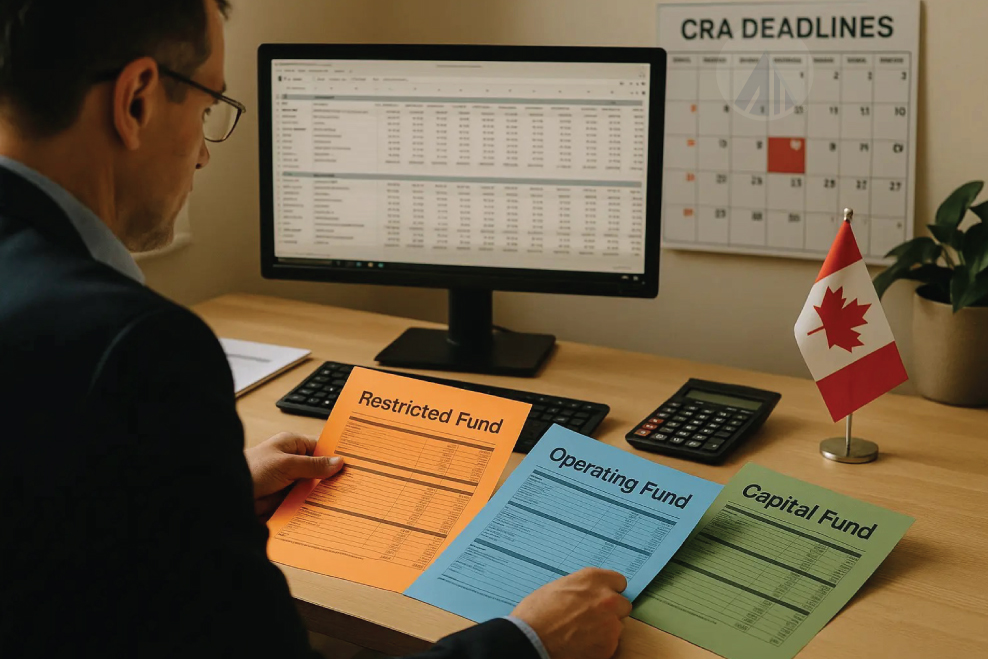
Fund accounting is a specialized system that separates a charity’s finances into distinct categories or “funds.” Each fund has its own purpose and restrictions. This system ensures proper tracking and compliance with donor requirements and regulatory obligations.
Canadian charities managing multiple funding sources with different restrictions need more than traditional accounting methods. This system becomes essential when organizations receive restricted grants, earmarked donations, or set aside funds for specific initiatives. Without proper fund accounting, charities risk misusing restricted funds and losing their charitable status.
This guide examines Canada Revenue Agency requirements, accounting standards for not-for-profit organizations, and practical implementation tools. Understanding these principles helps organizations maintain compliance while building trust with donors and communities they serve.
Fund Accounting Principles for Canadian Charities
Fund accounting forms the foundation for charity financial management in Canada. We separate money based on donor-imposed restrictions and internal policies.
This system ensures charities track unrestricted funds, restricted funds, and endowment funds according to specific rules that protect donor trust.
Purpose of Fund Accounting in Charities
Fund accounting helps Canadian charities manage different types of money separately. We use this system to track funds with specific rules about spending.
Accountability and Transparency This method shows donors and the public how we use their money. Each fund operates like its own account with balanced debits and credits.
Legal Compliance Canadian charities must follow strict rules about restricted funds. Fund accounting helps us prove we use money correctly according to donor wishes and government rules.
Financial Reporting We can create clear reports that show different fund categories. This makes it easier for board members, donors, and regulators to understand our financial health.
The system protects donor trust by ensuring restricted donations go only toward their intended purpose.
Key Elements of Fund Accounting
Fund accounting requires specific components that work together. We organize our finances using these essential elements.
Self-Balancing Accounts Each fund maintains its own set of accounts where debits equal credits. This creates a complete financial picture for every fund category.
Separate Record Keeping We track income, expenses, and assets separately for each fund. This prevents mixing restricted money with general operating funds.
Fund Transfers Sometimes we need to move money between funds following specific rules. These transfers must be properly documented and legally allowed.
Net Asset Classification We classify net assets based on restrictions rather than just total amounts. This shows what money is available for different purposes.
Types of Funds: Restricted, Unrestricted, and Endowment
Canadian charities typically manage three main fund types. Each type has different rules and purposes.
Unrestricted Funds These funds have no donor-imposed restrictions on their use. We can spend this money on any charity purpose including:
- General operations
- Administrative costs
- Program activities
- Emergency expenses
Restricted Funds Donors or government grants create specific spending rules for these funds. Common restrictions include:
- Purchasing specific items only
- Supporting particular programs
- Geographic limitations
- Time-based requirements
Endowment Funds These funds preserve the original donation amount permanently. We invest the principal and use only the investment income for charity work.
The principal amount stays intact while earnings support our mission over time.
Want to better understand fund accounting for charities in Canada? To learn more about restricted funds, check out our practical guide for nonprofits.
Legal and Regulatory Requirements
Canadian charities must follow strict legal rules when using fund accounting. The Canada Revenue Agency sets these rules through the Income Tax Act and requires specific reporting methods.
Charitable Registration and Status
We must register with the Canada Revenue Agency to operate as a charity in Canada. This registration gives us charitable status under the Income Tax Act.
The CRA reviews our application to make sure we meet all requirements. We need to show that our purpose helps the public and that we have proper governance structures. The CRA outlines the roles and responsibilities of directors and board members, which charities should follow to maintain good governance and accountability.
Once registered, we get a charity number. This number lets donors claim tax receipts for their gifts, and we must display it on all official documents.
Key requirements for registration:
- Clear charitable purpose
- Public benefit activities
- Proper board structure
- Financial accountability systems
We can lose our charitable status if we break the rules. The CRA can revoke registration for serious violations.
Regulations from the Canada Revenue Agency
The CRA sets specific rules for how we track and report our funds. We must keep detailed books and records for all financial activities. For more detailed guidance on acceptable fundraising practices and regulatory expectations, the CRA provides a comprehensive Fundraising Guidance for Registered Charities.
Required record-keeping includes:
- All donation receipts and records
- Bank statements and financial transactions
- Board meeting minutes
- Expense tracking by fund type
We must file our Annual Information Return (Form T3010) every year. This form shows how we used our funds during the fiscal year.
The CRA can audit our records at any time. During audits, they check if we properly separated restricted and unrestricted funds.
We must spend a minimum amount on charitable activities each year. The CRA calls this the “disbursement quota.”
The Income Tax Act and Related Legislation
The Income Tax Act is the main law that governs Canadian charities. It defines what counts as a charitable organization and sets our legal duties.
The Act requires us to:
- Use funds only for charitable purposes
- Keep separate accounting for restricted donations
- File annual returns on time
- Maintain proper financial controls
Section 149.1 of the Act outlines the specific rules for registered charities. This section explains how we must handle different types of funds.
We must follow the disbursement quota rules under the Act. This means spending at least 3.5% of our investment assets each year on charitable activities.
The Act also sets penalties for non-compliance. These can include fines, suspension of receipting privileges, or loss of charitable status.
Financial Reporting Obligations
Canadian charities must meet specific financial reporting requirements set by the Canada Revenue Agency and comply with accounting standards. These obligations include filing annual information returns and preparing detailed financial statements that show transparency and proper fund management.
Annual Information Returns (T3010 and Form T3010)
We must file Form T3010, the Registered Charity Information Return, with the CRA each year. This form is due within six months of our fiscal year-end.
The T3010 requires detailed information about our charity’s activities, finances, and governance. We need to report total revenues, expenditures, assets, and liabilities.
Key sections include:
- Financial information from our audited statements
- Details about our charitable programs and activities
- Information about directors, trustees, and key staff
- Compensation details for employees earning over $40,000
Missing the T3010 deadline can result in penalties or loss of charitable status. We must also make this return publicly available through the CRA’s website.
The form helps the CRA monitor our compliance with charitable purposes and spending requirements.
Required Financial Statements
We must prepare annual financial statements that follow Canadian accounting standards. These statements provide a complete picture of our financial position and activities.
The four required statements are:
- Statement of Financial Position: Shows our assets, liabilities, and net assets at year-end
- Statement of Operations: Details revenues and expenses for the fiscal year
- Statement of Changes in Net Assets: Tracks changes in restricted and unrestricted funds
- Statement of Cash Flows: Reports cash receipts and payments during the year
Large charities with revenues over $500,000 typically need audited statements. Smaller organizations may prepare reviewed or compiled statements depending on provincial requirements.
Financial Statement Presentation and Disclosures
Our financial statements must clearly separate restricted and unrestricted funds to show donors how we use their contributions. We present fund information in columns or separate statements.
Required disclosures include:
- Accounting policies we follow
- Details about significant investments
- Information about government grants and major donors
- Related party transactions
We must also include notes explaining our fund accounting practices and any restrictions on net assets. Tax receipts issued during the year should be properly documented and supported by our records.
The statements must show that we spend funds according to donor restrictions and charitable purposes.
Accounting Standards and Frameworks
Canadian charities must follow specific accounting standards that differ from for-profit businesses. The Accounting Standards for Not-for-Profit Organizations (ASNPO) provides the main framework. CPA Canada oversees implementation and guidance.
Overview of ASNPO for Charities
The Accounting Standards for Not-for-Profit Organizations (ASNPO) serves as the primary accounting framework for Canadian charities. We find this standard under Part III of the CPA Canada Handbook.
ASNPO focuses on accountability and transparency in financial reporting. This approach helps charities show donors and stakeholders how they use funds.
Key features of ASNPO include:
- Fund accounting requirements for restricted donations
- Revenue recognition rules specific to charitable giving
- Guidelines for reporting contributions and grants
- Standards for financial statement presentation
The framework requires charities to separate restricted and unrestricted funds clearly. We see this separation in financial statements through different fund categories.
ASNPO also addresses how charities should handle donated goods and volunteer services. These non-cash contributions need proper valuation and recording.
Role of CPA Canada and Other Regulatory Bodies
CPA Canada develops and maintains the ASNPO standards that govern charity accounting. We rely on their guidance for interpreting complex accounting situations.
The organization provides several resources for charities:
- Technical guidance documents on specific accounting issues
- Training materials for charity financial staff
- Updates on standard changes and new requirements
Canada Revenue Agency (CRA) also plays a key role in charity oversight. They require specific financial information in annual filings that must align with ASNPO standards.
Provincial regulators add another layer of requirements. Each province may have additional reporting rules for registered charities operating in their jurisdiction.
We often see coordination between these bodies to ensure consistent standards. This cooperation helps charities understand their obligations across different regulatory frameworks.
Financial Management and Internal Controls
Strong financial management requires proper budgeting, clear policies, and robust internal controls to protect charitable assets. These systems help Canadian charities maintain compliance and build donor trust through transparent operations.
Budgeting and Financial Policies
We must create detailed budgets that align with our charitable mission and fund restrictions. Annual budgets should separate restricted and unrestricted funds clearly.
Board-approved financial policies guide our daily operations. These policies cover spending limits, approval processes, and fund management rules.
Key Financial Policies Include:
- Expense approval thresholds
- Investment guidelines
- Reserve fund targets
- Donor stewardship procedures
We should review budgets monthly and compare actual results to projections. This helps us spot problems early and make necessary adjustments.
Financial policies must address how we handle different fund types. Restricted funds need separate tracking to ensure compliance with donor requirements.
Implementing Internal Controls
Internal controls protect our organization from fraud and errors.
We separate duties wherever possible to reduce risks.
Essential Control Areas:
- Cash handling:
Different people collect, deposit, and record money. - Cheque processing:
One person authorizes, while another signs cheques. - Bank reconciliation:
An independent person reviews all accounts monthly.
We match daily deposits to bank statements and donation records.
Receipt books and our accounting system track all incoming funds.
Purchasing controls require written approval for expenses above set limits.
We add protection by requiring multiple signatures on large cheques.
We document all financial procedures clearly.
Staff training helps everyone understand their role in maintaining these controls.
Audits and Working with Auditors
Annual audits verify our financial statements independently.
We prepare by organizing records and resolving outstanding issues.
Auditors review our fund accounting and internal controls.
They check that we use restricted funds properly and keep accurate statements.
Audit Preparation Steps:
- Gather all financial records.
- Prepare fund reconciliations.
- Document internal control procedures.
- Review board meeting minutes.
We work with our auditors throughout the process.
Quick responses to requests help keep audit costs down and timelines on track.
The audit report supports our public accountability.
Clean audit opinions build donor and funder confidence.
Tools, Best Practices, and Emerging Topics
Canadian charities need reliable systems and current knowledge to manage fund accounting well.
Modern software, good record-keeping, and ongoing training form the foundation for strong financial management.
Effective Record-Keeping Practices
Strong record-keeping starts with organizing documents by fund type and purpose.
Create separate filing systems for restricted grants, unrestricted donations, and internally designated funds.
Digital storage works best for most organizations.
Scan receipts, grant agreements, and donor correspondence right away.
Use clear file names like “2025-Grant-HealthCanada-Invoice001.”
Essential records to maintain:
- Donation receipts with tax numbers
- Grant agreements and reporting requirements
- Board resolutions for internal restrictions
- GST/HST documentation
- Monthly bank reconciliations
Track donor restrictions in a simple spreadsheet.
List each restricted fund, its purpose, and spending rules.
Update the document whenever you receive new restricted donations or grants.
Keep records for at least seven years.
The Canada Revenue Agency requires this for tax purposes, and some grants may require longer retention.
Accounting Software for Non-Profits
Specialized non-profit accounting software handles fund accounting better than general business programs.
These systems track multiple funds and generate required charity reports.
Popular options for Canadian charities:
- QuickBooks Non-profit:
Good for smaller organizations, handles basic fund tracking. - Sage Intacct:
Advanced features for larger charities, strong reporting tools. - Aplos:
Designed for non-profits, includes donor management. - Blackbaud Financial Edge NXT:
Comprehensive for complex organizations.
Choose software that separates funds automatically.
The system should create different accounts for restricted and unrestricted money.
GST/HST tracking is crucial.
Select software that handles tax calculations for different revenue types.
Some donations are tax-exempt, but program fees may require GST/HST.
Cloud-based systems work well for charities.
Multiple staff can access records safely, and automatic backups protect against data loss.
Professional Development and Workshops
Non-profit accounting rules change often.
We need ongoing training to stay current with regulations and best practices.
The Chartered Professional Accountants of Canada offers workshops for charity accounting.
These sessions cover fund accounting, tax compliance, and reporting requirements.
Key training topics to prioritize:
- Annual regulatory changes
- Grant reporting requirements
- New accounting standards
- Technology updates
Local non-profit associations offer affordable workshops.
Many provinces have charity councils that provide training throughout the year.
Online courses offer flexible learning options.
The Canadian Association of Gift Planners provides webinars on donation processing and tax receipting.
Budget for training costs each year.
Well-trained staff make fewer errors and save money long-term.
Trends and Innovation in Charity Accounting
Automation is changing how we handle routine tasks.
Modern software can categorize donations and generate monthly reports automatically.
Artificial intelligence speeds up data entry.
Some programs read invoices and enter information directly into accounting systems.
This reduces errors and saves time.
Real-time reporting gives better financial control.
Board members can access current data anytime through secure dashboards.
Emerging technology trends:
- Mobile expense tracking apps
- Automated bank reconciliation
- Digital receipt processing
- Cloud-based collaboration tools
Data security is more important as we store information online.
Two-factor authentication and encrypted storage protect donor information.
System integration improves efficiency.
Donation management software now connects directly with accounting programs.
This eliminates duplicate data entry.
Grant management tools are more advanced now.
These systems track application deadlines, reporting, and spending for multiple grants.
Tax Considerations for Canadian Charities
Charities in Canada must issue proper donation receipts, manage GST/HST, and handle different funding sources.
Each area needs specific knowledge to stay compliant with Canada Revenue Agency rules.
Handling Donations and Issuing Tax Receipts
When we receive donations, we issue official receipts that meet CRA requirements.
These receipts let donors claim tax credits on their tax returns.
Receipt Requirements:
- Include our registered charity number
- Show the donation amount and date
- Include donor’s name and address
- Display our organization’s name and address
We issue receipts only for eligible gifts.
Cash donations and some property gifts qualify.
We cannot receipt payments for services, goods, or membership fees.
Non-cash donations need special attention.
We determine fair market value at the time of donation.
For items over $1,000, we get a professional appraisal.
We keep detailed records of all donations.
The CRA requires us to keep these records for at least two years after we lose charitable status.
GST/HST Compliance
Most charities can claim GST/HST rebates on eligible purchases.
We recover 50% of GST/HST paid on most goods and services used in our activities.
Rebate Process:
- File Form GST66 every two years
- Include supporting receipts and invoices
- Submit within four years of the purchase date
Some purchases qualify for higher rebates.
Books, medical equipment, and some building materials may get full rebates.
We register for GST/HST if our revenues exceed $50,000 a year.
Once registered, we collect GST/HST on taxable supplies and can claim full input tax credits.
Navigating Grants and Other Funding
Government grants usually do not generate taxable income for charities.
We track how we use restricted grant funds through proper fund accounting.
Grant Considerations:
- Most grants are tax-free if used for charitable purposes
- Business income from grants may be taxable
- We must meet specific reporting requirements
Corporate sponsorships may be taxable if we provide advertising or promotional benefits.
We distinguish between donations and business arrangements.
Investment income from endowment funds is usually tax-exempt.
We must spend a minimum amount each year on charitable activities based on our assets.
Disbursement Quota: We spend at least 3.5% of assets not used directly in charitable activities each year.
If we do not meet this quota, we may face penalties or lose charitable status.
Conclusion
Fund accounting serves as the foundation for effective charity management in Canada, helping organizations track restricted donations, meet legal requirements, and build donor trust. This system enables clear spending records and compliance with Canada Revenue Agency standards.
Key benefits include better financial tracking, regulatory compliance, improved donor confidence, and proper separation of restricted funds. Charities with proper fund accounting can focus on their mission while maintaining required transparency and accountability.
At Northfield & Associates, we help Canadian organizations implement compliant fund accounting systems. Book a free call to learn how we can support your charity’s financial management needs.
Frequently Asked Questions
Fund accounting raises many questions for Canadian charities.
These questions cover basic concepts, reporting standards, audit requirements, examples, accounting methods, and the purpose of this system.
What are the basics of fund accounting?
Fund accounting separates money into categories based on restrictions. Each fund tracks its own income and expenses, with restricted funds having specific spending rules from donors, grants, or the board.
What is the accounting standard for charity?
Canadian charities follow the Accounting Standards for Not-for-Profit Organizations (ASNPO). These standards require a clear separation of restricted and unrestricted funds in financial statements.
Do charities need audited financial statements in Canada?
Audit requirements vary by province and charity size. Most charities with annual revenue over $250,000-$500,000 need audited statements. Check your provincial regulations for specific thresholds.
What is an example of fund accounting?
A food bank receives $50,000 in restricted government grants, $20,000 in general donations, and sets aside $10,000 for building repairs. Each creates a separate fund with its own tracking and reporting.
What are the methods of fund accounting?
Two primary methods: restricted fund method (creates separate funds) and deferral method (records as deferred revenue). Most Canadian charities use the restricted fund method for clearer tracking.
What is the primary purpose of fund accounting?
To ensure donations and grants are used for their intended purposes while maintaining compliance with donor agreements and regulations. It provides clear financial tracking and stakeholder transparency.
| Ready for better nonprofit reporting? |
| At Northfield & Associates, we have a team of professional bookkeepers and accountants to help your organization manage the books so that you can breeze through tax season. |
| GET IN TOUCH |
What We Do!
We’re often asked by prospective clients what our Bookkeeping Service covers? People want to know what specific tasks we do, and what their responsibility is. This brief explainer page will answer that question. This is by no means an exhaustive list, but covers the most frequently asked questions.
Getting Started
- Review your existing books for needed corrections or back-work
- Chart of accounts setup or amendment
- Assistance with setting up bank feeds
- Limited assistance* with setting up payroll (QBO or Gusto only)
- Your books brought current and reconciled if needed
Ongoing Monthly Bookkeeping
- After-the-fact transaction recording
- Post to general ledger
- Post to other ledgers (as needed)
- Bank account reconciliation
- Monthly financial statements
- Other bookkeeping services, as required
- Best-practice bookkeeping advice and counsel
Year End
- Assistance with 1099-NEC preparation*
- Assistance with 1099-MISC preparation*
- Year-end financial statements and period-end closing
What We Don’t Do
Pay bills
We do not offer bill-pay services at this time, nor do we manage Accounts Payable (AP) or Accounts Receivable (AR).
Payroll tax responsibility
Our bookkeepers can assist you in setting up your initial payroll service in QBO or Gusto. We are not responsible for entering payroll hours/salary, accruing payroll taxes, nor the transmittal of payroll taxes to the IRS or the state. Your full-service payroll provider (QBO, Gusto, or whatever other service a client uses) will be the responsible party for payroll and payroll tax compliance.
*Payroll deductions and benefits
We provide assistance with setting up a payroll account in either Quickbooks Online or Gusto, including entry of employee data. We do not assist in state registrations, benefits, or advise on deductions. Those service areas are provided directly by either QBO or Gusto.
Preparation of W2s
Similar to the last item, your full-service payroll provider (QBO/Gusto) is responsible for preparation of Form W2 for employees.
Sales tax reporting
For those nonprofits that sell taxable goods and/or services, your bookkeeper will assist in accounting for sales taxes collected and transmitted, but we do not prepare state sales tax reports.
Donation recording
We do not provide individual donation data entry into your neither your donor CRM nor Quickbooks Online, nor do we prepare year-end donor acknowledgements.
Administrative tasks
We cannot provide administrative services unrelated to our bookkeeping function.
Attend board meetings
Due to the constraints of time and distance, we are unable to be present, physically nor virtually, at a meeting of a client’s board of directors.*May incur additional fee per 1099-NEC or 1099-MISC.
| Let’s Collaborate & Make a Difference! |
| Partner with us to amplify your mission. Whether it’s Charity accounting, financial transparency, or strategic growth—we’re here to help you create meaningful impact. Let’s work together to build a better future! |
| Book a Call |
Contact us today to schedule your consultation.
Working with Our Firm
In this evolving economic landscape, collaboration with our firm offers clients a strategic advantage. With Cambodia’s reform-driven investment environment and Canada’s expanding footprint in Southeast Asia, our team of experienced consultants and legal advisors provides tailored guidance to help businesses navigate cross-border opportunities. We focus in developing comprehensive legal strategies, structuring international partnerships, and ensuring compliance in emerging markets.
By leveraging our regional insight and international expertise, you benefit from a trusted partner dedicated to helping you capitalize on growth potential in Cambodia and beyond.
| Book a Consultation with Northfield & Associates |
| Your Trusted Partner in International Bilateral Relations |
At Northfield & Associates are focus in Foreign Direct Investment (FDI), international trade missions, and cross-border legal strategy. Our team of experienced consultants and legal advisors offers tailored guidance and strategic insight to help you navigate the complexities of international partnerships and development opportunities.
Whether you choose to meet in person at one of our offices or connect virtually, we provide flexible and accessible consultation options. During your session, we’ll assess your goals, review key documentation, and guide you through every stage of your FDI or trade mission engagement.
Let us help you take the next step with confidence supported by trusted legal and strategic counsel every step of the way.
| Northfield & Associates |
| Advancing Global Partnerships, Together. |
Take the First Step Today
If you believe you may be eligible for legal relief or simply need sound legal advice, we’re here to help. Contact us today to book your consultation. Let us provide the clarity, strategy, and peace of mind you need to move forward.
Disclaimer: The information contained in this article is provided for general information purposes only and does not constitute legal or other professional advice. Readers should seek tailored legal advice in relation to their personal circumstances.
We serve our clients in English, Cambodian, Vietnamese, Mandarin and Cantonese, especially in Asian clients.
- If you or anybody that you know, think that you meet the requirements and wish to receive further information.
- We can help you start the application process and confirm eligibility requirements to participate.
- We Offer Consultations & Meetings by Phone & Virtually. Affordable Fees.
| Book a Consultation Today |
| Contact Northfield & Associates today to schedule a consultation with an experienced Consultant. |
| Book a call with a Consultation |
| Join the community of Northfield & Associates |
| Connect with peers and community ambassadors to hear real experiences, tips, and advice about studying abroad. |
| Explore Northfield & Associates community |
About Northfield
Northfield & Associates International Corporation is a global consulting firm serving private enterprises, public institutions, not-for-profit organizations, and institutional capital providers. Operating across Cambodia, Canada, and global markets, the firm supports capital deployment, regulatory navigation, and enterprise decision-making in complex economic and geopolitical environments. Northfield & Associates delivers customized, execution-focused advisory solutions that drive measurable transformation, strengthen competitiveness, and enhance long-term highest value opportunities. The firm incorporates consulting, legal, regulatory, financial, and risk expertise to enable disciplined capital allocation, strong governance, and operational resilience. Northfield & Associates upholds a culture of applied insight and innovation, supporting clients across digital transformation, growth strategy, and organizational capability building. The firm advises individual, leading global corporations, midsize enterprises, government agencies, and mission-driven organizations through long-term partnerships. Enterprise-wide risk management, professional ethics, and fiduciary standards are embedded across all operations. Northfield & Associates’ diverse, globally unified teams are committed to execution certainty and sustainable, risk-adjusted returns aligned with ESG and stakeholder objectives.
Forward-Looking Information
This news release contains forward-looking information. All statements, other than statements of historic fact, that address activities, events or developments that the Company believes, expects or anticipates will or may occur in the future constitute forward-looking information.
This forward-looking information reflects the current expectations or beliefs of the Company based on information currently available to the Company.
Forward-looking information is subject to a number of risks and uncertainties that may cause the actual results of the Company to differ materially from those discussed in the forward-looking information, and even if such actual results are realized or substantially realized, there can be no assurance that they will have the expected consequences to, or effects on the Company. Factors that could cause actual results or events to differ materially from current expectations include, among other things: the failure to finalize negotiations concerning the increase of the Loan or to close such transaction and the failure of the Company to complete the acquisition of the Company Facility; operating performance of facilities; environmental and safety risks; delays in obtaining or failure to obtain necessary permits and approvals from government authorities; unavailability of plant, equipment or labour; inability to retain key management and personnel; changes to regulations or policies affecting the Company’s activities; and the other risks disclosed under the heading “Risk Factors” and elsewhere in the Company’s amended annual information.
Forward-looking information speaks only as of the date on which it is made and, except as may be required by applicable securities laws, the Company disclaims any intent or obligation to update any forward-looking information, whether as a result of new information, future events or results or otherwise. Although the Company believes that the assumptions inherent in the forward-looking information are reasonable, forward-looking information is not a guarantee of future performance and accordingly undue reliance should not be put on such information due to the inherent uncertainty therein.
Questions?
info@northfied.biz
Within Corporate Newsroom
Media Contact:
media@northfied.biz
Press contact
PR consultants
press@northfied.biz
NOT LEGAL ADVICE. Information made available on this website in any form is for information purposes only. It is not, and should not be taken as, legal advice. You should not rely on, or take or fail to take any action based upon this information. Never disregard professional legal advice or delay in seeking legal advice because of something you have read on this website. Northfield & Associates professionals will be pleased to discuss resolutions to specific legal concerns you may have.