
Categories
Business News Government Contracting & Public Sector Legal News Northfield News

What Is a T3010 Form, When Is It Due, and Where to Send or Mail It in Canada?

What Is a T3010 Form, When Is It Due, and Where to Send or Mail It in Canada?

Are you aware of the risks your charity faces if you file your annual return late or incorrectly? Filing the T3010 Registered Charity Information Return is not just a routine task; it’s essential for keeping your charitable status active with the Canada Revenue Agency (CRA).

This article explains what a T3010 form is, how to submit it, when it’s due, and what can happen if it’s not filed on time. We’ll also go over the key steps to make sure your return is complete and accurate.

1. What Is a T3010 Form?

If you’re asking, “What is a T3010 form?”, it’s the annual report that all registered charities in Canada must send to the CRA. This form includes:

  • Information about your charity’s financesleadership, and activities
  • A breakdown of your programs and how donations are used
  • Lists of directorsdonations to other charities, and fundraising details

Think of the T3010 as your charity’s yearly report card to the government. It’s used by the CRA to make sure you still meet the requirements for charitable status in CRA records.

2. Who Must File a T3010 Form in Canada?

Every registered charity in Canada must file a T3010 form with the CRA, regardless of size, revenue, or activity level.

Organizations Required to File:

  • All registered charities with an active registration number
  • New charities must file starting from their first fiscal year after registration
  • Inactive charities that had no financial activity still must file
  • Charitable organizationspublic foundations, and private foundations

Who Does NOT File a T3010:

  • Non-profit organizations without charitable registration (they file Form T1044 instead)
  • For-profit businesses, even if they support charitable causes
  • Religious organizations that are not registered as charities

Special Cases:

  • Foreign charities operating in Canada through a registered entity must file
  • Amalgamated charities must file in the year of amalgamation
  • Dissolved charities must file a final return

If you’re unsure whether your organization needs to file a T3010 or a T1044, check our comparison guide for clarification.

3. How to Access and Download Your T3010 Form

The CRA provides multiple ways to access the T3010 form:

Option 1: File Online (Recommended)

  • Log in to My Business Account or Represent a Client portal at canada.ca
  • Navigate to “File a return” under your charity’s account
  • Complete the form directly in the online portal
  • Submit electronically and receive instant confirmation

Option 2: Download Fillable PDF

  • Visit the CRA website at canada.ca/charities-giving
  • Search for “T3010 Registered Charity Information Return”
  • Download the fillable PDF version
  • Complete offline and mail to CRA

Accessing Previous Returns:

You can view past T3010 returns through:

  • Your My Business Account (last 10 years available)
  • Written request to the Charities Directorate
  • Public registry at canada.ca/charities-listings (T3010 returns are public documents)

Saving Your Work:

If filing online, the portal automatically saves your draft. You can return to complete it before the deadline.

4. When Is the T3010 Due?

You must submit your T3010 return within six months after your charity’s fiscal year-end.

Example: If your year ends on December 31, your T3010 is due by June 30 of the next year.

Missing the deadline can lead to serious consequences.

5. T3010 Filing Deadlines by Fiscal Year-End

Use this quick reference table to find your charity’s filing deadline:

Fiscal Year-EndT3010 Due DateReminder
January 31July 31File by end of July
February 28/29August 31File by end of August
March 31September 30File by end of September
April 30October 31File by end of October
May 31November 30File by end of November
June 30December 31File before year-end
July 31January 31 (next year)File by end of January
August 31February 28/29 (next year)File by end of February
September 30March 31 (next year)File by end of March
October 31April 30 (next year)File by end of April
November 30May 31 (next year)File by end of May
December 31June 30 (next year)File by end of June

Important: If your filing deadline falls on a weekend or statutory holiday, the CRA considers your return on time if filed the next business day.

6. How Do I Submit My T3010 to CRA?

There are two main ways to submit your T3010 return:

Online Submission (Preferred Method)

  • Log in through CRA’s My Business Account or the Represent a Client portal
  • Upload the required documents, including financials, Form T1235, and Form T1236
  • Receive instant confirmation of submission
  • Track your filing status online

Mail Submission

If you’re wondering where to mail the T3010 form, use this address:

Charities Directorate
Canada Revenue Agency
105 – 275 Pope Road
Summerside PE C1N 6E8
Canada

Mailing Tips:

  • Send via registered mail or courier for proof of delivery
  • Allow extra time for mail processing (mail submissions take 10-12 weeks vs. 6-8 weeks for online)
  • Keep copies of everything you send

Both methods are accepted, but CRA prefers online filing because it’s faster and reduces errors.

7. Required Documents for a Complete T3010 Return

When filing your T3010, make sure to include:

  • Financial Statements matching your declared fiscal year (audited, reviewed, or compiled depending on your revenue)
  • Form T1235 – Directors/Trustees and Like Officials Worksheet (include names, birthdates, postal codes, and relationships)
  • Form T1236 – Qualified Donees Worksheet/Amounts Provided to Other Organizations (list donations to other registered charities or qualified donees with registration numbers)

Additional Documents Based on Charity Size:

For charities with revenue or assets over $250,000:

  • Detailed program information
  • Additional schedules as required

For charities with revenue over $1 million:

  • Schedule 6 (Detailed financial information)
  • Schedule 5 if applicable (Compensation information)

Looking for a T3010 fillable form or a printable form? Visit the CRA’s official site for the latest version.

8. T3010 Requirements: Small vs. Large Charities

The CRA has different reporting requirements based on your charity’s annual revenue:

Small Charities (Revenue Under $250,000)

Simplified reporting includes:

  • Basic financial information in Part B
  • Section C for charitable activities
  • Section D for directors and trustees
  • Form T1235 (directors list)
  • Form T1236 (if you made donations to other charities)

Financial statement requirements:

  • Can submit internally prepared financial statements
  • No audit required

Medium Charities (Revenue $250,000 to $999,999)

Additional requirements:

  • More detailed financial reporting
  • Enhanced program descriptions
  • Complete Parts A through F
  • May need review engagement for financial statements

Large Charities (Revenue $1,000,000 or More)

Must complete:

  • All sections of the T3010
  • Schedule 6 (detailed financial information)
  • Schedule 5 (if compensation over thresholds)
  • Audited financial statements
  • Detailed breakdown of programs and expenditures

Assets Test:

Even if your revenue is low, if your total assets exceed $250,000, you must follow the reporting requirements for larger charities.

9. How to Fill Out Key Sections Accurately

Pay special attention to these sections:

Section C – Programs and General Information

  • Section C2 – Describe your charitable activities in detail (don’t just focus on fundraising events)
  • Explain who benefits from your programs
  • Describe how you deliver charitable services

Section D – Directors/Trustees and Like Officials

  • List all current directors as of fiscal year-end
  • Include complete information (legal names, addresses, birthdates)
  • Note any relationships between directors

Section E – Certification

  • Must be signed by a director, trustee, or similar official
  • Electronic signatures accepted for online filing
  • Ensure the signatory has authority to sign

Schedule 6 (If Required)

  • Required for charities with large assets or revenue
  • Provides detailed breakdown of revenues and expenditures
  • Must reconcile with your financial statements

Other Important Lines:

  • Lines 4500–4650 – Revenue details
  • Lines 4860–4920 – Expenditure breakdown
  • Line 5000 – Total expenditures on charitable activities
  • Lines 5050–5100 – Compensation information

Common mistakes to avoid:

  • Leaving required fields blank
  • Not matching financial statement totals
  • Incomplete director information
  • Missing required schedules

Planning to file your T3010 form? Avoid costly errors by first understanding our tips on avoiding mistakes when filing your charity’s T3010 return.

10. Common T3010 Filing Mistakes and How to Avoid Them

Avoid these frequent errors that delay processing or trigger CRA reviews:

1. Incomplete Director Information

Mistake: Missing birthdates, incomplete addresses, or forgetting to note family relationships.

Solution: Complete Form T1235 carefully. Include postal codes and identify any directors related to each other by blood, marriage, or common-law partnership.

2. Financial Statement Mismatches

Mistake: Numbers on the T3010 don’t match your financial statements.

Solution: Double-check that totals reconcile. Use the same fiscal period for both documents.

3. Vague Program Descriptions

Mistake: Writing “We help people in need” or focusing only on fundraising events.

Solution: Be specific. Describe who you help, what services you provide, and how you deliver programs.

4. Missing Required Schedules

Mistake: Not including Schedule 6 when your charity meets the threshold requirements.

Solution: Review the T3010 instructions to determine which schedules apply to your charity based on revenue and assets.

5. Unsigned Returns

Mistake: Forgetting to sign and date the certification section.

Solution: Have an authorized director sign before submitting. Online submissions require electronic signature.

6. Filing for Wrong Fiscal Period

Mistake: Submitting a return for the calendar year when your fiscal year-end is different.

Solution: Always file for your charity’s actual fiscal year as registered with CRA, not the calendar year.

7. Not Including Form T1236

Mistake: Forgetting to attach the list of donations made to other qualified donees.

Solution: If your charity gave money to other registered charities or qualified donees, complete Form T1236 with their registration numbers.

8. Math Errors in Financial Sections

Mistake: Revenue and expenditure totals don’t add up correctly.

Solution: Use the online portal’s built-in calculator or have someone review your math before submitting.

9. Missing Deadlines

Mistake: Filing late because you didn’t track your deadline properly.

Solution: Set calendar reminders 2-3 months before your due date. Start gathering documents early.

11. Don’t Skip Filing (Yes, Even If Inactive)

Your charity must file a T3010 even if you had no financial activity during the year. Inactivity is not an excuse to skip filing.

What to Report for Inactive Charities:

  • Report zero revenue and zero expenditures
  • Still list all directors
  • Explain in Section C why there was no activity
  • Indicate your plans to resume operations or dissolve

The CRA needs to know your charity still exists and maintains its registration requirements.

12. What Is the Penalty for Late Filing T3010?

If you file your T3010 late or don’t file at all, your charity risks revocation and losing its registered status. This means:

  • You will no longer be able to issue official donation receipts
  • You may be subject to penalties or audits
  • Your organization will be removed from the CRA’s List of Charities
  • Donors can no longer claim tax deductions for their gifts
  • Your charity may owe taxes on its income

There’s no monetary fine for late filing, but the loss of charitable status can seriously hurt your operations and reputation.

Consequences of Revocation:

  • Immediate impact: Cannot issue tax receipts from date of revocation
  • Financial impact: Must pay taxes on revenue and assets
  • Public impact: Removed from CRA’s online charity listings
  • Donor impact: Loss of donor trust and reduced donations
  • Re-registration challenges: Difficult and costly to re-apply

13. What Happens After You File Your T3010?

Understanding the post-filing process helps you prepare for CRA’s next steps:

Processing Timeframes:

  • Online submissions: 6-8 weeks for processing
  • Mail submissions: 10-12 weeks for processing
  • Complex returns: May take longer if CRA has questions

How to Check Your Filing Status:

  1. Log in to My Business Account
  2. Select your charity’s account
  3. View “Filing status” under returns
  4. Look for confirmation that your return was accepted

What If CRA Has Questions?

The CRA may contact you if:

  • Information is incomplete or unclear
  • Financial numbers don’t reconcile
  • Program descriptions need clarification
  • Additional schedules are required

How to respond:

  • Reply promptly to any CRA correspondence
  • Provide requested information in writing
  • Keep copies of all communications
  • Contact your charity lawyer if you need guidance

Public Accessibility of T3010 Information:

Your T3010 becomes a public document after processing. Anyone can view:

  • Your charity’s revenue and expenditures
  • Director names and locations (general area, not full addresses)
  • Program descriptions
  • Donations made to other charities

This transparency builds donor trust and accountability.

How to File an Amended T3010:

If you discover an error after filing:

  1. Prepare a letter explaining the error
  2. Include corrected information or revised form
  3. Mail to the Charities Directorate
  4. Reference your charity’s registration number and fiscal year
  5. Keep a copy for your records

Note: You cannot amend a T3010 through the online portal. Amendments must be mailed with a cover letter.

14. What Are the Requirements for Charitable Status in CRA?

To keep your charitable status with the CRA, your charity must:

  • File the T3010 return every year on time
  • Operate exclusively for charitable purposes (e.g., relief of poverty, advancement of education, advancement of religion, or other purposes beneficial to the community)
  • Maintain proper financial records and books
  • Stay transparent in how donations and funds are used
  • Avoid prohibited political activities or engaging in for-profit ventures (unless it is a “related business“)
  • Issue donation receipts properly according to CRA rules
  • Spend funds on charitable activities within Canada or through qualified partners
  • Keep directors and officers in good standing

Failing to meet these rules can put your registration at risk.

Conclusion

Staying compliant with CRA rules isn’t just about avoiding penalties; it helps build trust with donors, keeps your operations running smoothly, and ensures your charity can continue to make a positive impact.

By understanding what a T3010 form is, knowing how to submit your T3010 to CRA, meeting the requirements for charitable status, and avoiding late filing penalties, your charity can stay in good standing year after year.

Need help filing your T3010 or registering your charity in Canada?

Call us today

to get experienced support.

Frequently Asked Questions

Filing your T3010 form correctly and on time is important for keeping your charity’s status with the Canada Revenue Agency (CRA). Here are answers to common questions that charity leaders ask about this yearly requirement.

Where do I send my T3010 charity return?

You can file your T3010 online through the CRA website at canada.ca or mail it to Charities Directorate, Canada Revenue Agency, 105 – 275 Pope Road, Summerside PE C1N 6E8, Canada. The CRA prefers online filing because it is faster and reduces errors.

How do I file a T3010 online?

Visit the CRA website at canada.ca, log in using your charity’s CRA account through My Business Account or Represent a Client portal, complete the T3010 form electronically, and submit it through the online portal. Online filing gives you instant confirmation that your return was received.

Where do I mail my T3010 form?

Mail your T3010 form to Charities Directorate, Canada Revenue Agency, 105 – 275 Pope Road, Summerside PE C1N 6E8, Canada. Make sure to send it early enough to arrive before your filing deadline.

What is the penalty for filing T3010 late?

There is no monetary fine for filing late, but your charity can lose its registered status. This means you cannot issue tax receipts, donors lose their tax benefits, and your charity may have to pay taxes on its income. The CRA can revoke your charitable status if you do not file on time.

When do I file my T3010?

You must file your T3010 within six months after your charity’s fiscal year ends. For example, if your fiscal year ends on December 31, your T3010 is due by June 30 of the following year.

What is the maximum fine for a late tax return?

There is no monetary fine for filing a late T3010, but the penalty is much worse. You can lose your charitable status completely, which means you cannot issue tax receipts and donors cannot claim tax deductions for their gifts. This makes filing on time very important for charities.

At Northfield & Associates our expert teams guidance on compliance requirements. Our team understands Canadian charity law and can help ensure your organisation follows proper procedures.

Get professional support today

to discuss your specific circumstances and receive expert assistance throughout the reinstatement process with our experienced legal team.


Contact To Action

Contact us today to schedule your consultation.

Northfield & Associates

Advancing Global Partnerships, Together.

Working with Our Firm

In this evolving economic landscape, collaboration with our firm offers clients a strategic advantage. With Cambodia’s reform-driven investment environment and Canada’s expanding footprint in Southeast Asia, our team of experienced consultants and legal advisors provides tailored guidance to help businesses navigate cross-border opportunities. We focus in developing comprehensive legal strategies, structuring international partnerships, and ensuring compliance in emerging markets.

By leveraging our regional insight and international expertise, you benefit from a trusted partner dedicated to helping you capitalize on growth potential in Cambodia and beyond.

Book a Consultation with Northfield & Associates

Your Trusted Partner in International Bilateral Relations

At Northfield & Associates are focus in Foreign Direct Investment (FDI), international trade missions, and cross-border legal strategy. Our team of experienced consultants and legal advisors offers tailored guidance and strategic insight to help you navigate the complexities of international partnerships and development opportunities.

Whether you choose to meet in person at one of our offices or connect virtually, we provide flexible and accessible consultation options. During your session, we’ll assess your goals, review key documentation, and guide you through every stage of your FDI or trade mission engagement.

Let us help you take the next step with confidence supported by trusted legal and strategic counsel every step of the way.

Take the First Step Today

If you believe you may be eligible for legal relief or simply need sound legal advice, we’re here to help. Contact us today to book your consultation. Let us provide the clarity, strategy, and peace of mind you need to move forward.

We serve our clients in English, Cambodian, Vietnamese, Mandarin and Cantonese, especially in Asian clients.

  • If you or anybody that you know, think that you meet the requirements and wish to receive further information.
  • We can help you start the application process and confirm eligibility requirements to participate.
  • We Offer Consultations & Meetings by Phone & Virtually. Affordable Fees.

Disclaimer:

The information contained in this article is provided for general information purposes only and does not constitute legal or other professional advice. Readers should seek tailored legal advice in relation to their personal circumstances.

Northfield & Associates

Advancing Global Partnerships, Together.

Book a Consultation Today

Contact Northfield & Associates today to schedule a FREE consultation with an experienced Consultant.

Join the community of Northfield & Associates

Connect with peers and community ambassadors to hear real experiences, tips, and advice about studying abroad.


About Northfield

Northfield & Associates International Corporation is a global consulting firm serving private enterprises, public institutions, not-for-profit organizations, and institutional capital providers. Operating across Cambodia, Canada, and global markets, the firm supports capital deployment, regulatory navigation, and enterprise decision-making in complex economic and geopolitical environments. Northfield & Associates delivers customized, execution-focused advisory solutions that drive measurable transformation, strengthen competitiveness, and enhance long-term highest value opportunities. The firm incorporates consulting, legal, regulatory, financial, and risk expertise to enable disciplined capital allocation, strong governance, and operational resilience. Northfield & Associates upholds a culture of applied insight and innovation, supporting clients across digital transformation, growth strategy, and organizational capability building. The firm advises individual, leading global corporations, midsize enterprises, government agencies, and mission-driven organizations through long-term partnerships. Enterprise-wide risk management, professional ethics, and fiduciary standards are embedded across all operations. Northfield & Associates’ diverse, globally unified teams are committed to execution certainty and sustainable, risk-adjusted returns aligned with ESG and stakeholder objectives.

Forward-Looking Information

This news release contains forward-looking information. All statements, other than statements of historic fact, that address activities, events or developments that the Company believes, expects or anticipates will or may occur in the future constitute forward-looking information.

This forward-looking information reflects the current expectations or beliefs of the Company based on information currently available to the Company.

Forward-looking information is subject to a number of risks and uncertainties that may cause the actual results of the Company to differ materially from those discussed in the forward-looking information, and even if such actual results are realized or substantially realized, there can be no assurance that they will have the expected consequences to, or effects on the Company. Factors that could cause actual results or events to differ materially from current expectations include, among other things: the failure to finalize negotiations concerning the increase of the Loan or to close such transaction and the failure of the Company to complete the acquisition of the Company Facility; operating performance of facilities; environmental and safety risks; delays in obtaining or failure to obtain necessary permits and approvals from government authorities; unavailability of plant, equipment or labour; inability to retain key management and personnel; changes to regulations or policies affecting the Company’s activities; and the other risks disclosed under the heading “Risk Factors” and elsewhere in the Company’s amended annual information.

Forward-looking information speaks only as of the date on which it is made and, except as may be required by applicable securities laws, the Company disclaims any intent or obligation to update any forward-looking information, whether as a result of new information, future events or results or otherwise. Although the Company believes that the assumptions inherent in the forward-looking information are reasonable, forward-looking information is not a guarantee of future performance and accordingly undue reliance should not be put on such information due to the inherent uncertainty therein.

Questions?

info@northfied.biz

Within Corporate Newsroom  

Media Contact:

media@northfied.biz

Press contact

PR consultants
press@northfied.biz

NOT LEGAL ADVICE. Information made available on this website in any form is for information purposes only. It is not, and should not be taken as, legal advice. You should not rely on, or take or fail to take any action based upon this information. Never disregard professional legal advice or delay in seeking legal advice because of something you have read on this website. Northfield & Associates professionals will be pleased to discuss resolutions to specific legal concerns you may have.
Categories
Business News Government Contracting & Public Sector Legal News Northfield News

What is the Cost to Register a Charity in Canada?

What is the Cost to Register a Charity in Canada?

Registering a charity in Canada is a meaningful endeavor, but it’s important to be aware of the financial responsibilities involved. From legal fees to ongoing administrative costs, understanding these expenses can help you plan effectively. In this detailed guide, we’ll explore the various costs associated with setting up a registered charity in Canada, helping you navigate the process with confidence.

Quick Cost Overview: At a Glance

Before diving into the details, here’s a snapshot of the main costs you’ll encounter when registering and maintaining a charity in Canada:

Cost CategoryOne-Time CostsAnnual Costs
Legal Fees (Registration)$2,500 – $7,500
Incorporation$200 – $750
Accounting & Financial Statements$1,000+
T3010 Filing$1,000+
Liability Insurance$700 – $2,000
Fundraising Expenses10-15% of funds raised
Governance Costs$500 – $5,000
Software & Technology$500 – $3,000
Total Estimated Range$2,700 – $8,250$3,700 – $12,000+

Now let’s break down each of these costs in detail.

Understanding Registered Charities in Canada

Registering a charity in Canada is a meaningful endeavour, but it’s important to be aware of the financial responsibilities involved. From legal fees to ongoing administrative costs, understanding these expenses can help you plan effectively. In this detailed guide, we’ll explore the various costs associated with setting up a registered charity in Canada, helping you navigate the process with confidence.

A registered charity in Canada is an organization that is officially recognized by the Canada Revenue Agency (CRA) – Charities Directorate, allowing it to issue tax receipts for donations and benefit from tax exemptions. Registered charities must operate exclusively for charitable purposes as defined by Canadian law, and they are subject to regulatory oversight to ensure compliance with the Income Tax Act.

Upfront Costs for Charity Registration

Legal Fees for Charity Registration

To register a charity with the CRA, you must submit an Application to Register a Charity under the Income Tax Act. There is no government fee to submit this form, but many organizations seek the assistance of experienced charity lawyers or a charity law firm to ensure the application is thorough, accurate, and likely to be successful. Mistakes in the application can result in significant delays or even rejection (the CRA typically rejects over 50% of charity applications), making charity law counsel a valuable and frequently crucial investment.

What’s Included in Legal Fees?

When you hire a charity lawyer, understanding what’s covered in their fee structure is essential. Comprehensive legal services for charity registration should include:

  • Document Preparation: Drafting your governing documents, charitable purposes, and all required application materials
  • CRA Correspondence: All communication with the CRA throughout the application process, including responding to questions and requests for additional information
  • Application Review & Revisions: Multiple rounds of review and refinement to ensure your application meets CRA standards
  • Consultation Hours: Strategic advice on structuring your charity, choosing the right charitable category, and planning for compliance
  • Registration Support: Guidance from incorporation through to final CRA approval

Watch Out for Hidden Legal Costs: Some charity lawyers quote an attractive fixed fee but include significant carve-outs that can add thousands of dollars to your final bill. Common extra charges include:

  • CRA correspondence and follow-up questions ($200-$500 per response)
  • Revisions beyond a set number ($150-$300 per revision)
  • Phone consultations after initial meetings ($250-$400 per hour)
  • Document amendments during the process ($500-$1,500)

Questions to Ask Your Charity Lawyer

When selecting legal counsel for charity registration, consider asking:

(1) What is your charity registration success rate?

(2) Does your quote for legal fees include everything, including any questions relating to the charity formation and registration, as well as all correspondence with the CRA until the charity is registered (some charity lawyers quote a fixed fee, but neglect to advise that there are significant carve outs to the quote, including CRA correspondence, which can often run many additional thousands of dollars. It’s critical to ensure that the quote for charity registration includes A-Z, from incorporation through CRA Charity Registration)?; and

(3) Do you provide your charity application clients a 100% money-back guarantee of registration?

Incorporation Costs

While it’s not mandatory for all charities, many opt to incorporate to protect their directors and add a formal structure to their operations. Incorporation can be done at either the federal or provincial level.

Federal vs. Provincial Incorporation: Cost Comparison

Choosing between federal and provincial incorporation affects both your initial costs and your charity’s operational scope. Here’s what you need to know:

Federal Incorporation:

  • Online filing: $200
  • Paper filing: $250
  • Benefits: Operate across all provinces and territories, name protection nationwide, perceived credibility for national organizations
  • Best for: Charities planning multi-provincial operations or national fundraising campaigns

Provincial Incorporation Costs:

  • Ontario: $155 (online) | $175 (mail)
  • British Columbia: $100 (online) | $150 (paper)
  • Alberta: $100 (online)
  • Quebec: $163 (requires bilingual documentation, which may increase translation costs by $500-$2,000)
  • Nova Scotia: $150
  • Manitoba: $150

Important Considerations:

  • Provincial incorporation limits operations to that province without extra-provincial registration
  • Extra-provincial registration in additional provinces costs $100-$350 per province
  • Some provinces require annual corporate filings ($20-$40) in addition to CRA requirements
  • Federal corporations must file annual corporate returns ($20 online)

Cost-Saving Tip: If you’re unsure about your geographic scope, federal incorporation provides flexibility without the hassle of multiple provincial registrations later.

Ongoing Annual Costs for Registered Charities

Once your charity is registered, there are several recurring costs to consider. These expenses are essential to maintaining compliance with CRA regulations and ensuring the smooth operation of your organization.

Accounting and Financial Statements ($1,000+)

Registered charities are required to submit annual financial statements to the CRA, regardless of size. While smaller organizations with simple financials may be able to handle this internally, most charities hire professional accountants or bookkeepers. Accounting services for preparing financial statements start at $1,000 for very small charities, and rise proportionally for larger charities, depending on the complexity of the charity’s operations and volume of revenue. Larger organizations may also need to undergo audits, which could increase this cost.

T3010 Filing Costs ($1,000+)

Every registered charity in Canada must file a T3010 form (Registered Charity Information Return) annually. This form details the charity’s financial activities and ensures compliance with CRA rules. While smaller organizations may handle this task internally, many charities choose to hire an accounting firm, with costs starting at $1,000.

Fundraising Expenses (10-15% of Funds Raised)

Fundraising is a key part of any charity’s financial plan, but it also comes with costs. Whether your charity relies on events, professional fundraisers, online donations, or direct mail campaigns, it’s essential to budget for fundraising expenses. These costs can vary significantly depending on the method used but generally range between 10% to 15% of the total funds raised. For example, organizing a charity gala may involve renting a venue, hiring staff, and producing marketing materials, all of which contribute to the fundraising budget.

Governance and Board Meeting Costs ($500 – $5,000)

Strong governance is vital for any charity’s success. This includes maintaining an active board of directors, holding regular meetings, and ensuring that all necessary governance documents are up to date. Depending on the size of the charity, these governance costs could range from $500 to $5,000 per year, including expenses such as meeting room rentals, travel reimbursements for board members, and filing fees for updating incorporation documents.

Liability Insurance ($700 – $2,000)

Liability insurance is often necessary for charities, especially those running public programs or events. The cost of insurance can vary depending on the nature of the charity’s activities, with most organizations spending between $700 and $2,000 per year on basic coverage.

Additional Operating Costs to Consider

In addition to the primary costs mentioned above, charities may incur other expenses depending on their specific needs and operations.

Software and Technology ($500 – $3,000)

Many charities rely on software to manage donors, track finances, and automate their communications. Popular options like donor management software, accounting programs, and customer relationship management (CRM) tools can cost between $500 and $3,000 annually, depending on the size of the organization and the features required.

Staff Training and Professional Development ($100 – $1,000 per person)

Investing in staff training is essential to keep up with evolving regulations and best practices. Charities often provide professional development opportunities for their team members, which may include attending conferences, workshops, or online courses. Training costs can range from $100 to $1,000 per staff member annually.

Office Space and Utilities ($500 – $10,000)

If your charity requires physical office space, rent and utilities can be significant expenses. While some smaller charities operate out of home offices or shared spaces, others may require dedicated office space, with costs ranging from $500 to $10,000 annually, depending on the location and size.

Hidden Costs Many Charities Overlook

When budgeting for your charity, don’t forget these often-overlooked expenses that can catch new organizations off guard:

Translation Services (Quebec & Bilingual Requirements) — $500 – $2,000

Charities operating in Quebec or providing services in both official languages need bilingual documentation. This includes:

  • Governing documents and bylaws translation
  • Fundraising materials in both English and French
  • Website content translation
  • Annual reports and public communications

Professional translation services for charity documents typically cost $0.15-$0.25 per word, with full document packages ranging from $500 to $2,000.

CRA Audit Response Legal Fees — $3,000 – $10,000

If the CRA selects your charity for an audit or compliance review (which happens to approximately 1 in 10 charities over a five-year period), you’ll likely need legal representation. Costs include:

  • Reviewing CRA audit letters and information requests
  • Preparing comprehensive responses
  • Representing your charity in discussions with the CRA
  • Implementing recommended changes

Budget for $3,000-$10,000 in legal fees if your charity faces a CRA audit.

Amendment Fees (Changing Purposes or Structure) — $500 – $3,000

As your charity evolves, you may need to amend your governing documents or charitable purposes. This requires:

  • Legal review and document drafting: $500-$1,500
  • CRA approval process support: $500-$1,000
  • Provincial corporate filing fees: $50-$200
  • Legal correspondence with CRA: $500-$1,500

Total amendment costs typically range from $500 to $3,000, depending on complexity.

Bank Fees and Payment Processing — 2-3% of Donations

Don’t forget the ongoing costs of accepting donations:

  • Credit card processing fees: 2.5-3% per transaction
  • Monthly bank account fees: $15-$50 for charity accounts
  • Online donation platform fees: 2-5% plus $0.30 per transaction
  • Cheque printing and bank drafts: $50-$200 annually

For a charity receiving $50,000 in donations annually, expect $1,000-$1,500 in banking and processing fees.

Website Hosting, Domain, and Maintenance — $200 – $1,000/year

A professional online presence is essential for credibility and fundraising:

  • Domain registration: $15-$50/year
  • Website hosting: $100-$400/year
  • SSL certificate (security): $0-$100/year (often free)
  • Website maintenance and updates: $0-$500/year
  • Email hosting (professional addresses): $60-$150/year

Budget $200-$1,000 annually depending on your website’s complexity.

Legal Compliance and Policy Updates — $500 – $2,000

Laws change, and your charity needs to stay compliant:

  • Annual policy reviews and updates
  • Privacy policy compliance (PIPEDA)
  • Employment law updates
  • Contract reviews for partnerships or leases
  • Legal advice on new activities or programs

Annual legal compliance work typically costs $500-$2,000 for established charities.

Cost-Saving Strategies for New Charities

Starting a charity on a limited budget? Here are proven strategies to reduce your initial and ongoing costs:

1. Start with Federal Incorporation

Federal incorporation costs slightly more upfront ($200 vs. $100-$155 provincially) but saves money long-term if you plan to operate in multiple provinces. Registering extra-provincially in each province later costs $100-$350 per province.

2. Use Free or Low-Cost Software Initially

Many software providers offer discounted or free plans for nonprofits:

  • Google Workspace for Nonprofits: Free (email, cloud storage, collaboration tools)
  • Microsoft 365 for Nonprofits: Free or heavily discounted
  • Canva for Nonprofits: Free design tool
  • Mailchimp: Free up to 500 subscribers
  • Wave Accounting: Free accounting software

Upgrade to paid versions as your charity grows and requires advanced features.

3. Leverage Volunteer Expertise

Recruit board members and volunteers with professional skills:

  • Accountants or bookkeepers for financial statement preparation
  • Lawyers for contract reviews and basic legal questions
  • Marketing professionals for fundraising campaigns
  • IT specialists for website and tech support

Important: While volunteers can help with routine tasks, always use licensed professionals for CRA submissions, charity registration, and audits.

4. Apply for Start-Up Grants

Several organizations provide grants specifically for charity start-up costs:

  • Community foundations often have capacity-building grants ($1,000-$5,000)
  • Provincial government programs support social enterprises and nonprofits
  • Corporate sponsorships may cover incorporation or registration costs
  • National organizations like Community Foundations of Canada offer support

Research grants available in your province or sector.

5. Consider Fiscal Sponsorship Temporarily

If registration costs are prohibitive, work under an existing charity’s umbrella through fiscal sponsorship:

  • Benefits: Immediate tax receipt issuing, lower overhead, mentorship, shared services
  • Costs: 5-15% administrative fee on donations received
  • Timeline: Use fiscal sponsorship while saving for full registration (typically 1-2 years)

Once you’ve built capacity and funding, transition to independent registration.

6. Bundle Services for Better Rates

Many charity service providers offer package deals:

  • Combined incorporation + registration: Save $500-$1,000
  • Annual accounting + T3010 filing: Save $200-$500
  • Multi-year retainer agreements with lawyers: Save 10-20%

Ask potential service providers if they offer bundled pricing.

7. Join Sector Associations for Resources

Membership in charity sector associations provides:

  • Discounted legal and accounting services
  • Free templates and policy documents
  • Training webinars and workshops
  • Networking and mentorship opportunities

Examples:

  • Imagine Canada
  • Ontario Nonprofit Network
  • Provincial nonprofit associations

Membership fees ($100-$500/year) often pay for themselves through savings on services and resources.

Timeline: What to Expect During the Registration Process

Understanding the registration timeline helps you plan effectively and budget for the entire journey:

Month 1-2: Preparation Phase

  • Initial consultations with lawyers
  • Drafting governing documents
  • Defining charitable purposes
  • Establishing board of directors
  • Costs incurred: Initial legal fees, incorporation fees

Month 3-4: Application Submission

  • Final application review
  • CRA submission
  • Await initial CRA response
  • Costs incurred: Remaining legal fees

Month 5-9: CRA Review Period

  • CRA reviews application
  • Potential questions or requests for clarification
  • Lawyer responds to CRA inquiries
  • Costs incurred: None if comprehensive legal package; $200-$500 per response if not included

Month 10-12: Final Approval

  • CRA issues registration approval
  • Charity number assigned
  • Begin operations as registered charity
  • Costs incurred: Initial annual costs begin (insurance, bank accounts, etc.)

Total Timeline: 6-12 months on average, though complex applications may take longer.

Conclusion

Setting up a registered charity in Canada involves a range of costs, from initial legal fees to ongoing expenses for compliance and governance. By planning ahead and understanding these costs, you can ensure your charity is financially prepared for both the registration process and long-term operations.

Total Initial Investment: Expect to invest $2,700 to $8,250 in your first year for incorporation, legal fees, and initial setup costs.

Annual Operating Costs: Budget $2,500 to $12,000+ annually depending on your charity’s size and complexity.

While the financial commitment may seem substantial, the benefits of charitable status—including tax exemptions and the ability to issue donation receipts to donors, thereby encouraging increased donations—make the investment worthwhile for most organizations.

Regional Considerations: Costs may vary by province, particularly in Quebec where bilingual documentation is required, potentially adding $500-$2,000 in translation costs. Additionally, provincial incorporation fees and annual filing requirements differ across Canada, so research your specific province’s requirements.

The registration process typically takes 6 to 12 months from application to approval, so factor this timeline into your planning and budget accordingly.

Ready to Start Your Charity? We’re Here to Help

Looking to start a charity? Contact the experienced and knowledgeable Charity Registration Lawyers at B.I.G. Charity Law Group for a streamlined, affordable and efficient charity registration.

Contact Us Today:

Phone: 416-488-5888

Email: ask@charitylawgroup.ca

Schedule a Free Consultation: Book your free, 15-minute meeting with our legal team here where we can answer all your questions about registering your charity in Canada.

Charity and Nonprofit Law: It’s all we do.

Frequently Asked Questions

How long does charity registration take in Canada?

The charity registration process typically takes 6 to 12 months from initial application submission to final CRA approval. However, timelines vary based on several factors:

  • Application complexity: Simple applications may be approved in 4-6 months, while complex structures can take 12-18 months
  • CRA workload: Processing times fluctuate based on the CRA’s backlog
  • Completeness of application: Applications requiring multiple rounds of CRA questions take longer
  • Time of year: Applications submitted in early fall may face delays due to year-end processing

Pro tip: Working with experienced charity lawyers often reduces processing time by 2-4 months because applications are complete and error-free from the start.

Can I get a refund if my charity application is rejected?

Refund policies depend entirely on your legal service provider:

  • CRA fees: The CRA doesn’t charge application fees, so there’s nothing to refund from them
  • Legal fees: Most charity lawyers do not offer refunds for rejected applications because significant work was still completed
  • Our guarantee: At B.I.G. Charity Law Group, we provide a 100% money-back guarantee if your charity application is rejected—a unique offering in the industry that reflects our confidence in our registration success rate

Always clarify refund policies in writing before engaging legal services.

Do I need a lawyer to register a charity in Canada?

No, hiring a lawyer is not legally required to register a charity. You can complete and submit the CRA application yourself at no cost.

However, legal representation is highly recommended because:

  • The CRA rejects over 50% of charity applications, often due to incomplete documentation, unclear charitable purposes, or inadequate governance structures
  • Rejected applications waste 6-12 months and require complete resubmission
  • Lawyers experienced in charity law understand CRA requirements and anticipate potential issues
  • Professional applications are typically approved faster with fewer rounds of CRA questions

Bottom line: While you can register without a lawyer, the investment in professional legal services ($2,500-$7,500) significantly increases your chances of success and saves time.

What happens if I can’t afford the registration costs?

If charity registration costs are beyond your current budget, consider these alternatives:

1. Fiscal Sponsorship Work under an existing charity’s registration for 1-2 years while building capacity. Sponsors typically charge 5-15% of donations but provide immediate tax-receipting ability.

2. Phased Approach Operate as an unincorporated nonprofit initially (no tax receipts) and transition to registered charity status once you’ve raised sufficient funds.

3. Start-Up Grants Apply for capacity-building grants from community foundations, corporate sponsors, or government programs that specifically support new nonprofits.

4. Payment Plans Some charity lawyers offer installment payment plans for registration fees, allowing you to spread costs over 6-12 months.

5. Pro Bono Services Law schools and legal clinics occasionally provide pro bono charity registration support, though availability is limited and competitive.

Are there government grants to help with registration costs?

While there’s no federal grant specifically for charity registration costs, several funding sources can help:

Provincial Programs:

  • Ontario Trillium Foundation: Seed grants for new organizations ($5,000-$75,000)
  • British Columbia Gaming Grants: Support for startup costs
  • Alberta Community Initiatives Program: Capacity building funding
  • Quebec community support programs: Various provincial initiatives

Other Funding Sources:

  • Community foundations: Often provide $1,000-$5,000 capacity-building grants
  • United Way agencies: Support for new community organizations
  • Corporate foundation programs: Many corporations fund nonprofit startup costs
  • Crowdfunding: Some organizations successfully crowdfund registration costs from supporters

Important: Most grants require either existing charity status or fiscal sponsorship, so explore fiscal sponsorship first to access grant funding.

How much does it cost to maintain charity status annually in Canada?

After registration, expect ongoing annual costs of $2,500 to $10,000+ depending on your charity’s size and complexity:

Minimum Annual Costs (Small Charity):

  • T3010 filing: $1,000
  • Accounting/financial statements: $1,000
  • Liability insurance: $700
  • Bank fees: $200-$500
  • Total minimum: ~$2,900

Mid-Size Charity Annual Costs:

  • T3010 filing: $1,500
  • Accounting/audit: $3,000-$5,000
  • Insurance: $1,500
  • Governance costs: $1,000
  • Software/technology: $1,000
  • Fundraising (10-15% of funds raised)
  • Total: ~$8,000-$12,000+

Large Charity Annual Costs:

  • Professional audit: $10,000+
  • Full-time bookkeeping staff
  • Comprehensive insurance: $3,000-$5,000
  • Legal compliance: $2,000-$5,000
  • Advanced donor management systems: $3,000+
  • Total: $20,000+

What are the costs if CRA audits my charity?

CRA audits or compliance reviews occur for approximately 1 in 10 charities over a five-year period. Costs include:

Legal Representation:

  • Initial audit response: $3,000-$5,000
  • Comprehensive audit defense: $5,000-$10,000
  • Complex compliance issues: $10,000-$25,000+

Accounting Services:

  • Document preparation and financial analysis: $1,500-$3,000
  • Restating financial statements if required: $2,000-$5,000

Administrative Time:

  • Staff time gathering documents and responding to CRA requests (50-200 hours)

Potential Penalties:

  • Penalties for non-compliance vary but can include revocation of charitable status in severe cases

Prevention is cheaper: Annual legal compliance reviews ($500-$1,500) and proper bookkeeping significantly reduce audit risk and costs.

Is GST/HST applicable to charity registration services?

Legal services are GST/HST exempt in Canada, meaning:

  • Lawyers’ fees for charity registration and legal advice are not subject to GST/HST
  • Accounting services for charities are also GST/HST exempt
  • Government filing fees (incorporation, etc.) do not include GST/HST

However, some services may include GST/HST:

  • Software subscriptions: Subject to GST/HST
  • Office supplies: Subject to GST/HST
  • Certain consulting services: May be subject to GST/HST depending on the provider’s status

When you receive quotes for charity registration services from lawyers and accountants, the prices quoted are typically final amounts without additional tax.


Contact To Action

Contact us today to schedule your consultation.

Northfield & Associates

Advancing Global Partnerships, Together.

Working with Our Firm

In this evolving economic landscape, collaboration with our firm offers clients a strategic advantage. With Cambodia’s reform-driven investment environment and Canada’s expanding footprint in Southeast Asia, our team of experienced consultants and legal advisors provides tailored guidance to help businesses navigate cross-border opportunities. We focus in developing comprehensive legal strategies, structuring international partnerships, and ensuring compliance in emerging markets.

By leveraging our regional insight and international expertise, you benefit from a trusted partner dedicated to helping you capitalize on growth potential in Cambodia and beyond.

Book a Consultation with Northfield & Associates

Your Trusted Partner in International Bilateral Relations

At Northfield & Associates are focus in Foreign Direct Investment (FDI), international trade missions, and cross-border legal strategy. Our team of experienced consultants and legal advisors offers tailored guidance and strategic insight to help you navigate the complexities of international partnerships and development opportunities.

Whether you choose to meet in person at one of our offices or connect virtually, we provide flexible and accessible consultation options. During your session, we’ll assess your goals, review key documentation, and guide you through every stage of your FDI or trade mission engagement.

Let us help you take the next step with confidence supported by trusted legal and strategic counsel every step of the way.

Take the First Step Today

If you believe you may be eligible for legal relief or simply need sound legal advice, we’re here to help. Contact us today to book your consultation. Let us provide the clarity, strategy, and peace of mind you need to move forward.

We serve our clients in English, Cambodian, Vietnamese, Mandarin and Cantonese, especially in Asian clients.

  • If you or anybody that you know, think that you meet the requirements and wish to receive further information.
  • We can help you start the application process and confirm eligibility requirements to participate.
  • We Offer Consultations & Meetings by Phone & Virtually. Affordable Fees.

Disclaimer:

The information contained in this article is provided for general information purposes only and does not constitute legal or other professional advice. Readers should seek tailored legal advice in relation to their personal circumstances.

Northfield & Associates

Advancing Global Partnerships, Together.

Book a Consultation Today

Contact Northfield & Associates today to schedule a FREE consultation with an experienced Consultant.

Join the community of Northfield & Associates

Connect with peers and community ambassadors to hear real experiences, tips, and advice about studying abroad.


About Northfield

Northfield & Associates International Corporation is a global consulting firm serving private enterprises, public institutions, not-for-profit organizations, and institutional capital providers. Operating across Cambodia, Canada, and global markets, the firm supports capital deployment, regulatory navigation, and enterprise decision-making in complex economic and geopolitical environments. Northfield & Associates delivers customized, execution-focused advisory solutions that drive measurable transformation, strengthen competitiveness, and enhance long-term highest value opportunities. The firm incorporates consulting, legal, regulatory, financial, and risk expertise to enable disciplined capital allocation, strong governance, and operational resilience. Northfield & Associates upholds a culture of applied insight and innovation, supporting clients across digital transformation, growth strategy, and organizational capability building. The firm advises individual, leading global corporations, midsize enterprises, government agencies, and mission-driven organizations through long-term partnerships. Enterprise-wide risk management, professional ethics, and fiduciary standards are embedded across all operations. Northfield & Associates’ diverse, globally unified teams are committed to execution certainty and sustainable, risk-adjusted returns aligned with ESG and stakeholder objectives.

Forward-Looking Information

This news release contains forward-looking information. All statements, other than statements of historic fact, that address activities, events or developments that the Company believes, expects or anticipates will or may occur in the future constitute forward-looking information.

This forward-looking information reflects the current expectations or beliefs of the Company based on information currently available to the Company.

Forward-looking information is subject to a number of risks and uncertainties that may cause the actual results of the Company to differ materially from those discussed in the forward-looking information, and even if such actual results are realized or substantially realized, there can be no assurance that they will have the expected consequences to, or effects on the Company. Factors that could cause actual results or events to differ materially from current expectations include, among other things: the failure to finalize negotiations concerning the increase of the Loan or to close such transaction and the failure of the Company to complete the acquisition of the Company Facility; operating performance of facilities; environmental and safety risks; delays in obtaining or failure to obtain necessary permits and approvals from government authorities; unavailability of plant, equipment or labour; inability to retain key management and personnel; changes to regulations or policies affecting the Company’s activities; and the other risks disclosed under the heading “Risk Factors” and elsewhere in the Company’s amended annual information.

Forward-looking information speaks only as of the date on which it is made and, except as may be required by applicable securities laws, the Company disclaims any intent or obligation to update any forward-looking information, whether as a result of new information, future events or results or otherwise. Although the Company believes that the assumptions inherent in the forward-looking information are reasonable, forward-looking information is not a guarantee of future performance and accordingly undue reliance should not be put on such information due to the inherent uncertainty therein.

Questions?

info@northfied.biz

Within Corporate Newsroom  

Media Contact:

media@northfied.biz

Press contact

PR consultants
press@northfied.biz

NOT LEGAL ADVICE. Information made available on this website in any form is for information purposes only. It is not, and should not be taken as, legal advice. You should not rely on, or take or fail to take any action based upon this information. Never disregard professional legal advice or delay in seeking legal advice because of something you have read on this website. Northfield & Associates professionals will be pleased to discuss resolutions to specific legal concerns you may have.

Categories
Business News Government Contracting & Public Sector Legal News Northfield News

How to Set Up a Private or Public Foundation in Canada

How to Set Up a Private or Public Foundation in Canada

Starting a foundation in Canada can feel overwhelming with complex regulations, paperwork requirements, and decisions between public and private structures. 

Setting up a foundation requires incorporating, applying for CRA charitable registration, establishing governance, and meeting funding requirements. Costs range $5,000-$15,000 with several months of processing time.

Are you interested in setting up a foundation in Canada? Whether you want to establish a private foundation or a public foundation, this guide will walk you through the essential steps for success. Learn how to navigate the process of foundation registration, legal requirements, and key considerations.

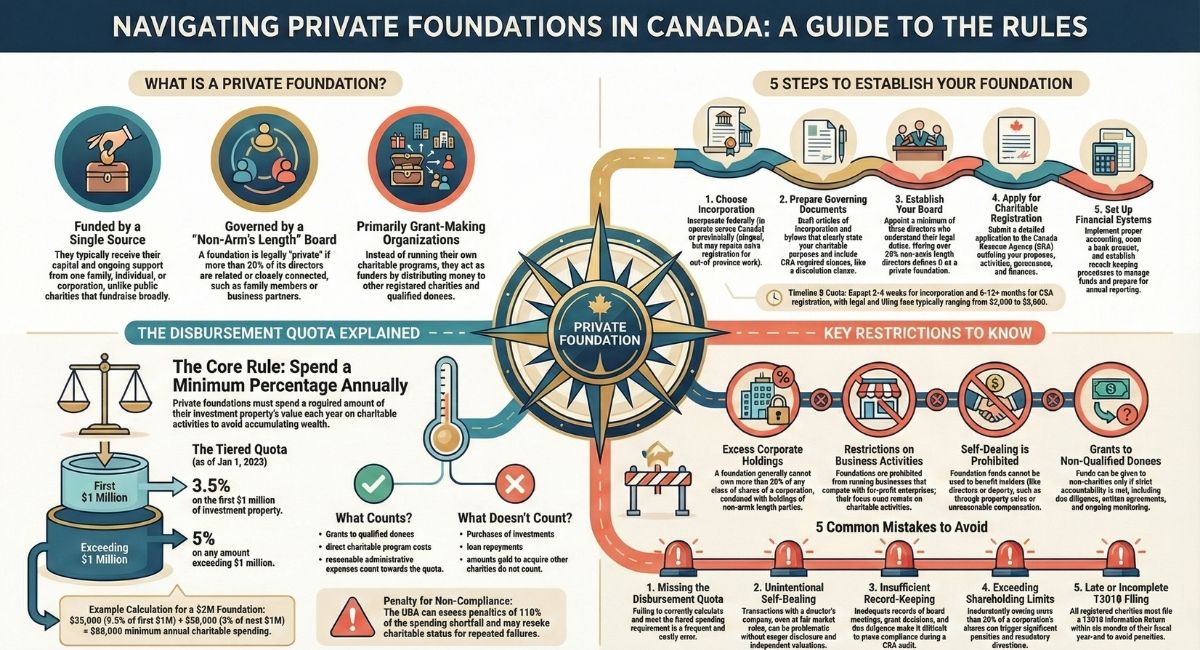
What Are Private and Public Foundations in Canada?

Private Foundations

A private foundation in Canada is typically established as a trust or corporation and is primarily funded by an individual, family, or corporation. Private foundations may either fund other registered charities or conduct their own charitable activities.

Public Foundations

A public foundation, on the other hand, is also a trust or corporation but is primarily funded by the public, typically through donations from individuals, organizations, or corporations. Public foundations allocate a significant portion of their income to support other qualified donees, often including registered charities.

How Are Private and Public Foundations Different?

The key difference between private and public foundations lies in their funding sources and how they operate:

  • Private Foundations: Funded mainly by a single donor or family, private foundations usually have a smaller, more focused scope of charitable activities.
  • Public Foundations: Funded by the public, public foundations engage in activities that support a broader range of charitable causes and often allocate a significant portion of their income to other registered charities.

Steps to Establish a Foundation in Canada

  1. Seek Professional Guidance
    Consulting with an experienced charity lawyer or expert in Canadian charity law is essential before you start the foundation setup process. Legal experts can ensure you comply with all regulations, avoid legal pitfalls, and choose the right foundation type (private or public) based on your goals.
  2. Understand Legal Obligations
    To enjoy the benefits of charitable status, foundations must be registered with the Canada Revenue Agency (CRA) as charities. Failure to register can result in income tax liabilities and prevent the issuance of tax receipts to donors.
  3. Establish the Foundation
    You must formally establish your foundation as a legal entity, either as a trust or corporation. This involves complying with federal, provincial, or territorial laws, depending on your foundation’s structure.
  4. Apply for Charitable Registration
    The next step is to apply for charitable registration with the CRA. During this process, you’ll need to submit detailed documentation regarding your foundation’s structure, intended activities, and funding sources. The CRA will classify your foundation as a charitable organizationpublic foundation, or private foundation based on its operational and funding structure.

Understanding Registered Charity Designations

In Canada, registered charities are categorized into three main designations:

  • Charitable Organization: Conducts its own charitable activities and receives funding from various sources, with more than 50% of its directors being independent.
  • Public Foundation: Primarily allocates more than 50% of its income to other qualified donees while also engaging in charitable activities. The majority of the directors or trustees must be at arm’s length.
  • Private Foundation: Primarily funded by a single individual or family and conducts charitable activities or funds other qualified donees. Less than 50% of its directors or trustees maintain arm’s-length relationships with the foundation.

Financial Considerations for Establishing a Foundation

Setting up a foundation, whether private or public, involves financial considerations. Legal fees for a comprehensive foundation set up in Canada generally range from $6,000 to $15,000. We recommend obtaining quotes from multiple charity law firms for the best fit. If you are incorporating a nonprofit without charity status, you can expect legal fees between $2,000 to $3,000.

Tax Implications for Foundation in Canada

Both private and public foundations benefit from tax exemptions under the Income Tax Act. This includes the ability to issue donation receipts, charitable tax credits, and exemption from income tax. However, the registration process requires compliance with specific regulations to maintain tax-exempt status.

Benefits of Establishing a Private or Public Foundation

Starting a foundation in Canada, whether private or public, offers several advantages:

  • Promote Positive Change: Foundations enable individuals or groups to support meaningful causes and create lasting impact in their communities.
  • Family Involvement: Private foundations often allow families to get involved in philanthropy, passing down values of giving across generations.
  • Tax Benefits: Foundations enjoy generous tax benefits, including the ability to issue tax receipts and qualify for charitable tax credits.
  • Control and Decision-Making: Founders of private foundations maintain significant control over how the foundation is operated and ensure it aligns with their vision.

How Long Does It Take to Set Up a Foundation?

Establishing and registering a foundation in Canada generally takes 3 to 4 months, though delays may arise due to CRA backlogs. Our efficient process can often speed up registration, and we have successfully established many foundations throughout Canada, including TorontoVancouverMontrealOttawaCalgaryWinnipegMississauga, and other major cities across our great country.

Get Started Today

If you are ready to create a private or public foundation in Canada, the experienced charity and foundation lawyers at Northfield & Associates are here to help. We’ve helped numerous philanthropists establish foundations and register them efficiently, often completing incorporation in as little as 3 days.

Get professional support today

to discuss your specific circumstances and receive expert assistance throughout the reinstatement process with our experienced legal team.

Our expert team can guide you through every step of the process and ensure your foundation is set up correctly and efficiently.

‍Frequently Asked Questions

Foundations play a vital role in Canada’s charitable sector, providing funding and support for important causes. Understanding the differences between public and private foundations, their setup requirements, and operational rules is essential for anyone considering establishing a foundation or working with existing ones.

What is a public foundation? 

A public foundation is a registered charity that raises funds from the general public to support other qualified donees or operate charitable programs. Public foundations must receive donations from multiple sources and cannot be controlled by a single donor or related group. They have more flexibility in their activities and can raise funds through public fundraising campaigns.

What is a private foundation? 

A private foundation is a registered charity typically funded by a single source, such as an individual, family, or corporation. Private foundations usually make grants to other qualified donees rather than operating their own charitable programs. They face stricter rules, including higher annual spending requirements and limitations on business activities.

How to start a public foundation? 

To start a public foundation, you must apply for charitable registration with the CRA, demonstrate public support through diverse funding sources, establish proper governance structures, and show your foundation will advance charitable purposes. You’ll need articles of incorporation, bylaws, a business plan, and evidence of community need for your foundation’s work.

How do I set up a private foundation? 

Setting up a private foundation requires incorporating under federal or provincial law, applying for charitable registration with the CRA, establishing governance structures, and demonstrating sufficient funding to meet operational requirements. You’ll need legal documentation, a clear charitable purpose, and plans for granting activities or charitable programs.

What is a private foundation vs nonprofit? 

A private foundation is a specific type of registered charity focused on making grants or operating charitable programs, typically funded by a single source. A nonprofit is a broader term covering any organization not operated for profit, including charities, clubs, and associations. Not all nonprofits qualify for charitable registration or tax receipting privileges.

Can private foundations accept donations? 

Yes, private foundations can accept donations and issue official donation receipts. However, they must be careful not to become controlled by a single donor or related group, which could affect their charitable status. Most private foundations primarily rely on their original endowment rather than ongoing fundraising.

How do you start a private foundation? 

Starting a private foundation involves incorporating the organization, applying for charitable registration with the CRA, establishing proper governance, and securing adequate funding. You’ll need legal documents, a clear charitable mission, plans for grant-making or programs, and sufficient capital to meet the CRA’s operational requirements.

How much does it cost to set up a foundation in Canada? 

Setup costs typically range from $5,000 to $15,000, including legal fees, incorporation costs, and CRA application fees. Ongoing operational costs include annual legal and accounting fees, CRA filing requirements, and administrative expenses. Private foundations should have substantial initial funding to meet their annual disbursement requirements.

What is the difference between a public and private foundation in Canada? 

Public foundations raise funds from multiple sources and have more operational flexibility, while private foundations are typically funded by single sources with stricter rules. Private foundations must spend 3.5% of assets annually, while public foundations spend 3.5%. Private foundations face more restrictions on business activities and political involvement than public foundations.


Contact To Action

Contact us today to schedule your consultation.

Northfield & Associates

Advancing Global Partnerships, Together.

Working with Our Firm

In this evolving economic landscape, collaboration with our firm offers clients a strategic advantage. With Cambodia’s reform-driven investment environment and Canada’s expanding footprint in Southeast Asia, our team of experienced consultants and legal advisors provides tailored guidance to help businesses navigate cross-border opportunities. We focus in developing comprehensive legal strategies, structuring international partnerships, and ensuring compliance in emerging markets.

By leveraging our regional insight and international expertise, you benefit from a trusted partner dedicated to helping you capitalize on growth potential in Cambodia and beyond.

Book a Consultation with Northfield & Associates

Your Trusted Partner in International Bilateral Relations

At Northfield & Associates are focus in Foreign Direct Investment (FDI), international trade missions, and cross-border legal strategy. Our team of experienced consultants and legal advisors offers tailored guidance and strategic insight to help you navigate the complexities of international partnerships and development opportunities.

Whether you choose to meet in person at one of our offices or connect virtually, we provide flexible and accessible consultation options. During your session, we’ll assess your goals, review key documentation, and guide you through every stage of your FDI or trade mission engagement.

Let us help you take the next step with confidence supported by trusted legal and strategic counsel every step of the way.

Take the First Step Today

If you believe you may be eligible for legal relief or simply need sound legal advice, we’re here to help. Contact us today to book your consultation. Let us provide the clarity, strategy, and peace of mind you need to move forward.

We serve our clients in English, Cambodian, Vietnamese, Mandarin and Cantonese, especially in Asian clients.

  • If you or anybody that you know, think that you meet the requirements and wish to receive further information.
  • We can help you start the application process and confirm eligibility requirements to participate.
  • We Offer Consultations & Meetings by Phone & Virtually. Affordable Fees.

Disclaimer:

The information contained in this article is provided for general information purposes only and does not constitute legal or other professional advice. Readers should seek tailored legal advice in relation to their personal circumstances.

Northfield & Associates

Advancing Global Partnerships, Together.

Book a Consultation Today

Contact Northfield & Associates today to schedule a FREE consultation with an experienced Consultant.

Join the community of Northfield & Associates

Connect with peers and community ambassadors to hear real experiences, tips, and advice about studying abroad.


About Northfield

Northfield & Associates International Corporation is a global consulting firm serving private enterprises, public institutions, not-for-profit organizations, and institutional capital providers. Operating across Cambodia, Canada, and global markets, the firm supports capital deployment, regulatory navigation, and enterprise decision-making in complex economic and geopolitical environments. Northfield & Associates delivers customized, execution-focused advisory solutions that drive measurable transformation, strengthen competitiveness, and enhance long-term highest value opportunities. The firm incorporates consulting, legal, regulatory, financial, and risk expertise to enable disciplined capital allocation, strong governance, and operational resilience. Northfield & Associates upholds a culture of applied insight and innovation, supporting clients across digital transformation, growth strategy, and organizational capability building. The firm advises individual, leading global corporations, midsize enterprises, government agencies, and mission-driven organizations through long-term partnerships. Enterprise-wide risk management, professional ethics, and fiduciary standards are embedded across all operations. Northfield & Associates’ diverse, globally unified teams are committed to execution certainty and sustainable, risk-adjusted returns aligned with ESG and stakeholder objectives.

Forward-Looking Information

This news release contains forward-looking information. All statements, other than statements of historic fact, that address activities, events or developments that the Company believes, expects or anticipates will or may occur in the future constitute forward-looking information.

This forward-looking information reflects the current expectations or beliefs of the Company based on information currently available to the Company.

Forward-looking information is subject to a number of risks and uncertainties that may cause the actual results of the Company to differ materially from those discussed in the forward-looking information, and even if such actual results are realized or substantially realized, there can be no assurance that they will have the expected consequences to, or effects on the Company. Factors that could cause actual results or events to differ materially from current expectations include, among other things: the failure to finalize negotiations concerning the increase of the Loan or to close such transaction and the failure of the Company to complete the acquisition of the Company Facility; operating performance of facilities; environmental and safety risks; delays in obtaining or failure to obtain necessary permits and approvals from government authorities; unavailability of plant, equipment or labour; inability to retain key management and personnel; changes to regulations or policies affecting the Company’s activities; and the other risks disclosed under the heading “Risk Factors” and elsewhere in the Company’s amended annual information.

Forward-looking information speaks only as of the date on which it is made and, except as may be required by applicable securities laws, the Company disclaims any intent or obligation to update any forward-looking information, whether as a result of new information, future events or results or otherwise. Although the Company believes that the assumptions inherent in the forward-looking information are reasonable, forward-looking information is not a guarantee of future performance and accordingly undue reliance should not be put on such information due to the inherent uncertainty therein.

Questions?

info@northfied.biz

Within Corporate Newsroom  

Media Contact:

media@northfied.biz

Press contact

PR consultants
press@northfied.biz

NOT LEGAL ADVICE. Information made available on this website in any form is for information purposes only. It is not, and should not be taken as, legal advice. You should not rely on, or take or fail to take any action based upon this information. Never disregard professional legal advice or delay in seeking legal advice because of something you have read on this website. Northfield & Associates professionals will be pleased to discuss resolutions to specific legal concerns you may have.

Categories
Business News Government Contracting & Public Sector Legal News Northfield News

What’s the Difference Between a Charity and a Non-Profit in Canada?

What’s the Difference Between a Charity and a Non-Profit in Canada?

When it comes to organizations focused on helping others, you may have heard the terms “nonprofit” and “registered charity” used interchangeably. While both types of organizations work to support social good, they are not the same in Canada. Understanding the differences between a nonprofit and a registered charity is essential for anyone looking to start or support an organization in the charitable sector.

If you’re considering starting an organization in Canada, one of the first questions you might ask is: What’s the difference between a charity and a non-profit? Although both types of organizations operate on a non-profit basis and focus on benefiting the community, they have distinct legal definitions, requirements, and benefits. Let’s break down the difference between a charity and a non-profit in Canada, so you can make the right choice for your organization.

This article will break down the key distinctions between the two so you can make informed decisions.

What is a Charity in Canada?

charity is a type of organization that is officially registered with the Canadian government under the Income Tax Act. To qualify as a registered charity in Canada, the organization must have a charitable purpose that falls under one or more of the following categories:

  • The advancement of education
  • The relief of poverty
  • The advancement of religion
  • Other purposes that benefit the community

Charities enjoy the significant benefit of being able to issue tax receipts for donations. This not only encourages private individuals and corporations to donate, but it also allows donors to claim a tax credit. This is one of the key differences between a charity and a non-profit organization, as only registered charities have the ability to offer this benefit.

What is a Non-Profit Organization?

On the other hand, a non-profit organization (NPO) is an association, club, or society that is formed for purposes other than generating profit for its members. These organizations can be created for a variety of goals, including:

  • Social welfare
  • Civic improvement
  • Recreational or leisure activities
  • Sports clubs and leagues
  • Professional associations

While not-for-profit organizations don’t have the ability to issue tax receipts like charities, they are still eligible for tax-exempt status. This means they are exempt from paying certain taxes, such as income and property taxes (note: exemption from property taxes for nonprofits is a muncipal matter, with exemptions ranging from partial to full). However, their flexibility in operations allows them to pursue a broader range of activities compared to charities.

Key Differences Between Charities and Non-Profit Organizations

Understanding the difference between charity and non-profit is crucial for deciding which structure suits your organization best. Here are the main differences:

  1. Purpose: Charities must operate exclusively for charitable purposes, such as poverty relief, advancement of education, animal rescue, promotion of health, or advancing religion. Non-profits, however, have more flexibility in their objectives, focusing on things like recreation, social welfare, or civic improvement.
  2. Tax Benefits: Charities can issue tax receipts for donations, providing an incentive for donors. Non-profits do not have this ability but can apply for tax-exempt status for certain activities.
  3. Reporting RequirementsCharities are subject to more stringent reporting requirements than non-profits. For instance, charities must file an annual information return with the Canada Revenue Agency (CRA) referred to as form T3010 to maintain their status. Non-profits typically face fewer reporting obligations.
  4. Funding: While both can apply for funding from government grants, private foundations, and corporate donations, only charities can issue tax receipts to donors, which can make fundraising more efficient.

Choosing Between a Charity and a Non-Profit

The decision of whether to register as a charity or a non-profit organization depends on your goals and the specific needs of your organization. If your mission aligns with the definition of charity and you aim to raise funds through donations, registering as a charity is likely the right option. On the other hand, if your organization focuses on providing community services, recreational activities, or social welfare without the need to issue tax receipts, a non-profit should be a better fit.

Why Does the Distinction Matter?

For anyone looking to establish or support an organization in Canada, understanding the differences between a nonprofit and a registered charity is crucial. The distinction can affect an organization’s ability to raise funds, its regulatory requirements, and the benefits it offers to donors.

  • Tax Benefits: If your organization is focused on raising funds from donations, becoming a registered charity may be the best route, as it enables you to issue tax receipts.
  • Operational Flexibility: If your organization’s primary focus is community development or another cause not strictly aligned with the criteria for a registered charity, a nonprofit status may be a better fit.
  • Compliance Requirements: Registered charities face stricter reporting and operational regulations than nonprofits. If you prefer more flexibility, a nonprofit organization may be the better choice.

How Can You Transition from a Nonprofit to a Registered Charity?

If your nonprofit organization in Canada wants to become a registered charity, there are several steps to follow:

  1. Review Eligibility: Ensure that your organization’s activities align with the CRA’s definition of charitable purposes.
  2. Apply to the CRA: Submit an application for charitable status to the CRA. This process includes providing details about your organization’s structure, activities, and finances.
  3. Wait for Approval: The CRA will review your application and determine if your organization qualifies for charitable status. This can take several months.

Comply with Charitable Regulations: Once approved, your organization must comply with all the regulations governing registered charities, including filing annual returns and maintaining proper records.

Conclusion

In summary, the key difference between a nonprofit and a registered charity in Canada lies in their purpose, tax benefits, and regulatory requirements. Nonprofits operate with a broad range of purposes and are not required to follow the strict rules that apply to registered charities.

Need Help with Charity Registration?

If you believe that charity registration aligns with the goals of your organization, we encourage you to reach out for professional legal advice. Understanding the difference between a non-profit and a charity is just the first step in the process of registering as a charity in Canada.

For more information on the registration process and the benefits of charity status

Whether you’re aiming to register a charity in Toronto, or starting a non-profit in Vancouver, the choice you make will shape your organization’s future. Seeking legal advice can ensure that your organization complies with all regulations and meets the necessary requirements. If you’re looking for the legal and tax distinctions, see our full guide on charity vs nonprofit status in Canada.

Frequently Asked Questions

Have questions about charities and non-profits in Canada? Our FAQ section covers the most common topics to help you understand how these organisations work and what’s required for registration and compliance.

What qualifies as a non-profit in Canada?

A non-profit in Canada must operate for purposes other than profit, such as social welfare, community benefit, or cultural and recreational activities. Any surplus funds must be used to further the organisation’s mission, not distributed to members.

What are the three types of charities in Canada?

The three types are charitable organisations (which deliver charitable programs), public foundations (which mainly fund other charities), and private foundations (which are usually funded by a single source and provide grants).

What qualifies you as a charity?

To qualify as a charity in Canada, your organisation must have exclusively charitable purposes—such as relief of poverty, advancement of education or religion, or other benefits to the community—and be registered with the CRA.

What category does charity fall under?

In Canada, charity falls under the broader category of non-profit organisations, specifically those registered to carry out charitable activities with public benefit.

What is the highest form of charity?

The highest form of charity is often considered to be direct relief of poverty or support for those in greatest need, but in Canada, all registered charities are recognised equally under the law.


Contact To Action

Contact us today to schedule your consultation.

Northfield & Associates

Advancing Global Partnerships, Together.

Working with Our Firm

In this evolving economic landscape, collaboration with our firm offers clients a strategic advantage. With Cambodia’s reform-driven investment environment and Canada’s expanding footprint in Southeast Asia, our team of experienced consultants and legal advisors provides tailored guidance to help businesses navigate cross-border opportunities. We focus in developing comprehensive legal strategies, structuring international partnerships, and ensuring compliance in emerging markets.

By leveraging our regional insight and international expertise, you benefit from a trusted partner dedicated to helping you capitalize on growth potential in Cambodia and beyond.

Book a Consultation with Northfield & Associates

Your Trusted Partner in International Bilateral Relations

At Northfield & Associates are focus in Foreign Direct Investment (FDI), international trade missions, and cross-border legal strategy. Our team of experienced consultants and legal advisors offers tailored guidance and strategic insight to help you navigate the complexities of international partnerships and development opportunities.

Whether you choose to meet in person at one of our offices or connect virtually, we provide flexible and accessible consultation options. During your session, we’ll assess your goals, review key documentation, and guide you through every stage of your FDI or trade mission engagement.

Let us help you take the next step with confidence supported by trusted legal and strategic counsel every step of the way.

Take the First Step Today

If you believe you may be eligible for legal relief or simply need sound legal advice, we’re here to help. Contact us today to book your consultation. Let us provide the clarity, strategy, and peace of mind you need to move forward.

We serve our clients in English, Cambodian, Vietnamese, Mandarin and Cantonese, especially in Asian clients.

  • If you or anybody that you know, think that you meet the requirements and wish to receive further information.
  • We can help you start the application process and confirm eligibility requirements to participate.
  • We Offer Consultations & Meetings by Phone & Virtually. Affordable Fees.

Disclaimer:

The information contained in this article is provided for general information purposes only and does not constitute legal or other professional advice. Readers should seek tailored legal advice in relation to their personal circumstances.

Northfield & Associates

Advancing Global Partnerships, Together.

Book a Consultation Today

Contact Northfield & Associates today to schedule a FREE consultation with an experienced Consultant.

Join the community of Northfield & Associates

Connect with peers and community ambassadors to hear real experiences, tips, and advice about studying abroad.


About Northfield

Northfield & Associates International Corporation is a global consulting firm serving private enterprises, public institutions, not-for-profit organizations, and institutional capital providers. Operating across Cambodia, Canada, and global markets, the firm supports capital deployment, regulatory navigation, and enterprise decision-making in complex economic and geopolitical environments. Northfield & Associates delivers customized, execution-focused advisory solutions that drive measurable transformation, strengthen competitiveness, and enhance long-term highest value opportunities. The firm incorporates consulting, legal, regulatory, financial, and risk expertise to enable disciplined capital allocation, strong governance, and operational resilience. Northfield & Associates upholds a culture of applied insight and innovation, supporting clients across digital transformation, growth strategy, and organizational capability building. The firm advises individual, leading global corporations, midsize enterprises, government agencies, and mission-driven organizations through long-term partnerships. Enterprise-wide risk management, professional ethics, and fiduciary standards are embedded across all operations. Northfield & Associates’ diverse, globally unified teams are committed to execution certainty and sustainable, risk-adjusted returns aligned with ESG and stakeholder objectives.

Forward-Looking Information

This news release contains forward-looking information. All statements, other than statements of historic fact, that address activities, events or developments that the Company believes, expects or anticipates will or may occur in the future constitute forward-looking information.

This forward-looking information reflects the current expectations or beliefs of the Company based on information currently available to the Company.

Forward-looking information is subject to a number of risks and uncertainties that may cause the actual results of the Company to differ materially from those discussed in the forward-looking information, and even if such actual results are realized or substantially realized, there can be no assurance that they will have the expected consequences to, or effects on the Company. Factors that could cause actual results or events to differ materially from current expectations include, among other things: the failure to finalize negotiations concerning the increase of the Loan or to close such transaction and the failure of the Company to complete the acquisition of the Company Facility; operating performance of facilities; environmental and safety risks; delays in obtaining or failure to obtain necessary permits and approvals from government authorities; unavailability of plant, equipment or labour; inability to retain key management and personnel; changes to regulations or policies affecting the Company’s activities; and the other risks disclosed under the heading “Risk Factors” and elsewhere in the Company’s amended annual information.

Forward-looking information speaks only as of the date on which it is made and, except as may be required by applicable securities laws, the Company disclaims any intent or obligation to update any forward-looking information, whether as a result of new information, future events or results or otherwise. Although the Company believes that the assumptions inherent in the forward-looking information are reasonable, forward-looking information is not a guarantee of future performance and accordingly undue reliance should not be put on such information due to the inherent uncertainty therein.

Questions?

info@northfied.biz

Within Corporate Newsroom  

Media Contact:

media@northfied.biz

Press contact

PR consultants
press@northfied.biz

NOT LEGAL ADVICE. Information made available on this website in any form is for information purposes only. It is not, and should not be taken as, legal advice. You should not rely on, or take or fail to take any action based upon this information. Never disregard professional legal advice or delay in seeking legal advice because of something you have read on this website. Northfield & Associates professionals will be pleased to discuss resolutions to specific legal concerns you may have.

Categories
Business News Government Contracting & Public Sector Legal News Northfield News

How to Register a Nonprofit in Canada: A Step-by-Step Guide

How to Register a Nonprofit in Canada: A Step-by-Step Guide

Starting a nonprofit or charity in Canada can be a fulfilling endeavor, but it requires careful planning and legal compliance. Whether you’re creating a nonprofit to address a community need or aiming to establish a charitable organization with tax-exempt status, understanding the registration process is crucial. This guide will walk you through the steps of registering a nonprofit and charity in Canada, covering the costs, legal requirements, and what you need to know before you begin.

Registering a Nonprofit in 8 Steps

Step 1: Determine the Purpose of Your Organization

The first step in the process is defining the purpose of your organization. Is it a nonprofit aimed at social development, environmental issues, or cultural promotion? Or do you plan to establish a charity that provides services such as education, healthcare, or poverty alleviation?

The purpose will determine whether you should apply for nonprofit organization registration or charity registration. If you aim to offer public benefits and seek tax-exempt status, registering as a charity may be more suitable.

Step 2: Choose a Name for Your Organization

Your organization’s name must be unique and not too similar to other registered entities in Canada. It should reflect the mission and activities of the nonprofit or charity. Be sure to check the availability of the name through a corporate name search, which can be done through the Canada Business Corporations Act (CBCA) or your provincial registry.

For nonprofits, the name must not mislead the public regarding the organization’s activities, and it should include the term “nonprofit” or “not-for-profit” to indicate its status. For charities, the name should reflect the charitable purpose.

Step 3: Create Your Organization’s Governing Documents

This step involves creating two key documents:

  1. Articles of Incorporation (or Constitution): This document outlines the legal structure, purpose, and powers of your organization. It includes details about your nonprofit or charity’s mission, the responsibilities of directors, and how decisions will be made.
  2. Bylaws: These are the internal rules that govern the operations of your organization. They cover areas such as how board members are elected, how meetings are conducted, and how finances are managed.

If you’re forming a charity, your governing documents must also include a statement of charitable purpose, specifying how the organization intends to benefit the public.

Step 4: Apply for Incorporation

To officially create your nonprofit or charity, you must file an application with the appropriate government authority.

  • Federal Incorporation (Nonprofit): If you want to register your nonprofit organization across Canada, you can apply for federal incorporation under the Canada Not-for-profit Corporations Act (CNCA). This process is done through Corporations Canada, and your organization will be able to operate nationwide.
  • Provincial Incorporation: If you want to operate only in one province, you can choose to incorporate under the specific provincial nonprofit legislation. Each province has its own rules and processes for nonprofit incorporation.

Once your application is approved, your organization will be legally incorporated.

Step 5: Register for Charitable Status (If Applicable)

If you’re looking to register as a charity, you must apply to the Canada Revenue Agency (CRA) for charitable status. To do so, your organization must meet specific criteria, including:

  • Having a charitable purpose that benefits the public (e.g., relieving poverty, advancing education, or promoting religion).
  • Demonstrating that you will use your resources exclusively for charitable activities.

The CRA evaluates your application based on the documents you submit, including your governing documents and financial plans. If successful, your charity will be issued a charitable registration number, which allows you to issue tax receipts to donors.

Step 6: Cost of Registering a Nonprofit or Charity

The cost of registering a nonprofit or charity in Canada varies depending on the type of registration and whether you’re incorporating at the federal or provincial level. Here’s an overview of typical costs:

  • Federal Incorporation (Nonprofit): The cost to incorporate a nonprofit federally is approximately $200 (for online applications).
  • Provincial Incorporation (Nonprofit): Provincial fees vary, typically ranging from $100 to $250.
  • Charity Registration (CRA): There is no fee to apply for charity registration with the CRA, but it can take several months for the process to complete. You may want to consult a charity lawyer or professional to ensure your application is complete and meets CRA’s standards.

Step 7: Set Up a Bank Account and Financial Structure

Once your nonprofit or charity is registered, you’ll need to set up a bank account for the organization. This account should be used exclusively for the nonprofit’s or charity’s activities and financial transactions.

Additionally, you should establish a clear financial structure for your organization. This includes:

  • Keeping proper financial records.
  • Developing a budget for activities.
  • Setting up internal controls for managing funds.

Nonprofits and charities are subject to specific accounting and reporting requirements, so it’s important to ensure compliance from the outset.

Step 8: Ongoing Compliance and Reporting Requirements

After registering, your nonprofit or charity must maintain its status through regular reporting and compliance. This includes:

  • Filing annual returns with the CRA for charities.
  • Holding regular board meetings and documenting the minutes.
  • Updating the organization’s information with the appropriate provincial or federal registry.

Failure to comply with these requirements can result in penalties or, in the case of charities, loss of charitable status.

How Long Does It Take to Register a Nonprofit or Charity?

The timeline for registering a nonprofit or charity can vary. For federal incorporation, the process typically takes 1-3 days if there are no issues with your application. Charity registration can take much longer, often 5 to 8 months, due to the additional review by the CRA. The timeframe variables for charity registration also vary by how quick your charity lawyer processes the application, how experienced he or she is at registering charities, and the level of detail included in the charity application. We note in this regard that the charity lawyers at B.I.G. Charity Law Group can file a charity application with the CRA in under 1 week, the quickest record in Canada.

Understanding Nonprofit Organizations in Canada

Nonprofit organizations in Canada follow specific legal frameworks. These rules define their structure, purpose, and regulatory requirements.

The distinction between basic nonprofits and registered charities affects tax benefits and reporting obligations.

Legal Structure and Entity Types

Nonprofits can be established in Canada through two main routes. Federal incorporation under the Canada Not-for-profit Corporations Act allows operations across all provinces and territories.

Provincial incorporation limits operations to one province. Each province has its own nonprofit legislation and requirements.

Both options create a separate legal entity from members and directors. This structure provides legal protection and allows the organization to enter contracts, own property, and conduct business activities.

Key characteristics include:

  • No profit distribution to members or directors
  • Reinvestment of surplus funds into the mission
  • Limited liability protection for members
  • Perpetual existence beyond founding members

The organization must have a board of directors and proper governance structures. Federal incorporation requires at least three directors, with specific residency requirements for Canadian directors.

What Is the Difference Between a Nonprofit and a Charity in Canada?

Before you start, it’s important to understand the distinction between a nonprofit and a charity in Canada. Both types of organizations are similar, but they have different legal statuses and requirements.

  • Nonprofit Organizations (NPOs): These organizations are formed for purposes other than generating profit for individuals or shareholders. They can provide community services, promote certain causes, or engage in social activities. However, NPOs cannot distribute profits to their members. Nonprofits are usually tax exempt, but cannot issue tax receips to donors unless they are also registered as a charity.
  • Charities: Charities are a specific type of nonprofit that focuses on activities benefiting the public, such as alleviating poverty, advancing education, or promoting religion. Charities enjoy special tax-exempt status and can issue official receipts for donations, allowing donors to claim tax credits.

Role of the Canada Not-for-profit Corporations Act

The Canada Not-for-profit Corporations Act (NFP Act) governs federally incorporated nonprofit organizations. This law replaced the old Canada Corporations Act and modernized nonprofit governance.

The NFP Act sets mandatory governance standards, including director duties, member rights, and financial reporting. It provides clear rules for operations and decision-making.

Key provisions include:

  • Minimum three directors requirement
  • Annual member meetings
  • Financial statement preparation
  • Conflict of interest rules

The Act allows organizations to operate nationwide under consistent regulations. Different provincial rules don’t need to be followed when expanding.

Articles of incorporation must be filed with Corporations Canada to incorporate under the NFP Act. The process costs $200 for online applications and usually takes 1-3 days for approval.

Choosing Between Federal and Provincial Incorporation

When registering a nonprofit in Canada, a decision must be made between federal or provincial incorporation. Federal incorporation offers broader protection and nationwide recognition. Provincial incorporation may suit smaller, locally-focused organizations.

Federal Incorporation Process

Federal incorporation can be completed online through Corporations Canada. The process is faster and more convenient than most provincial options.

Application Process:

  • Submit documents online
  • Pay fees electronically
  • Receive confirmation digitally
  • Complete the incorporation within a few business days

The federal application costs $155. Documents don’t need to be mailed and government offices don’t need to be visited.

Key Benefits:

  • Name Protection: The organization’s name receives Canada-wide protection
  • Operating Rights: Operations are permitted in any province or territory under the same name
  • Recognition: Federal incorporation provides global recognition as a Canadian organization

Corporations Canada uses strict tests before approving corporate names. Once approved, the name is protected across the country.

Access to online tools like the By-law Builder is also provided. This tool helps create bylaws that fit the organization’s needs.

Provincial Incorporation Requirements

Provincial incorporation varies by province. Each province has its own rules, fees, and processing times.

Typical Process:

  • Submit applications by mail or in person
  • Wait 6-8 weeks for processing
  • Pay provincial fees (amounts vary by province)
  • Follow province-specific requirements

Most provinces require paper applications. This makes the process slower than federal incorporation.

Limitations:

  • Name protection only within that province
  • Extra-provincial registration is required to operate in other provinces
  • Different rules in each province
  • Longer processing times

Organizations that incorporate provincially but want to expand later will need to register as extra-provincial corporations in each new province. This creates more paperwork and costs.

Some provinces offer online services, but most still use paper-based systems.

Factors in Decision-Making

Several key factors should be considered when choosing between federal and provincial incorporation.

Choose Federal If:

  • Operations are planned in multiple provinces
  • Strong name protection across Canada is desired
  • Faster processing times are needed
  • Online services and tools are preferred

Choose Provincial If:

  • Operations will only be local
  • Working with local government offices is preferred
  • The province offers specific benefits for nonprofits

Cost Considerations: Even federal corporations must register extra-provincially where they do business. In Ontario, this registration is free for federal corporations. Other provinces charge fees.

Growth Plans: If expansion across provinces is planned, federal incorporation makes more sense from the start. Changing from provincial to federal later requires more work and costs.

Legal Advice: Many charity lawyers recommend federal incorporation for organizations planning to register as charities. Federal incorporation often provides better protection and recognition for fundraising.

Preparing for Incorporation

Getting a nonprofit ready for incorporation involves choosing a name, filing the right documents, and setting up governance. These steps create the legal foundation the organization needs to operate in Canada.

Selecting a Nonprofit Name

A name must be chosen that meets Corporations Canada’s requirements. The name must be unique and not confuse people with existing organizations.

The nonprofit name must include one of these words:

  • Corporation
  • Incorporated (Inc.)
  • Limited (Ltd.)

Names that suggest commercial activities should be avoided. Names that reference professions need special approval from regulatory bodies.

Name availability check: Search existing names through Corporations Canada’s database before applying. This saves time and prevents rejections.

The name can be in English, French, or both official languages. The format should be chosen that works best for the audience and service areas.

Drafting and Filing Articles of Incorporation

Articles of Incorporation are the most important document to file. This is Form 4001 which officially creates the nonprofit corporation.

Key sections to complete:

  • Corporate name
  • Purpose statement
  • Membership structure
  • Director information

The purpose statement needs careful attention. It must clearly explain what the nonprofit will do.

If the plan is to become a registered charity later, this statement must meet Canada Revenue Agency requirements. File online through Corporations Canada’s website.

The process is faster and easier than paper filing. Filing fees apply when Articles of Incorporation are submitted.

These costs should be included in startup expenses.

Appointing Directors and Creating Bylaws

At least three directors are needed to start a nonprofit corporation. Directors must be individuals, not other organizations.

Director requirements:

  • At least 18 years old
  • Mentally capable
  • Not bankrupt
  • The majority must be Canadian residents

Directors can create bylaws at the first organizational meeting. Bylaws explain how the nonprofit will operate day-to-day.

Corporations Canada offers model bylaws that can be used as a starting point. Their online bylaw builder helps customize rules for organizational needs.

Bylaws don’t need to be filed with the incorporation application. File them within 12 months after members confirm them.

Bylaws should cover membership rules, meeting procedures, and financial management. These rules help prevent conflicts and keep operations smooth.

Financial Management and Record-Keeping Responsibilities

Canadian nonprofits must keep detailed financial records. Annual reports also need to be submitted to stay compliant with federal and provincial laws.

Poor record-keeping can lead to penalties, audits, or loss of tax-exempt status.

Maintaining Financial Records

Nonprofits need to keep accurate financial records to meet legal requirements. This also helps maintain transparency.

The Canada Not-for-profit Corporations Act requires specific documentation.

Essential financial records include:

  • Bank statements and reconciliations
  • Revenue records from all sources
  • Expense receipts and invoices
  • Donation records and tax receipts issued
  • Board meeting minutes discussing financial decisions

Records are stored either physically or electronically at the registered office. Financial documents should be organized by fiscal year and kept easily accessible for review.

The record-keeping system tracks all income sources, including grants, donations, and program fees. All expenses should be documented with receipts and categorized correctly.

The Canada Revenue Agency requires charities to keep detailed revenue records. Copies of all tax receipts issued to donors must be maintained, and how funds are used for charitable purposes must be tracked.

Annual Filings and Reporting

Every nonprofit corporation files an annual return with Corporations Canada each year. Skipping this requirement risks administrative dissolution.

Annual returns include basic corporate information and confirm the organization remains active. The filing deadline is usually within six months of the fiscal year-end.

Annual financial statements must comply with:

  • Generally Accepted Accounting Principles (GAAP)
  • Canada Not-for-profit Corporations Act standards
  • Provincial reporting requirements where registered

Financial statements should be prepared that show the organization’s financial position clearly. These statements include a balance sheet, statement of operations, and statement of cash flows.

If the nonprofit solicits donations from the public, additional reporting requirements apply. Soliciting corporations must follow stricter financial disclosure rules than non-soliciting ones.

Compliance With Government Regulations

Both federal and provincial regulations must be followed for financial management. The Income Tax Act and provincial corporation laws set specific record-keeping requirements.

Key compliance areas include:

  • Maintaining books and records for audit purposes
  • Following charitable spending requirements (if applicable)
  • Meeting director and member reporting obligations
  • Submitting required government filings on time

Nonprofits may lose tax-exempt status if proper financial records aren’t maintained. Regular financial reviews help spot compliance issues early.

Internal controls should be established to prevent financial mismanagement. This includes requiring multiple signatures for large expenses and regular financial reporting to the board of directors.

Fundraising and Securing Nonprofit Funding

Nonprofits access funding sources and manage fundraising activities in several ways. Government grants have specific eligibility criteria, fundraising events need careful planning, and capital grants have unique management requirements.

Eligibility for Government Grants and Programs

Government grants form a major funding source for Canadian nonprofits. The Canada Revenue Agency requires organizations to maintain tax-exempt status to qualify for most federal grants.

Federal Grant Requirements:

  • Valid nonprofit incorporation
  • Current CRA registration
  • Clear charitable purpose alignment
  • Financial reporting compliance

Provincial governments offer additional grant programs with their own criteria. Research should be conducted on programs in the relevant province because requirements vary between jurisdictions.

Common Grant Categories:

  • Community development grants for local projects
  • Social services funding for vulnerable populations
  • Arts and culture support for creative initiatives
  • Environmental grants for sustainability projects

Detailed project proposals must be prepared that show measurable outcomes. Most government grants require matching funds or volunteer contributions from the organization.

Application deadlines are strict and often annual. You’ll plan grant applications early and keep detailed records of how awarded funds are used.

Planning Fundraising Events

Registration for fundraising activities is required in several provinces before hosting events. Ontario, Alberta, and Nova Scotia require specific fundraising registration for nonprofits soliciting donations.

Key Planning Steps:

  • Obtain necessary permits and licences
  • Set clear financial goals and budgets
  • Choose appropriate venues and dates
  • Develop marketing materials

All expenses during fundraising events must be tracked. The CRA requires that fundraising costs stay reasonable compared to the funds raised.

Generally, fundraising expenses should be kept below 35% of total donations received.

Popular Fundraising Event Types:

  • Charity auctions and galas
  • Community walks or runs
  • Online crowdfunding campaigns
  • Corporate sponsorship partnerships

Proper tax receipts must be issued for donations over $20. Only registered charities can provide official donation receipts that donors can claim on their tax returns.

Event insurance protects organizations from liability during fundraising activities. Consult insurance providers about coverage for specific event types.

Managing Capital Grants

Capital grants fund major purchases like buildings, equipment, or infrastructure improvements. Strict guidelines must be followed for spending and reporting these funds.

Capital Grant Requirements:

  • Detailed asset purchase plans
  • Multiple vendor quotes for major purchases
  • Regular progress reporting to funders
  • Asset maintenance commitments

Capital grant spending should be tracked separately from operating funds. Many funders require quarterly reports showing how money was used and what assets were acquired.

Common Capital Grant Uses:

  • Building purchases or renovations
  • Technology equipment and software
  • Vehicles for service delivery
  • Accessibility improvements

Capital assets must be maintained for specific periods, often 5-10 years. Selling or disposing of grant-funded assets early may require repaying part of the original grant.

Some capital grants require matching contributions from the organization. Plan for these requirements before applying and ensure committed funding sources exist before accepting grants.

Final Thoughts

Starting a nonprofit or charity in Canada requires careful planning and adherence to legal guidelines. By understanding the steps involved—from defining your organization’s purpose to registering with the appropriate authorities—you’ll be on your way to successfully creating a nonprofit or charity that can serve its intended mission.

If you need help navigating the registration process or ensuring compliance with Canadian laws, consulting a charity lawyer or nonprofit lawyer can make the process smoother and help you avoid potential pitfalls.

Thinking of starting your own nonprofit? Hear firsthand what the journey looks like in our podcast episode, A Founder’s Guide to Starting a Nonprofit in Canada. Get real-world insights, challenges, and lessons from someone who’s been there.

Frequently Asked Questions

Starting a nonprofit in Canada involves several key steps and requirements. Most organizations need formal registration, fall into specific categories, and have clear tax obligations.

How much does it cost to register a non-profit in Canada?

Registering a non-profit federally costs $200 if you apply online, while paper applications cost $250. Provincial registration fees vary but typically range from $100 to $300 depending on the province and the type of organisation.

What is the difference between a charity and a nonprofit in Canada?

A charity must register with the CRA and can issue tax receipts for donations, but it must operate exclusively for charitable purposes like poverty relief, education, or religion. A nonprofit, on the other hand, operates for social, cultural, or community purposes and cannot issue tax receipts for donations.

What qualifies as a non-profit in Canada?

To qualify as a non-profit, an organisation must be set up for purposes other than making a profit, such as serving the community, advancing a cause, or providing recreational activities. Any profits made must be reinvested into the organisation’s mission rather than distributed to members.

What are the four categories of Canadian nonprofits?

Canadian nonprofits are generally classified as charitable organisations, social clubs (like sports or hobby groups), professional or trade associations, and advocacy or member-based groups. Each type serves a unique role and has different regulatory requirements.

How to start a Nonprofit in Canada? 

First, define your organization’s purpose and mission. Choose a unique name and check if it’s available through the corporate registry. Create governing documents like articles of incorporation and bylaws. Apply for incorporation either federally ($200 online) or provincially. Finally, open a dedicated bank account separate from personal finances.

Do non-profits have to register in Canada? 

Yes, most nonprofits must register to operate legally. You can incorporate federally to operate nationwide or provincially to work in one province. Unincorporated groups face major limits – they can’t own property, sign contracts, or get many types of funding.

What are the four categories of Canadian nonprofits? 

The four main types are: charitable organizations (can issue tax receipts), social clubs (sports teams, hobby groups), professional associations (industry groups offering training), and advocacy groups (lobby for policy changes).

What qualifies something as a non-profit? 

Nonprofits must operate without making profit for individuals. Any extra money supports the organization’s mission. Profits cannot go to members or directors. Activities must serve community, social, cultural, or charitable purposes. A board of directors must govern the organization.

Do non-profits pay taxes in Canada? 

Most nonprofits don’t pay income tax on their revenue. They may pay GST/HST on purchases but can claim rebates. Property taxes depend on how the building is used. Payroll taxes like CPP and EI must still be paid on staff wages.

What is the main purpose of a nonprofit organization? 

Nonprofits serve the public good, not profits. They address community needs through social, cultural, educational, or charitable work. Some serve member interests like professional groups. They fill gaps in public services and create positive social change.


Contact To Action

Contact us today to schedule your consultation.

Northfield & Associates

Advancing Global Partnerships, Together.

Working with Our Firm

In this evolving economic landscape, collaboration with our firm offers clients a strategic advantage. With Cambodia’s reform-driven investment environment and Canada’s expanding footprint in Southeast Asia, our team of experienced consultants and legal advisors provides tailored guidance to help businesses navigate cross-border opportunities. We focus in developing comprehensive legal strategies, structuring international partnerships, and ensuring compliance in emerging markets.

By leveraging our regional insight and international expertise, you benefit from a trusted partner dedicated to helping you capitalize on growth potential in Cambodia and beyond.

Book a Consultation with Northfield & Associates

Your Trusted Partner in International Bilateral Relations

At Northfield & Associates are focus in Foreign Direct Investment (FDI), international trade missions, and cross-border legal strategy. Our team of experienced consultants and legal advisors offers tailored guidance and strategic insight to help you navigate the complexities of international partnerships and development opportunities.

Whether you choose to meet in person at one of our offices or connect virtually, we provide flexible and accessible consultation options. During your session, we’ll assess your goals, review key documentation, and guide you through every stage of your FDI or trade mission engagement.

Let us help you take the next step with confidence supported by trusted legal and strategic counsel every step of the way.

Take the First Step Today

If you believe you may be eligible for legal relief or simply need sound legal advice, we’re here to help. Contact us today to book your consultation. Let us provide the clarity, strategy, and peace of mind you need to move forward.

We serve our clients in English, Cambodian, Vietnamese, Mandarin and Cantonese, especially in Asian clients.

  • If you or anybody that you know, think that you meet the requirements and wish to receive further information.
  • We can help you start the application process and confirm eligibility requirements to participate.
  • We Offer Consultations & Meetings by Phone & Virtually. Affordable Fees.

Disclaimer:

The information contained in this article is provided for general information purposes only and does not constitute legal or other professional advice. Readers should seek tailored legal advice in relation to their personal circumstances.

Northfield & Associates

Advancing Global Partnerships, Together.

Book a Consultation Today

Contact Northfield & Associates today to schedule a FREE consultation with an experienced Consultant.

Join the community of Northfield & Associates

Connect with peers and community ambassadors to hear real experiences, tips, and advice about studying abroad.


About Northfield

Northfield & Associates International Corporation is a global consulting firm serving private enterprises, public institutions, not-for-profit organizations, and institutional capital providers. Operating across Cambodia, Canada, and global markets, the firm supports capital deployment, regulatory navigation, and enterprise decision-making in complex economic and geopolitical environments. Northfield & Associates delivers customized, execution-focused advisory solutions that drive measurable transformation, strengthen competitiveness, and enhance long-term highest value opportunities. The firm incorporates consulting, legal, regulatory, financial, and risk expertise to enable disciplined capital allocation, strong governance, and operational resilience. Northfield & Associates upholds a culture of applied insight and innovation, supporting clients across digital transformation, growth strategy, and organizational capability building. The firm advises individual, leading global corporations, midsize enterprises, government agencies, and mission-driven organizations through long-term partnerships. Enterprise-wide risk management, professional ethics, and fiduciary standards are embedded across all operations. Northfield & Associates’ diverse, globally unified teams are committed to execution certainty and sustainable, risk-adjusted returns aligned with ESG and stakeholder objectives.

Forward-Looking Information

This news release contains forward-looking information. All statements, other than statements of historic fact, that address activities, events or developments that the Company believes, expects or anticipates will or may occur in the future constitute forward-looking information.

This forward-looking information reflects the current expectations or beliefs of the Company based on information currently available to the Company.

Forward-looking information is subject to a number of risks and uncertainties that may cause the actual results of the Company to differ materially from those discussed in the forward-looking information, and even if such actual results are realized or substantially realized, there can be no assurance that they will have the expected consequences to, or effects on the Company. Factors that could cause actual results or events to differ materially from current expectations include, among other things: the failure to finalize negotiations concerning the increase of the Loan or to close such transaction and the failure of the Company to complete the acquisition of the Company Facility; operating performance of facilities; environmental and safety risks; delays in obtaining or failure to obtain necessary permits and approvals from government authorities; unavailability of plant, equipment or labour; inability to retain key management and personnel; changes to regulations or policies affecting the Company’s activities; and the other risks disclosed under the heading “Risk Factors” and elsewhere in the Company’s amended annual information.

Forward-looking information speaks only as of the date on which it is made and, except as may be required by applicable securities laws, the Company disclaims any intent or obligation to update any forward-looking information, whether as a result of new information, future events or results or otherwise. Although the Company believes that the assumptions inherent in the forward-looking information are reasonable, forward-looking information is not a guarantee of future performance and accordingly undue reliance should not be put on such information due to the inherent uncertainty therein.

Questions?

info@northfied.biz

Within Corporate Newsroom  

Media Contact:

media@northfied.biz

Press contact

PR consultants
press@northfied.biz

NOT LEGAL ADVICE. Information made available on this website in any form is for information purposes only. It is not, and should not be taken as, legal advice. You should not rely on, or take or fail to take any action based upon this information. Never disregard professional legal advice or delay in seeking legal advice because of something you have read on this website. Northfield & Associates professionals will be pleased to discuss resolutions to specific legal concerns you may have.

Categories
Business News Government Contracting & Public Sector Legal News Northfield News

What Rules Apply to Private Foundations in Canada?

What Rules Apply to Private Foundations in Canada?

Private foundations play a crucial role in philanthropy, but the rules governing them can be complex. However, understanding the rules that govern these foundations is essential to ensure they operate effectively and fulfill their charitable mission. Let’s break down the key regulations for private foundations in a straightforward and simple way.

What is a Private Foundation in Canada?

Navigating Private Foundations in Canada

A private foundation is a type of registered charity in Canada that operates differently from other charities. Here’s what makes it unique:

Private foundations typically receive their funding from a single source, such as a family, an individual, or a corporation. Unlike public charities that raise money from many donors, private foundations usually have one main benefactor who provides the initial capital and ongoing support.

The board of directors in a private foundation often includes people who are not at arm’s length with each other. This means they might be family members, business partners, or closely connected individuals. For a foundation to be considered “private,” more than 50% of the directors, trustees, or officials must be non-arm’s length to each other or to major donors.

Instead of running their own programs like food banks or shelters, private foundations primarily make grants to other qualified donees. They act as funders, distributing money to registered charities and other organizations that carry out charitable work on the ground.

How to Establish a Private Foundation in Canada

Setting up a private foundation involves several key steps. Here’s what you need to know:

Step 1: Choose Your Incorporation Option

You can incorporate your foundation either federally under the Canada Not-for-profit Corporations Act or provincially under your province’s nonprofit legislation. Federal incorporation allows you to operate across Canada without extra-provincial registration. Provincial incorporation is simpler but may require extra registration if you want to operate in other provinces.

Step 2: Prepare Governing Documents

You’ll need articles of incorporation and bylaws that clearly state your foundation’s charitable purposes. These documents must include provisions required by the CRA, such as dissolution clauses ensuring assets go to other qualified donees if the foundation winds up.

Step 3: Establish Your Board

Your foundation needs at least three directors to meet CRA requirements. Choose directors who understand their legal responsibilities and can help guide the foundation’s charitable work. Remember that having more than 50% non-arm’s length directors is what makes your foundation “private.”

Step 4: Apply for Charitable Registration

After incorporation, you’ll apply to the Canada Revenue Agency for charitable registration. The application requires detailed information about your purposes, activities, governance, and finances. The CRA reviews applications to ensure they meet the legal definition of charity.

Step 5: Set Up Financial Systems

Before you start operations, establish proper accounting systems, open a bank account, and implement record-keeping procedures. These systems help you track donations, manage investments, and prepare for annual reporting requirements.

Timeline and Costs

The incorporation process typically takes 2-4 weeks. CRA charitable registration can take 6-12 months or longer, depending on the complexity of your application. Legal and filing fees generally range from $2,000 to $5,000, plus ongoing annual costs for accounting, filing, and legal advice.

Working with a charity lawyer experienced in private foundations can help ensure your foundation is set up correctly from the start, avoiding costly mistakes and delays.

Why Are the Rules for Private Foundations Important?

A. Prevent Misuse of Funds

Private foundations are subject to regulations to prevent the misuse or mismanagement of their funds. These rules ensure that the foundation’s assets are used exclusively for charitable purposes and not for personal gain or non-charitable activities. Here are some key points:

  • Accountability and Transparency: Foundations must maintain detailed records of their financial transactions and activities. This helps ensure that all expenditures are properly documented and justified.
  • Annual Reporting: Foundations are required to file annual returns with regulatory authorities. These returns provide a comprehensive overview of the foundation’s financial activities, including donations received, grants made, and administrative expenses.
  • Limitations on Self-Dealing: There are strict rules against self-dealing, which means the foundation’s funds cannot be used to benefit its insiders, such as directors, officers, or substantial contributors. This includes transactions like selling property to the foundation or receiving unreasonable compensation.

B. Ensure Charitable Purpose

The primary goal of a private foundation is to serve the public good through its charitable mission. The rules and regulations help ensure that the foundation stays focused on this mission:

  • Mission Alignment: All activities and expenditures must align with the foundation’s stated charitable purposes. This means that the foundation cannot fund activities that do not directly support its mission.
  • Program Expenses: A significant portion of the foundation’s expenditures must be directed toward its charitable programs rather than administrative or fundraising costs. This ensures that the majority of resources go towards achieving the foundation’s goals.
  • Grantmaking Requirements: When making grants to other organizations, the foundation must conduct due diligence to ensure that the recipients will use the funds for charitable purposes. This involves reviewing the grantee’s mission, financial health, and track record.

C. Tax Regulations

Private foundations are subject to various tax regulations that affect both the foundation and its donors. Understanding these tax implications is essential for proper financial planning and compliance:

  • Tax-Exempt Status: Private foundations are generally exempt from federal income tax, but they must meet certain requirements to maintain this status. This includes adhering to the rules on self-dealing, payout requirements, and engaging only in non-partisan public policy activities that further their charitable purposes.

Key Rules and Regulations

1. Restrictions on Business Activities

  • No Business Operations: Foundations cannot run businesses or compete with for-profit enterprises. They must focus on charitable activities and donations.

2. Control and Governance 

  • Major Donors and Directors: Foundations can be controlled by major donors but may also have independent directors to maintain balance and oversight.
  • Example: A foundation established by a wealthy individual might have family members on the board, but it may also include independent directors to ensure impartial decision-making.
  • Minimum Director Requirements: Private foundations must have at least three directors to meet CRA requirements. This ensures proper governance and decision-making oversight.
  • Arm’s Length Definition: The CRA considers individuals to be at arm’s length if they deal with each other as independent parties without personal relationships or business connections that could influence their decisions. Family members, spouses, and business partners are typically non-arm’s length.
  • Board Meeting Requirements: Directors must meet regularly to review the foundation’s activities, approve grants, review financial statements, and make governance decisions. Keeping detailed minutes of these meetings is essential for demonstrating proper oversight.
  • Conflict of Interest Policies: Every private foundation should have a written conflict of interest policy. Directors must disclose any personal interests in transactions being considered by the foundation and abstain from voting on those matters.
  • Director Liability: Directors have a legal duty to act honestly, in good faith, and in the foundation’s best interests. They can be held personally liable for breaches of these duties, which is why proper governance and compliance are critical.

3. Gifts and Donations

  • Qualified Donees: Foundations can give gifts to other qualified donees (e.g., public charities) or carry out their own charitable activities.
  • Grants to Non-Qualified Donees: Since 2022, private foundations can make “qualifying disbursements” to non-qualified donees (grantees who are not registered charities) provided they meet specific accountability requirements. These include conducting due diligence on the grantee, entering into written agreements that specify how funds will be used, and monitoring the use of funds to ensure they further the foundation’s charitable purposes.
  • Fundraising: Allowed to fundraise and receive gifts from other donors.

4. Debt and Investments

  • Debt Limitations: Can only incur debt for current operating expenses, purchasing investments, or managing charitable activities. Significant debt beyond these purposes is prohibited.

5. Corporate Holdings

  • Excess Corporate Holdings Regime: Private foundations are subject to strict limits on corporate shareholdings. Under the Excess Corporate Holdings Regime, foundations generally cannot own more than 20% of any class of shares of a corporation (combined with holdings of non-arm’s length parties). Exceeding this threshold triggers mandatory divestiture periods and significant penalties. Foundations must carefully monitor their share ownership and plan for divestiture when required to maintain compliance.

Disbursement Quota Requirements

One of the most important rules for private foundations is the disbursement quota. This requirement ensures foundations actively use their resources for charitable purposes rather than simply accumulating wealth.

What is the Disbursement Quota?

Private foundations must spend a minimum percentage of the average value of their investment property each year on charitable activities. This is called the disbursement quota. As of January 1, 2023, the disbursement quota is calculated on a tiered basis:

  • 3.5% on the first $1 million of property not used in charitable activities or administration
  • 5% on any amount exceeding $1 million

Investment property includes stocks, bonds, real estate held for investment purposes, and other assets that generate income.

How is it Calculated?

The CRA calculates your disbursement quota based on the average fair market value of your investment property over the previous 24 months. For example:

  • If your foundation has $800,000 in investments, you must spend at least $28,000 annually (3.5% of $800,000)
  • If your foundation has $2 million in investments, you must spend at least $85,000 annually (3.5% on the first $1 million = $35,000, plus 5% on the remaining $1 million = $50,000)

What Counts Toward the Quota?

Several types of spending count toward meeting your disbursement quota:

  • Grants to Qualified Donees: Money given to registered charities and other qualified donees counts fully toward your quota.
  • Direct Charitable Programs: If your foundation runs its own charitable programs, reasonable expenses for these activities count.
  • Qualifying Disbursements to Non-Qualified Donees: Grants to non-charities can count toward your quota if they meet the requirements for qualifying disbursements, including proper due diligence, written agreements, and monitoring to ensure the funds further your charitable purposes.
  • Reasonable Administrative Costs: A portion of administrative expenses related to charitable activities may count, but this is limited.

What Doesn’t Count?

Certain expenditures do not count toward your disbursement quota:

  • Purchases of investment property or capital assets
  • Loan principal repayments
  • Amounts paid to acquire other charities
  • Gifts received from other registered charities that are spent in the same fiscal year

Penalties for Non-Compliance

Failing to meet your disbursement quota has serious consequences. The CRA can assess penalties equal to 110% of the shortfall amount. Repeated failures can lead to suspension or even revocation of your charitable status.

Excess Disbursements

If your foundation spends more than the required quota in a given year, you can carry forward the excess amount for up to five years. This provides flexibility if your spending varies from year to year.

Annual Filing and Compliance Requirements

Private foundations must meet several ongoing compliance obligations to maintain their charitable status.

T3010 Annual Information Return

Every registered charity, including private foundations, must file a T3010 Registered Charity Information Return each year. This comprehensive form reports your foundation’s financial activities, governance, programs, and compliance with CRA rules. Learn more about Form T3010 requirements.

Filing Deadlines

You must file your T3010 return within six months after your fiscal year-end. For example, if your fiscal year ends on December 31, your return is due by June 30 of the following year. Missing this deadline can result in penalties and potential revocation of charitable status.

Public Disclosure Requirements

The CRA makes T3010 returns publicly available online. Anyone can view your foundation’s financial information, governance structure, and charitable activities. This transparency helps ensure accountability in the charitable sector.

Books and Records

Private foundations must maintain detailed books and records for at least six years. These records include:

  • Financial statements and accounting records
  • Bank statements and cancelled cheques
  • Receipts for all expenditures
  • Board meeting minutes
  • Grant agreements and due diligence documentation
  • Donation receipts issued to donors
  • Employment records if you have staff

Financial Statement Requirements

While not all small foundations require audited statements, maintaining accurate financial records is mandatory. Foundations with significant assets or revenues may need to prepare audited or reviewed financial statements depending on their governing documents and provincial requirements.

Registration Renewals

Unlike some jurisdictions, Canadian charitable registration does not expire as long as you continue filing annual returns and complying with CRA requirements. However, you must update your registration information whenever there are changes to your directors, address, or legal structure.

Tax Benefits and Restrictions

1. Donation of Publicly-Listed Securities

  • Capital Gains Tax Elimination: No capital gains tax on the donation of publicly-listed securities, making it attractive for donors to contribute stocks and securities.
  • Example: If someone donates $10,000 worth of publicly-listed shares to a foundation, they do not have to pay capital gains tax on the increase in value of those shares.

2. Ecologically Sensitive Land

  • Capital Gains Tax: Donations of ecologically sensitive land do not receive an exemption from capital gains tax.

3. Non-Qualifying Securities

  • Restrictions: Donating non-qualifying securities (e.g., certain private company shares) is subject to strict rules to prevent abuse.

4. Loanbacks and Non-Qualified Investments

  • Heavy Regulation: Restrictions on loanbacks and non-qualified investments to prevent conflicts of interest and ensure charitable use of assets.
  • Example: A foundation cannot lend money to its major donor or invest in a business owned by the donor without facing significant regulatory hurdles.

Common Mistakes Private Foundations Make

Learning from common mistakes helps your foundation avoid compliance problems and operate more effectively.

Mistake #1: Missing Disbursement Quota Requirements

Many foundations fail to properly calculate and meet their disbursement quota. This happens when founders don’t understand the tiered structure (3.5% on the first $1 million and 5% above that) or mistakenly believe certain expenditures count when they don’t. Always track your quota carefully throughout the year and plan spending accordingly.

Mistake #2: Improper Gifts to Non-Qualified Donees

Private foundations can make grants to non-charities through qualifying disbursements, but only with proper accountability measures in place. Making grants without conducting due diligence, entering into written agreements, and monitoring fund usage puts your charitable status at risk. Always document your qualifying disbursement procedures when funding non-qualified donees.

Mistake #3: Self-Dealing Without Realizing It

Board members sometimes don’t recognize transactions as self-dealing. Purchasing services from a director’s company, even at fair market value, can be problematic. Always disclose potential conflicts and get independent valuations for any transactions involving insiders.

Mistake #4: Poor Investment Management

Some foundations invest in prohibited investments without realizing they’re non-qualified. Others fail to diversify properly or take excessive risks with charitable assets. Work with qualified investment advisors who understand the special rules applying to charitable assets.

Mistake #5: Insufficient Record-Keeping

Many foundations keep inadequate records of board meetings, grant decisions, and due diligence. If the CRA audits your foundation, poor documentation makes it difficult to demonstrate compliance. Maintain detailed records of all decisions and transactions.

Mistake #6: Ignoring Qualifying Disbursement Requirements

When making grants to non-charities, foundations must meet specific accountability requirements including due diligence, written agreements, and monitoring. Simply giving money and hoping it’s used for charitable purposes isn’t enough. Implement proper oversight mechanisms and documentation to ensure your grants qualify as qualifying disbursements.

Mistake #7: Unclear Charitable Purposes

Some foundations draft overly broad purposes or include non-charitable objectives in their governing documents. This creates problems during CRA reviews. Ensure your purposes are exclusively charitable and clearly drafted.

Mistake #8: Mixing Personal and Foundation Finances

Using foundation bank accounts for personal expenses, even temporarily, is a serious violation. Maintain strict separation between personal and foundation finances at all times.

Mistake #9: Late or Incomplete T3010 Filing

Rushing to complete your annual return at the deadline often results in errors or missing information. Start your T3010 preparation early each year to ensure accuracy and timely filing.

Mistake #10: Failing to Update Governing Documents

Laws change, and your foundation’s governing documents may need updates to remain compliant. Older foundations incorporated before current legislation may have outdated provisions. Review your documents regularly with a charity lawyer.

Mistake #11: Exceeding Corporate Shareholding Limits

Foundations sometimes inadvertently exceed the 20% limit on corporate shareholdings, especially when they receive share donations or when share values fluctuate. Monitor your holdings regularly and have a divestiture plan in place to address excess holdings before penalties apply.

Conclusion

Understanding the rules that apply to private foundations is crucial for effective management and donation. While complex, these regulations ensure transparency and adherence to charitable missions. By adhering to these rules, private foundations can continue making a positive impact on society, ensuring their operations are both lawful and effective.

If you’re establishing a private foundation or need guidance on compliance requirements, Northfield & Associates can help. Our experienced charity lawyers provide practical legal solutions tailored to your foundation’s unique needs, from charitable registration to ongoing compliance.

Get professional support today

to discuss your specific circumstances and receive expert assistance throughout the reinstatement process with our experienced legal team.

Frequently Asked Questions

What is a private foundation in Canada?

A private foundation is a type of registered charity that typically receives funding from a single source (like a family or corporation), has a board with non-arm’s length members, and primarily makes grants to other qualified donees rather than running its own charitable programs.

What are the rules for not-for-profits in Canada?

Nonprofits must operate exclusively for non-profit purposes, cannot distribute profits to members, must dissolve assets to similar organizations if wound up, and follow provincial/territorial incorporation laws. They may need to register federally if operating across provinces.

How do foundations work in Canada?

Foundations raise funds, invest assets, and distribute money through grants to support charitable causes. Private foundations are funded by limited sources, while public foundations raise money broadly. Both must spend a minimum percentage annually on charitable activities—as of 2023, this is 3.5% on the first $1 million and 5% on amounts exceeding $1 million.

What are the four categories of Canadian nonprofits?

Charitable organizations conduct direct charitable work like running food banks or hospitals. Public foundations raise money from the general public to make grants to other charities. Private foundations receive funding from limited sources like families or corporations to distribute grants. Non-charitable nonprofits operate for social, recreational, or community purposes without charitable status.

What are the requirements for a charity in Canada?

Must have exclusively charitable purposes (relief of poverty, advancement of education, advancement of religion, or other purposes benefiting the community), provide public benefit, be registered with Canada Revenue Agency, file annual returns, and spend required amounts on charitable activities.

What is the difference between a nonprofit and a charity in Canada?

Nonprofits operate for non-profit purposes but aren’t necessarily charitable. Charities are a specific type of nonprofit with exclusively charitable purposes, CRA registration, tax-exempt status, and ability to issue tax receipts for donations. All charities are nonprofits, but not all nonprofits are charities.

At Northfield & Associates our expert teams guidance on compliance requirements. Our team understands Canadian charity law and can help ensure your organisation follows proper procedures.

Get professional support today

to discuss your specific circumstances and receive expert assistance throughout the reinstatement process with our experienced legal team.


Contact To Action

Contact us today to schedule your consultation.

Northfield & Associates

Advancing Global Partnerships, Together.

Working with Our Firm

In this evolving economic landscape, collaboration with our firm offers clients a strategic advantage. With Cambodia’s reform-driven investment environment and Canada’s expanding footprint in Southeast Asia, our team of experienced consultants and legal advisors provides tailored guidance to help businesses navigate cross-border opportunities. We focus in developing comprehensive legal strategies, structuring international partnerships, and ensuring compliance in emerging markets.

By leveraging our regional insight and international expertise, you benefit from a trusted partner dedicated to helping you capitalize on growth potential in Cambodia and beyond.

Book a Consultation with Northfield & Associates

Your Trusted Partner in International Bilateral Relations

At Northfield & Associates are focus in Foreign Direct Investment (FDI), international trade missions, and cross-border legal strategy. Our team of experienced consultants and legal advisors offers tailored guidance and strategic insight to help you navigate the complexities of international partnerships and development opportunities.

Whether you choose to meet in person at one of our offices or connect virtually, we provide flexible and accessible consultation options. During your session, we’ll assess your goals, review key documentation, and guide you through every stage of your FDI or trade mission engagement.

Let us help you take the next step with confidence supported by trusted legal and strategic counsel every step of the way.

Take the First Step Today

If you believe you may be eligible for legal relief or simply need sound legal advice, we’re here to help. Contact us today to book your consultation. Let us provide the clarity, strategy, and peace of mind you need to move forward.

We serve our clients in English, Cambodian, Vietnamese, Mandarin and Cantonese, especially in Asian clients.

  • If you or anybody that you know, think that you meet the requirements and wish to receive further information.
  • We can help you start the application process and confirm eligibility requirements to participate.
  • We Offer Consultations & Meetings by Phone & Virtually. Affordable Fees.

Disclaimer:

The information contained in this article is provided for general information purposes only and does not constitute legal or other professional advice. Readers should seek tailored legal advice in relation to their personal circumstances.

Northfield & Associates

Advancing Global Partnerships, Together.

Book a Consultation Today

Contact Northfield & Associates today to schedule a FREE consultation with an experienced Consultant.

Join the community of Northfield & Associates

Connect with peers and community ambassadors to hear real experiences, tips, and advice about studying abroad.


About Northfield

Northfield & Associates International Corporation is a global consulting firm serving private enterprises, public institutions, not-for-profit organizations, and institutional capital providers. Operating across Cambodia, Canada, and global markets, the firm supports capital deployment, regulatory navigation, and enterprise decision-making in complex economic and geopolitical environments. Northfield & Associates delivers customized, execution-focused advisory solutions that drive measurable transformation, strengthen competitiveness, and enhance long-term highest value opportunities. The firm incorporates consulting, legal, regulatory, financial, and risk expertise to enable disciplined capital allocation, strong governance, and operational resilience. Northfield & Associates upholds a culture of applied insight and innovation, supporting clients across digital transformation, growth strategy, and organizational capability building. The firm advises individual, leading global corporations, midsize enterprises, government agencies, and mission-driven organizations through long-term partnerships. Enterprise-wide risk management, professional ethics, and fiduciary standards are embedded across all operations. Northfield & Associates’ diverse, globally unified teams are committed to execution certainty and sustainable, risk-adjusted returns aligned with ESG and stakeholder objectives.

Forward-Looking Information

This news release contains forward-looking information. All statements, other than statements of historic fact, that address activities, events or developments that the Company believes, expects or anticipates will or may occur in the future constitute forward-looking information.

This forward-looking information reflects the current expectations or beliefs of the Company based on information currently available to the Company.

Forward-looking information is subject to a number of risks and uncertainties that may cause the actual results of the Company to differ materially from those discussed in the forward-looking information, and even if such actual results are realized or substantially realized, there can be no assurance that they will have the expected consequences to, or effects on the Company. Factors that could cause actual results or events to differ materially from current expectations include, among other things: the failure to finalize negotiations concerning the increase of the Loan or to close such transaction and the failure of the Company to complete the acquisition of the Company Facility; operating performance of facilities; environmental and safety risks; delays in obtaining or failure to obtain necessary permits and approvals from government authorities; unavailability of plant, equipment or labour; inability to retain key management and personnel; changes to regulations or policies affecting the Company’s activities; and the other risks disclosed under the heading “Risk Factors” and elsewhere in the Company’s amended annual information.

Forward-looking information speaks only as of the date on which it is made and, except as may be required by applicable securities laws, the Company disclaims any intent or obligation to update any forward-looking information, whether as a result of new information, future events or results or otherwise. Although the Company believes that the assumptions inherent in the forward-looking information are reasonable, forward-looking information is not a guarantee of future performance and accordingly undue reliance should not be put on such information due to the inherent uncertainty therein.

Questions?

info@northfied.biz

Within Corporate Newsroom  

Media Contact:

media@northfied.biz

Press contact

PR consultants
press@northfied.biz

NOT LEGAL ADVICE. Information made available on this website in any form is for information purposes only. It is not, and should not be taken as, legal advice. You should not rely on, or take or fail to take any action based upon this information. Never disregard professional legal advice or delay in seeking legal advice because of something you have read on this website. Northfield & Associates professionals will be pleased to discuss resolutions to specific legal concerns you may have.

Categories
Business News Government Contracting & Public Sector Legal News Northfield News

What Requirements Must Soliciting Corporations Meet in Canada?

What Requirements Must Soliciting Corporations Meet in Canada?

In Canada, soliciting corporations are organizations that seek public donations or receive substantial funding from public sources. They must follow specific regulations to ensure transparency and proper governance. Here’s a comprehensive overview of the requirements for soliciting corporations and how they compare to non-soliciting corporations.

Key Requirements for Soliciting Corporations

These requirements apply only if the corporation receives over $10,000 from public sources during a financial year. The corporation must determine this amount at the end of its financial year. If it surpasses $10,000, the requirements will be applicable starting from the corporation’s next annual meeting. This allows time for adjustments to meet compliance standards.

  1. Board Composition: The corporation must have at least three directors. Out of these, a minimum of two directors must not hold any officer or employee position within the corporation or its affiliates. This rule is meant to ensure that the board remains independent and free from internal conflicts of interest.
  2. Financial Oversight: The corporation is required to comply with specific rules related to financial reviews and accounting practices. This includes submitting its financial statements and the public accountant’s report, if applicable, to the Director of Corporations Canada. The level of review or audit required depends on the corporation’s annual revenue.
  3. Asset Distribution Upon Liquidation: The corporation’s articles of incorporation must specify that any remaining assets, upon liquidation, must be given to a “qualified donee” as defined by the Income Tax Act. This ensures that the corporation’s assets benefit other charitable organizations or causes rather than being distributed to private individuals.
  4. Unanimous Members Agreement: Soliciting corporations cannot have a unanimous members agreement. This restriction helps to ensure decisions are made with broader input and transparency, avoiding potential conflicts or concentration of power.

These requirements remain applicable until the corporation does not meet the soliciting corporation criteria for three consecutive financial years. After this period, the corporation may no longer need to follow these specific rules.

Comparing Soliciting and Non-Soliciting Corporations

Here’s how soliciting corporations differ from non-soliciting corporations:

AspectSoliciting CorporationNon-Soliciting Corporation
DirectorsMus have at least 3 directors, with 2 being independent (not involved as officers or employees)Requires only 1 director
Financial Review– Less than $50,000 in annual revenue: default audit, review and $250,000: default review engagement possible
– Between $50,000 and $250,000: default audit, review engagement possible
– Over $250,000: mandatory audit
– Less than $1 million in annual revenue: default review engagement
– Over $1 million: mandatory audit
Filling Financial StatementsMust file with Corporations CanadaNo requirement to file
Asset Distribution on LiquidationAssets must be given to qualified donees under the Income Tax ActNo specific distribution restrictions
Unanimous Members AgreementNot PermittedAllowed

‍These regulations are crucial for maintaining transparency and accountability within soliciting corporations. By ensuring an independent board, adhering to financial review standards, and directing assets to qualified donees, these requirements help build public trust and ensure responsible management of public funds.

Real-Life Example: From Non-Soliciting to Soliciting Status

Consider the “Riverside Community Garden Society” (a fictional but realistic example), which started in 2020 as a small neighborhood initiative in Toronto. For their first three years, the organization operated with:

  • $3,000 in annual membership fees from 30 local gardeners ($100 each)
  • $2,500 in donations from the founding board members and their families
  • $1,500 from a plant sale fundraiser among members
  • Total annual revenue: $7,000

As a non-soliciting corporation, Riverside operated with minimal regulatory oversight. They had a simple two-person board (the married couple who founded the organization), kept basic financial records, and focused entirely on maintaining their small community garden plots.

However, in 2023, the society’s success attracted broader community attention. They received:

  • $8,000 from the city’s Community Development Grant program
  • $4,500 from a local foundation’s environmental initiatives fund
  • $3,200 in public donations through an online crowdfunding campaign
  • $2,800 in their traditional member fees and board donations
  • Total 2023 revenue: $18,500

This $12,500 in public funding (government grant + foundation grant + public donations) suddenly pushed Riverside over the $10,000 threshold, making them a soliciting corporation effective at their 2024 annual meeting.

The transition required significant changes:

Board Restructuring: The founding couple had to recruit a third independent director who wasn’t related to them or employed by the organization. They found a local retired teacher who was passionate about community gardening.

Financial Oversight: With revenue now approaching $20,000 annually, they needed to implement proper accounting practices and potentially require a financial review, depending on their provincial requirements.

Governance Changes: They had to abandon their informal decision-making process and establish proper meeting procedures, voting protocols, and documentation practices.

Legal Documentation: Their articles of incorporation needed amendments to specify that upon dissolution, any remaining assets would go to another qualified environmental charity rather than being distributed among members.

This real-world progression illustrates how quickly and unexpectedly an organization can transition from non-soliciting to soliciting status, and why understanding these requirements is crucial for any growing charitable organization.


Contact To Action

Contact us today to schedule your consultation.

Northfield & Associates

Advancing Global Partnerships, Together.

Working with Our Firm

In this evolving economic landscape, collaboration with our firm offers clients a strategic advantage. With Cambodia’s reform-driven investment environment and Canada’s expanding footprint in Southeast Asia, our team of experienced consultants and legal advisors provides tailored guidance to help businesses navigate cross-border opportunities. We focus in developing comprehensive legal strategies, structuring international partnerships, and ensuring compliance in emerging markets.

By leveraging our regional insight and international expertise, you benefit from a trusted partner dedicated to helping you capitalize on growth potential in Cambodia and beyond.

Book a Consultation with Northfield & Associates

Your Trusted Partner in International Bilateral Relations

At Northfield & Associates are focus in Foreign Direct Investment (FDI), international trade missions, and cross-border legal strategy. Our team of experienced consultants and legal advisors offers tailored guidance and strategic insight to help you navigate the complexities of international partnerships and development opportunities.

Whether you choose to meet in person at one of our offices or connect virtually, we provide flexible and accessible consultation options. During your session, we’ll assess your goals, review key documentation, and guide you through every stage of your FDI or trade mission engagement.

Let us help you take the next step with confidence supported by trusted legal and strategic counsel every step of the way.

Take the First Step Today

If you believe you may be eligible for legal relief or simply need sound legal advice, we’re here to help. Contact us today to book your consultation. Let us provide the clarity, strategy, and peace of mind you need to move forward.

We serve our clients in English, Cambodian, Vietnamese, Mandarin and Cantonese, especially in Asian clients.

  • If you or anybody that you know, think that you meet the requirements and wish to receive further information.
  • We can help you start the application process and confirm eligibility requirements to participate.
  • We Offer Consultations & Meetings by Phone & Virtually. Affordable Fees.

Disclaimer:

The information contained in this article is provided for general information purposes only and does not constitute legal or other professional advice. Readers should seek tailored legal advice in relation to their personal circumstances.

Northfield & Associates

Advancing Global Partnerships, Together.

Book a Consultation Today

Contact Northfield & Associates today to schedule a FREE consultation with an experienced Consultant.

Join the community of Northfield & Associates

Connect with peers and community ambassadors to hear real experiences, tips, and advice about studying abroad.


About Northfield

Northfield & Associates International Corporation is a global consulting firm serving private enterprises, public institutions, not-for-profit organizations, and institutional capital providers. Operating across Cambodia, Canada, and global markets, the firm supports capital deployment, regulatory navigation, and enterprise decision-making in complex economic and geopolitical environments. Northfield & Associates delivers customized, execution-focused advisory solutions that drive measurable transformation, strengthen competitiveness, and enhance long-term highest value opportunities. The firm incorporates consulting, legal, regulatory, financial, and risk expertise to enable disciplined capital allocation, strong governance, and operational resilience. Northfield & Associates upholds a culture of applied insight and innovation, supporting clients across digital transformation, growth strategy, and organizational capability building. The firm advises individual, leading global corporations, midsize enterprises, government agencies, and mission-driven organizations through long-term partnerships. Enterprise-wide risk management, professional ethics, and fiduciary standards are embedded across all operations. Northfield & Associates’ diverse, globally unified teams are committed to execution certainty and sustainable, risk-adjusted returns aligned with ESG and stakeholder objectives.

Forward-Looking Information

This news release contains forward-looking information. All statements, other than statements of historic fact, that address activities, events or developments that the Company believes, expects or anticipates will or may occur in the future constitute forward-looking information.

This forward-looking information reflects the current expectations or beliefs of the Company based on information currently available to the Company.

Forward-looking information is subject to a number of risks and uncertainties that may cause the actual results of the Company to differ materially from those discussed in the forward-looking information, and even if such actual results are realized or substantially realized, there can be no assurance that they will have the expected consequences to, or effects on the Company. Factors that could cause actual results or events to differ materially from current expectations include, among other things: the failure to finalize negotiations concerning the increase of the Loan or to close such transaction and the failure of the Company to complete the acquisition of the Company Facility; operating performance of facilities; environmental and safety risks; delays in obtaining or failure to obtain necessary permits and approvals from government authorities; unavailability of plant, equipment or labour; inability to retain key management and personnel; changes to regulations or policies affecting the Company’s activities; and the other risks disclosed under the heading “Risk Factors” and elsewhere in the Company’s amended annual information.

Forward-looking information speaks only as of the date on which it is made and, except as may be required by applicable securities laws, the Company disclaims any intent or obligation to update any forward-looking information, whether as a result of new information, future events or results or otherwise. Although the Company believes that the assumptions inherent in the forward-looking information are reasonable, forward-looking information is not a guarantee of future performance and accordingly undue reliance should not be put on such information due to the inherent uncertainty therein.

Questions?

info@northfied.biz

Within Corporate Newsroom  

Media Contact:

media@northfied.biz

Press contact

PR consultants
press@northfied.biz

NOT LEGAL ADVICE. Information made available on this website in any form is for information purposes only. It is not, and should not be taken as, legal advice. You should not rely on, or take or fail to take any action based upon this information. Never disregard professional legal advice or delay in seeking legal advice because of something you have read on this website. Northfield & Associates professionals will be pleased to discuss resolutions to specific legal concerns you may have.

Categories
Business News Government Contracting & Public Sector Legal News Northfield News

Who is responsible for creating ONCA amendments to my bylaws?

Who is responsible for creating ONCA amendments to my bylaws?

When it comes to making amendments to our nonprofit’s bylaws under the Ontario Not-for-Profit Corporations Act (ONCA), the responsibility usually falls on the board of directors. The board leads this process, often supported by a committee of stakeholders and legal experts to ensure the changes follow legal requirements and fit our organization’s needs. This approach helps us keep our governance aligned with current laws while reflecting our mission and values.

It’s important to involve people who understand both ONCA and the unique aspects of our nonprofit. Legal professionals guide us to create clear, compliant bylaws, while stakeholder committees provide diverse perspectives. Together, they help us avoid common pitfalls and make well-informed decisions that protect our organization.

By knowing who should take charge of these changes, we can focus on effective governance and stay compliant with ONCA. Understanding the roles involved ensures our bylaws serve our nonprofit well, now and in the future.

Key Players and Considerations in ONCA Bylaw Amendments

This article will provide important insights into who might take on this task, the factors to consider, and why choosing the right individuals is essential.

When it comes to creating amendments to your bylaws, here are the three primary groups of people that you should consider:

1. Board of Directors

Leading your organization, the board of directors holds a crucial position in crafting changes to the bylaws. Their involvement ensures that those making decisions about the organization’s direction actively participate in the bylaw amendment process.

2. Stakeholder Committee

Forming a committee that includes various stakeholders can provide diverse perspectives. Members of this committee might consist of board members, volunteers, and individuals with expertise relevant to your nonprofit’s mission. This approach ensures comprehensive and inclusive approach to bylaw amendments.

3. Legal Professionals

Engaging a lawyer with expertise in nonprofit law and ONCA is prudent. Legal professionals can provide valuable insights, ensuring the amendments align with relevant legal frameworks and regulations. Their expertise helps in drafting precise, legally sound language.

Factors to Consider

Here are the factors that you should consider when amending your nonprofit’s bylaws:

a. Charity Law

Amendments should align with charity laws applicable to your nonprofit. It is essential to uphold compliance with these laws to preserve your organization’s charitable standing and meet legal obligations.

b. Specific Organizational Laws

Your nonprofit may be subject to specific laws beyond ONCA. Understanding and incorporating these laws into your bylaws is essential for comprehensive legal compliance.

c. Your nonprofit’s Culture and Goals

Your bylaws should reflect the culture and goals of your nonprofit. Individuals involved in the amendment process must deeply understand your organization’s values and long-term objectives.

Why Choose the Right Individuals?

Choosing the right individuals for amending bylaws is paramount for several reasons:

1. Legal Soundness

Individuals familiar with ONCA and relevant legal frameworks ensure that your updated bylaws are legally sound and comply with all necessary regulations.

2. Consistency with Mission

Those intimately connected with your nonprofit’s mission can better align the bylaws with the organization’s overarching goals, ensuring harmony between governance and mission.

3. Compliance with Bylaws

Choosing individuals well-versed in the legal and organizational aspects increases the likelihood that all members and stakeholders will adhere to the amended bylaws.

4. Avoiding Pitfalls

Experts in updating bylaws can help you navigate potential pitfalls, foresee issues that might arise, and include provisions to address them.

5. Tailoring and Transparency

Tailoring the bylaws to suit the specific requirements of your nonprofit and crafting them clearly and transparently can be achieved by the appropriate individuals, facilitating understanding among all stakeholders.

6. Flexibility and Conflict Resolution

Flexibility and there solution of conflicts can be effectively addressed by a well-informed team when drafting organizational bylaws presented in a clear and understandable article.

7. Professionalism and Credibility

Expertise in updating bylaws contributes to your nonprofit’s overall professionalism and credibility, which is essential for building trust among members, donors, and the community.

Understanding ONCA and Its Impact on Bylaws

We need to understand how ONCA shapes the rules governing not-for-profit corporations, particularly when changing bylaws. This includes its core principles, how these affect our organizations, and important timelines for compliance.

Key Principles of the Not-for-Profit Corporations Act

The Ontario Not-for-Profit Corporations Act (ONCA) sets the legal framework for all not-for-profit corporations in Ontario. It aims to modernize governance, increase transparency, and provide clearer rights and duties for members and directors.

ONCA emphasises good governance by requiring corporations to have clear bylaws that reflect their mission and structure. It also strengthens accountability by defining how decisions should be made and how conflicts of interest must be handled.

Its focus on member rights ensures members have a meaningful voice in corporate decisions, such as voting and attending meetings. Understanding these principles helps us create bylaws that are fair, clear, and legally compliant.

Implications of ONCA for Not-for-Profit Corporations

ONCA introduces several changes affecting the content and amendment process of bylaws. For example, it standardizes key provisions like member voting rights, director responsibilities, and conflict-of-interest rules.

Bylaws must now align with ONCA’s requirements to maintain legal validity. This means reviewing our current bylaws carefully and updating sections that contradict or omit ONCA standards.

Legal consultation is often necessary to ensure changes comply fully with ONCA. Failure to update bylaws correctly can affect our nonprofit’s governance and even its charitable status.

Transition Period and Deadlines

Not-for-profit corporations had a three-year transition period starting from ONCA’s enforcement on October 19, 2021. This meant all needed to update their governing documents, including articles and bylaws, by October 19, 2024.

If we have not completed these updates, we must act quickly since non-compliance can lead to legal issues and operational risks.

During this period, we must have carefully reviewed our governance documents to meet ONCA’s requirements, including proper amendments to bylaws. It’s essential to track deadlines closely and document all changes properly to demonstrate compliance.

Who Is Responsible for Drafting ONCA Amendments?

When we update our bylaws under ONCA, certain key groups guide the drafting process. These groups ensure changes fit our organization’s needs while complying with the law. Their roles vary but focus on accuracy, legal compliance, and reflecting our nonprofit’s mission.

Board of Directors’ Role in Bylaw Amendments

Our board of directors takes the lead in drafting bylaw amendments. They are responsible for setting the direction and making key decisions. Because the board governs our nonprofit or public benefit corporation, they understand our goals and legal obligations.

The board reviews existing bylaws and identifies needed changes. They ensure amendments align with ONCA and other relevant laws. Their role also includes communicating with members and approving final versions before any formal filing.

Directors use their authority and knowledge to guide the process professionally. This keeps our amendments consistent with governance best practices and strengthens our nonprofit’s structure.

Committees and Working Groups Involved

We often form committees or working groups to help draft amendments. These groups include directors, volunteers, and sometimes external experts. This diversity brings different perspectives on practical and legal aspects.

Committees conduct detailed reviews and consult stakeholders. They draft clear, precise language that reflects our nonprofit’s culture and goals. Having a small team focus on the wording helps avoid confusion and potential legal issues.

These groups also help manage feedback and revise drafts to meet both governance standards and member expectations. Using committees ensures a thorough and inclusive amendment process.

Member Participation in the Amendment Process

Members play a vital role in approving and shaping bylaw amendments. While they typically do not draft changes, their input is essential for legitimacy and transparency. Depending on our bylaws, members may vote on special resolutions to accept amendments.

We keep members informed through meetings, notices, and discussions. Their participation ensures amendments reflect the community’s interest and values. Engaging members also helps us avoid conflicts and encourages compliance with new rules.

Involving members respects our nonprofit’s democratic nature and supports smooth implementation of amendments under ONCA.

Approval and Adoption of Bylaw Amendments

When we amend our bylaws under the Not-for-Profit Corporations Act (ONCA), we must navigate specific approval steps and meet member requirements. The type of resolution needed, how members approve changes, and the filing or implementation process all shape how our amendments become official and enforceable.

Ordinary Resolution Versus Special Resolution

Bylaw amendments under ONCA often require one of two types of resolutions: ordinary or special. An ordinary resolution needs more than half of the votes cast to approve the change. This is usually enough for minor bylaw amendments or routine updates.

special resolution demands a higher threshold, typically at least two-thirds or 75% of votes, as defined by our bylaws. This resolution is necessary for more significant changes, such as altering membership rights or major governance provisions. We must carefully check our bylaws to know which resolution fits each amendment to ensure validity.

Membership Approval Requirements

Member approval plays a critical role in bylaw changes. First, the board usually approves draft amendments at a meeting with quorum. Then, the changes must be presented to our members in a meeting or special general meeting.

Members vote according to the type of resolution required. For example, a special resolution means we need a large majority for acceptance. Members must receive proper notice about the amendment details and the meeting to ensure transparency and informed voting.

Filing and Implementation Procedures

After member approval, implementing amendments follows legal steps. Unlike articles of incorporation amendments, ONCA does not require filing updated bylaws with the government of Ontario. However, we must keep accurate records of the amended bylaws within our organization.

The amendments only take effect after member confirmation, even if the board initially approved them. We then communicate changes clearly to all stakeholders, ensuring everyone understands the updated rules and governance procedures. This clarity supports smooth operation and legal compliance going forward.

Charitable Status and Additional Considerations

When making amendments under ONCA, we must be aware that charities face specific legal rules beyond general not-for-profit requirements. These rules affect how we draft bylaws and how we manage compliance and reporting.

Requirements for Charities Under ONCA

Charities under ONCA are classified as public benefit corporations. This means they must include clauses in their bylaws that address the distribution of assets if the charity winds up. For example, assets must be transferred to another qualified charity or a similar organisation.

We also need to ensure that the amendments respect restrictions on changes to the charity’s purposes. Any changes require consent from Ontario’s Public Guardian and Trustee. This approval protects the charity’s mission and its donors’ intentions.

In some cases, the governing documents must clearly state the charity’s responsibility to operate exclusively for charitable purposes. These specifics safeguard our charitable status under ONCA law.

Compliance With Charity Law

Our bylaws must align with federal and provincial charity laws, including the Income Tax Act. This ensures the charity maintains its registered status and tax exemptions.

We need to carefully include legal language referencing the charity’s obligations to operate in accordance with the law and its stated purposes. Non-compliance risks penalties or loss of status.

It is important to review existing bylaws for potential conflicts with charity law before making amendments. This protects the charity’s continued eligibility for government benefits and maintains public trust.

Reporting and Record-Keeping

ONCA requires charities to keep thorough records of amendments and governance decisions for transparency and accountability. These records must be accessible to members and regulators when requested.

We must file updated governing documents with the Ontario government within specific deadlines, especially when amendments are made. Missing these deadlines can lead to compliance issues.

Good record-keeping also supports annual filings with the Canada Revenue Agency. Accurate reports build credibility with donors and government agencies, reinforcing the organisation’s integrity.

Maintaining Compliance After Amendments

We need to keep our bylaws up to date and aligned with legal requirements to maintain good governance and protect our not-for-profit corporation. This means regularly checking our documents, considering the financial year’s impact, and adopting smart governance habits.

Annual Review of Bylaws

We should review our bylaws at least once every year. This helps us spot any changes in laws or internal operations that affect how we govern. The board of directors plays a key role in this review to ensure the bylaws remain relevant and comply with ONCA.

During the review, we check if any clauses need updating due to new legal rules or organizational shifts. This process keeps us proactive and avoids surprises. We also document the review results and decide if formal amendments are necessary, following proper approval steps.

Role of the Financial Year

Our financial year influences when and how we plan bylaw reviews and amendments. Aligning bylaw updates with the financial year helps us coordinate budgeting, reporting, and governance tasks smoothly.

Since the board of directors handles financial oversight, they must ensure bylaw changes do not conflict with financial policies or audit requirements. We also use the financial year schedule to set timelines for filing amendments and compliance reports with regulators, avoiding late submissions.

Best Practices for Ongoing Governance

Maintaining compliance requires clear communication and transparency. We make sure all stakeholders, including members and volunteers, understand bylaw updates and their roles. Regular training and clear documents support this.

We also establish procedures for monitoring compliance and handling conflicts. The board must enforce bylaws fairly and consistently, ensuring our nonprofit stays credible and trustworthy.

Using checklists and planning tools can help keep governance on track. We document all meetings and decisions to provide a clear audit trail for future reference.

Legal Resources and Tools for Amending Bylaws

When updating bylaws under ONCA, we need precise and practical resources. These include standard templates, expert legal advice, and reliable online tools that help us comply with the law and reflect our nonprofit’s needs.

Standard Organizational Bylaws and Templates

Ontario provides standard bylaws and templates aligned with ONCA. These documents offer a solid starting point for organizations unfamiliar with legal language. Using them can save time and reduce errors while ensuring compliance with ONCA’s requirements.

Templates often cover essential topics such as membership rules, director duties, and meeting procedures. They are designed to be adaptable, letting us customise sections to fit our nonprofit’s unique goals and culture.

We should review these templates carefully to make sure they reflect our organisation’s specific context. Relying on up-to-date documents also helps us avoid conflicts between old rules and ONCA’s new provisions.

Professional Legal Support

Engaging legal professionals is key when we face complex or sensitive bylaw changes. Lawyers familiar with ONCA can review our amendments for legal accuracy and help avoid risks that might threaten our nonprofit’s good standing.

Legal experts guide us in interpreting ONCA’s language and applying it to our situation. They can draft clear, enforceable bylaw clauses and ensure that all amendments meet charity and corporate law standards.

While legal services involve costs, their expertise increases confidence that our bylaws will hold up under scrutiny. This reduces the chances of future disputes or compliance issues that may arise from flawed bylaws.

Helpful Online Resources

There are several reputable online tools and guides designed to assist Ontario nonprofits with bylaw amendments under ONCA. These include detailed guides, comparison tools, and official government resources.

We can access downloadable workbooks or template collections that break down ONCA requirements into manageable steps. Some platforms allow us to compare current bylaws against ONCA standards to identify areas needing updates.

Government websites provide direct access to legal texts and forms for filing articles of amendment. These resources help us understand procedural requirements and ensure we meet filing deadlines properly.

Using these tools alongside professional advice strengthens our amendment process and keeps it efficient and compliant.

Conclusion

In conclusion, it’s essential to make sure that your nonprofit’s bylaws is given to individuals who understand ONCA, relevant laws, and your nonprofit’s unique circumstances. Their expertise is an invaluable asset that safeguards your organization’s interests and ensures legal compliance, alignment with mission, and your organization’s practical and lawful operation. 

By considering the abovementioned factors and choosing the right individuals, you can ensure that your nonprofit’s bylaws reflect your organization’s culture, values, and goals while complying with legal requirements.

If you need guidance navigating ONCA amendments or want to make sure your bylaws are compliant and clear, we invite you to contact Northfield & Associates.

You can reach us

Frequently Asked Questions

We need to know when to update bylaws and what approvals are required. Understanding who drafts the amendments and the impact of ONCA on existing bylaws is also important. Finally, knowing if and how filings must be made with the government is key for proper compliance.

When to amend bylaws?

Bylaws should be amended when changes in law, like ONCA, occur or when the nonprofit’s operations or goals evolve. Regular reviews help ensure bylaws stay relevant and legally compliant.

Do members need to approve ONCA bylaw amendments?

Yes, most bylaw amendments require approval from the members of the nonprofit. This ensures transparency and that all stakeholders have a say in major governance changes.

Can a nonprofit’s bylaws be amended without member approval?

In limited cases, the board of directors may amend bylaws without member approval if the bylaws or governing legislation explicitly allow it. However, this is not common under ONCA.

Who is responsible for drafting ONCA bylaw amendments?

The board of directors usually leads the drafting process. They may form a committee and consult legal experts to ensure amendments meet ONCA requirements and align with the nonprofit’s mission.

How does the ONCA affect existing bylaws and what is the process for updating them?

ONCA sets new legal requirements that many existing bylaws do not meet. Nonprofits must review their bylaws, amend them as needed for compliance, and then approve and file these changes to make the transition official.

Do bylaw amendments need to be filed with the Ontario government?

Not all bylaw amendments require filing. However, changes related to articles of incorporation or fundamental governance often must be filed with the Ontario government to remain in compliance with ONCA.


Contact To Action

Contact us today to schedule your consultation.

Northfield & Associates

Advancing Global Partnerships, Together.

Working with Our Firm

In this evolving economic landscape, collaboration with our firm offers clients a strategic advantage. With Cambodia’s reform-driven investment environment and Canada’s expanding footprint in Southeast Asia, our team of experienced consultants and legal advisors provides tailored guidance to help businesses navigate cross-border opportunities. We focus in developing comprehensive legal strategies, structuring international partnerships, and ensuring compliance in emerging markets.

By leveraging our regional insight and international expertise, you benefit from a trusted partner dedicated to helping you capitalize on growth potential in Cambodia and beyond.

Book a Consultation with Northfield & Associates

Your Trusted Partner in International Bilateral Relations

At Northfield & Associates are focus in Foreign Direct Investment (FDI), international trade missions, and cross-border legal strategy. Our team of experienced consultants and legal advisors offers tailored guidance and strategic insight to help you navigate the complexities of international partnerships and development opportunities.

Whether you choose to meet in person at one of our offices or connect virtually, we provide flexible and accessible consultation options. During your session, we’ll assess your goals, review key documentation, and guide you through every stage of your FDI or trade mission engagement.

Let us help you take the next step with confidence supported by trusted legal and strategic counsel every step of the way.

Take the First Step Today

If you believe you may be eligible for legal relief or simply need sound legal advice, we’re here to help. Contact us today to book your consultation. Let us provide the clarity, strategy, and peace of mind you need to move forward.

We serve our clients in English, Cambodian, Vietnamese, Mandarin and Cantonese, especially in Asian clients.

  • If you or anybody that you know, think that you meet the requirements and wish to receive further information.
  • We can help you start the application process and confirm eligibility requirements to participate.
  • We Offer Consultations & Meetings by Phone & Virtually. Affordable Fees.

Disclaimer:

The information contained in this article is provided for general information purposes only and does not constitute legal or other professional advice. Readers should seek tailored legal advice in relation to their personal circumstances.

Northfield & Associates

Advancing Global Partnerships, Together.

Book a Consultation Today

Contact Northfield & Associates today to schedule a FREE consultation with an experienced Consultant.

Join the community of Northfield & Associates

Connect with peers and community ambassadors to hear real experiences, tips, and advice about studying abroad.


About Northfield

Northfield & Associates International Corporation is a global consulting firm serving private enterprises, public institutions, not-for-profit organizations, and institutional capital providers. Operating across Cambodia, Canada, and global markets, the firm supports capital deployment, regulatory navigation, and enterprise decision-making in complex economic and geopolitical environments. Northfield & Associates delivers customized, execution-focused advisory solutions that drive measurable transformation, strengthen competitiveness, and enhance long-term highest value opportunities. The firm incorporates consulting, legal, regulatory, financial, and risk expertise to enable disciplined capital allocation, strong governance, and operational resilience. Northfield & Associates upholds a culture of applied insight and innovation, supporting clients across digital transformation, growth strategy, and organizational capability building. The firm advises individual, leading global corporations, midsize enterprises, government agencies, and mission-driven organizations through long-term partnerships. Enterprise-wide risk management, professional ethics, and fiduciary standards are embedded across all operations. Northfield & Associates’ diverse, globally unified teams are committed to execution certainty and sustainable, risk-adjusted returns aligned with ESG and stakeholder objectives.

Forward-Looking Information

This news release contains forward-looking information. All statements, other than statements of historic fact, that address activities, events or developments that the Company believes, expects or anticipates will or may occur in the future constitute forward-looking information.

This forward-looking information reflects the current expectations or beliefs of the Company based on information currently available to the Company.

Forward-looking information is subject to a number of risks and uncertainties that may cause the actual results of the Company to differ materially from those discussed in the forward-looking information, and even if such actual results are realized or substantially realized, there can be no assurance that they will have the expected consequences to, or effects on the Company. Factors that could cause actual results or events to differ materially from current expectations include, among other things: the failure to finalize negotiations concerning the increase of the Loan or to close such transaction and the failure of the Company to complete the acquisition of the Company Facility; operating performance of facilities; environmental and safety risks; delays in obtaining or failure to obtain necessary permits and approvals from government authorities; unavailability of plant, equipment or labour; inability to retain key management and personnel; changes to regulations or policies affecting the Company’s activities; and the other risks disclosed under the heading “Risk Factors” and elsewhere in the Company’s amended annual information.

Forward-looking information speaks only as of the date on which it is made and, except as may be required by applicable securities laws, the Company disclaims any intent or obligation to update any forward-looking information, whether as a result of new information, future events or results or otherwise. Although the Company believes that the assumptions inherent in the forward-looking information are reasonable, forward-looking information is not a guarantee of future performance and accordingly undue reliance should not be put on such information due to the inherent uncertainty therein.

Questions?

info@northfied.biz

Within Corporate Newsroom  

Media Contact:

media@northfied.biz

Press contact

PR consultants
press@northfied.biz

NOT LEGAL ADVICE. Information made available on this website in any form is for information purposes only. It is not, and should not be taken as, legal advice. You should not rely on, or take or fail to take any action based upon this information. Never disregard professional legal advice or delay in seeking legal advice because of something you have read on this website. Northfield & Associates professionals will be pleased to discuss resolutions to specific legal concerns you may have.

Categories
Business News Government Contracting & Public Sector Northfield News

How Can Canadian Charities Issue Official Donation Receipts?

How Can Canadian Charities Issue Official Donation Receipts?

When a charity in Canada receives a donation, it can issue an official donation receipt that allows donors to claim tax benefits. However, issuing these receipts comes with strict rules set by the Canada Revenue Agency (CRA). Failure to comply can lead to penalties or even loss of charitable status. This guide explains how Canadian charities can properly issue official donation receipts to ensure compliance with CRA regulations.

‍What Is an Official Donation Receipt?

An official donation receipt is a document issued by a registered charity to confirm a donation. Donors can use this receipt to claim a tax credit when filing their income tax returns. Only charities registered with the CRA can issue these receipts—nonprofits that are not registered charities do not have this privilege.

How Can Canadian Charities Issue Official Donation Receipts?

When a charity in Canada receives a donation, it can issue an official donation receipt that allows donors to claim tax benefits. However, issuing these receipts comes with strict rules set by the Canada Revenue Agency (CRA). Failure to comply can lead to penalties or even loss of charitable status. This guide explains how Canadian charities can properly issue official donation receipts to ensure compliance with CRA regulations.

‍Who Can Issue Official Donation Receipts?

Only organizations that have been granted registered charity status by the CRA can issue official donation receipts. Other nonprofit organizations, even if they operate for a good cause, are not eligible to provide these receipts. To confirm whether an organization is a registered charity, you can check the CRA’s list of registered charities.

What Donations Qualify for Official Donation Receipts?

Not all donations are eligible for a tax receipt. The CRA defines a qualifying donation as a voluntary transfer of property made without expectation of anything in return. Here are some key points:

  • Eligible Donations: Cash, publicly traded securities, real estate, and other physical property.
  • Ineligible Donations: Services, gift certificates from the issuer, and loans.
  • Partial Contributions: If a donor receives something in return (e.g., event tickets), only the portion exceeding the fair market value of the benefit can be receipted.‍

What Information Must Be on an Official Donation Receipt?

A proper donation receipt must contain specific information to be valid. Here is what the CRA requires:

‍‍Mandatory Information for Cash Donations

  • Name and address of the charity as registered with the CRA
  • Charity’s registration number
  • Unique serial number for tracking
  • Date the donation was received
  • Date the receipt was issued (if different from the donation date)
  • Full name and address of the donor
  • Total amount of the donation
  • Signature of an authorized representative of the charity
  • Statement: “Official receipt for income tax purposes”
  • Website address of the CRA (canada.ca/charities-giving)

‍Mandatory Information for Non-Cash Donations

‍How to Determine Fair Market Value (FMV)

If a donor contributes a non-cash gift, the charity must determine its fair market value. The FMV is the price the item would sell for in an open market between a willing buyer and a willing seller. If the value exceeds $1,000, an independent appraiser should assess the item.

‍When Should Charities Issue Donation Receipts?

Charities should issue donation receipts promptly, either at the time of the donation or by February 28 of the following year. This ensures donors can use them when filing their tax returns.

The issued receipts can be made periodically or in a cumulative receipt for the year for cash donations. For non-cash donations, a separate receipt must be issued when the non-cash donations are made on different dates, as the fair market value of an item is for a particular date.

How Should Charities Store Donation Receipts?

‍Charities must keep copies of all receipts issued for at least six years in case the CRA requests them for audit purposes. They should also maintain a donation log to track each receipt issued.

Common Mistakes to Avoid

Many charities unknowingly make errors when issuing donation receipts. Some common mistakes include:

  • Issuing receipts for ineligible donations, such as services or volunteer time.
  • Failing to include the required information making the receipt invalid.
  • Overstating the donation amount, which can trigger CRA audits.
  • Not keeping proper records, leading to compliance issues.

What Happens If a Charity Doesn’t Follow CRA Rules?‍

If a charity fails to comply with CRA donation receipt rules, it may face penalties, including:

  • Fines of 5% to 125% of the amount on the incorrect receipts
  • Suspension of the charity’s ability to issue receipts
  • Revocation of registered charity status, meaning loss of tax-exempt privileges

ITA Requirements for Official Donation Receipts

In regards to the contents of the official donation receipt itself, the CRA outlines guidelines as to what should be included on the receipt which will be outlined below. There are different requirements for official donation receipts for cash gifts and non-cash gifts.

A proper donation receipt must contain specific information to be valid. Here is what the CRA requires:

Mandatory Information for Cash Donations

Official Donation Receipts Cash gifts must include the following:

  • A statement that it is an official receipt for income tax purposes
  • The name and address of the charity as on file with the Canada Revenue Agency (CRA)
  • A unique serial number
  • The registration number issued by the CRA
  • The location where the receipt was issued (city, town, municipality)
  • The date or year the gift was received
  • The date the receipt was issued
  • The full name, including middle initial, and address of the donor
  • The amount of the gift
  • The amount and description of any advantage received by the donor
  • The eligible amount of the gift
  • The signature of an individual authorized by the charity to acknowledge gifts
  • The name and website address of the CRA

Mandatory Information for Non-Cash Donations

Official Donation Receipts Non-cash gifts must include the following:

  • The date the gift was received (if not already included)
  • A brief description of the gift received by the charity
  • The name and address of the appraiser (if the gift was appraised)

Important Update: These mandatory elements may change over the next few months if the proposal by the Federal Government in their 2024 Budget is passed. In that case, the place of issuance of the receipt, the name and address of the appraiser and the middle initial of the donor will then not be required.

Looking to understand whether Canadian charities can issue donation receipts for service gifts? Explore our full guide on official donation receipts for service gifts.

Conclusion

Issuing official donation receipts is a privilege that comes with strict CRA requirements. Canadian charities must ensure they follow the correct procedures, issue receipts only for eligible donations, and include all required details. Keeping accurate records is crucial to maintaining compliance and avoiding penalties. By following these guidelines, charities can support their donors while protecting their charitable status.

Need Expert Guidance on Donation Receipts?

Navigating charity law and donation receipt requirements can be complex. If you have questions about your organization’s receipting practices or need assistance ensuring CRA compliance, Northfield & Associates is here to help.

Our experienced charity law team can review your current receipting procedures, help you establish compliant policies, and provide ongoing support to protect your charitable status. 

Contact us today

to learn more about our charity law services and how we can support your organization’s success while maintaining full compliance with Canadian charity regulations.

Frequently Asked Questions

Common questions about official donation receipts in Canada, with practical answers for charities and donors.

Who can issue donation receipts in Canada?

Only qualified donees registered with the CRA can issue official donation receipts. This includes registered charities, registered journalism organizations, and registered Canadian municipal or public bodies. Regular nonprofits that aren’t registered charities cannot issue tax receipts.

How to generate a donation receipt?

Use the CRA’s sample receipt templates and include all mandatory information: charity name and registration details, donor information, gift amounts, and authorized signature. For non-cash gifts, add gift descriptions and appraiser details if the item was professionally valued.

How do charitable donations work in Canada?

When you donate to a registered charity, you receive an official receipt that allows you to claim a charitable donation tax credit on your tax return. This credit reduces your taxes owed and can be carried forward for up to five years if not fully used.

How to write a receipt in Canada?

Follow CRA requirements by including “Official receipt for income tax purposes,” your charity’s registered name and address, registration number, unique serial number, donation details, and authorized signature. Use the CRA’s official sample templates to ensure compliance.

What legally needs to be on a receipt in Canada?

Cash donations require 13 mandatory elements including charity details, registration number, donor’s full name and address, gift amount, any advantages received, eligible amount, and CRA website. Non-cash gifts need additional description and appraiser information if applicable.


Contact To Action

Contact us today to schedule your consultation.

Northfield & Associates

Advancing Global Partnerships, Together.

Working with Our Firm

In this evolving economic landscape, collaboration with our firm offers clients a strategic advantage. With Cambodia’s reform-driven investment environment and Canada’s expanding footprint in Southeast Asia, our team of experienced consultants and legal advisors provides tailored guidance to help businesses navigate cross-border opportunities. We focus in developing comprehensive legal strategies, structuring international partnerships, and ensuring compliance in emerging markets.

By leveraging our regional insight and international expertise, you benefit from a trusted partner dedicated to helping you capitalize on growth potential in Cambodia and beyond.

Book a Consultation with Northfield & Associates

Your Trusted Partner in International Bilateral Relations

At Northfield & Associates are focus in Foreign Direct Investment (FDI), international trade missions, and cross-border legal strategy. Our team of experienced consultants and legal advisors offers tailored guidance and strategic insight to help you navigate the complexities of international partnerships and development opportunities.

Whether you choose to meet in person at one of our offices or connect virtually, we provide flexible and accessible consultation options. During your session, we’ll assess your goals, review key documentation, and guide you through every stage of your FDI or trade mission engagement.

Let us help you take the next step with confidence supported by trusted legal and strategic counsel every step of the way.

Take the First Step Today

If you believe you may be eligible for legal relief or simply need sound legal advice, we’re here to help. Contact us today to book your consultation. Let us provide the clarity, strategy, and peace of mind you need to move forward.

We serve our clients in English, Cambodian, Vietnamese, Mandarin and Cantonese, especially in Asian clients.

  • If you or anybody that you know, think that you meet the requirements and wish to receive further information.
  • We can help you start the application process and confirm eligibility requirements to participate.
  • We Offer Consultations & Meetings by Phone & Virtually. Affordable Fees.

Disclaimer:

The information contained in this article is provided for general information purposes only and does not constitute legal or other professional advice. Readers should seek tailored legal advice in relation to their personal circumstances.

Northfield & Associates

Advancing Global Partnerships, Together.

Book a Consultation Today

Contact Northfield & Associates today to schedule a FREE consultation with an experienced Consultant.

Join the community of Northfield & Associates

Connect with peers and community ambassadors to hear real experiences, tips, and advice about studying abroad.


About Northfield

Northfield & Associates International Corporation is a global consulting firm serving private enterprises, public institutions, not-for-profit organizations, and institutional capital providers. Operating across Cambodia, Canada, and global markets, the firm supports capital deployment, regulatory navigation, and enterprise decision-making in complex economic and geopolitical environments. Northfield & Associates delivers customized, execution-focused advisory solutions that drive measurable transformation, strengthen competitiveness, and enhance long-term highest value opportunities. The firm incorporates consulting, legal, regulatory, financial, and risk expertise to enable disciplined capital allocation, strong governance, and operational resilience. Northfield & Associates upholds a culture of applied insight and innovation, supporting clients across digital transformation, growth strategy, and organizational capability building. The firm advises individual, leading global corporations, midsize enterprises, government agencies, and mission-driven organizations through long-term partnerships. Enterprise-wide risk management, professional ethics, and fiduciary standards are embedded across all operations. Northfield & Associates’ diverse, globally unified teams are committed to execution certainty and sustainable, risk-adjusted returns aligned with ESG and stakeholder objectives.

Forward-Looking Information

This news release contains forward-looking information. All statements, other than statements of historic fact, that address activities, events or developments that the Company believes, expects or anticipates will or may occur in the future constitute forward-looking information.

This forward-looking information reflects the current expectations or beliefs of the Company based on information currently available to the Company.

Forward-looking information is subject to a number of risks and uncertainties that may cause the actual results of the Company to differ materially from those discussed in the forward-looking information, and even if such actual results are realized or substantially realized, there can be no assurance that they will have the expected consequences to, or effects on the Company. Factors that could cause actual results or events to differ materially from current expectations include, among other things: the failure to finalize negotiations concerning the increase of the Loan or to close such transaction and the failure of the Company to complete the acquisition of the Company Facility; operating performance of facilities; environmental and safety risks; delays in obtaining or failure to obtain necessary permits and approvals from government authorities; unavailability of plant, equipment or labour; inability to retain key management and personnel; changes to regulations or policies affecting the Company’s activities; and the other risks disclosed under the heading “Risk Factors” and elsewhere in the Company’s amended annual information.

Forward-looking information speaks only as of the date on which it is made and, except as may be required by applicable securities laws, the Company disclaims any intent or obligation to update any forward-looking information, whether as a result of new information, future events or results or otherwise. Although the Company believes that the assumptions inherent in the forward-looking information are reasonable, forward-looking information is not a guarantee of future performance and accordingly undue reliance should not be put on such information due to the inherent uncertainty therein.

Questions?

info@northfied.biz

Within Corporate Newsroom  

Media Contact:

media@northfied.biz

Press contact

PR consultants
press@northfied.biz

NOT LEGAL ADVICE. Information made available on this website in any form is for information purposes only. It is not, and should not be taken as, legal advice. You should not rely on, or take or fail to take any action based upon this information. Never disregard professional legal advice or delay in seeking legal advice because of something you have read on this website. Northfield & Associates professionals will be pleased to discuss resolutions to specific legal concerns you may have.

Categories
Business News Government Contracting & Public Sector Northfield News

Charitable Receipts: A Guide for Canadian Registered Charities

Charitable Receipts: A Guide for Canadian Registered Charities

Canadian registered charities and qualified donees are granted a remarkable privilege: the ability to issue “official donation receipts.” This powerful tool allows these organizations to acknowledge the generosity of their donors and foster continued support. However, many charities inadvertently stumble when it comes to understanding receipting requirements, leading to compliance issues that can affect both the organization and its directors. In this comprehensive article, we will go through the common misconceptions and provide valuable tips for registered charities and qualified donees navigating donation tax receipt rules in Canada.

1. Understanding the Voluntary Nature of Receipts

One common misconception among charities is the belief that they must issue tax receipts for all donations received. However, this is not mandatory. Charities have the flexibility to set policies regarding when they will issue tax receipts. Some may establish thresholds for issuing receipts, while others might limit receipts to specific types of gifts. Clear communication of these policies is crucial to ensuring the public’s confidence and trust in the receipting process—and in staying compliant with donation tax receipt rules.

2. Spending Flexibility and Receipting

Another misconception is that failing to issue a receipt gives charities unrestricted flexibility in using the donated funds. Regardless of whether a receipt is issued, Canadian registered charities are bound by their objects, legal requirements, common law, and CRA’s guidance when it comes to fund usage. This applies equally across provinces, including donation tax receipt rules in Ontario.

3. The Definition of a ‘Gift’

To qualify for an official donation receipt, a transfer of funds or gifts in kind must meet specific criteria. It must be voluntary, represent a complete transfer of property, and demonstrate donative intent on the part of the donor. If any of these elements are missing, the transfer does not qualify as a ‘gift,’ and no receipt should be issued.

4. Common Payments That Don’t Qualify

Certain payments do not qualify as gifts for receipting purposes. These include basic event or program fees, membership fees with material value, payments for lottery tickets, tuition fees (except for specific religious school tuition fees), and business sponsorships.

5. Mandatory Information on Receipts

Official donation receipts must include specific information. Failure to include this information results in improper receipting. This is a common error but one that is easily rectifiable. Properly issued receipts help ensure your organization complies with donation tax receipt rules Canada requires under the Income Tax Act.‍

6. Understanding Split Receipting Rules

Charities must correctly determine the eligible amount of a gift on the receipt, often referred to as ‘split receipting.’ When donors receive an advantage in return for their gift, the advantage’s value must be deducted from the total gift value. This ensures the eligible gift amount is accurately reflected on the receipt in accordance with donation tax receipt rules.

7. Handling Donations of Services

Donations of time, skills, and effort are considered ‘services’ rather than property, and they do not qualify as ‘gifts’ for receipting purposes.

8. Identifying the Donor

Accurately determining the donor is vital to providing the correct receipt. When in doubt, charities can request a declaration from the donor or corporation to confirm the donor’s identity.

9. Record Keeping

The Canada Revenue Agency (CRA) mandates that charities retain copies of official donation receipts for a minimum of two years from the end of the calendar year in which the donations were made. Most other records must be kept for seven years, and it is advisable to keep donation receipts for longer, given their importance—especially when reviewing past compliance with donation tax receipt rules in Ontario or elsewhere in Canada.

10. Avoiding Conduit Situations

Charities must not act as a conduit for funds directed to foreign charities or Canadian non-profits that lack charitable status. This practice can lead to inappropriate situations and revocation of charitable status.

Conclusion

Issuing official donation receipts is a valuable privilege for registered Canadian charities. However, with this privilege comes a responsibility to ensure compliance with the Income Tax Act (Canada) and CRA’s guidance. Addressing common misconceptions and adhering to best practices for receipting is essential. By mastering the art of charitable receipts—and staying informed about the donation tax receipt rules Canada enforces—organizations can build trust, maintain compliance, and secure continued support for their vital missions.

Get started now:

Frequently Asked Questions

Donating to charity comes with tax benefits, but the rules around receipts can be confusing. Here are answers to common questions about how charitable tax receipts work in Canada.

How to issue tax receipts for donations in Canada?

Registered charities must follow CRA rules when issuing tax receipts. The receipt needs to include the charity’s name and registration number, the donor’s name and address, the donation date, and the amount given. For gifts over $20, you must provide a receipt within 30 days if the donor requests one. Cash donations need receipts issued right away. The receipt should also state it’s an official donation receipt for income tax purposes. Make sure all information is accurate because errors can lead to penalties.

Do charities give receipts for donations?

Only registered charities can give official tax receipts. If an organization isn’t registered with the CRA, they can’t issue receipts that donors can use for tax credits. Before you donate, check if the charity has a registration number. You can search for registered charities on the CRA website. Some organizations collect donations on behalf of registered charities and can issue receipts through them. Always ask for a receipt when you donate so you can claim your tax credit.

Do charitable donations to registered charities reduce taxable income in Canada?

Charitable donations don’t reduce your taxable income, but they do give you tax credits that lower the tax you owe. You get a federal tax credit of 15% on the first $200 you donate each year. Any amount over $200 gets a 29% federal credit, or 33% if your income is over $235,675. Your province also gives additional credits. These credits come off your final tax bill, which can mean significant savings. You can claim donations from the current year or any of the past five years.

What is the minimum charitable donation for tax receipt?

There’s no minimum amount required for a charity to issue a tax receipt. Charities can give receipts for donations of any size, even just a few dollars. However, the CRA says charities don’t have to give receipts for gifts under $20 unless the donor asks for one. Many charities set their own minimum amounts for issuing receipts automatically, often around $10 or $20, to reduce paperwork. If you donate less than their minimum, you can still request a receipt and they must provide one.

What is the maximum amount you can claim for donations without receipts?

You can’t claim any charitable donations without proper receipts from registered charities. The CRA requires official donation receipts for all charitable tax credits. There’s no exception that lets you claim donations without documentation. You need receipts that meet CRA requirements, including the charity’s registration number and all required information. Keep your receipts for at least six years in case the CRA asks to see them. If you lose a receipt, contact the charity and ask for a duplicate before filing your taxes.


Contact To Action

Contact us today to schedule your consultation.

Northfield & Associates

Advancing Global Partnerships, Together.

Working with Our Firm

In this evolving economic landscape, collaboration with our firm offers clients a strategic advantage. With Cambodia’s reform-driven investment environment and Canada’s expanding footprint in Southeast Asia, our team of experienced consultants and legal advisors provides tailored guidance to help businesses navigate cross-border opportunities. We focus in developing comprehensive legal strategies, structuring international partnerships, and ensuring compliance in emerging markets.

By leveraging our regional insight and international expertise, you benefit from a trusted partner dedicated to helping you capitalize on growth potential in Cambodia and beyond.

Book a Consultation with Northfield & Associates

Your Trusted Partner in International Bilateral Relations

At Northfield & Associates are focus in Foreign Direct Investment (FDI), international trade missions, and cross-border legal strategy. Our team of experienced consultants and legal advisors offers tailored guidance and strategic insight to help you navigate the complexities of international partnerships and development opportunities.

Whether you choose to meet in person at one of our offices or connect virtually, we provide flexible and accessible consultation options. During your session, we’ll assess your goals, review key documentation, and guide you through every stage of your FDI or trade mission engagement.

Let us help you take the next step with confidence supported by trusted legal and strategic counsel every step of the way.

Take the First Step Today

If you believe you may be eligible for legal relief or simply need sound legal advice, we’re here to help. Contact us today to book your consultation. Let us provide the clarity, strategy, and peace of mind you need to move forward.

We serve our clients in English, Cambodian, Vietnamese, Mandarin and Cantonese, especially in Asian clients.

  • If you or anybody that you know, think that you meet the requirements and wish to receive further information.
  • We can help you start the application process and confirm eligibility requirements to participate.
  • We Offer Consultations & Meetings by Phone & Virtually. Affordable Fees.

Disclaimer:

The information contained in this article is provided for general information purposes only and does not constitute legal or other professional advice. Readers should seek tailored legal advice in relation to their personal circumstances.

Northfield & Associates

Advancing Global Partnerships, Together.

Book a Consultation Today

Contact Northfield & Associates today to schedule a FREE consultation with an experienced Consultant.

Join the community of Northfield & Associates

Connect with peers and community ambassadors to hear real experiences, tips, and advice about studying abroad.


About Northfield

Northfield & Associates International Corporation is a global consulting firm serving private enterprises, public institutions, not-for-profit organizations, and institutional capital providers. Operating across Cambodia, Canada, and global markets, the firm supports capital deployment, regulatory navigation, and enterprise decision-making in complex economic and geopolitical environments. Northfield & Associates delivers customized, execution-focused advisory solutions that drive measurable transformation, strengthen competitiveness, and enhance long-term highest value opportunities. The firm incorporates consulting, legal, regulatory, financial, and risk expertise to enable disciplined capital allocation, strong governance, and operational resilience. Northfield & Associates upholds a culture of applied insight and innovation, supporting clients across digital transformation, growth strategy, and organizational capability building. The firm advises individual, leading global corporations, midsize enterprises, government agencies, and mission-driven organizations through long-term partnerships. Enterprise-wide risk management, professional ethics, and fiduciary standards are embedded across all operations. Northfield & Associates’ diverse, globally unified teams are committed to execution certainty and sustainable, risk-adjusted returns aligned with ESG and stakeholder objectives.

Forward-Looking Information

This news release contains forward-looking information. All statements, other than statements of historic fact, that address activities, events or developments that the Company believes, expects or anticipates will or may occur in the future constitute forward-looking information.

This forward-looking information reflects the current expectations or beliefs of the Company based on information currently available to the Company.

Forward-looking information is subject to a number of risks and uncertainties that may cause the actual results of the Company to differ materially from those discussed in the forward-looking information, and even if such actual results are realized or substantially realized, there can be no assurance that they will have the expected consequences to, or effects on the Company. Factors that could cause actual results or events to differ materially from current expectations include, among other things: the failure to finalize negotiations concerning the increase of the Loan or to close such transaction and the failure of the Company to complete the acquisition of the Company Facility; operating performance of facilities; environmental and safety risks; delays in obtaining or failure to obtain necessary permits and approvals from government authorities; unavailability of plant, equipment or labour; inability to retain key management and personnel; changes to regulations or policies affecting the Company’s activities; and the other risks disclosed under the heading “Risk Factors” and elsewhere in the Company’s amended annual information.

Forward-looking information speaks only as of the date on which it is made and, except as may be required by applicable securities laws, the Company disclaims any intent or obligation to update any forward-looking information, whether as a result of new information, future events or results or otherwise. Although the Company believes that the assumptions inherent in the forward-looking information are reasonable, forward-looking information is not a guarantee of future performance and accordingly undue reliance should not be put on such information due to the inherent uncertainty therein.

Questions?

info@northfied.biz

Within Corporate Newsroom  

Media Contact:

media@northfied.biz

Press contact

PR consultants
press@northfied.biz

NOT LEGAL ADVICE. Information made available on this website in any form is for information purposes only. It is not, and should not be taken as, legal advice. You should not rely on, or take or fail to take any action based upon this information. Never disregard professional legal advice or delay in seeking legal advice because of something you have read on this website. Northfield & Associates professionals will be pleased to discuss resolutions to specific legal concerns you may have.

Hey there! Ask me anything!