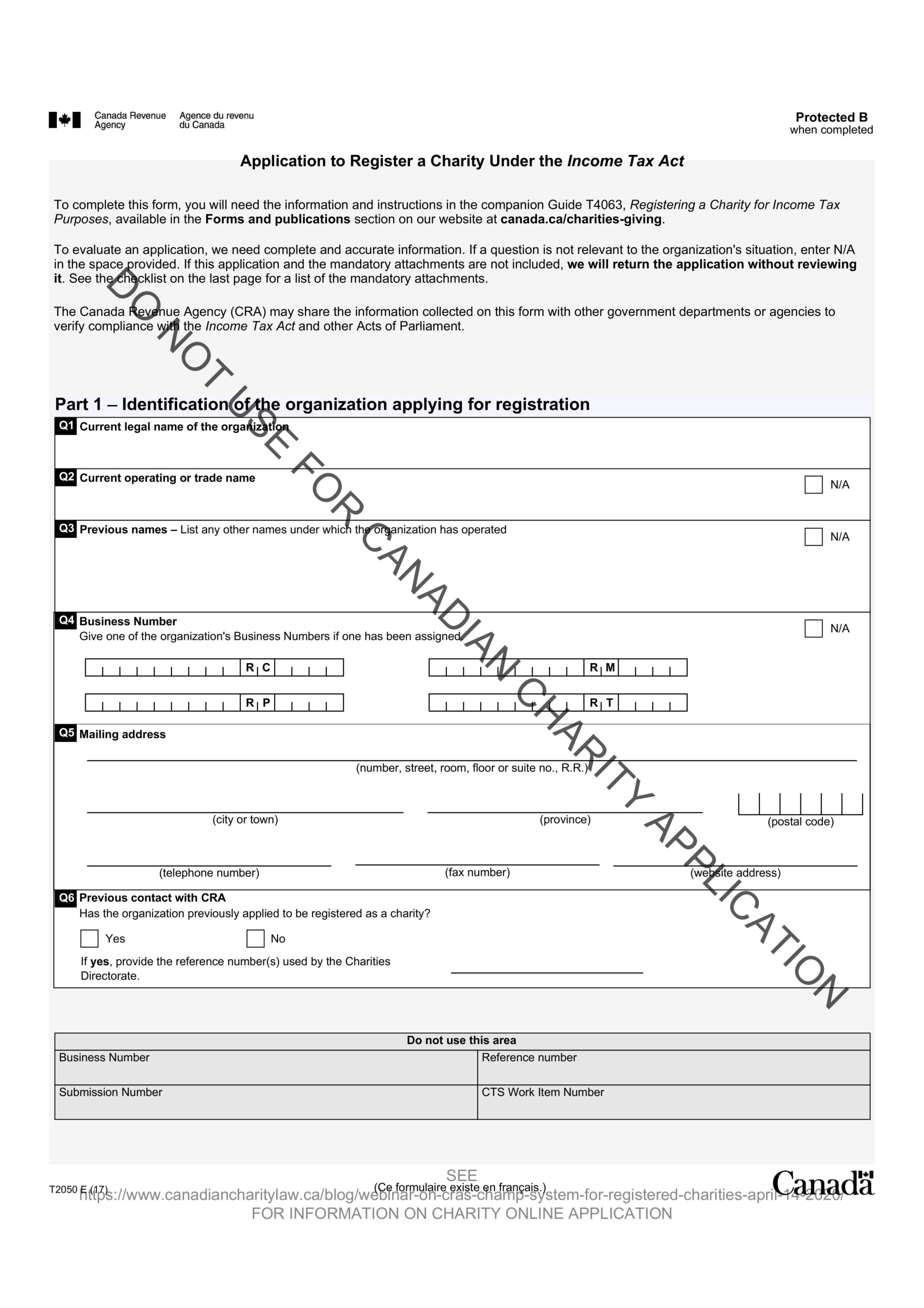
Don’t Use the Form T2050 To Register a Charity In Canada: It is No Longer Accepted by the CRA
Understanding the process to register a charity in Canada is crucial for any organization aiming to make a significant social impact.
It’s important to note that the Canada Revenue Agency (CRA) has transitioned to a primarily online application system. The previously used T2050 form is no longer accepted by the CRA.
We’ve heard anecdotally from CRA examiners that four years after the form has been discontinued, it continues to receive tens of applications to register a Canadian charity using form T2050 every year, including from accountants and law firms!
While a paper application is still available upon request for those with extenuating circumstances, be aware that these applications face significantly longer processing times. The CRA actively encourages all applicants to utilize the online system.
It’s vital to recognize that applying to register a charity in Canada is a far more intricate process than obtaining a standard business number or license. The CRA requires extensive documentation and information to assess an organization’s eligibility.
Furthermore, becoming a registered charity entails substantial ongoing compliance obligations. Organizations must be prepared to adhere to stringent regulations and reporting requirements.
Professional Assistance:
Many organizations seek professional legal assistance to navigate the complexities of the CRA Charity Registration application process. Experienced Charity Lawyers can provide valuable guidance and support, ensuring a smoother and more efficient application experience. With about 50% of all charity applications being rejected annually by the CRA – Charities Directorate, the ROI of using an experienced Charity Consulting Firm, such as Northfield & Associates, is invaluable.
By understanding the updated online application process and the associated compliance requirements, organizations can better prepare to register a charity or Foundation in Canada and maximize their positive impact.
If you are looking to register your charity using the CRA’s mandated online portal and need assistance, contact our charity registration legal team.
At Northfield & Associates our expert teams guidance on compliance requirements. Our team understands Canadian charity law and can help ensure your organisation follows proper procedures.
In this evolving economic landscape, collaboration with our firm offers clients a strategic advantage. With Cambodia’s reform-driven investment environment and Canada’s expanding footprint in Southeast Asia, our team of experienced consultants and legal advisors provides tailored guidance to help businesses navigate cross-border opportunities. We focus in developing comprehensive legal strategies, structuring international partnerships, and ensuring compliance in emerging markets.
By leveraging our regional insight and international expertise, you benefit from a trusted partner dedicated to helping you capitalize on growth potential in Cambodia and beyond.
Book a Consultation with Northfield & Associates
Your Trusted Partner in International Bilateral Relations
At Northfield & Associates are focus in Foreign Direct Investment (FDI), international trade missions, and cross-border legal strategy. Our team of experienced consultants and legal advisors offers tailored guidance and strategic insight to help you navigate the complexities of international partnerships and development opportunities.
Whether you choose to meet in person at one of our offices or connect virtually, we provide flexible and accessible consultation options. During your session, we’ll assess your goals, review key documentation, and guide you through every stage of your FDI or trade mission engagement.
Let us help you take the next step with confidence supported by trusted legal and strategic counsel every step of the way.
Take the First Step Today
If you believe you may be eligible for legal relief or simply need sound legal advice, we’re here to help. Contact us today to book your consultation. Let us provide the clarity, strategy, and peace of mind you need to move forward.
We serve our clients in English, Cambodian, Vietnamese, Mandarin and Cantonese, especially in Asian clients.
If you or anybody that you know, think that you meet the requirements and wish to receive further information.
We can help you start the application process and confirm eligibility requirements to participate.
We Offer Consultations & Meetings by Phone & Virtually. Affordable Fees.
Disclaimer:
The information contained in this article is provided for general information purposes only and does not constitute legal or other professional advice. Readers should seek tailored legal advice in relation to their personal circumstances.
Northfield & Associates International Corporation is a global consulting firm serving private enterprises, public institutions, not-for-profit organizations, and institutional capital providers. Operating across Cambodia, Canada, and global markets, the firm supports capital deployment, regulatory navigation, and enterprise decision-making in complex economic and geopolitical environments. Northfield & Associates delivers customized, execution-focused advisory solutions that drive measurable transformation, strengthen competitiveness, and enhance long-term highest value opportunities. The firm incorporates consulting, legal, regulatory, financial, and risk expertise to enable disciplined capital allocation, strong governance, and operational resilience. Northfield & Associates upholds a culture of applied insight and innovation, supporting clients across digital transformation, growth strategy, and organizational capability building. The firm advises individual, leading global corporations, midsize enterprises, government agencies, and mission-driven organizations through long-term partnerships. Enterprise-wide risk management, professional ethics, and fiduciary standards are embedded across all operations. Northfield & Associates’ diverse, globally unified teams are committed to execution certainty and sustainable, risk-adjusted returns aligned with ESG and stakeholder objectives.
Forward-Looking Information
This news release contains forward-looking information. All statements, other than statements of historic fact, that address activities, events or developments that the Company believes, expects or anticipates will or may occur in the future constitute forward-looking information.
This forward-looking information reflects the current expectations or beliefs of the Company based on information currently available to the Company.
Forward-looking information is subject to a number of risks and uncertainties that may cause the actual results of the Company to differ materially from those discussed in the forward-looking information, and even if such actual results are realized or substantially realized, there can be no assurance that they will have the expected consequences to, or effects on the Company. Factors that could cause actual results or events to differ materially from current expectations include, among other things: the failure to finalize negotiations concerning the increase of the Loan or to close such transaction and the failure of the Company to complete the acquisition of the Company Facility; operating performance of facilities; environmental and safety risks; delays in obtaining or failure to obtain necessary permits and approvals from government authorities; unavailability of plant, equipment or labour; inability to retain key management and personnel; changes to regulations or policies affecting the Company’s activities; and the other risks disclosed under the heading “Risk Factors” and elsewhere in the Company’s amended annual information.
Forward-looking information speaks only as of the date on which it is made and, except as may be required by applicable securities laws, the Company disclaims any intent or obligation to update any forward-looking information, whether as a result of new information, future events or results or otherwise. Although the Company believes that the assumptions inherent in the forward-looking information are reasonable, forward-looking information is not a guarantee of future performance and accordingly undue reliance should not be put on such information due to the inherent uncertainty therein.
Questions?
info@northfied.biz
Within Corporate Newsroom
Media Contact:
media@northfied.biz
Press contact
PR consultants press@northfied.biz
NOT LEGAL ADVICE. Information made available on this website in any form is for information purposes only. It is not, and should not be taken as, legal advice. You should not rely on, or take or fail to take any action based upon this information. Never disregard professional legal advice or delay in seeking legal advice because of something you have read on this website. Northfield & Associates professionals will be pleased to discuss resolutions to specific legal concerns you may have.
Why the CRA Ghosted Your Private Foundation Application (And How to Win Them Back)
So, you’ve done well for yourself. Maybe you sold your business, your investments paid off handsomely, or you finally convinced your wealthy aunt that you were her favorite nephew. Whatever the reason, you’ve decided to join the ranks of philanthropic elite by starting your own private foundation in Canada. You’ve imagined the press releases, the galas, maybe even a building with your name on it.
Then you got the letter.
The Canada Revenue Agency—those delightful folks who live to audit your receipts and question your home office claims—has rejected your application. Welcome to the club nobody wants to join. Let’s talk about why this happened and, more importantly, how to avoid becoming a cautionary tale at your lawyer’s office.
You Thought This Was Going to Be Easy (Spoiler: It’s Not)
Embed this infographic on your site:
Here’s the thing about starting a private foundation: it’s not like opening a lemonade stand. You can’t just slap together some paperwork, declare yourself a philanthropist, and start issuing tax receipts to your golf buddies.
The CRA application process can take anywhere from two months for “simple” applications to six months or more for “regular” ones. And trust me, if you’re reading this article because your application was rejected, yours definitely fell into the “regular” category—or worse, the “what were they thinking?” category.
Reason #1: You Confused “Private Foundation” with “Private Piggy Bank”
Let’s start with the most common misconception. Remember that businessman from our sources who, standing at his dying brother’s bedside, realized you can’t take your wealth with you? Well, he also learned you can’t use a private foundation as a personal ATM.
Once you donate property to a private foundation, it’s gone. Forever. You cannot retrieve it. Not for emergencies. Not for “just this once.” Not because you promised your kid you’d help with their down payment and forgot about it.
The CRA has seen it all: people trying to move money in and out of foundations for non-charitable purposes, treating the foundation like a flexible savings account with better tax benefits. This is explicitly prohibited, and attempting it is a fast track to rejection—or worse, revocation of charitable status if you somehow sneak through.
Real-life example: Imagine Uncle Bob sets up his foundation, donates $500,000, and then six months later decides he actually needs that money for his vacation property in Muskoka. Too bad, Uncle Bob. That money now belongs to charity. The CRA doesn’t care that your real estate agent assured you the cottage was a “can’t-miss opportunity.”
Reason #2: Your “Charitable Purpose” Was More “Vague Purpose”
To get CRA approval, you need defined charitable objectives. “Doing good things” doesn’t cut it. Neither does “helping people” or “making the world better” or any other fortune cookie philosophy you pulled from your vision board.
The CRA recognizes four charitable purposes: relief of poverty, advancement of education, advancement of religion, and other purposes beneficial to the community. Your application needs to clearly articulate which category you’re targeting and how you plan to achieve your goals.
What went wrong: You probably wrote something like “We want to support great causes in our community and help those in need.” The CRA read that and thought, “Cool story. Which causes? Which needs? How will you determine who to help? What’s your criteria?”
What you should have done: Be specific. Instead of “supporting education,” try “providing scholarships to low-income students pursuing STEM degrees at accredited Canadian universities.” See the difference? One sounds like a beauty pageant answer; the other sounds like a plan.
Reason #3: You Tried to Sneak in Private Company Shares (and Got Caught)
Oh boy. This is where things get spicy.
Remember that 2007 federal budget that made everyone excited because you could now donate listed securities without capital gains? Well, the government giveth, and the government also created the Excess Corporate Holdings Regime for Private Foundations.
Here’s the deal: if your foundation owns more than 2% of any share class of a private company, you enter what’s called the “Monitoring” range. Own more than 20%? Welcome to the “Divestment” range, where you have specific time frames to reduce your holdings or face penalties that would make a tax accountant weep.
The horror story: You donated 30% of your private company shares to your new foundation, thinking you were being generous. The CRA looked at this and saw a potential tax avoidance scheme. First-offense penalty? Five percent of the fair market value of those shares multiplied by your divestment obligation. Second offense within five years? That jumps to 10%. Fail to file properly? Another 10% penalty.
As one source wisely noted: “Unless there is a specific and immediate plan to redeem the shares caught by this legislation, I strongly suggest that donors not use this type of property in private foundations.” Translation: Don’t even think about it unless you have a rock-solid exit strategy and a lawyer who specializes in making miracles happen.
Reason #4: Your Family Involvement Plan Looked Like a Dynasty
Private foundations can absolutely be family affairs. In fact, the majority of them are. Family members can sit on the board, make decisions together, and create a lasting legacy. It’s actually one of the beautiful things about private foundations—three generations working together to do good.
But here’s where people trip up: they don’t think through the governance structure, conflict-of-interest policies, or succession planning. They create a board that’s 100% blood relatives with no thought to what happens when Uncle Jerry and Aunt Martha stop speaking to each other over that incident at Christmas 2023.
What the CRA saw: A governance structure that looked less like a professional charitable organization and more like a family reunion where someone’s going to end up crying in the bathroom.
What you needed: Clear bylaws. Defined roles. Conflict-of-interest guidelines. Decision-making processes that don’t involve shouting matches. As one third-generation foundation chairman wisely noted: “Set conflict of interest guidelines. Have some policies or a healthy discussion that is recorded for posterity for successive meetings on how personal interests should be dealt with.”
Reason #5: You Underestimated the Money (and Overestimated Your Commitment)
Let’s talk about everyone’s favorite topic: money.
The setup costs: Legal fees for incorporation and CRA registration typically run between $5,000-$15,000, though more complex foundations can cost up to $25,000.
The minimum investment: While there’s technically no minimum amount required to start a foundation, most experts recommend at least $1 million. Why? Because of the disbursement quota.
The disbursement quota: This is the kicker that trips up many applicants. Your foundation must spend 3.5% of its invested assets annually on charitable activities (for those with revenue under $1,000,000). If you start with $100,000, that’s $3,500 per year. After administrative costs (typically 0.75%-1.5% of assets), investment management fees, and other expenses, you’re left with very little for actual grantmaking.
The time commitment: One founder admitted, “I didn’t know entirely what I was getting into when I started. If I hadn’t become so personally involved, I’m not sure I’d be doing today what I’m doing.” Starting a foundation isn’t passive philanthropy. It’s a part-time job at minimum, possibly a full-time one if you’re serious.
Where applications fail: You probably proposed starting a foundation with $250,000, no clear plan for adding capital, vague administrative support, and the assumption that you could run this in your spare time between your day job, coaching Little League, and your standing golf game.
Reason #6: You Got Creative with What Qualifies as “Charitable Activities”
The CRA is very specific about where foundation money can go: registered charities, registered amateur athletic associations, public bodies, and other qualified donees. That’s it. That’s the list.
You cannot:
Fund your buddy’s “totally going to change the world” startup
Support international organizations that aren’t on the CRA’s approved list
Give money directly to individuals in need (even if they really, really need it)
Engage in business activities (private foundations are explicitly prohibited from this, unlike other charities)
The mistake: Your application probably included some well-intentioned but technically ineligible activities. Maybe you wanted to help entrepreneurs in developing countries, fund a community organization that isn’t actually registered as a charity, or support a cause that’s more political than philanthropic.
What you should have done: Before writing your application, you should have verified that every single organization and activity you planned to support meets CRA’s qualified donee requirements. This isn’t the time for creative interpretation.
Reason #7: Your Legal Structure Was Half-Baked
You have two options for structuring your foundation: as a trust or as a corporation. Most people choose incorporation because it provides limited liability and is generally easier to manage. But here’s where things went sideways:
You probably:
Didn’t consult with a lawyer who specializes in charitable law
Used generic incorporation documents that weren’t properly tailored for a charitable organization
Forgot that after incorporation, you still need to register with the CRA as a charity
Didn’t properly establish whether you wanted an inter-vivos trust (operating during your lifetime) or a testamentary trust (established by your will)
The two-step tango: Setting up a private foundation requires two distinct steps. First, create the legal entity (trust or corporation). Second, apply for charitable status with the CRA. You can’t do them simultaneously, and messing up either step means starting over.
Reason #8: Your Application Looked Like You Wrote It During Halftime
The CRA application requires responses to 21 questions. Twenty-one questions that determine whether your foundation receives charitable status and all the tax benefits that come with it.
Looking at rejected applications, it’s clear that some people treated this like a job application for a position they don’t really want. Rushed answers. Vague descriptions. Copy-pasted text from other foundations’ websites. Missing information. Inconsistencies that suggest different people filled out different sections without talking to each other.
Governance structure that would make a corporate lawyer nervous
Activities that might technically violate CRA regulations
How to Actually Get It Right
Alright, enough doom and gloom. Let’s talk about how to avoid rejection and join the successful 5,334 private foundations currently operating in Canada.
1. Start with Soul-Searching, Not Spreadsheets
Before you fill out a single form, ask yourself:
Why do I really want to do this?
What specific problem am I trying to solve?
Am I willing to permanently part with this money?
Do I have the time to be genuinely involved?
How do I want my family involved (if at all)?
What’s my 10-year vision for this foundation?
One co-founder put it perfectly: “I think philanthropy can give meaning to your life. I don’t want to have a lot of regrets when I’m 85, 95. I want to be able to say, you gave back, you made a difference.”
2. Hire Professionals (and Actually Listen to Them)
This is not a DIY project. You need:
A lawyer specializing in charitable law
An accountant familiar with foundation taxation
A financial advisor who understands philanthropic planning
Possibly a consultant on philanthropic strategy
Yes, this will cost money. But it costs far less than having your application rejected and starting over, or worse, having your foundation’s charitable status revoked later because you didn’t understand the rules.
3. Be Boringly Specific
Your mission statement should be so specific that someone could read it and immediately understand exactly what you’re doing. Compare:
Bad: “Supporting children’s education in Canada”
Good: “Providing academic scholarships and mentorship programs to students from low-income families in Atlantic Canada pursuing post-secondary education in STEM fields, with emphasis on first-generation university students”
Yes, the second one is wordier. It’s also approvable. (See: CRA Guidance CG-019 for more on drafting purposes).
4. Plan for the Long Haul
Most foundations are created to promote sustained giving over time. Your application should demonstrate that you’ve thought about:
How the foundation will be funded initially and ongoing
Investment strategy to meet the disbursement quota while maintaining capital
Governance structure that can outlive the founders
Succession planning for board members
How the foundation will evolve over decades
5. Get Your Governance House in Order
Before you submit your application, you should have draft documents for:
Bylaws or trust deed
Conflict of interest policy
Investment policy
Grantmaking guidelines
Board member roles and responsibilities
Compensation policy (most board members serve as volunteers, and in some provinces like Ontario, it’s prohibited to compensate them)
6. Understand the Money Math
Run the numbers before you commit:
Annual disbursement quota (3.5% of assets)
Administrative expenses (0.75%-1.5% of assets)
Investment management fees
Audit and legal fees
Other operational costs
If you’re starting with $500,000, your annual disbursement quota is $17,500. After expenses, you might have $10,000-$12,000 for actual grants. Is that enough to achieve your mission? If not, you need more initial capital or a plan to grow the endowment.
Private company shares (proceed with extreme caution)
Art and collectibles
One financial advisor recommends to commit at least $1 million, though this can be funded over several years. Start with what you can comfortably contribute now, and plan for future additions.
8. Study Successful Foundations
Before you apply, research foundations with similar missions. Look at their public filings (available through the CRA website). See how they articulate their purposes, structure their governance, and report their activities.
You don’t need to reinvent the wheel. Learn from those who’ve successfully navigated the process.
The Silver Lining
If your application was rejected, you’re not alone. Many successful foundations had to revise and resubmit their applications. The difference between them and the permanently rejected is that they listened to the feedback, addressed the concerns, and tried again with better preparation.
As one executive director of a second-generation foundation noted: “It’s money for the common good. I think there are a lot of philanthropists who are taking that responsibility seriously.”
The CRA isn’t trying to prevent you from doing good—they’re ensuring that entities claiming charitable status are legitimate, well-governed, and actually serving charitable purposes. Their job is to protect the integrity of the charitable sector and ensure that tax advantages aren’t abused.
Your Next Steps
So your application was rejected. Here’s what to do:
Read the rejection letter carefully. The CRA usually explains why they said no. Don’t dismiss their concerns as bureaucratic nonsense—address each one specifically.
Consult with professionals who specialize in charitable law and CRA applications. Share the rejection letter with them. Get their honest assessment.
Consider alternatives. Maybe a private foundation isn’t the right vehicle for your philanthropic goals right now. Donor-advised funds offer many similar benefits with less administrative burden and lower startup costs.
If you’re committed to the foundation route, revise your application thoroughly. Don’t just tweak a few sentences—fundamentally address the CRA’s concerns.
Take your time. The application can take 6+ months even when everything goes smoothly. Rushing the resubmission will likely result in another rejection.
The Bottom Line
Starting a private foundation in Canada is one of the most rewarding ways to give back to your community and create a lasting legacy. But it requires genuine commitment, substantial resources, proper planning, and professional guidance.
The CRA rejected your application not because they’re heartless bureaucrats who hate philanthropy (though I’m sure you called them worse things when you got that letter), but because your application didn’t meet the legal requirements for charitable status.
Learn from it. Fix it. Try again.
And next time, maybe start with that soul-searching before you fill out the paperwork. As one third-generation foundation trustee wisely noted: “If you’re going to have a lot of related family members involved, set conflict of interest guidelines. Have some policies or a healthy discussion that is recorded for posterity.”
In other words: do the hard thinking before you do the paperwork. Your future board meetings—and your relationship with the CRA—will thank you for it.
In this evolving economic landscape, collaboration with our firm offers clients a strategic advantage. With Cambodia’s reform-driven investment environment and Canada’s expanding footprint in Southeast Asia, our team of experienced consultants and legal advisors provides tailored guidance to help businesses navigate cross-border opportunities. We focus in developing comprehensive legal strategies, structuring international partnerships, and ensuring compliance in emerging markets.
By leveraging our regional insight and international expertise, you benefit from a trusted partner dedicated to helping you capitalize on growth potential in Cambodia and beyond.
Book a Consultation with Northfield & Associates
Your Trusted Partner in International Bilateral Relations
At Northfield & Associates are focus in Foreign Direct Investment (FDI), international trade missions, and cross-border legal strategy. Our team of experienced consultants and legal advisors offers tailored guidance and strategic insight to help you navigate the complexities of international partnerships and development opportunities.
Whether you choose to meet in person at one of our offices or connect virtually, we provide flexible and accessible consultation options. During your session, we’ll assess your goals, review key documentation, and guide you through every stage of your FDI or trade mission engagement.
Let us help you take the next step with confidence supported by trusted legal and strategic counsel every step of the way.
Take the First Step Today
If you believe you may be eligible for legal relief or simply need sound legal advice, we’re here to help. Contact us today to book your consultation. Let us provide the clarity, strategy, and peace of mind you need to move forward.
We serve our clients in English, Cambodian, Vietnamese, Mandarin and Cantonese, especially in Asian clients.
If you or anybody that you know, think that you meet the requirements and wish to receive further information.
We can help you start the application process and confirm eligibility requirements to participate.
We Offer Consultations & Meetings by Phone & Virtually. Affordable Fees.
Disclaimer:
The information contained in this article is provided for general information purposes only and does not constitute legal or other professional advice. Readers should seek tailored legal advice in relation to their personal circumstances.
Northfield & Associates International Corporation is a global consulting firm serving private enterprises, public institutions, not-for-profit organizations, and institutional capital providers. Operating across Cambodia, Canada, and global markets, the firm supports capital deployment, regulatory navigation, and enterprise decision-making in complex economic and geopolitical environments. Northfield & Associates delivers customized, execution-focused advisory solutions that drive measurable transformation, strengthen competitiveness, and enhance long-term highest value opportunities. The firm incorporates consulting, legal, regulatory, financial, and risk expertise to enable disciplined capital allocation, strong governance, and operational resilience. Northfield & Associates upholds a culture of applied insight and innovation, supporting clients across digital transformation, growth strategy, and organizational capability building. The firm advises individual, leading global corporations, midsize enterprises, government agencies, and mission-driven organizations through long-term partnerships. Enterprise-wide risk management, professional ethics, and fiduciary standards are embedded across all operations. Northfield & Associates’ diverse, globally unified teams are committed to execution certainty and sustainable, risk-adjusted returns aligned with ESG and stakeholder objectives.
Forward-Looking Information
This news release contains forward-looking information. All statements, other than statements of historic fact, that address activities, events or developments that the Company believes, expects or anticipates will or may occur in the future constitute forward-looking information.
This forward-looking information reflects the current expectations or beliefs of the Company based on information currently available to the Company.
Forward-looking information is subject to a number of risks and uncertainties that may cause the actual results of the Company to differ materially from those discussed in the forward-looking information, and even if such actual results are realized or substantially realized, there can be no assurance that they will have the expected consequences to, or effects on the Company. Factors that could cause actual results or events to differ materially from current expectations include, among other things: the failure to finalize negotiations concerning the increase of the Loan or to close such transaction and the failure of the Company to complete the acquisition of the Company Facility; operating performance of facilities; environmental and safety risks; delays in obtaining or failure to obtain necessary permits and approvals from government authorities; unavailability of plant, equipment or labour; inability to retain key management and personnel; changes to regulations or policies affecting the Company’s activities; and the other risks disclosed under the heading “Risk Factors” and elsewhere in the Company’s amended annual information.
Forward-looking information speaks only as of the date on which it is made and, except as may be required by applicable securities laws, the Company disclaims any intent or obligation to update any forward-looking information, whether as a result of new information, future events or results or otherwise. Although the Company believes that the assumptions inherent in the forward-looking information are reasonable, forward-looking information is not a guarantee of future performance and accordingly undue reliance should not be put on such information due to the inherent uncertainty therein.
Questions?
info@northfied.biz
Within Corporate Newsroom
Media Contact:
media@northfied.biz
Press contact
PR consultants press@northfied.biz
NOT LEGAL ADVICE. Information made available on this website in any form is for information purposes only. It is not, and should not be taken as, legal advice. You should not rely on, or take or fail to take any action based upon this information. Never disregard professional legal advice or delay in seeking legal advice because of something you have read on this website. Northfield & Associates professionals will be pleased to discuss resolutions to specific legal concerns you may have.
How Can Churches, Temples and Mosques Improve Volunteer Engagement?
Volunteers play a vital role in driving the mission of a church, temple and mosques forward. They support outreach, evangelism, and various faith programs, ensuring that the church, temple and mosques or mosque can continue its good work in the community. However, to maximize their impact, church, temple and mosques volunteers need proper training. Here are five training tips to empower your church, temple and mosques volunteers and help them serve more effectively.
1. Connect Volunteers with Your Church’s Mission
To start, it’s essential for volunteers to understand and connect with your church’s, temple’s and mosque’s mission. This connection will deepen their commitment and help them see how their efforts contribute to the church’s, temple’s and mosque’s goals.
How to Connect Volunteers with Your Mission:
Group Bible Studies: Choose a Bible or other religions scripts study that reflects your church’s, temple’s and mosque’s mission. Discuss how volunteer roles help achieve this mission.
Testimonies: Invite church, temple and mosques leaders or members to share stories about how the church, temple and mosques has impacted their lives, highlighting the role of volunteers.
Church History Overview: Share the story of your church’s, temple’s and mosque’s beginnings, its initial purpose, and how it has evolved. This gives volunteers a sense of belonging and purpose.
Personal Stories: Encourage volunteers to share their own stories and motivations. This mutual sharing fosters a supportive community and a deeper connection to the church’s, temple’s and mosque’s mission.
2. Create Comprehensive Training Materials
Once volunteers understand the mission, provide detailed training on their specific roles. A well-structured training program will prepare them to handle their responsibilities kconfidently.
Key Components of Training Materials:
Role-Playing Activities: Simulate common scenarios volunteers might face. This helps them practice and improve their responses in a supportive environment.
Interactive Quizzes: Use quizzes to test volunteers’ knowledge about their roles and church, temple and mosques procedures. Reviewing answers as a group ensures everyone is on the same page.
Q&A Sessions: Allow volunteers to ask questions and receive answers from leaders. This clarifies doubts and promotes a culture of open communication.
Detailed Guides: Provide written guides covering essential information, like the church, temple and mosques status and other logistical details. Volunteers can refer to these guides even after training ends.
3. Offer Ongoing Learning Opportunities
Learning shouldn’t stop after the initial training. Continuous learning keeps volunteers engaged and helps them grow in their roles.
Ways to Provide Ongoing Learning:
Books and Studies: Offer resources that emphasize the importance of volunteer service and its spiritual rewards.
Mentorship: Pair new volunteers with experienced ones for one-on-one guidance. This fosters a strong, supportive volunteer community.
Workshops and Training Sessions: Host regular workshops to help volunteers develop specific skills. Frequent sessions ensure that training is accessible when needed.
Easy Access to Support: Invest in volunteer management software or appoint a group leader to facilitate communication and address questions promptly.
4. Encourage Volunteer Growth
As your church, temple and mosques grows, so should the opportunities for your volunteers. Supporting their growth ensures they stay motivated and can take on new challenges.
Strategies to Encourage Growth:
Shadowing Opportunities: Let volunteers shadow church, temple and mosques leaders to learn about different roles firsthand.
Rotational Assignments: Rotate volunteers through different areas of ministry to broaden their experience.
Increased Responsibility: Allow volunteers to take on leadership roles within the volunteer program. This prepares them for larger responsibilities in the future.
Clear Growth Pathways: Clearly outline the steps for volunteers to advance to leadership positions. This transparency helps them understand how they can grow within the church.
5. Show Volunteer Appreciation
Recognizing volunteers’ efforts boosts their morale and reinforces their value to the church, temple and mosques community. Appreciation should be an ongoing part of the volunteer experience, not just an afterthought.
Creative Ways to Show Appreciation:
Personalized Thank-You Notes: Send thank-you cards that highlight specific achievements during training. Personal touches show volunteers that their contributions are noticed and valued.
Appreciation Events: Host events like dinners for volunteers and their families. Use these occasions to thank volunteers publicly and celebrate their hard work.
Gifts: Give meaningful gifts, such as tickets to a religious conference, which can also serve as an opportunity for volunteers to connect with each other.
Involvement of Church Leaders: Encourage church, temple and mosques leaders to express their appreciation, such as through handwritten notes or video messages from congregants.
By implementing these training tips, your church, temple and mosques can empower volunteers to serve more effectively, leading to a more impactful ministry. Proper training not only equips volunteers with the necessary skills but also connects them deeply with the church’s, temple’s and mosque’s mission, fostering a committed and enthusiastic volunteer community.
In this evolving economic landscape, collaboration with our firm offers clients a strategic advantage. With Cambodia’s reform-driven investment environment and Canada’s expanding footprint in Southeast Asia, our team of experienced consultants and legal advisors provides tailored guidance to help businesses navigate cross-border opportunities. We focus in developing comprehensive legal strategies, structuring international partnerships, and ensuring compliance in emerging markets.
By leveraging our regional insight and international expertise, you benefit from a trusted partner dedicated to helping you capitalize on growth potential in Cambodia and beyond.
Book a Consultation with Northfield & Associates
Your Trusted Partner in International Bilateral Relations
At Northfield & Associates are focus in Foreign Direct Investment (FDI), international trade missions, and cross-border legal strategy. Our team of experienced consultants and legal advisors offers tailored guidance and strategic insight to help you navigate the complexities of international partnerships and development opportunities.
Whether you choose to meet in person at one of our offices or connect virtually, we provide flexible and accessible consultation options. During your session, we’ll assess your goals, review key documentation, and guide you through every stage of your FDI or trade mission engagement.
Let us help you take the next step with confidence supported by trusted legal and strategic counsel every step of the way.
Take the First Step Today
If you believe you may be eligible for legal relief or simply need sound legal advice, we’re here to help. Contact us today to book your consultation. Let us provide the clarity, strategy, and peace of mind you need to move forward.
We serve our clients in English, Cambodian, Vietnamese, Mandarin and Cantonese, especially in Asian clients.
If you or anybody that you know, think that you meet the requirements and wish to receive further information.
We can help you start the application process and confirm eligibility requirements to participate.
We Offer Consultations & Meetings by Phone & Virtually. Affordable Fees.
Disclaimer:
The information contained in this article is provided for general information purposes only and does not constitute legal or other professional advice. Readers should seek tailored legal advice in relation to their personal circumstances.
Northfield & Associates International Corporation is a global consulting firm serving private enterprises, public institutions, not-for-profit organizations, and institutional capital providers. Operating across Cambodia, Canada, and global markets, the firm supports capital deployment, regulatory navigation, and enterprise decision-making in complex economic and geopolitical environments. Northfield & Associates delivers customized, execution-focused advisory solutions that drive measurable transformation, strengthen competitiveness, and enhance long-term highest value opportunities. The firm incorporates consulting, legal, regulatory, financial, and risk expertise to enable disciplined capital allocation, strong governance, and operational resilience. Northfield & Associates upholds a culture of applied insight and innovation, supporting clients across digital transformation, growth strategy, and organizational capability building. The firm advises individual, leading global corporations, midsize enterprises, government agencies, and mission-driven organizations through long-term partnerships. Enterprise-wide risk management, professional ethics, and fiduciary standards are embedded across all operations. Northfield & Associates’ diverse, globally unified teams are committed to execution certainty and sustainable, risk-adjusted returns aligned with ESG and stakeholder objectives.
Forward-Looking Information
This news release contains forward-looking information. All statements, other than statements of historic fact, that address activities, events or developments that the Company believes, expects or anticipates will or may occur in the future constitute forward-looking information.
This forward-looking information reflects the current expectations or beliefs of the Company based on information currently available to the Company.
Forward-looking information is subject to a number of risks and uncertainties that may cause the actual results of the Company to differ materially from those discussed in the forward-looking information, and even if such actual results are realized or substantially realized, there can be no assurance that they will have the expected consequences to, or effects on the Company. Factors that could cause actual results or events to differ materially from current expectations include, among other things: the failure to finalize negotiations concerning the increase of the Loan or to close such transaction and the failure of the Company to complete the acquisition of the Company Facility; operating performance of facilities; environmental and safety risks; delays in obtaining or failure to obtain necessary permits and approvals from government authorities; unavailability of plant, equipment or labour; inability to retain key management and personnel; changes to regulations or policies affecting the Company’s activities; and the other risks disclosed under the heading “Risk Factors” and elsewhere in the Company’s amended annual information.
Forward-looking information speaks only as of the date on which it is made and, except as may be required by applicable securities laws, the Company disclaims any intent or obligation to update any forward-looking information, whether as a result of new information, future events or results or otherwise. Although the Company believes that the assumptions inherent in the forward-looking information are reasonable, forward-looking information is not a guarantee of future performance and accordingly undue reliance should not be put on such information due to the inherent uncertainty therein.
Questions?
info@northfied.biz
Within Corporate Newsroom
Media Contact:
media@northfied.biz
Press contact
PR consultants press@northfied.biz
NOT LEGAL ADVICE. Information made available on this website in any form is for information purposes only. It is not, and should not be taken as, legal advice. You should not rely on, or take or fail to take any action based upon this information. Never disregard professional legal advice or delay in seeking legal advice because of something you have read on this website. Northfield & Associates professionals will be pleased to discuss resolutions to specific legal concerns you may have.
Debt obligations register (where relevant) showing: (a) the name and residential or business address of each debt obligation holder; (b) an email address; (c) the date of debt entered into; (d) the date on which debt was ceased; and (e) the principal amount of the debt;
Director’s register showing the (a) names, (b) residential address, (c) email address, (d) the date of appointment, and (e) the date of termination;
Officers register showing the (a) names, (b) residential address, (c) email address, (d) the date of appointment, and (e) the date of termination;
Members register showing the (a) names, (b) residential address, (c) email address, (d) the date of appointment, (e) the date of termination, and (f) the class or group of membership of each member, if relevant.
In addition to the records mentioned above, not-for-profit corporations must keep financial records and supporting documentation, including receipts, invoices, and bank statements, for at least six years. These records must show all monetary transactions and the corporation’s financial position and be kept in a manner that allows for accurate and timely preparation of financial statements.
Not-for-profit corporations must also maintain a record of all donations received, including the donor’s name, address, and the amount and date of the donation. This record must be kept for at least six years and available for inspection by the Canada Revenue Agency upon request.
Furthermore, suppose a not-for-profit corporation is a registered charity. In that case, it must maintain additional records, such as a list of all disbursements made by the charity and a copy of any tax receipts issued to donors.
Not-for-profit corporations are legally required to maintain accurate and complete records, which helps ensure transparency and accountability to members, donors, and other stakeholders.
In this evolving economic landscape, collaboration with our firm offers clients a strategic advantage. With Cambodia’s reform-driven investment environment and Canada’s expanding footprint in Southeast Asia, our team of experienced consultants and legal advisors provides tailored guidance to help businesses navigate cross-border opportunities. We focus in developing comprehensive legal strategies, structuring international partnerships, and ensuring compliance in emerging markets.
By leveraging our regional insight and international expertise, you benefit from a trusted partner dedicated to helping you capitalize on growth potential in Cambodia and beyond.
Book a Consultation with Northfield & Associates
Your Trusted Partner in International Bilateral Relations
At Northfield & Associates are focus in Foreign Direct Investment (FDI), international trade missions, and cross-border legal strategy. Our team of experienced consultants and legal advisors offers tailored guidance and strategic insight to help you navigate the complexities of international partnerships and development opportunities.
Whether you choose to meet in person at one of our offices or connect virtually, we provide flexible and accessible consultation options. During your session, we’ll assess your goals, review key documentation, and guide you through every stage of your FDI or trade mission engagement.
Let us help you take the next step with confidence supported by trusted legal and strategic counsel every step of the way.
Take the First Step Today
If you believe you may be eligible for legal relief or simply need sound legal advice, we’re here to help. Contact us today to book your consultation. Let us provide the clarity, strategy, and peace of mind you need to move forward.
We serve our clients in English, Cambodian, Vietnamese, Mandarin and Cantonese, especially in Asian clients.
If you or anybody that you know, think that you meet the requirements and wish to receive further information.
We can help you start the application process and confirm eligibility requirements to participate.
We Offer Consultations & Meetings by Phone & Virtually. Affordable Fees.
Disclaimer:
The information contained in this article is provided for general information purposes only and does not constitute legal or other professional advice. Readers should seek tailored legal advice in relation to their personal circumstances.
Northfield & Associates International Corporation is a global consulting firm serving private enterprises, public institutions, not-for-profit organizations, and institutional capital providers. Operating across Cambodia, Canada, and global markets, the firm supports capital deployment, regulatory navigation, and enterprise decision-making in complex economic and geopolitical environments. Northfield & Associates delivers customized, execution-focused advisory solutions that drive measurable transformation, strengthen competitiveness, and enhance long-term highest value opportunities. The firm incorporates consulting, legal, regulatory, financial, and risk expertise to enable disciplined capital allocation, strong governance, and operational resilience. Northfield & Associates upholds a culture of applied insight and innovation, supporting clients across digital transformation, growth strategy, and organizational capability building. The firm advises individual, leading global corporations, midsize enterprises, government agencies, and mission-driven organizations through long-term partnerships. Enterprise-wide risk management, professional ethics, and fiduciary standards are embedded across all operations. Northfield & Associates’ diverse, globally unified teams are committed to execution certainty and sustainable, risk-adjusted returns aligned with ESG and stakeholder objectives.
Forward-Looking Information
This news release contains forward-looking information. All statements, other than statements of historic fact, that address activities, events or developments that the Company believes, expects or anticipates will or may occur in the future constitute forward-looking information.
This forward-looking information reflects the current expectations or beliefs of the Company based on information currently available to the Company.
Forward-looking information is subject to a number of risks and uncertainties that may cause the actual results of the Company to differ materially from those discussed in the forward-looking information, and even if such actual results are realized or substantially realized, there can be no assurance that they will have the expected consequences to, or effects on the Company. Factors that could cause actual results or events to differ materially from current expectations include, among other things: the failure to finalize negotiations concerning the increase of the Loan or to close such transaction and the failure of the Company to complete the acquisition of the Company Facility; operating performance of facilities; environmental and safety risks; delays in obtaining or failure to obtain necessary permits and approvals from government authorities; unavailability of plant, equipment or labour; inability to retain key management and personnel; changes to regulations or policies affecting the Company’s activities; and the other risks disclosed under the heading “Risk Factors” and elsewhere in the Company’s amended annual information.
Forward-looking information speaks only as of the date on which it is made and, except as may be required by applicable securities laws, the Company disclaims any intent or obligation to update any forward-looking information, whether as a result of new information, future events or results or otherwise. Although the Company believes that the assumptions inherent in the forward-looking information are reasonable, forward-looking information is not a guarantee of future performance and accordingly undue reliance should not be put on such information due to the inherent uncertainty therein.
Questions?
info@northfied.biz
Within Corporate Newsroom
Media Contact:
media@northfied.biz
Press contact
PR consultants press@northfied.biz
NOT LEGAL ADVICE. Information made available on this website in any form is for information purposes only. It is not, and should not be taken as, legal advice. You should not rely on, or take or fail to take any action based upon this information. Never disregard professional legal advice or delay in seeking legal advice because of something you have read on this website. Northfield & Associates professionals will be pleased to discuss resolutions to specific legal concerns you may have.
What are the ways in which a charity can collaborate with an intermediary?
Charities often face challenges in executing their activities, especially in regions where their staff may be unable to operate effectively. In such cases, charities turn to intermediaries who can provide essential resources, skills, and regional knowledge. However, working through an intermediary comes with its own set of considerations and responsibilities to ensure compliance with regulatory frameworks. In this article, we explore the dynamics of charity-intermediary relationships, common types of intermediaries, and the importance of maintaining control over resources.
Understanding Intermediaries:
Purposeful Selection and Review: Before engaging with an intermediary, a charity must thoroughly assess the intermediary’s capacity, including personnel, experience, and equipment. Regular reviews throughout the partnership ensure ongoing compliance and effectiveness.
Direction and Control: To avoid legal consequences, a charity must actively direct and control the use of its resources by the intermediary. Failure to do so can lead to sanctions under the Income Tax Act, including financial penalties or revocation of the charity’s registration.
Common Types of Intermediaries:
1. Consultant or Contractor: A consultant or contractor intermediary is engaged to carry out specific activities on behalf of the charity. This could involve hiring a non-profit organization or a for-profit contractor to provide services or expertise. A clear agreement detailing roles, responsibilities, and reporting mechanisms is crucial to maintaining control.
Example: Using a Consultant
A charity combating poverty in a developing country engages a foreign non-profit organization as a consultant. A detailed agreement outlines responsibilities, and the charity maintains control by intervening as needed.
Example: Using a Contractor
A charity addressing clean water scarcity hires a for-profit contractor to dig a well. A contract is established to ensure the charity’s resources are used in line with its purpose.
2. Joint Venture Participant: In a joint venture, a charity collaborates with other organizations to achieve a shared goal. Unlike a consultant or contractor, the charity actively participates in decision-making through a joint venture agreement.
Example: Direction and Control in a Joint Venture
A charity focused on empowering disadvantaged women partners with a foreign organization to provide education and business training. The charity controls a significant portion of the project funding and voting rights on the governing board.
3. Co-operative Participants: Co-operative participants work alongside a charity on specific aspects of a project, with each organization taking responsibility for distinct parts. This differs from a joint venture, where participants pool resources for the project as a whole.
Example: Co-operative Participant Project
A charity promoting health collaborates with a foreign organization to build and operate a medical clinic. The charity focuses on providing qualified nursing staff, while the foreign organization handles other aspects like construction and procurement.
Working through intermediaries can be a strategic approach for charities to extend their impact. However, it requires careful consideration, including the selection of suitable partners, maintaining control over resources, and adhering to regulatory guidelines. By understanding the nuances of different intermediary types and incorporating best practices in agreements, charities can navigate these partnerships successfully, ensuring their resources contribute effectively to their mission.
In this evolving economic landscape, collaboration with our firm offers clients a strategic advantage. With Cambodia’s reform-driven investment environment and Canada’s expanding footprint in Southeast Asia, our team of experienced consultants and legal advisors provides tailored guidance to help businesses navigate cross-border opportunities. We focus in developing comprehensive legal strategies, structuring international partnerships, and ensuring compliance in emerging markets.
By leveraging our regional insight and international expertise, you benefit from a trusted partner dedicated to helping you capitalize on growth potential in Cambodia and beyond.
Book a Consultation with Northfield & Associates
Your Trusted Partner in International Bilateral Relations
At Northfield & Associates are focus in Foreign Direct Investment (FDI), international trade missions, and cross-border legal strategy. Our team of experienced consultants and legal advisors offers tailored guidance and strategic insight to help you navigate the complexities of international partnerships and development opportunities.
Whether you choose to meet in person at one of our offices or connect virtually, we provide flexible and accessible consultation options. During your session, we’ll assess your goals, review key documentation, and guide you through every stage of your FDI or trade mission engagement.
Let us help you take the next step with confidence supported by trusted legal and strategic counsel every step of the way.
Take the First Step Today
If you believe you may be eligible for legal relief or simply need sound legal advice, we’re here to help. Contact us today to book your consultation. Let us provide the clarity, strategy, and peace of mind you need to move forward.
We serve our clients in English, Cambodian, Vietnamese, Mandarin and Cantonese, especially in Asian clients.
If you or anybody that you know, think that you meet the requirements and wish to receive further information.
We can help you start the application process and confirm eligibility requirements to participate.
We Offer Consultations & Meetings by Phone & Virtually. Affordable Fees.
Disclaimer:
The information contained in this article is provided for general information purposes only and does not constitute legal or other professional advice. Readers should seek tailored legal advice in relation to their personal circumstances.
Northfield & Associates International Corporation is a global consulting firm serving private enterprises, public institutions, not-for-profit organizations, and institutional capital providers. Operating across Cambodia, Canada, and global markets, the firm supports capital deployment, regulatory navigation, and enterprise decision-making in complex economic and geopolitical environments. Northfield & Associates delivers customized, execution-focused advisory solutions that drive measurable transformation, strengthen competitiveness, and enhance long-term highest value opportunities. The firm incorporates consulting, legal, regulatory, financial, and risk expertise to enable disciplined capital allocation, strong governance, and operational resilience. Northfield & Associates upholds a culture of applied insight and innovation, supporting clients across digital transformation, growth strategy, and organizational capability building. The firm advises individual, leading global corporations, midsize enterprises, government agencies, and mission-driven organizations through long-term partnerships. Enterprise-wide risk management, professional ethics, and fiduciary standards are embedded across all operations. Northfield & Associates’ diverse, globally unified teams are committed to execution certainty and sustainable, risk-adjusted returns aligned with ESG and stakeholder objectives.
Forward-Looking Information
This news release contains forward-looking information. All statements, other than statements of historic fact, that address activities, events or developments that the Company believes, expects or anticipates will or may occur in the future constitute forward-looking information.
This forward-looking information reflects the current expectations or beliefs of the Company based on information currently available to the Company.
Forward-looking information is subject to a number of risks and uncertainties that may cause the actual results of the Company to differ materially from those discussed in the forward-looking information, and even if such actual results are realized or substantially realized, there can be no assurance that they will have the expected consequences to, or effects on the Company. Factors that could cause actual results or events to differ materially from current expectations include, among other things: the failure to finalize negotiations concerning the increase of the Loan or to close such transaction and the failure of the Company to complete the acquisition of the Company Facility; operating performance of facilities; environmental and safety risks; delays in obtaining or failure to obtain necessary permits and approvals from government authorities; unavailability of plant, equipment or labour; inability to retain key management and personnel; changes to regulations or policies affecting the Company’s activities; and the other risks disclosed under the heading “Risk Factors” and elsewhere in the Company’s amended annual information.
Forward-looking information speaks only as of the date on which it is made and, except as may be required by applicable securities laws, the Company disclaims any intent or obligation to update any forward-looking information, whether as a result of new information, future events or results or otherwise. Although the Company believes that the assumptions inherent in the forward-looking information are reasonable, forward-looking information is not a guarantee of future performance and accordingly undue reliance should not be put on such information due to the inherent uncertainty therein.
Questions?
info@northfied.biz
Within Corporate Newsroom
Media Contact:
media@northfied.biz
Press contact
PR consultants press@northfied.biz
NOT LEGAL ADVICE. Information made available on this website in any form is for information purposes only. It is not, and should not be taken as, legal advice. You should not rely on, or take or fail to take any action based upon this information. Never disregard professional legal advice or delay in seeking legal advice because of something you have read on this website. Northfield & Associates professionals will be pleased to discuss resolutions to specific legal concerns you may have.
How to Apply for Church, Temple and Mosques Tax Exemption in Canada
Churches, Temples and Mosques in Canada can access significant tax benefits, but the process requires proper registration and ongoing compliance with specific rules.
To apply for a church, temple and mosques tax exemption in Canada, a church, temple and mosques must first incorporate as a nonprofit organization, obtain a Business Number from the Canada Revenue Agency (CRA), and then apply for registered charity status. This process typically takes 6-12 months and allows the church, temple and mosques to become exempt from income tax and issue donation receipts.
Many churches, temples and mosquesoperate without understanding these requirements, which can lead to missed benefits or compliance issues.
The application process involves multiple steps and government agencies, from provincial or federal incorporation to CRA charitable registration.
Churches, Temples and Mosques need proper governing documents, a clear religious purpose that benefits the public, and at least three directors.
The costs range from $200 to $2,500, depending on whether legal assistance is used. The actual CRA registration is free.
Understanding what qualifies as tax-exempt, maintaining compliance, and navigating special considerations like GST/HST rebates helps churches, temples and mosquesmaximize their benefits while avoiding penalties.
This guide covers everything from eligibility requirements through the application process to ongoing obligations that registered churches, temples and mosquesmust meet.
Understanding Church, Temple and Mosques Tax Exemption in Canada
Churches, Temples and Mosques in Canada can access several tax benefits, but the exemption isn’t automatic.
The government grants these benefits based on how a church, temple and mosques is structured and whether it qualifies as a registered charity under Canadian law.
Definition and Key Concepts
Tax exemption means a church, temple and mosques doesn’t pay certain taxes that regular businesses must pay.
Under the Income Tax Act, churches, temples and mosquescan qualify for exemption from federal income tax if they meet specific requirements.
The Canada Revenue Agency (CRA) administers these rules through the Income Tax Regulations.
A church, temple and mosques operates as a non-profit organization (NPO) at a minimum. This means it can’t distribute profits to members or directors.
All income must support the church’s, temple’s and mosque’s religious purposes.
Registered charity status goes further than basic NPO status. Churches, Temples and Mosques with this designation receive tax-exempt status and can issue donation receipts.
They must register with the CRA and prove their activities advance religion for public benefit.
The concept of “advancement of religion” requires regular worship services, religious education, and community outreach.
The CRA evaluates whether these activities genuinely benefit the public, not just a private group.
A federal income tax exemption means they pay no tax on income used for charitable purposes. This applies to donations, fundraising revenue, and investment income.
Property tax exemptions vary by province and municipality.
Most local governments exempt active church, temple and mosques properties like worship halls and on-site residences for clergy. However, rental properties or unused land may still face taxation.
GST/HST rebates allow churches, temples and mosquesto recover a portion of sales tax paid on purchases.
Registered charities receive a 50% rebate on eligible expenses. This reduces operational costs significantly.
Churches, Temples and Mosques may also access payroll deductions for clergy housing allowances.
Ministers can claim portions of their compensation as housing benefits, which receive special tax treatment under the Income Tax Act.
Distinction Between Charities and Non-Profit Organizations
The difference between a charitable organization and a non-profit organization (NPO) affects tax benefits substantially.
Both types operate without distributing profits, but only registered charities receive full tax-exempt status.
NPOs can operate legally and avoid income tax on member dues and fundraising for their activities.
They cannot issue donation receipts for income tax purposes. Their supporters can’t claim tax deductions for contributions.
Registered charities must apply to the CRA and meet strict requirements.
They prove their activities provide public benefit, maintain detailed records, and file annual returns. In exchange, they receive tax-exempt status and donation receipting privileges.
A church, temple and mosques can exist as an NPO without charitable status. However, most churches, temples and mosquespursue charitable registration to access full tax benefits and offer donors tax receipts.
The application process takes 6-12 months and requires governing documents that comply with Canadian law.
Eligibility Criteria for Church, Temple and Mosques Tax Exemption
Churches, Temples and Mosques seeking tax-exempt status in Canada must meet specific requirements set by the Canada Revenue Agency.
These requirements focus on demonstrating religious purposes that benefit the public, maintaining proper organizational structure, and completing the registration process for charitable status.
Charitable Purposes and Advancement of Religion
The CRA requires churches, temples and mosquesto prove their primary purpose is advancing religion in a way that benefits the public.
This means conducting regular worship services open to the community, providing religious education programs, and maintaining places of worship.
Churches, Temples and Mosques must have a clear statement of faith and recognized religious practices.
The organization must demonstrate genuine religious purpose rather than primarily social or recreational activities.
Activities like Sunday school, Bible studies, pastoral care, and religious ceremonies qualify as advancement of religion.
The church’s, temple’s and mosque’s activities must be available to a significant segment of the public, not limited to a private group or family.
The CRA examines whether the church, temple and mosques has trained or ordained religious leaders and a formal congregation or membership.
Religious charities must direct at least 80% of their resources toward charitable activities.
Churches, Temples and Mosques cannot distribute income to members or directors, though reasonable compensation for services is allowed.
Organizational Structure and Governance
Churches, Temples and Mosques need a minimum of three directors to incorporate as a nonprofit organization.
The organization must create proper governing documents including articles of incorporation and bylaws that comply with CRA requirements.
These bylaws must include mandatory dissolution clauses specifying that assets go to another registered charity if the church, temple and mosques closes.
Directors cannot be bankrupt or convicted of fraud. They must act in the church’s, temple’s and mosque’s best interests and avoid conflicts of interest.
The church, temple and mosques needs a formal governance structure with clear decision-making processes, membership rules, and leadership roles defined.
Churches, Temples and Mosques must hold regular board meetings with documented minutes.
They need to maintain arms-length transactions and ensure no private benefit flows to individuals.
The organizational structure should demonstrate accountability and transparency in operations.
Requirements for Registration as a Charity
Registered charities must first incorporate as a nonprofit religious corporation under provincial or federal legislation.
After incorporation, the church, temple and mosques applies for a Business Number from the CRA.
The church, temple and mosques then submits an application for charitable registration including all governing documents.
The application requires specific examples of religious activities, worship schedules, and how the church, temple and mosques will benefit the public.
Vague descriptions are insufficient.
The CRA review process takes 6-12 months depending on application completeness.
Once registered, churches, temples and mosquesmust file annual T3010 returns within six months of their fiscal year-end.
They must keep detailed records for at least seven years including donation receipts, financial statements, and board meeting minutes.
Churches, Temples and Mosques can only issue donation receipts following exact CRA guidelines.
Churches, Temples and Mosques may engage in non-partisan political activities, including public policy dialogue and development activities, provided these activities are connected to and support the church’s, temple’s and mosque’s charitable purposes. Political activities must remain non-partisan, meaning churches, temples and mosquescannot support or oppose political parties or candidates for public office.
Churches, Temples and Mosques must stay within their registered charitable purposes and cannot change these purposes without CRA approval.
Step-by-Step Application Process
Churches, Temples and Mosques in Canada must complete four main steps to gain tax-exempt status: incorporate as a non-profit, fill out the charitable registration forms, get a business number, and submit everything to the CRA.
Incorporation of the Church, Temple and Mosques as a Non-Profit
Churches, Temples and Mosques need to incorporate as a non-profit organization before they can apply for charitable status.
This step creates a legal entity separate from its members and leaders.
The incorporation process happens at the provincial or federal level.
Most churches, temples and mosqueschoose provincial incorporation because it costs less and takes less time. Federal incorporation works better for churches, temples and mosquesthat plan to operate in multiple provinces.
The church, temple and mosques needs at least three founding members to incorporate.
These individuals become the initial board of directors.
The church, temple and mosques must also create governing documents that include a constitution and bylaws.
The governing documents must clearly state the church’s, temple’s and mosque’s religious purpose.
They need to show that any assets will go to another registered charity if the church, temple and mosques dissolves.
The documents should also confirm that no private individuals will benefit from the church’s, temple’s and mosque’s resources.
Completing the Charitable Registration Application
The Canada Revenue Agency requires an Application to Register a Charity for charitable registration applications.
This form asks detailed questions about the church’s, temple’s and mosque’s structure, activities, and finances.
The application requires specific information about the church’s, temple’s and mosque’s religious purposes.
Churches, Temples and Mosques must explain their beliefs, practices, and how they serve their community.
They need to describe regular worship services and other religious activities.
The CRA wants to see detailed financial information.
Churches, Temples and Mosques must provide a proposed budget for the first year.
They should also include any financial statements if the organization already exists.
Guide RC4034 helps churches, temples and mosquescomplete the application correctly.
This guide explains what the CRA looks for in each section. Churches, Temples and Mosques can download it from the CRA website.
Obtaining a Business Number
Every registered charity needs a business number from the Canada Revenue Agency.
This nine-digit number identifies the organization in all dealings with the federal government.
Churches, Temples and Mosques can request a business number through their charitable registration application.
The CRA assigns this number when it approves the application.
The business number stays with the church, temple and mosques permanently.
The business number gives access to My Business Account.
This online portal lets churches, temples and mosquesfile annual returns and update their information. Churches, Temples and Mosques use it to manage their charitable registration throughout the year.
Submitting the Application to the Canada Revenue Agency
Churches, Temples and Mosques submit an Application to Register a Charity and all supporting documents to the CRA Charities Directorate.
The application package must include the governing documents, financial information, and detailed activity descriptions.
The CRA review process takes six to twelve months on average.
Processing times vary based on application volume and complexity. Churches, Temples and Mosques can check their application status through My Business Account.
The CRA may request additional information during the review.
Churches, Temples and Mosques should respond quickly to these requests to avoid delays. Complete applications with clear documentation move through the system faster.
Maintaining and Demonstrating Compliance
Once a church, temple and mosques receives charitable status, it must follow specific rules to keep its tax-exempt position.
Churches, Temples and Mosques need to maintain proper records, file annual returns, issue donation receipts correctly, and prepare financial statements.
Books and Records Requirements
Registered charities must keep detailed books and records for at least seven years from the end of the fiscal period.
These records prove that the church, temple and mosques follows CRA rules and spends donated funds properly.
The CRA requires churches, temples and mosquesto maintain complete financial records.
This includes bank statements, receipts for all expenses, and documentation of all revenue sources.
Churches, Temples and Mosques must also keep copies of all donation receipts issued to donors.
Board meeting minutes are essential books and records.
These documents show how church, temple and mosques leaders make decisions and manage charitable assets. The minutes should record attendance, discussions, and votes on important matters.
Churches, Temples and Mosques need to preserve their governing documents and any amendments.
This includes the articles of incorporation, bylaws, and policies. The CRA may request these documents during reviews or audits.
Annual Information Return and Form T3010
Every registered charity must file Form T3010, the Registered Charity Information Return, within six months of its fiscal year-end.
This annual return provides the CRA with details about the church’s, temple’s and mosque’s finances, activities, and governance.
Form T3010 requires churches, temples and mosquesto report all revenue and expenses.
The annual information return asks for information about charitable programs, employee compensation, and political activities. All sections must be completed accurately.
Key sections of Form T3010 include:
Revenue from donations, fundraising, and other sources
Expenditures on charitable activities and administration
Assets and liabilities at year-end
Information about directors and staff
Details of charitable programs and beneficiaries
Late filing results in a $500 penalty.
Missing the deadline repeatedly can lead to revocation of charitable status. Churches, Temples and Mosques should mark their filing deadline on the calendar and prepare documents well in advance.
The completed annual return becomes public information.
Anyone can view a church’s, temple’s and mosque’s Form T3010 on the CRA website. This transparency helps donors make informed decisions about their charitable donations.
Reporting Donations and Issuing Receipts
Churches, Temples and Mosques with charitable status can issue official donation receipts for income tax purposes. These receipts allow donors to claim charitable donation deductions on their tax returns.
Official donation receipts must include specific information to be valid. The receipt needs the church’s, temple’s and mosque’s legal name, charitable registration number, and the donation amount.
It must also show the date the donation was received and the donor’s name and address.
Churches, Temples and Mosques can only issue receipts for eligible donations. Cash, cheques, and property transfers qualify.
The church, temple and mosques cannot receipt volunteer time, services, or gifts that provide personal benefit to the donor.
Required information on charitable donation receipts:
Statement that it is an official receipt for income tax purposes
Church’s,Temple’s and Mosque’s name and address as registered with CRA
Charitable registration number
Serial number of receipt
Date the donation was received
Donor’s full name and address
Amount of cash donation or fair market value of property
Signature of authorized signing officer
The church, temple and mosques must keep copies of all issued tax receipts. These copies are part of the required books and records.
The CRA may audit donation receipting practices during compliance reviews.
Financial Statements and Fiscal Period
Churches, Temples and Mosques must choose a fiscal period for their charitable activities. The fiscal period cannot exceed 12 months.
Many churches, temples and mosquesalign their fiscal year with the calendar year, but any 12-month period works.
Financial statements provide a summary of the church’s, temple’s and mosque’s financial position. Basic statements include a statement of revenue and expenses and a balance sheet.
Larger churches, temples and mosquesmay need audited or reviewed financial statements.
The CRA does not require audited statements for most small churches. Provincial incorporation laws may have different rules.
Churches, Temples and Mosques should check their provincial requirements for financial reporting.
Financial statements must match the information reported on Form T3010. Discrepancies raise red flags during CRA reviews.
Churches, Temples and Mosques should have their treasurer or bookkeeper verify all numbers before filing the annual information return.
Churches, Temples and Mosques need to present financial statements to their board annually. Many also share financial information with congregation members at annual meetings.
This transparency builds trust and shows donors how their charitable donations support church, temple and mosques activities.
GST/HST and Other Tax Considerations for Churches
Churches, Temples and Mosques in Canada face specific tax obligations related to GST/HST collection and remittance. Certain exemptions and rebates can reduce their tax burden.
Property taxes and small supplier status also affect how churches, temples and mosquesmanage their financial responsibilities.
Understanding GST/HST Obligations
Churches, Temples and Mosques must understand whether they need to register for GST/HST and collect tax on their activities. The GST applies at 5% across Canada, while HST rates vary in provinces like Ontario, Nova Scotia, New Brunswick, Prince Edward Island, and Newfoundland and Labrador.
Most church, temple and mosques activities qualify as exempt supplies, meaning no GST/HST applies. These include religious services, ceremonies, and related spiritual activities.
Churches, Temples and Mosques that sell goods or provide taxable services may need to register and collect GST/HST.
Churches, Temples and Mosques can claim the public service bodies’ rebate to recover a portion of GST/HST paid on purchases. Registered charities receive a 50% rebate on federal GST and varying provincial rebates depending on the province.
Churches, Temples and Mosques must file rebate applications even if they don’t file regular GST/HST returns.
Input tax credits allow registered churches, temples and mosquesto recover GST/HST paid on business expenses related to taxable activities. Churches, Temples and Mosques making only exempt supplies cannot claim input tax credits but can access the public service bodies’ rebate instead.
In Quebec, churches, temples and mosquesdeal with Revenu Québec for both GST and QST administration instead of the Canada Revenue Agency.
Property Tax Exemption and Municipal Requirements
Church, Temple and Mosques properties used for worship and religious purposes typically qualify for property tax exemption from municipal governments. Each municipality sets its own rules and application processes for these exemptions.
Churches, Temples and Mosques must apply directly to their local municipality to receive property tax exemptions. The application process varies by location and requires documentation proving the property’s religious use.
Properties used partially for commercial purposes may only receive partial exemptions.
Some municipalities offer grants instead of full exemptions. Churches, Temples and Mosques should contact their municipal tax office to understand specific requirements and deadlines.
Rental income from church, temple and mosques property may affect exemption eligibility. If a church, temple and mosques rents space to outside organizations, the municipality may reassess the property’s tax status.
Qualifying as a Small Supplier and Other Exemptions
Churches, Temples and Mosques qualify as small suppliers when their total taxable revenue stays at or below $50,000 over four consecutive calendar quarters. Small suppliers don’t need to register for or collect GST/HST.
The gross revenue test includes all revenue from taxable activities but excludes exempt supplies, donations, and grants. Churches, Temples and Mosques must track their revenue carefully to determine if they exceed the threshold.
Once total taxable revenue surpasses $50,000, the church, temple and mosques must register for GST/HST within 29 days.
Zero-rated supplies include certain items like basic groceries and exports that are taxable but charge 0% GST/HST. These supplies factor into the small supplier calculation even though no tax applies.
Churches, Temples and Mosques receiving government funding or municipal grants don’t count these amounts toward the small supplier threshold if they qualify as grants. Donated goods and volunteer services also stay outside the calculation.
Special Cases and Important Considerations
Churches, Temples and Mosques face unique tax situations based on their financial activities and compliance with Canada Revenue Agency rules.
Accepting donations and gifts affects reporting obligations and tax exemption status.
Donations, Gifts-in-Kind, and Capital Property
Churches, Temples and Mosques must follow strict rules when issuing official donation receipts. Only registered charities can provide receipts that allow donors to claim tax deductions.
These receipts must show the fair market value of donations, which is the highest price the property would sell for in an open market.
Gifts-in-kind, such as equipment or buildings, require careful valuation. The church, temple and mosques must determine the fair market value at the time of the donation.
For capital property, the donor may realize a capital gain if the property increased in value.
Loss of Status and Audit Process
The Canada Revenue Agency conducts audits to verify that churches, temples and mosquescomply with tax exemption requirements. During an audit, the agency reviews financial records, donation receipts, and activities to ensure the church, temple and mosques operates for charitable purposes.
Churches, Temples and Mosques risk losing their charitable status if they issue improper donation receipts, engage in partisan political activities, or fail to file required returns.
The audit process examines whether the organization truly advances religion as its primary purpose.
Public institutions such as schools and hospitals may provide grants or subsidies to religious charities for social welfare programs. These arrangements require proper documentation and reporting.
Churches, Temples and Mosques must maintain detailed records of all financial transactions, including the source and use of funds from external organizations.
Conclusion
Applying for church, temple and mosques tax exemption in Canada requires careful attention to legal requirements and proper documentation. Churches, Temples and Mosques must register as charities with the Canada Revenue Agency and meet specific criteria to maintain their tax-exempt status.
This includes avoiding issuing donation receipts in certain cases and following all reporting requirements set out by the CRA.
The process can seem complex, but professional guidance makes it manageable. B.I.G. Charity Law Group helps religious organizations navigate the application process and understand their obligations under Canadian law.
Churches, Temples and Mosques that work with experienced legal advisors are more likely to achieve successful registration and maintain compliance over time.
Contact Northfield & Associates for help with your church’s, temple’s and mosque’s tax exemption application.
to learn more about services for religious organizations, or schedule a free consultation to get started.
Professional legal support ensures your church, temple and mosques meets all requirements and protects its tax-exempt status for years to come.
Frequently Asked Questions
Churches, Temples and Mosques in Canada can access tax exemptions through charitable registration with the CRA. This allows them to operate tax-free and issue donation receipts.
The process requires meeting specific religious and organizational requirements set by the Canada Revenue Agency.
Are churches, temples and mosquesin Canada tax exempt?
Churches, Temples and Mosques in Canada are not automatically tax exempt. They must apply for and receive charitable status from the Canada Revenue Agency to qualify for tax exemptions.
Without this registration, churches, temples and mosquesoperate as regular nonprofit organizations and remain subject to income tax on certain revenues.
Once a church, temple and mosques receives charitable registration, it becomes exempt from federal income tax. The church, temple and mosques can also apply for property tax exemptions at the municipal level, though these vary by location.
Most municipalities offer property tax relief for active worship spaces and church, temple and mosques buildings used for religious purposes.
Churches, Temples and Mosques with charitable status also qualify for HST/GST rebates on eligible purchases. The rebate typically covers 50% of the GST/HST paid on goods and services used for charitable activities.
This reduces operating costs for registered religious organizations.
What is the process for a church, temple and mosques to obtain charitable status with the Canada Revenue Agency?
A church, temple and mosques must first incorporate as a nonprofit religious corporation at the provincial or federal level. After incorporation, the church, temple and mosques applies for a Business Number from the CRA.
The incorporation process takes 2-6 weeks depending on the jurisdiction chosen.
The church, temple and mosques then submits an application for charitable registration to the CRA. This application requires governing documents including articles of incorporation and bylaws.
The documents must demonstrate that the church’s, temple’s and mosque’s purposes advance religion and benefit the public.
The CRA reviews the application to ensure compliance with charity law requirements. Churches, Temples and Mosques must provide detailed information about worship services, religious education programs, and community outreach activities.
The review process takes 6-12 months on average.
The CRA examines whether the church, temple and mosques has proper governance structures in place. This includes having at least three directors who are not disqualified from serving.
The agency also checks that the bylaws include required dissolution clauses.
What is a church, temple and mosques tax exemption in Canada?
A church, temple and mosques tax exemption means the religious organization does not pay federal income tax on its revenues. This applies to donations, membership fees, and other income generated through charitable activities.
The exemption only applies to churches, temples and mosquesregistered as charities with the CRA.
Property tax exemptions represent another component of church, temple and mosques tax relief. Municipal governments typically exempt active church, temple and mosques buildings from property taxes.
The exemption usually covers the main worship space and may extend to church, temple and mosques halls and on-site residences for clergy.
Churches, Temples and Mosques with charitable status can issue official donation receipts to donors. These receipts allow donors to claim tax deductions on their personal income tax returns.
This benefit helps churches, temples and mosquesattract financial support from their congregations.
How can a church, temple and mosques qualify for tax-exempt status?
A church, temple and mosques qualifies by demonstrating it advances religion in a way that benefits the public. The organization must conduct regular worship services open to the community.
Religious education programs, pastoral care, and maintenance of places of worship also support qualification.
The church, temple and mosques needs proper organizational structures including a board of directors. The governing documents must restrict activities to charitable purposes only.
Bylaws should prohibit distributing income to members or directors.
The church, temple and mosques must show it will devote at least 80% of its resources to charitable religious activities. Administrative costs should not exceed 10% of the budget.
Fundraising expenses must also stay within reasonable limits.
Financial accountability and transparent reporting are essential requirements. Churches, Temples and Mosques must maintain detailed records of donations, expenses, and activities.
The CRA expects clear statements of faith and recognized religious practices.
How do you apply for church, temple and mosques tax exemption with the CRA?
The application begins with completing incorporation at the provincial or federal level. Churches, Temples and Mosques in Ontario use the Ontario Not-for-Profit Corporations Act.
Churches, Temples and Mosques that operate nationally incorporate under the Canada Not-for-Profit Corporations Act. Other provinces have their own incorporation laws.
After incorporation, the church, temple and mosques obtains a Business Number using the CRA’s Business Registration system. The church, temple and mosques then fills out the application for charitable registration.
The application form asks for detailed information about the church’s, temple’s and mosque’s religious purposes and activities. Information about governance is also required.
Churches, Temples and Mosques must submit their articles of incorporation and bylaws with the application. These documents should include examples of worship schedules, religious education programs, and community benefits.
Vague descriptions can lead to delays or rejections. The CRA does not charge a fee for charitable registration applications.
Many churches, temples and mosqueshire lawyers to help prepare the application. Legal fees typically range from $1,500 to $15,000.
Legal assistance can improve approval chances and reduce processing delays.
What happens after a church, temple and mosques is approved for tax exemption?
The church, temple and mosques receives a charitable registration number from the CRA. This number must appear on all official donation receipts issued to donors.
The church, temple and mosques becomes eligible for federal income tax exemption once approved.
It can also apply for municipal property tax exemptions and HST/GST rebates. Property tax exemption applications go through local municipal governments.
Each municipality has its own application process and eligibility criteria.
Churches, Temples and Mosques must file an annual T3010 Registered Charity Information Return within six months of their fiscal year-end. The return reports all revenue, expenses, and charitable activities.
Late filing may result in a $500 penalty or loss of charitable status.
The church, temple and mosques must keep detailed financial records for seven years. It should also hold regular board meetings.
All activities must align with registered charitable purposes. Non-compliance can lead to penalties, audits, or revocation of charitable status.
In this evolving economic landscape, collaboration with our firm offers clients a strategic advantage. With Cambodia’s reform-driven investment environment and Canada’s expanding footprint in Southeast Asia, our team of experienced consultants and legal advisors provides tailored guidance to help businesses navigate cross-border opportunities. We focus in developing comprehensive legal strategies, structuring international partnerships, and ensuring compliance in emerging markets.
By leveraging our regional insight and international expertise, you benefit from a trusted partner dedicated to helping you capitalize on growth potential in Cambodia and beyond.
Book a Consultation with Northfield & Associates
Your Trusted Partner in International Bilateral Relations
At Northfield & Associates are focus in Foreign Direct Investment (FDI), international trade missions, and cross-border legal strategy. Our team of experienced consultants and legal advisors offers tailored guidance and strategic insight to help you navigate the complexities of international partnerships and development opportunities.
Whether you choose to meet in person at one of our offices or connect virtually, we provide flexible and accessible consultation options. During your session, we’ll assess your goals, review key documentation, and guide you through every stage of your FDI or trade mission engagement.
Let us help you take the next step with confidence supported by trusted legal and strategic counsel every step of the way.
Take the First Step Today
If you believe you may be eligible for legal relief or simply need sound legal advice, we’re here to help. Contact us today to book your consultation. Let us provide the clarity, strategy, and peace of mind you need to move forward.
We serve our clients in English, Cambodian, Vietnamese, Mandarin and Cantonese, especially in Asian clients.
If you or anybody that you know, think that you meet the requirements and wish to receive further information.
We can help you start the application process and confirm eligibility requirements to participate.
We Offer Consultations & Meetings by Phone & Virtually. Affordable Fees.
Disclaimer:
The information contained in this article is provided for general information purposes only and does not constitute legal or other professional advice. Readers should seek tailored legal advice in relation to their personal circumstances.
Northfield & Associates International Corporation is a global consulting firm serving private enterprises, public institutions, not-for-profit organizations, and institutional capital providers. Operating across Cambodia, Canada, and global markets, the firm supports capital deployment, regulatory navigation, and enterprise decision-making in complex economic and geopolitical environments. Northfield & Associates delivers customized, execution-focused advisory solutions that drive measurable transformation, strengthen competitiveness, and enhance long-term highest value opportunities. The firm incorporates consulting, legal, regulatory, financial, and risk expertise to enable disciplined capital allocation, strong governance, and operational resilience. Northfield & Associates upholds a culture of applied insight and innovation, supporting clients across digital transformation, growth strategy, and organizational capability building. The firm advises individual, leading global corporations, midsize enterprises, government agencies, and mission-driven organizations through long-term partnerships. Enterprise-wide risk management, professional ethics, and fiduciary standards are embedded across all operations. Northfield & Associates’ diverse, globally unified teams are committed to execution certainty and sustainable, risk-adjusted returns aligned with ESG and stakeholder objectives.
Forward-Looking Information
This news release contains forward-looking information. All statements, other than statements of historic fact, that address activities, events or developments that the Company believes, expects or anticipates will or may occur in the future constitute forward-looking information.
This forward-looking information reflects the current expectations or beliefs of the Company based on information currently available to the Company.
Forward-looking information is subject to a number of risks and uncertainties that may cause the actual results of the Company to differ materially from those discussed in the forward-looking information, and even if such actual results are realized or substantially realized, there can be no assurance that they will have the expected consequences to, or effects on the Company. Factors that could cause actual results or events to differ materially from current expectations include, among other things: the failure to finalize negotiations concerning the increase of the Loan or to close such transaction and the failure of the Company to complete the acquisition of the Company Facility; operating performance of facilities; environmental and safety risks; delays in obtaining or failure to obtain necessary permits and approvals from government authorities; unavailability of plant, equipment or labour; inability to retain key management and personnel; changes to regulations or policies affecting the Company’s activities; and the other risks disclosed under the heading “Risk Factors” and elsewhere in the Company’s amended annual information.
Forward-looking information speaks only as of the date on which it is made and, except as may be required by applicable securities laws, the Company disclaims any intent or obligation to update any forward-looking information, whether as a result of new information, future events or results or otherwise. Although the Company believes that the assumptions inherent in the forward-looking information are reasonable, forward-looking information is not a guarantee of future performance and accordingly undue reliance should not be put on such information due to the inherent uncertainty therein.
Questions?
info@northfied.biz
Within Corporate Newsroom
Media Contact:
media@northfied.biz
Press contact
PR consultants press@northfied.biz
NOT LEGAL ADVICE. Information made available on this website in any form is for information purposes only. It is not, and should not be taken as, legal advice. You should not rely on, or take or fail to take any action based upon this information. Never disregard professional legal advice or delay in seeking legal advice because of something you have read on this website. Northfield & Associates professionals will be pleased to discuss resolutions to specific legal concerns you may have.
Is Your Charity Board of Directors Related to Each Other? Unraveling Related Persons and Arm’s Length Dealings
Understanding the intricacies of related persons and their dealings at arm’s length is crucial for navigating the complexities of the Income Tax Act. In this blog post, we delve into Income Tax Folio S1-F5-C1, Chapter 1, which sheds light on the criteria used to determine relationships and transactions considered at arm’s length for tax purposes.
Related Persons: Unraveling the Definitions
Income Tax Act deems related persons as those who do not deal at arm’s length, irrespective of their actual interactions. The Act, however, lacks a precise definition of this term. Subsections 251(2) to 251(6) play a crucial role in defining and expanding on the concept of related persons.
Related Individuals: Blood, Marriage, and More
According to the Act, individuals connected by blood, marriage, common-law partnership, or adoption fall under the category of related persons. Delving deeper into blood relationships, the Act specifies the relationships, including parents and children, and siblings.
Understanding the definition of a child becomes essential, encompassing legal parenthood, dependency, and the spouse or partner of the individual’s child. This intricate web of relationships is crucial for determining related persons, as illustrated in examples involving divorce or death.
The Dynamics of Marriage and Common-Law Partnerships
The Act elaborates on connections through marriage and common-law partnerships. The dissolution of marriage through divorce or death alters the relatedness status, emphasizing the dynamic nature of relationships for tax considerations.
The definition of a common-law partner emphasizes the continuous 12-month period of conjugal cohabitation. The example provided illustrates the importance of understanding the timeline for determining common-law partnership status.
Other Relationships: Nieces, Nephews, and More
The Act also addresses relationships beyond immediate family ties. It clarifies that nieces, nephews, aunts, uncles, and cousins are generally not considered related unless there is another qualifying relationship, such as the extended meaning of a child.
Adoption: Legal and De Facto PerspectivesThe Act delves into the
omplexities of adoption. Legal and de facto adoptions are explored, with the latter requiring considerations of control, custody, parental care, dependency, and proximity.
Understanding the nuances of related persons and the dealings at arm’s length is essential for tax professionals and individuals navigating the intricacies of the Income Tax Act. While this blog post provides insights, it is crucial to consult the relevant provisions of the law for the specific tax year under consideration.
At Northfield & Associates our expert teams guidance on compliance requirements. Our team understands Canadian charity law and can help ensure your organisation follows proper procedures.
In this evolving economic landscape, collaboration with our firm offers clients a strategic advantage. With Cambodia’s reform-driven investment environment and Canada’s expanding footprint in Southeast Asia, our team of experienced consultants and legal advisors provides tailored guidance to help businesses navigate cross-border opportunities. We focus in developing comprehensive legal strategies, structuring international partnerships, and ensuring compliance in emerging markets.
By leveraging our regional insight and international expertise, you benefit from a trusted partner dedicated to helping you capitalize on growth potential in Cambodia and beyond.
Book a Consultation with Northfield & Associates
Your Trusted Partner in International Bilateral Relations
At Northfield & Associates are focus in Foreign Direct Investment (FDI), international trade missions, and cross-border legal strategy. Our team of experienced consultants and legal advisors offers tailored guidance and strategic insight to help you navigate the complexities of international partnerships and development opportunities.
Whether you choose to meet in person at one of our offices or connect virtually, we provide flexible and accessible consultation options. During your session, we’ll assess your goals, review key documentation, and guide you through every stage of your FDI or trade mission engagement.
Let us help you take the next step with confidence supported by trusted legal and strategic counsel every step of the way.
Take the First Step Today
If you believe you may be eligible for legal relief or simply need sound legal advice, we’re here to help. Contact us today to book your consultation. Let us provide the clarity, strategy, and peace of mind you need to move forward.
We serve our clients in English, Cambodian, Vietnamese, Mandarin and Cantonese, especially in Asian clients.
If you or anybody that you know, think that you meet the requirements and wish to receive further information.
We can help you start the application process and confirm eligibility requirements to participate.
We Offer Consultations & Meetings by Phone & Virtually. Affordable Fees.
Disclaimer:
The information contained in this article is provided for general information purposes only and does not constitute legal or other professional advice. Readers should seek tailored legal advice in relation to their personal circumstances.
Northfield & Associates International Corporation is a global consulting firm serving private enterprises, public institutions, not-for-profit organizations, and institutional capital providers. Operating across Cambodia, Canada, and global markets, the firm supports capital deployment, regulatory navigation, and enterprise decision-making in complex economic and geopolitical environments. Northfield & Associates delivers customized, execution-focused advisory solutions that drive measurable transformation, strengthen competitiveness, and enhance long-term highest value opportunities. The firm incorporates consulting, legal, regulatory, financial, and risk expertise to enable disciplined capital allocation, strong governance, and operational resilience. Northfield & Associates upholds a culture of applied insight and innovation, supporting clients across digital transformation, growth strategy, and organizational capability building. The firm advises individual, leading global corporations, midsize enterprises, government agencies, and mission-driven organizations through long-term partnerships. Enterprise-wide risk management, professional ethics, and fiduciary standards are embedded across all operations. Northfield & Associates’ diverse, globally unified teams are committed to execution certainty and sustainable, risk-adjusted returns aligned with ESG and stakeholder objectives.
Forward-Looking Information
This news release contains forward-looking information. All statements, other than statements of historic fact, that address activities, events or developments that the Company believes, expects or anticipates will or may occur in the future constitute forward-looking information.
This forward-looking information reflects the current expectations or beliefs of the Company based on information currently available to the Company.
Forward-looking information is subject to a number of risks and uncertainties that may cause the actual results of the Company to differ materially from those discussed in the forward-looking information, and even if such actual results are realized or substantially realized, there can be no assurance that they will have the expected consequences to, or effects on the Company. Factors that could cause actual results or events to differ materially from current expectations include, among other things: the failure to finalize negotiations concerning the increase of the Loan or to close such transaction and the failure of the Company to complete the acquisition of the Company Facility; operating performance of facilities; environmental and safety risks; delays in obtaining or failure to obtain necessary permits and approvals from government authorities; unavailability of plant, equipment or labour; inability to retain key management and personnel; changes to regulations or policies affecting the Company’s activities; and the other risks disclosed under the heading “Risk Factors” and elsewhere in the Company’s amended annual information.
Forward-looking information speaks only as of the date on which it is made and, except as may be required by applicable securities laws, the Company disclaims any intent or obligation to update any forward-looking information, whether as a result of new information, future events or results or otherwise. Although the Company believes that the assumptions inherent in the forward-looking information are reasonable, forward-looking information is not a guarantee of future performance and accordingly undue reliance should not be put on such information due to the inherent uncertainty therein.
Questions?
info@northfied.biz
Within Corporate Newsroom
Media Contact:
media@northfied.biz
Press contact
PR consultants press@northfied.biz
NOT LEGAL ADVICE. Information made available on this website in any form is for information purposes only. It is not, and should not be taken as, legal advice. You should not rely on, or take or fail to take any action based upon this information. Never disregard professional legal advice or delay in seeking legal advice because of something you have read on this website. Northfield & Associates professionals will be pleased to discuss resolutions to specific legal concerns you may have.
Church, Temple and Mosques Finances Made Simple: Your Guide to Faithful Bookkeeping
Effective church, temple and mosques bookkeeping keeps your ministry financially healthy and maintains the trust and transparency your congregation deserves.
Canadian Churches, Temples and Mosques play a vital role in communities, providing spiritual guidance, support, and community services. However, to sustain their mission effectively, they must manage their finances efficiently. In this article, we explore the importance of financial management for non-profit churches, temples and mosques and highlight critical practices to ensure compliance with Canada Revenue Agency (CRA) regulations while maintaining transparency.
Why Efficient Financial Management Matters for Churches
Stability and Long-Term Success: A robust financial management system ensures stability for the organization. Both board members and staff are accountable for maintaining financial integrity.
External Stakeholder Confidence: Financial transparency builds trust with external stakeholders, including members, funders, donors, and regulatory bodies like the CRA.
Key Components of Financial Management
1. Internal and External Financial Systems
Internal Systems: Staff collect relevant data, manage financial processes, and create reports for the board. These reports help monitor financial health and guide decision-making.
External Reporting: Boards report to external stakeholders, demonstrating asset protection and efficient resource utilization. Compliance with CRA regulations is crucial.
2. Budgeting
Operational Budget: Create an operating budget based on the organization’s strategic plan for the upcoming year. Include expected revenues (grants, donations) and expenses (salaries, rent, program costs).
Long-Term Budget: Consider longer-term budgets aligned with funding cycles for multi-year programs.
3. Accounting Systems
Cash-Basis vs. Accrual-Basis Accounting:
Smaller organizations may use cash-basis accounting (tracking income and expenses).
As non-profits grow, consider accrual-basis accounting (journals, ledgers, general ledger).
Financial Policies: Develop policies for expenditure approval, quarterly reporting, and year-end reporting. These policies streamline financial processes.
Practical strategies for the financial management of a church
Budgeting:
Create a realistic budget aligned with your church’s, temple’s and mosque’s mission and activities.
Monitor actual expenses against the budget regularly.
Record Keeping:
Maintain accurate records of all financial transactions.
Utilize accounting software for monitoring income, fees, and donations.
Division of responsibilities:
Separate responsibilities for financial tasks (e.g., handling funds and approving expenses).
Regular Financial Reporting:
Provide quarterly and annual financial reports to the board and stakeholders.
Incorporate statements detailing income, balance, and cash flow.
Adherence to regulations established by the Canada Revenue Agency (CRA):
Offer various donation methods (online, in-person, recurring).
Encourage regular contributions through automated giving.
Remember, efficient financial management ensures your non-profit church, temple and mosques can continue its mission, serve the community, and maintain transparency.
Principles of Faithful Church, Temple and Mosques Bookkeeping
Church, Temple and Mosques financial management follows principles that honor both legal and spiritual responsibilities. These practices ensure transparency, accountability, and proper stewardship of donated funds.
They also help maintain the trust of congregations and regulatory bodies.
The Importance of Financial Integrity in Ministry
Financial integrity forms the foundation of effective church, temple and mosques ministry. Handling church, temple and mosques funds with honesty and transparency builds trust with your congregation and community.
Poor financial practices can damage a church’s, temple’s and mosque’s reputation. Members want to know their donations support the church’s, temple’s and mosque’s mission effectively.
Key aspects of financial integrity include:
Accurate record-keeping of all income and expenses
Regular financial reporting to church, temple and mosques leadership
Clear documentation of donation receipts
Proper authorization for all expenditures
Keep personal finances completely separate from church, temple and mosques accounts. Use dedicated church, temple and mosques bank accounts and credit cards only.
Regular financial reviews help identify potential problems early. Monthly reconciliations and quarterly reports keep finances on track.
Biblical Foundations of Stewardship
Scripture guides us to manage God’s resources responsibly. We serve as stewards of the funds entrusted to our care.
The parable of the talents teaches us to use resources wisely and productively. We must account for how we spend donated money.
Biblical stewardship principles include:
Faithfulness – Managing small amounts well before handling larger sums
Transparency – Operating with openness and honesty
Accountability – Answering for our financial decisions
Purpose – Aligning spending with ministry goals
Proverbs emphasizes planning and wise counsel in financial matters. Create budgets and seek advice from experienced church, temple and mosques leaders.
The early church, temple and mosques in Acts shows how to share resources and meet community needs effectively.
Establishing Internal Controls
Internal controls protect church, temple and mosques assets and prevent financial mistakes or fraud. These systems create checks and balances in financial processes.
Essential internal controls include:
Control Type
Description
Example
Segregation of Duties
Different people handle various financial tasks
One person counts offerings, another records deposits
Authorization Limits
Set spending limits requiring approval
Expenses over $500 need board approval
Documentation
Keep records of all financial transactions
Save receipts and maintain expense logs
Regular Reviews
Schedule periodic financial audits
Monthly bank reconciliations and quarterly reviews
Require dual signatures on cheques above certain amounts. This prevents unauthorized spending and provides oversight.
Send bank statements directly to someone who doesn’t handle cash daily. This person can spot unusual transactions quickly.
Regular financial reports help the congregation understand how we use their donations. Quarterly summaries build trust and accountability.
Setting Up Church, Temple and Mosques Financial Systems
Setting up your church’s, temple’s and mosque’s financial systems correctly from the start saves time and prevents costly mistakes. The right accounting methods, chart of accounts, and software create a strong foundation for managing your church’s, temple’s and mosque’s money.
Choosing the Right Accounting Methods
Fund accounting works best for churches. This method separates money into different funds based on donor intentions.
Unlike business accounting, fund accounting tracks restricted and unrestricted donations. Restricted funds must be used for specific purposes like building repairs or missions.
Cash basis accounting is simple and works well for smaller churches. Record income when you receive it and expenses when you pay them.
Accrual accounting fits larger churches, temples and mosques with more complex finances. Record transactions when they happen, not just when money changes hands.
The Financial Accounting Standards Board (FASB) sets rules for accurate and trustworthy financial reports. Following these guidelines helps your reports remain reliable.
Chart of Accounts for Churches
Your chart of accounts lists all the categories for tracking money coming in and going out. Churches, Temples and Mosques need different categories than regular businesses.
Revenue accounts should include:
Tithes and offerings
Special collections
Fundraising events
Rental income
Grants and donations
Expense accounts might include:
Salaries and benefits
Utilities and maintenance
Ministry programs
Missions support
Administrative costs
Set up separate accounts for each fund you manage. Create accounts for your general fund, building fund, mission fund, and any other restricted funds.
Use account numbers to organize everything. Start general fund accounts with 1000, building fund accounts with 2000, and so on.
Cloud-based options let you access your records from anywhere. Multiple staff members can work on the books at the same time with proper security controls.
Consider your church, temple and mosques size when choosing software. Small churches, temples and mosques might need basic features, while larger churches, temples and mosques require more advanced reporting and multiple user access.
Compare costs carefully. Some programs charge monthly fees, others require one-time purchases. Factor in training and ongoing support when making your decision.
Recording and Managing Church, Temple and Mosques Income
Tracking church, temple and mosques income requires careful documentation of all donations, proper handling of non-cash gifts, and regular bank reconciliation. These practices ensure donor trust and maintain accurate financial records for your ministry.
Proper Documentation of Donations
We must record every donation with specific details to maintain transparency and meet legal requirements. Each contribution needs a date, amount, donor name, and designated purpose.
Essential Documentation Elements:
Donor’s full name and address
Date of contribution
Amount (numerical and written)
Fund designation (general, building, missions)
Method of payment (cash, cheque, online)
For donations over $250, provide written acknowledgements that include whether goods or services were provided in return. This protects both the church, temple and mosques and donor during tax filing.
Assign unique receipt numbers to each transaction. This creates an audit trail and helps prevent duplicate entries or missing donations.
Cash donations need extra attention. Count cash with at least two people present and document the count immediately. Never leave cash unattended or allow one person to handle it alone.
Digital donations from online platforms need the same documentation standards. Export transaction records weekly and match them to bank deposits.
Handling Non-Cash Contributions
Non-cash gifts like stocks, vehicles, or property need different handling than regular donations. Establish fair market value and follow specific IRS guidelines for these contributions.
Common Non-Cash Donations:
Stocks and securities
Vehicles and boats
Real estate
Equipment and furniture
Gift cards and certificates
For gifts over $500, donors must complete IRS Form 8283. Professional appraisals are required for items valued over $5,000 to establish fair market value.
Never provide valuation estimates to donors. Direct donors to qualified appraisers instead to avoid conflicts of interest.
Stock donations require coordination with your brokerage account. Record the value on the date you receive the shares, not when the donor initiated the transfer.
Vehicle donations need title transfers and proper documentation. Work with established donation programs that handle paperwork and provide appropriate receipts.
Bank Deposits and Reconciliation
Regular bank deposits and monthly reconciliation keep records accurate and identify discrepancies quickly. Deposit all funds within 24-48 hours of receiving them.
Deposit Best Practices:
Count all cash and cheques with two people
Prepare deposit slips with detailed breakdowns
Photocopy all cheques before depositing
Keep deposit receipts with transaction records
Monthly bank reconciliation compares your records to bank statements. This identifies errors, missing deposits, or unauthorized transactions before they become serious problems.
Investigate any differences immediately. Common issues include outstanding cheques, bank fees, or timing differences between deposits and bank processing.
Use accounting software that connects to bank accounts for automatic transaction downloads. This reduces manual entry errors and speeds up reconciliation.
Separate bank accounts for different funds help track restricted donations properly. Consider accounts for general operations, building funds, and mission contributions.
Tracking and Approving Church, Temple and Mosques Expenses
Good expense tracking requires clear systems for receipts, purchase approvals, and staff payments. These systems protect your church, temple and mosques from financial mistakes and keep donors confident in your money management.
Receipt Management Best Practices
Digital receipt scanning makes tracking expenses much easier. Apps like ExpenseMonkey and Expensify let staff scan receipts with their phones right after making purchases.
Set up a simple filing system for paper receipts. Use folders for each month or expense type.
Store receipts in a dry, safe place where they won’t fade or get damaged.
Require receipts for all purchases over $25. For smaller amounts, use petty cash logs with signatures.
Create a receipt checklist:
Date of purchase
Vendor name
Amount spent
Purpose of expense
Staff member who made purchase
Train volunteers to turn in receipts within one week of purchases. Late receipts make bookkeeping harder and can cause tax problems.
Managing Credit Cards for Church, Temple and Mosques Purchases
Limit credit card access to two or three trusted staff members. More cardholders create more chances for problems and make tracking harder.
Use separate church, temple and mosques credit cards for different purposes:
Operations card for office supplies and utilities
Ministry card for program expenses
Emergency card for unexpected costs
Set spending limits on each card. Operations cards might have $1,000 monthly limits while emergency cards have $500 limits.
Check credit card statements weekly. This helps you spot problems or unauthorized charges quickly.
Create a card use policy that covers:
Who can use cards
What purchases are allowed
Receipt requirements
Approval needed for large purchases
Expense Approval Workflows
Set dollar limits for different approval levels. Staff might approve expenses under $100. Department heads approve $100-500. The board approves anything over $500.
Create a simple approval form with these fields:
Expense amount
Purpose
Budget category
Expected date
Staff member requesting
Use email approvals for quick decisions. Keep approval emails in your financial files as proof of permission.
Never let the same person approve and pay expenses. This separation protects against fraud and mistakes.
One person requests, another approves, and a third person processes payment.
For recurring expenses like utilities, get annual approval from your board. This saves time on routine payments while keeping oversight.
Reimbursing Staff and Volunteers
Pay reimbursements within two weeks of receiving proper paperwork. Quick payments keep staff happy and show good financial management.
Require these documents for all reimbursements:
Original receipts
Completed expense report
Manager approval signature
Brief explanation of church, temple and mosques purpose
Set monthly reimbursement limits. Staff might get up to $200 per month while volunteers get $50.
Higher amounts need special approval.
Use direct deposit when possible for staff reimbursements. For volunteers, cheques work fine since amounts are usually smaller.
Create separate budget lines for staff and volunteer reimbursements. This helps track these costs and plan next year’s budget better.
Don’t reimburse personal expenses by mistake. Items like personal meals, family activities, or non-church, temple and mosques travel shouldn’t be paid by the church.
Financial Reporting and Compliance
Churches, Temples and Mosques need clear financial reports to maintain trust and follow legal requirements. Proper financial statements, regular communication, and careful planning are essential for good church, temple and mosques management.
Preparing Financial Statements
We must create three key financial statements for our church. The Statement of Financial Position shows our assets, liabilities, and net assets at a specific date.
The Statement of Activities tracks our revenue and expenses over time. This includes donations, program fees, and operational costs.
Our Statement of Cash Flows explains how money moved in and out during the reporting period. It breaks down cash from operations, investments, and financing activities.
Financial Statement
Purpose
Key Information
Statement of Financial Position
Shows financial snapshot
Assets, liabilities, net assets
Statement of Activities
Tracks income and expenses
Revenue, expenses, changes in net assets
Statement of Cash Flows
Explains cash movement
Operating, investing, financing activities
We should prepare these statements monthly for internal use. Annual statements need professional review or audit depending on our size and requirements.
Fund accounting helps us track restricted donations properly. We separate general funds from designated funds like building projects or missions.
Reporting to Stakeholders
Our congregation expects regular financial updates. We should provide quarterly reports that show income, expenses, and how we used their donations.
Monthly reports help our board make informed decisions. These include budget comparisons and cash flow summaries.
We need to file annual reports with government agencies. The Canada Revenue Agency requires registered charities to submit Form T3010 within six months of our fiscal year-end.
Our reports should be easy to understand. We avoid accounting jargon and use simple charts or graphs to show key information.
Transparency builds trust. We share how restricted funds were used and explain any significant financial changes to our members.
Board meetings require detailed financial statements. We provide variance reports that compare actual results to our budget.
Budgeting and Forecasting for Churches
Our annual budget guides financial decisions throughout the year. We base income projections on past giving patterns and current membership trends.
Fixed expenses like salaries and utilities are easy to predict. Variable costs for programs and events need careful estimation based on planned activities.
We create separate budgets for restricted funds and special projects. This ensures we spend designated donations correctly.
Monthly budget reviews help us stay on track. We adjust spending when income falls short or increases unexpectedly.
Conservative forecasting protects our church, temple and mosques from financial problems. We plan for lower income rather than hoping for the best-case scenario.
Our budget should align with our ministry goals. We prioritize spending on programs that support our mission and serve our community effectively.
Safeguarding Records and Data
Protecting church, temple and mosques financial records requires physical security measures, strict privacy controls, and proper storage systems. Churches, Temples and Mosques must follow specific guidelines for how long to keep different types of records and who can access sensitive information.
Storing Financial Records Securely
We need to limit access to areas where financial records are kept. Only essential staff should have keys to offices containing donation information, payroll records, and blank cheques.
Limit master key holders to necessary personnel only
Digital records need equal protection. We should use password-protected files and encrypted storage systems.
Store regular backups in secure, off-site locations.
Cloud storage offers good security when we choose reputable providers. Look for services that offer two-factor authentication and automatic encryption.
Test backup systems monthly to make sure file recovery works properly.
Consider who has access to computer systems. Each staff member should have their own login credentials.
We must remove access immediately when employees leave their positions.
Data Privacy and Confidentiality
Donation records contain sensitive personal information that requires careful handling. We cannot share giving information between staff members without proper authorisation.
Privacy Protection Rules:
Never discuss donor amounts with unauthorized people
Store donor information in locked systems
Shred old financial documents properly
Train all staff on confidentiality policies
Only the bookkeeper, treasurer, and senior pastor should access complete giving records. Other staff members need information on a case-by-case basis only.
We must protect member contact details and payment information. This includes credit card numbers, bank account details, and personal addresses.
Store this data separately from general church, temple and mosques records.
Create written policies about who can see what information. Staff members should sign confidentiality agreements.
Update these policies yearly and review them with all team members.
Record Retention Guidelines
Churches, Temples and Mosques must keep different types of records for specific time periods. Tax documents require longer storage than routine correspondence.
Required Retention Periods:
Document Type
Keep For
Annual tax returns
Permanent
Monthly bank statements
7 years
Payroll records
7 years
Donation receipts
7 years
General correspondence
2 years
We should keep incorporation documents, property deeds, and audit reports permanently. Store these important papers in fireproof safes or safety deposit boxes.
Create a schedule for destroying old records. Mark boxes with destruction dates when storing documents.
This prevents offices from filling up with unnecessary paperwork.
Electronic records follow the same time requirements as paper documents. Set up automatic deletion systems for email and digital files after required periods end.
Conclusion
Good church, temple and mosques financial management protects your ministry and builds trust with your members. Proper bookkeeping helps your church, temple and mosques stay focused on its mission while meeting legal requirements.
Churches, Temples and Mosques that use clear budgets, accurate records, and regular reports create a strong foundation. These practices help church, temple and mosques leaders make smart decisions about money and resources.
Need help with your church, temple and mosques finances or CRA compliance?
to discuss your specific circumstances and receive expert assistance throughout the reinstatement process with our experienced legal team.
Frequently Asked Questions
Many churches, temples and mosques face similar challenges when managing their finances and maintaining proper records. These common questions address practical bookkeeping methods, financial reporting requirements, and biblical principles for handling church, temple and mosques money responsibly.
How do you do bookkeeping for a church?
Small churches, temples and mosques can use cash-basis accounting to track money coming in and going out. Set up separate accounts for different funds like general operations, missions, and building funds. Use church, temple and mosques accounting software like QuickBooks to make the job easier. Keep detailed records and save all receipts. Make sure someone different from the person handling money reviews the books each month.
How do you prepare financial statements for a church?
Churches, Temples and Mosques need three main statements: an income statement showing money received and spent, a balance sheet listing what the church, temple and mosques owns and owes, and a cash flow statement tracking money movement. Create separate reports for each fund and share summary reports monthly with detailed reports quarterly.
How do you keep track of church, temple and mosques finances?
Start with a realistic budget and compare actual spending each month. Record every transaction right away and keep receipts organized by date. Set up categories for income and expenses. Review bank statements monthly and match them with your records.
Why is financial management important in the church?
Good financial management builds trust with members and the community. It ensures bills and staff get paid on time. The Canada Revenue Agency requires accurate records and annual returns. Good bookkeeping prevents legal problems and lets pastors focus on caring for people.
What does the Bible say about managing church, temple and mosques finances?
The Bible teaches we are stewards of God’s money. First Corinthians 4:2 says stewards must be faithful. Luke 16:10 tells us to be faithful in small things. Second Corinthians 8:20-21 emphasizes avoiding criticism about money handling. Churches, Temples and Mosques should keep clear records and involve multiple people in decisions.
How should a church, temple and mosques approach financial accountability and reporting to its congregation?
Provide quarterly financial reports using clear language and simple charts. Share an annual budget showing expected income and planned spending. Assign different people to handle separate money tasks. Have an outside accountant review your books yearly and share results. Be open about salaries and major expenses.
In this evolving economic landscape, collaboration with our firm offers clients a strategic advantage. With Cambodia’s reform-driven investment environment and Canada’s expanding footprint in Southeast Asia, our team of experienced consultants and legal advisors provides tailored guidance to help businesses navigate cross-border opportunities. We focus in developing comprehensive legal strategies, structuring international partnerships, and ensuring compliance in emerging markets.
By leveraging our regional insight and international expertise, you benefit from a trusted partner dedicated to helping you capitalize on growth potential in Cambodia and beyond.
Book a Consultation with Northfield & Associates
Your Trusted Partner in International Bilateral Relations
At Northfield & Associates are focus in Foreign Direct Investment (FDI), international trade missions, and cross-border legal strategy. Our team of experienced consultants and legal advisors offers tailored guidance and strategic insight to help you navigate the complexities of international partnerships and development opportunities.
Whether you choose to meet in person at one of our offices or connect virtually, we provide flexible and accessible consultation options. During your session, we’ll assess your goals, review key documentation, and guide you through every stage of your FDI or trade mission engagement.
Let us help you take the next step with confidence supported by trusted legal and strategic counsel every step of the way.
Take the First Step Today
If you believe you may be eligible for legal relief or simply need sound legal advice, we’re here to help. Contact us today to book your consultation. Let us provide the clarity, strategy, and peace of mind you need to move forward.
We serve our clients in English, Cambodian, Vietnamese, Mandarin and Cantonese, especially in Asian clients.
If you or anybody that you know, think that you meet the requirements and wish to receive further information.
We can help you start the application process and confirm eligibility requirements to participate.
We Offer Consultations & Meetings by Phone & Virtually. Affordable Fees.
Disclaimer:
The information contained in this article is provided for general information purposes only and does not constitute legal or other professional advice. Readers should seek tailored legal advice in relation to their personal circumstances.
Northfield & Associates International Corporation is a global consulting firm serving private enterprises, public institutions, not-for-profit organizations, and institutional capital providers. Operating across Cambodia, Canada, and global markets, the firm supports capital deployment, regulatory navigation, and enterprise decision-making in complex economic and geopolitical environments. Northfield & Associates delivers customized, execution-focused advisory solutions that drive measurable transformation, strengthen competitiveness, and enhance long-term highest value opportunities. The firm incorporates consulting, legal, regulatory, financial, and risk expertise to enable disciplined capital allocation, strong governance, and operational resilience. Northfield & Associates upholds a culture of applied insight and innovation, supporting clients across digital transformation, growth strategy, and organizational capability building. The firm advises individual, leading global corporations, midsize enterprises, government agencies, and mission-driven organizations through long-term partnerships. Enterprise-wide risk management, professional ethics, and fiduciary standards are embedded across all operations. Northfield & Associates’ diverse, globally unified teams are committed to execution certainty and sustainable, risk-adjusted returns aligned with ESG and stakeholder objectives.
Forward-Looking Information
This news release contains forward-looking information. All statements, other than statements of historic fact, that address activities, events or developments that the Company believes, expects or anticipates will or may occur in the future constitute forward-looking information.
This forward-looking information reflects the current expectations or beliefs of the Company based on information currently available to the Company.
Forward-looking information is subject to a number of risks and uncertainties that may cause the actual results of the Company to differ materially from those discussed in the forward-looking information, and even if such actual results are realized or substantially realized, there can be no assurance that they will have the expected consequences to, or effects on the Company. Factors that could cause actual results or events to differ materially from current expectations include, among other things: the failure to finalize negotiations concerning the increase of the Loan or to close such transaction and the failure of the Company to complete the acquisition of the Company Facility; operating performance of facilities; environmental and safety risks; delays in obtaining or failure to obtain necessary permits and approvals from government authorities; unavailability of plant, equipment or labour; inability to retain key management and personnel; changes to regulations or policies affecting the Company’s activities; and the other risks disclosed under the heading “Risk Factors” and elsewhere in the Company’s amended annual information.
Forward-looking information speaks only as of the date on which it is made and, except as may be required by applicable securities laws, the Company disclaims any intent or obligation to update any forward-looking information, whether as a result of new information, future events or results or otherwise. Although the Company believes that the assumptions inherent in the forward-looking information are reasonable, forward-looking information is not a guarantee of future performance and accordingly undue reliance should not be put on such information due to the inherent uncertainty therein.
Questions?
info@northfied.biz
Within Corporate Newsroom
Media Contact:
media@northfied.biz
Press contact
PR consultants press@northfied.biz
NOT LEGAL ADVICE. Information made available on this website in any form is for information purposes only. It is not, and should not be taken as, legal advice. You should not rely on, or take or fail to take any action based upon this information. Never disregard professional legal advice or delay in seeking legal advice because of something you have read on this website. Northfield & Associates professionals will be pleased to discuss resolutions to specific legal concerns you may have.
Ten Simple Steps for Charity Budgeting: A Beginner’s Guide
Budgeting for a charity organization can be an overwhelming task, particularly for beginners who are unsure of where to begin. It’s common to feel anxious or stressed when there’s no clear process to follow, and the task can seem insurmountable when there’s no prior experience to draw from. However, by following some instructions and being a little patient, anyone can create a budget for their charity. By following a simple 10-step process, you can feel confident in your ability to put together a budget that will set your organization up for financial success. So, let’s dive in!
Establish a time frame
To ensure that your budget is complete and approved by your board in a timely manner, it’s important to establish a clear timeline. Start by creating a timeline that allows for at least two board meetings before the beginning of the next fiscal year to review, discuss, and approve the budget, working backwards from the scheduled meeting dates. While it’s possible to accomplish this in a single meeting, some board members may have questions that require additional time to address. Planning for two meetings is a safer approach. If you have well-documented aspirations and desired outcomes, beginning the process 3-4 months prior to year-end should provide sufficient time. However, if this is not the case, additional time may be necessary.
Identify the individuals from whom you require input and gather your team
Your budgeting team can include program managers, the Treasurer, key board members, key managers, or it can be a one-person job, but it’s preferable to involve more people in the process for better outcomes. This is because budgeting is a planning process and involving more people results in greater buy-in and accountability. Ultimately, you need buy-in from your board and team, so involving them in the budgeting process as much as possible is advantageous.
Collect the necessary information
To begin the budgeting process, it’s advisable to gather essential pieces of information. First, any planning documents that outline the organization’s goals and objectives for the current or prior year, if available, should be gathered. Ideally, some priorities have already been established for the current year. Additionally, it’s recommended to gather the current year’s year-to-date financial outcomes and estimates for the year-end, if feasible. This information serves as a solid starting point and provides insight into aspects that are likely to remain the same as in previous years.
Adopt the same account structure for your budget as you use to monitor actual results
Using different categories for revenues and expenses in your budget than those used to monitor actual results can make it challenging and time-consuming to compare the two and calculate variances. To simplify this process, using the same account structure in your budget as in your bookkeeping and accounting system is recommended.
Begin with the information you are most certain about
For certain organizations, the information they are most confident about may vary. It could be revenue, or it could be expenses such as salaries and rent. In cases where organizations have recurring grants, they may begin with revenue since they have been in discussions with their funders and can reasonably predict their revenue for the upcoming year. On the other hand, organizations with numerous full-time employees may start with salaries (and other expenses) to determine how much they need to raise to cover their expenses for the following year. The crucial aspect is to identify which information you are confident in and which you are not.
Complete the gaps as best as you can
For the majority of organizations, around 80% of their budget will typically be allocated towards salaries and facilities costs. As a result, in some cases, the majority of the budgeting process will be relatively straightforward. Some organizations may have a clear understanding of their revenue and facility expenses and can precisely estimate their payroll expenditures. The remaining figures are often relatively minor and can be estimated using logical reasoning.
Include any relevant notes in the budget document
It is not uncommon for budgets to include revenue that is uncertain or unconfirmed. It is important to include this information in your budget notes to ensure transparency and understanding of the budget’s reliability. Similarly, if there are significant changes in expenses from previous years or if some important numbers are based on estimates, make a note indicating that these figures are estimates and subject to change based on experience.
Document your assumptions and calculations
Using Excel’s note feature or other features, it’s highly recommended to document all the estimates included in your budget as it can be useful when analyzing variances and preparing for the next year, ultimately speeding up any subsequent analysis.
Aim to create a budget that allows your organization to break even
Budgeting to break even, where revenues match expenses, is the goal for most organizations, although there are cases where small surpluses may be budgeted to build up reserves, or deficits may be budgeted in years where capacity building or significant one-time expenses are needed and sufficient reserves are available.
Make sure that your budget is aligned with your priorities, goals, and objectives for the current year
While budgeting for ongoing operations is necessary, allocating resources (both money and volunteer labor) to achieve our goals for the year is equally important, and a crucial factor in evaluating a budget is how well it aligns with our priorities and shows the amount of money spent towards achieving them.
In this evolving economic landscape, collaboration with our firm offers clients a strategic advantage. With Cambodia’s reform-driven investment environment and Canada’s expanding footprint in Southeast Asia, our team of experienced consultants and legal advisors provides tailored guidance to help businesses navigate cross-border opportunities. We focus in developing comprehensive legal strategies, structuring international partnerships, and ensuring compliance in emerging markets.
By leveraging our regional insight and international expertise, you benefit from a trusted partner dedicated to helping you capitalize on growth potential in Cambodia and beyond.
Book a Consultation with Northfield & Associates
Your Trusted Partner in International Bilateral Relations
At Northfield & Associates are focus in Foreign Direct Investment (FDI), international trade missions, and cross-border legal strategy. Our team of experienced consultants and legal advisors offers tailored guidance and strategic insight to help you navigate the complexities of international partnerships and development opportunities.
Whether you choose to meet in person at one of our offices or connect virtually, we provide flexible and accessible consultation options. During your session, we’ll assess your goals, review key documentation, and guide you through every stage of your FDI or trade mission engagement.
Let us help you take the next step with confidence supported by trusted legal and strategic counsel every step of the way.
Take the First Step Today
If you believe you may be eligible for legal relief or simply need sound legal advice, we’re here to help. Contact us today to book your consultation. Let us provide the clarity, strategy, and peace of mind you need to move forward.
We serve our clients in English, Cambodian, Vietnamese, Mandarin and Cantonese, especially in Asian clients.
If you or anybody that you know, think that you meet the requirements and wish to receive further information.
We can help you start the application process and confirm eligibility requirements to participate.
We Offer Consultations & Meetings by Phone & Virtually. Affordable Fees.
Disclaimer:
The information contained in this article is provided for general information purposes only and does not constitute legal or other professional advice. Readers should seek tailored legal advice in relation to their personal circumstances.
Northfield & Associates International Corporation is a global consulting firm serving private enterprises, public institutions, not-for-profit organizations, and institutional capital providers. Operating across Cambodia, Canada, and global markets, the firm supports capital deployment, regulatory navigation, and enterprise decision-making in complex economic and geopolitical environments. Northfield & Associates delivers customized, execution-focused advisory solutions that drive measurable transformation, strengthen competitiveness, and enhance long-term highest value opportunities. The firm incorporates consulting, legal, regulatory, financial, and risk expertise to enable disciplined capital allocation, strong governance, and operational resilience. Northfield & Associates upholds a culture of applied insight and innovation, supporting clients across digital transformation, growth strategy, and organizational capability building. The firm advises individual, leading global corporations, midsize enterprises, government agencies, and mission-driven organizations through long-term partnerships. Enterprise-wide risk management, professional ethics, and fiduciary standards are embedded across all operations. Northfield & Associates’ diverse, globally unified teams are committed to execution certainty and sustainable, risk-adjusted returns aligned with ESG and stakeholder objectives.
Forward-Looking Information
This news release contains forward-looking information. All statements, other than statements of historic fact, that address activities, events or developments that the Company believes, expects or anticipates will or may occur in the future constitute forward-looking information.
This forward-looking information reflects the current expectations or beliefs of the Company based on information currently available to the Company.
Forward-looking information is subject to a number of risks and uncertainties that may cause the actual results of the Company to differ materially from those discussed in the forward-looking information, and even if such actual results are realized or substantially realized, there can be no assurance that they will have the expected consequences to, or effects on the Company. Factors that could cause actual results or events to differ materially from current expectations include, among other things: the failure to finalize negotiations concerning the increase of the Loan or to close such transaction and the failure of the Company to complete the acquisition of the Company Facility; operating performance of facilities; environmental and safety risks; delays in obtaining or failure to obtain necessary permits and approvals from government authorities; unavailability of plant, equipment or labour; inability to retain key management and personnel; changes to regulations or policies affecting the Company’s activities; and the other risks disclosed under the heading “Risk Factors” and elsewhere in the Company’s amended annual information.
Forward-looking information speaks only as of the date on which it is made and, except as may be required by applicable securities laws, the Company disclaims any intent or obligation to update any forward-looking information, whether as a result of new information, future events or results or otherwise. Although the Company believes that the assumptions inherent in the forward-looking information are reasonable, forward-looking information is not a guarantee of future performance and accordingly undue reliance should not be put on such information due to the inherent uncertainty therein.
Questions?
info@northfied.biz
Within Corporate Newsroom
Media Contact:
media@northfied.biz
Press contact
PR consultants press@northfied.biz
NOT LEGAL ADVICE. Information made available on this website in any form is for information purposes only. It is not, and should not be taken as, legal advice. You should not rely on, or take or fail to take any action based upon this information. Never disregard professional legal advice or delay in seeking legal advice because of something you have read on this website. Northfield & Associates professionals will be pleased to discuss resolutions to specific legal concerns you may have.
How to Apply for Church, Temple and Mosques Tax Exemption in Canada
Church, Temple and Mosques in Canada can access significant tax benefits, but the process requires proper registration and ongoing compliance with specific rules.
To apply for a church, temple and mosques tax exemption in Canada, a church, temple and mosques must first incorporate as a nonprofit organization, obtain a Business Number from the Canada Revenue Agency (CRA), and then apply for registered charity status. This process typically takes 6-12 months and allows the church, temple and mosques to become exempt from income tax and issue donation receipts.
Many church, temple and mosques operate without understanding these requirements, which can lead to missed benefits or compliance issues.
The application process involves multiple steps and government agencies, from provincial or federal incorporation to CRA charitable registration.
Church, Temple and Mosques need proper governing documents, a clear religious purpose that benefits the public, and at least three directors.
The costs range from $200 to $2,500, depending on whether legal assistance is used. The actual CRA registration is free.
Understanding what qualifies as tax-exempt, maintaining compliance, and navigating special considerations like GST/HST rebates helps church, temple and mosques maximize their benefits while avoiding penalties.
This guide covers everything from eligibility requirements through the application process to ongoing obligations that registered church, temple and mosques must meet.
Understanding Church, Temple and Mosques Tax Exemption in Canada
Church, Temple and Mosques in Canada can access several tax benefits, but the exemption isn’t automatic.
The government grants these benefits based on how a church, temple and mosques is structured and whether it qualifies as a registered charity under Canadian law.
Definition and Key Concepts
Tax exemption means a church, temple and mosques doesn’t pay certain taxes that regular businesses must pay.
Under the Income Tax Act, church, temple and mosques can qualify for exemption from federal income tax if they meet specific requirements.
The Canada Revenue Agency (CRA) administers these rules through the Income Tax Regulations.
A church, temple and mosques operates as a non-profit organization (NPO) at a minimum. This means it can’t distribute profits to members or directors.
All income must support the church’s, temple’s and mosque’s religious purposes.
Registered charity status goes further than basic NPO status. Church, Temple and Mosques with this designation receive tax-exempt status and can issue donation receipts.
They must register with the CRA and prove their activities advance religion for public benefit.
The concept of “advancement of religion” requires regular worship services, religious education, and community outreach.
The CRA evaluates whether these activities genuinely benefit the public, not just a private group.
Types of Tax Exemptions for Church, Temple and Mosques
A federal income tax exemption means they pay no tax on income used for charitable purposes. This applies to donations, fundraising revenue, and investment income.
Property tax exemptions vary by province and municipality.
Most local governments exempt active church, temple and mosques properties like worship halls and on-site residences for clergy. However, rental properties or unused land may still face taxation.
GST/HST rebates allow church, temple and mosques to recover a portion of sales tax paid on purchases.
Registered charities receive a 50% rebate on eligible expenses. This reduces operational costs significantly.
Church, Temple and Mosques may also access payroll deductions for clergy housing allowances.
Ministers can claim portions of their compensation as housing benefits, which receive special tax treatment under the Income Tax Act.
Distinction Between Charities and Non-Profit Organizations
The difference between a charitable organization and a non-profit organization (NPO) affects tax benefits substantially.
Both types operate without distributing profits, but only registered charities receive full tax-exempt status.
NPOs can operate legally and avoid income tax on member dues and fundraising for their activities.
They cannot issue donation receipts for income tax purposes. Their supporters can’t claim tax deductions for contributions.
Registered charities must apply to the CRA and meet strict requirements.
They prove their activities provide public benefit, maintain detailed records, and file annual returns. In exchange, they receive tax-exempt status and donation receipting privileges.
A church, temple and mosques can exist as an NPO without charitable status. However, most church, temple and mosques pursue charitable registration to access full tax benefits and offer donors tax receipts.
The application process takes 6-12 months and requires governing documents that comply with Canadian law.
Eligibility Criteria for Church, Temple and Mosques Tax Exemption
Church, Temple and Mosques seeking tax-exempt status in Canada must meet specific requirements set by the Canada Revenue Agency.
These requirements focus on demonstrating religious purposes that benefit the public, maintaining proper organizational structure, and completing the registration process for charitable status.
Charitable Purposes and Advancement of Religion
The CRA requires church, temple and mosques to prove their primary purpose is advancing religion in a way that benefits the public.
This means conducting regular worship services open to the community, providing religious education programs, and maintaining places of worship.
Church, Temple and Mosques must have a clear statement of faith and recognized religious practices.
The organization must demonstrate genuine religious purpose rather than primarily social or recreational activities.
Activities like Sunday school, Bible studies, pastoral care, and religious ceremonies qualify as advancement of religion.
The church, temple and mosques’s, temple’s and mosque’s/temples activities must be available to a significant segment of the public, not limited to a private group or family.
The CRA examines whether the church, temple and mosques has trained or ordained religious leaders and a formal congregation or membership.
Religious charities must direct at least 80% of their resources toward charitable activities.
Church, Temple and Mosques cannot distribute income to members or directors, though reasonable compensation for services is allowed.
Organizational Structure and Governance
Church, Temple and Mosques need a minimum of three directors to incorporate as a nonprofit organization.
The organization must create proper governing documents including articles of incorporation and bylaws that comply with CRA requirements.
These bylaws must include mandatory dissolution clauses specifying that assets go to another registered charity if the church, temple and mosques closes.
Directors cannot be bankrupt or convicted of fraud. They must act in the church’s, temple’s and mosque’s best interests and avoid conflicts of interest.
The church, temple and mosques needs a formal governance structure with clear decision-making processes, membership rules, and leadership roles defined.
Church, Temple and Mosques must hold regular board meetings with documented minutes.
They need to maintain arms-length transactions and ensure no private benefit flows to individuals.
The organizational structure should demonstrate accountability and transparency in operations.
Requirements for Registration as a Charity
Registered charities must first incorporate as a nonprofit religious corporation under provincial or federal legislation.
After incorporation, the church, temple and mosques applies for a Business Number from the CRA.
The church, temple and mosques then submits an application for charitable registration including all governing documents.
The application requires specific examples of religious activities, worship schedules, and how the church, temple and mosques will benefit the public.
Vague descriptions are insufficient.
The CRA review process takes 6-12 months depending on application completeness.
Once registered, church, temple and mosques must file annual T3010 returns within six months of their fiscal year-end.
They must keep detailed records for at least seven years including donation receipts, financial statements, and board meeting minutes.
Church, Temple and Mosques can only issue donation receipts following exact CRA guidelines.
Church, Temple and Mosques may engage in non-partisan political activities, including public policy dialogue and development activities, provided these activities are connected to and support the church’s, temple’s and mosque’s charitable purposes. Political activities must remain non-partisan, meaning church, temple and mosques cannot support or oppose political parties or candidates for public office.
Church, Temple and Mosques must stay within their registered charitable purposes and cannot change these purposes without CRA approval.
Step-by-Step Application Process
Church, Temple and Mosques in Canada must complete four main steps to gain tax-exempt status: incorporate as a non-profit, fill out the charitable registration forms, get a business number, and submit everything to the CRA.
Incorporation of the Church, Temple and Mosques as a Non-Profit
Church, Temple and Mosques need to incorporate as a non-profit organization before they can apply for charitable status.
This step creates a legal entity separate from its members and leaders.
The incorporation process happens at the provincial or federal level.
Most church, temple and mosques choose provincial incorporation because it costs less and takes less time. Federal incorporation works better for church, temple and mosques that plan to operate in multiple provinces.
The church, temple and mosques needs at least three founding members to incorporate.
These individuals become the initial board of directors.
The church, temple and mosques must also create governing documents that include a constitution and bylaws.
The governing documents must clearly state the church, temple and mosques religious purpose.
They need to show that any assets will go to another registered charity if the church, temple and mosques dissolves.
The documents should also confirm that no private individuals will benefit from the church, temple and mosques resources.
Completing the Charitable Registration Application
The Canada Revenue Agency requires an Application to Register a Charity for charitable registration applications.
This form asks detailed questions about the church’s, temple’s and mosque’s structure, activities, and finances.
The application requires specific information about the church’s, temple’s and mosque’s religious purposes.
Church, Temple and Mosques must explain their beliefs, practices, and how they serve their community.
They need to describe regular worship services and other religious activities.
The CRA wants to see detailed financial information.
Church, Temple and Mosques must provide a proposed budget for the first year.
They should also include any financial statements if the organization already exists.
Guide RC4034 helps church, temple and mosques complete the application correctly.
This guide explains what the CRA looks for in each section. Church, Temple and Mosques can download it from the CRA website.
Obtaining a Business Number
Every registered charity needs a business number from the Canada Revenue Agency.
This nine-digit number identifies the organization in all dealings with the federal government.
Church, Temple and Mosques can request a business number through their charitable registration application.
The CRA assigns this number when it approves the application.
The business number stays with the church, temple and mosques permanently.
The business number gives access to My Business Account.
This online portal lets church, temple and mosques file annual returns and update their information. Church, Temple and Mosques use it to manage their charitable registration throughout the year.
Submitting the Application to the Canada Revenue Agency
Church, Temple and Mosques submit an Application to Register a Charity and all supporting documents to the CRA Charities Directorate.
The application package must include the governing documents, financial information, and detailed activity descriptions.
The CRA review process takes six to twelve months on average.
Processing times vary based on application volume and complexity. Church, Temple and Mosques can check their application status through My Business Account.
The CRA may request additional information during the review.
Church, Temple and Mosques should respond quickly to these requests to avoid delays. Complete applications with clear documentation move through the system faster.
Maintaining and Demonstrating Compliance
Once a church, temple and mosques receives charitable status, it must follow specific rules to keep its tax-exempt position.
Church, Temple and Mosques need to maintain proper records, file annual returns, issue donation receipts correctly, and prepare financial statements.
Books and Records Requirements
Registered charities must keep detailed books and records for at least seven years from the end of the fiscal period.
These records prove that the church, temple and mosques follows CRA rules and spends donated funds properly.
The CRA requires church, temple and mosques to maintain complete financial records.
This includes bank statements, receipts for all expenses, and documentation of all revenue sources.
Church, Temple and Mosques must also keep copies of all donation receipts issued to donors.
Board meeting minutes are essential books and records.
These documents show how church, temple and mosques leaders make decisions and manage charitable assets. The minutes should record attendance, discussions, and votes on important matters.
Church, Temple and Mosques need to preserve their governing documents and any amendments.
This includes the articles of incorporation, bylaws, and policies. The CRA may request these documents during reviews or audits.
Annual Information Return and Form T3010
Every registered charity must file Form T3010, the Registered Charity Information Return, within six months of its fiscal year-end.
This annual return provides the CRA with details about the church, temple and mosques finances, activities, and governance.
Form T3010 requires church, temple and mosques to report all revenue and expenses.
The annual information return asks for information about charitable programs, employee compensation, and political activities. All sections must be completed accurately.
Key sections of Form T3010 include:
Revenue from donations, fundraising, and other sources
Expenditures on charitable activities and administration
Assets and liabilities at year-end
Information about directors and staff
Details of charitable programs and beneficiaries
Late filing results in a $500 penalty.
Missing the deadline repeatedly can lead to revocation of charitable status. Church, Temple and Mosques should mark their filing deadline on the calendar and prepare documents well in advance.
The completed annual return becomes public information.
Anyone can view a church, temple and mosques Form T3010 on the CRA website. This transparency helps donors make informed decisions about their charitable donations.
Reporting Donations and Issuing Receipts
Church, Temple and Mosques with charitable status can issue official donation receipts for income tax purposes. These receipts allow donors to claim charitable donation deductions on their tax returns.
Official donation receipts must include specific information to be valid. The receipt needs the church, temple and mosques legal name, charitable registration number, and the donation amount.
It must also show the date the donation was received and the donor’s name and address.
Church, Temple and Mosques can only issue receipts for eligible donations. Cash, cheques, and property transfers qualify.
The church, temple and mosques cannot receipt volunteer time, services, or gifts that provide personal benefit to the donor.
Required information on charitable donation receipts:
Statement that it is an official receipt for income tax purposes
Church, Temple and Mosques’s name and address as registered with CRA
Charitable registration number
Serial number of receipt
Date the donation was received
Donor’s full name and address
Amount of cash donation or fair market value of property
Signature of authorized signing officer
The church, temple and mosques must keep copies of all issued tax receipts. These copies are part of the required books and records.
The CRA may audit donation receipting practices during compliance reviews.
Financial Statements and Fiscal Period
Church, Temple and Mosques must choose a fiscal period for their charitable activities. The fiscal period cannot exceed 12 months.
Many church, temple and mosques align their fiscal year with the calendar year, but any 12-month period works.
Financial statements provide a summary of the church, temple and mosques financial position. Basic statements include a statement of revenue and expenses and a balance sheet.
Larger church, temple and mosques may need audited or reviewed financial statements.
The CRA does not require audited statements for most small church, temple and mosqueses, temples and mosques. Provincial incorporation laws may have different rules.
Church, Temple and Mosques should check their provincial requirements for financial reporting.
Financial statements must match the information reported on Form T3010. Discrepancies raise red flags during CRA reviews.
Church, Temple and Mosques should have their treasurer or bookkeeper verify all numbers before filing the annual information return.
Church, Temple and Mosques need to present financial statements to their board annually. Many also share financial information with congregation members at annual meetings.
This transparency builds trust and shows donors how their charitable donations support church, temple and mosques activities.
GST/HST and Other Tax Considerations for Church, Temple and Mosques
Church, Temple and Mosques in Canada face specific tax obligations related to GST/HST collection and remittance. Certain exemptions and rebates can reduce their tax burden.
Property taxes and small supplier status also affect how church, temple and mosques manage their financial responsibilities.
Understanding GST/HST Obligations
Church, Temple and Mosques must understand whether they need to register for GST/HST and collect tax on their activities. The GST applies at 5% across Canada, while HST rates vary in provinces like Ontario, Nova Scotia, New Brunswick, Prince Edward Island, and Newfoundland and Labrador.
Most church, temple and mosques activities qualify as exempt supplies, meaning no GST/HST applies. These include religious services, ceremonies, and related spiritual activities.
Church, Temple and Mosques that sell goods or provide taxable services may need to register and collect GST/HST.
Church, Temple and Mosques can claim the public service bodies’ rebate to recover a portion of GST/HST paid on purchases. Registered charities receive a 50% rebate on federal GST and varying provincial rebates depending on the province.
Church, Temple and Mosques must file rebate applications even if they don’t file regular GST/HST returns.
Input tax credits allow registered church, temple and mosques to recover GST/HST paid on business expenses related to taxable activities. Church, Temple and Mosques making only exempt supplies cannot claim input tax credits but can access the public service bodies’ rebate instead.
In Quebec, church, temple and mosques deal with Revenu Québec for both GST and QST administration instead of the Canada Revenue Agency.
Property Tax Exemption and Municipal Requirements
Church, Temple and Mosques properties used for worship and religious purposes typically qualify for property tax exemption from municipal governments. Each municipality sets its own rules and application processes for these exemptions.
Church, Temple and Mosques must apply directly to their local municipality to receive property tax exemptions. The application process varies by location and requires documentation proving the property’s religious use.
Properties used partially for commercial purposes may only receive partial exemptions.
Some municipalities offer grants instead of full exemptions. Church, Temple and Mosques should contact their municipal tax office to understand specific requirements and deadlines.
Rental income from church, temple and mosques property may affect exemption eligibility. If a church, temple and mosques rents space to outside organizations, the municipality may reassess the property’s tax status.
Qualifying as a Small Supplier and Other Exemptions
Church, Temple and Mosques qualify as small suppliers when their total taxable revenue stays at or below $50,000 over four consecutive calendar quarters. Small suppliers don’t need to register for or collect GST/HST.
The gross revenue test includes all revenue from taxable activities but excludes exempt supplies, donations, and grants. Church, Temple and Mosques must track their revenue carefully to determine if they exceed the threshold.
Once total taxable revenue surpasses $50,000, the church, temple and mosques must register for GST/HST within 29 days.
Zero-rated supplies include certain items like basic groceries and exports that are taxable but charge 0% GST/HST. These supplies factor into the small supplier calculation even though no tax applies.
Church, Temple and Mosques receiving government funding or municipal grants don’t count these amounts toward the small supplier threshold if they qualify as grants. Donated goods and volunteer services also stay outside the calculation.
Special Cases and Important Considerations
Church, Temple and Mosques face unique tax situations based on their financial activities and compliance with Canada Revenue Agency rules.
Accepting donations and gifts affects reporting obligations and tax exemption status.
Donations, Gifts-in-Kind, and Capital Property
Church, Temple and Mosques must follow strict rules when issuing official donation receipts. Only registered charities can provide receipts that allow donors to claim tax deductions.
These receipts must show the fair market value of donations, which is the highest price the property would sell for in an open market.
Gifts-in-kind, such as equipment or buildings, require careful valuation. The church, temple and mosques must determine the fair market value at the time of the donation.
For capital property, the donor may realize a capital gain if the property increased in value.
Loss of Status and Audit Process
The Canada Revenue Agency conducts audits to verify that church, temple and mosques comply with tax exemption requirements. During an audit, the agency reviews financial records, donation receipts, and activities to ensure the church, temple and mosques operates for charitable purposes.
Church, Temple and Mosques risk losing their charitable status if they issue improper donation receipts, engage in partisan political activities, or fail to file required returns.
The audit process examines whether the organization truly advances religion as its primary purpose.
Public institutions such as schools and hospitals may provide grants or subsidies to religious charities for social welfare programs. These arrangements require proper documentation and reporting.
Church, Temple and Mosques must maintain detailed records of all financial transactions, including the source and use of funds from external organizations.
Conclusion
Applying for church, temple and mosques tax exemption in Canada requires careful attention to legal requirements and proper documentation. Church, Temple and Mosques must register as charities with the Canada Revenue Agency and meet specific criteria to maintain their tax-exempt status.
This includes avoiding issuing donation receipts in certain cases and following all reporting requirements set out by the CRA.
The process can seem complex, but professional guidance makes it manageable. B.I.G. Charity Law Group helps religious organizations navigate the application process and understand their obligations under Canadian law.
Church, Temple and Mosques that work with experienced legal advisors are more likely to achieve successful registration and maintain compliance over time.
Contact B.I.G. Charity Law Group for help with your church, temple and mosques tax exemption application. Reach out by email at dov.goldberg@charitylawgroup.ca or call 416-488-5888 to discuss your specific situation.
Visit CharityLawGroup.ca to learn more about services for religious organizations, or schedule a free consultation to get started.
Professional legal support ensures your church, temple and mosques meets all requirements and protects its tax-exempt status for years to come.
Frequently Asked Questions
Church, Temple and Mosques in Canada can access tax exemptions through charitable registration with the CRA. This allows them to operate tax-free and issue donation receipts.
The process requires meeting specific religious and organizational requirements set by the Canada Revenue Agency.
Are church, temple and mosques in Canada tax exempt?
Church, Temple and Mosques in Canada are not automatically tax exempt. They must apply for and receive charitable status from the Canada Revenue Agency to qualify for tax exemptions.
Without this registration, church, temple and mosques operate as regular nonprofit organizations and remain subject to income tax on certain revenues.
Once a church, temple and mosques receives charitable registration, it becomes exempt from federal income tax. The church, temple and mosques can also apply for property tax exemptions at the municipal level, though these vary by location.
Most municipalities offer property tax relief for active worship spaces and church, temple and mosques buildings used for religious purposes.
Church, Temple and Mosques with charitable status also qualify for HST/GST rebates on eligible purchases. The rebate typically covers 50% of the GST/HST paid on goods and services used for charitable activities.
This reduces operating costs for registered religious organizations.
What is the process for a church, temple and mosques to obtain charitable status with the Canada Revenue Agency?
A church, temple and mosques must first incorporate as a nonprofit religious corporation at the provincial or federal level. After incorporation, the church, temple and mosques applies for a Business Number from the CRA.
The incorporation process takes 2-6 weeks depending on the jurisdiction chosen.
The church, temple and mosques then submits an application for charitable registration to the CRA. This application requires governing documents including articles of incorporation and bylaws.
The documents must demonstrate that the church, temple and mosques purposes advance religion and benefit the public.
The CRA reviews the application to ensure compliance with charity law requirements. Church, Temple and Mosques must provide detailed information about worship services, religious education programs, and community outreach activities.
The review process takes 6-12 months on average.
The CRA examines whether the church, temple and mosques has proper governance structures in place. This includes having at least three directors who are not disqualified from serving.
The agency also checks that the bylaws include required dissolution clauses.
What is a church, temple and mosques tax exemption in Canada?
A church, temple and mosques tax exemption means the religious organization does not pay federal income tax on its revenues. This applies to donations, membership fees, and other income generated through charitable activities.
The exemption only applies to church, temple and mosques registered as charities with the CRA.
Property tax exemptions represent another component of church, temple and mosques tax relief. Municipal governments typically exempt active church, temple and mosques buildings from property taxes.
The exemption usually covers the main worship space and may extend to church, temple and mosques halls and on-site residences for clergy.
Church, Temple and Mosques with charitable status can issue official donation receipts to donors. These receipts allow donors to claim tax deductions on their personal income tax returns.
This benefit helps church, temple and mosques attract financial support from their congregations.
How can a church, temple and mosques qualify for tax-exempt status?
A church, temple and mosques qualifies by demonstrating it advances religion in a way that benefits the public. The organization must conduct regular worship services open to the community.
Religious education programs, pastoral care, and maintenance of places of worship also support qualification.
The church, temple and mosques needs proper organizational structures including a board of directors. The governing documents must restrict activities to charitable purposes only.
Bylaws should prohibit distributing income to members or directors.
The church, temple and mosques must show it will devote at least 80% of its resources to charitable religious activities. Administrative costs should not exceed 10% of the budget.
Fundraising expenses must also stay within reasonable limits.
Financial accountability and transparent reporting are essential requirements. Church, Temple and Mosques must maintain detailed records of donations, expenses, and activities.
The CRA expects clear statements of faith and recognized religious practices.
How do you apply for church, temple and mosques tax exemption with the CRA?
The application begins with completing incorporation at the provincial or federal level. Church, Temple and Mosques in Ontario use the Ontario Not-for-Profit Corporations Act.
Church, Temple and Mosques that operate nationally incorporate under the Canada Not-for-Profit Corporations Act. Other provinces have their own incorporation laws.
After incorporation, the church, temple and mosques obtains a Business Number using the CRA’s Business Registration system. The church, temple and mosques then fills out the application for charitable registration.
The application form asks for detailed information about the church, temple and mosques religious purposes and activities. Information about governance is also required.
Church, Temple and Mosques must submit their articles of incorporation and bylaws with the application. These documents should include examples of worship schedules, religious education programs, and community benefits.
Vague descriptions can lead to delays or rejections. The CRA does not charge a fee for charitable registration applications.
Many church, temple and mosques hire lawyers to help prepare the application. Legal fees typically range from $1,500 to $15,000.
Legal assistance can improve approval chances and reduce processing delays.
What happens after a church, temple and mosques is approved for tax exemption?
The church, temple and mosques receives a charitable registration number from the CRA. This number must appear on all official donation receipts issued to donors.
The church, temple and mosques becomes eligible for federal income tax exemption once approved.
It can also apply for municipal property tax exemptions and HST/GST rebates. Property tax exemption applications go through local municipal governments.
Each municipality has its own application process and eligibility criteria.
Church, Temple and Mosques must file an annual T3010 Registered Charity Information Return within six months of their fiscal year-end. The return reports all revenue, expenses, and charitable activities.
Late filing may result in a $500 penalty or loss of charitable status.
The church, temple and mosques must keep detailed financial records for seven years. It should also hold regular board meetings.
All activities must align with registered charitable purposes. Non-compliance can lead to penalties, audits, or revocation of charitable status.
In this evolving economic landscape, collaboration with our firm offers clients a strategic advantage. With Cambodia’s reform-driven investment environment and Canada’s expanding footprint in Southeast Asia, our team of experienced consultants and legal advisors provides tailored guidance to help businesses navigate cross-border opportunities. We focus in developing comprehensive legal strategies, structuring international partnerships, and ensuring compliance in emerging markets.
By leveraging our regional insight and international expertise, you benefit from a trusted partner dedicated to helping you capitalize on growth potential in Cambodia and beyond.
Book a Consultation with Northfield & Associates
Your Trusted Partner in International Bilateral Relations
At Northfield & Associates are focus in Foreign Direct Investment (FDI), international trade missions, and cross-border legal strategy. Our team of experienced consultants and legal advisors offers tailored guidance and strategic insight to help you navigate the complexities of international partnerships and development opportunities.
Whether you choose to meet in person at one of our offices or connect virtually, we provide flexible and accessible consultation options. During your session, we’ll assess your goals, review key documentation, and guide you through every stage of your FDI or trade mission engagement.
Let us help you take the next step with confidence supported by trusted legal and strategic counsel every step of the way.
Take the First Step Today
If you believe you may be eligible for legal relief or simply need sound legal advice, we’re here to help. Contact us today to book your consultation. Let us provide the clarity, strategy, and peace of mind you need to move forward.
We serve our clients in English, Cambodian, Vietnamese, Mandarin and Cantonese, especially in Asian clients.
If you or anybody that you know, think that you meet the requirements and wish to receive further information.
We can help you start the application process and confirm eligibility requirements to participate.
We Offer Consultations & Meetings by Phone & Virtually. Affordable Fees.
Disclaimer:
The information contained in this article is provided for general information purposes only and does not constitute legal or other professional advice. Readers should seek tailored legal advice in relation to their personal circumstances.
Northfield & Associates International Corporation is a global consulting firm serving private enterprises, public institutions, not-for-profit organizations, and institutional capital providers. Operating across Cambodia, Canada, and global markets, the firm supports capital deployment, regulatory navigation, and enterprise decision-making in complex economic and geopolitical environments. Northfield & Associates delivers customized, execution-focused advisory solutions that drive measurable transformation, strengthen competitiveness, and enhance long-term highest value opportunities. The firm incorporates consulting, legal, regulatory, financial, and risk expertise to enable disciplined capital allocation, strong governance, and operational resilience. Northfield & Associates upholds a culture of applied insight and innovation, supporting clients across digital transformation, growth strategy, and organizational capability building. The firm advises individual, leading global corporations, midsize enterprises, government agencies, and mission-driven organizations through long-term partnerships. Enterprise-wide risk management, professional ethics, and fiduciary standards are embedded across all operations. Northfield & Associates’ diverse, globally unified teams are committed to execution certainty and sustainable, risk-adjusted returns aligned with ESG and stakeholder objectives.
Forward-Looking Information
This news release contains forward-looking information. All statements, other than statements of historic fact, that address activities, events or developments that the Company believes, expects or anticipates will or may occur in the future constitute forward-looking information.
This forward-looking information reflects the current expectations or beliefs of the Company based on information currently available to the Company.
Forward-looking information is subject to a number of risks and uncertainties that may cause the actual results of the Company to differ materially from those discussed in the forward-looking information, and even if such actual results are realized or substantially realized, there can be no assurance that they will have the expected consequences to, or effects on the Company. Factors that could cause actual results or events to differ materially from current expectations include, among other things: the failure to finalize negotiations concerning the increase of the Loan or to close such transaction and the failure of the Company to complete the acquisition of the Company Facility; operating performance of facilities; environmental and safety risks; delays in obtaining or failure to obtain necessary permits and approvals from government authorities; unavailability of plant, equipment or labour; inability to retain key management and personnel; changes to regulations or policies affecting the Company’s activities; and the other risks disclosed under the heading “Risk Factors” and elsewhere in the Company’s amended annual information.
Forward-looking information speaks only as of the date on which it is made and, except as may be required by applicable securities laws, the Company disclaims any intent or obligation to update any forward-looking information, whether as a result of new information, future events or results or otherwise. Although the Company believes that the assumptions inherent in the forward-looking information are reasonable, forward-looking information is not a guarantee of future performance and accordingly undue reliance should not be put on such information due to the inherent uncertainty therein.
Questions?
info@northfied.biz
Within Corporate Newsroom
Media Contact:
media@northfied.biz
Press contact
PR consultants press@northfied.biz
NOT LEGAL ADVICE. Information made available on this website in any form is for information purposes only. It is not, and should not be taken as, legal advice. You should not rely on, or take or fail to take any action based upon this information. Never disregard professional legal advice or delay in seeking legal advice because of something you have read on this website. Northfield & Associates professionals will be pleased to discuss resolutions to specific legal concerns you may have.
NorthfieldAssistant
Northfield
Welcome to Our Chat!
Let's get started. Enter your email to begin chatting with us.