Many people believe that they need a job offer to immigrate to Canada, but this is not always the case. There are many programs that do not require a job offer, to be eligible for immigration to Canada.
In fact, the programs that are mostly used to immigrate, do not require a job offer. Here is a list of a few of them:
Federal Skilled Worker (FSW) program – processed via Express Entry (EE) system
Canadian Experience Class (CEC) program – processed via Express Entry (EE) system
Federal Skilled Trades (FST) program – processed via Express Entry (EE) system
Many provincial nominees programs (PNP) – processed either via Express Entry (EE) system or separately, non-EE processing
Each province has its own programs that change from time to time, therefore it is advisable that one checks each province separately to know what categories are available at a certain date in time and what are the current requirements.
Most provinces prefer to accept people who have ties to the province, either they studied or worked there, they have relatives to support them during the first few months after becoming a permanent resident (PR) or otherwise are very much interested in establishing themselves in that province.
Family sponsorship program
Spousal / common-law partner category
Dependent children category
Parents and grand-parents category
Other members of the family, if the conditions are met
For the first four programs listed above, there are a few common conditions:
Have their language abilities tested (English or French or both) by an independent organization approved by Immigration, Refugee and Citizenship Canada (IRCC). Various programs have different levels of requirements regarding the language knowledge level in the four sections tested: speaking, writing, listening and reading. All tests must be evaluated to the equivalent of the Canadian Language Benchmark (CLB).
Have their credentials evaluated by an institution approved by Immigration Refugees and Citizenship Canada;
Have certain amount of work experience in an occupation listed in the National Occupational Classification (NOC) Canada, which includes in a systematic order all the occupations in the Canadian labour market (recently IRCC employs the 2021 NOC).
Various programs have different requirements regarding NOC levels (teers);
After registering the profile in EE, IRCC sends successful applicants an Invitation to Apply (ITA), for those that have been selected for the program;
Pass a medical exam and not be inadmissible;
Provide police certificates from all the countries where an applicant has lived continuously for six months or more in those places, since becoming eighteen years of age.
In this evolving economic landscape, collaboration with our firm offers clients a strategic advantage. With Cambodia’s reform-driven investment environment and Canada’s expanding footprint in Southeast Asia, our team of experienced consultants and legal advisors provides tailored guidance to help businesses navigate cross-border opportunities. We focus in developing comprehensive legal strategies, structuring international partnerships, and ensuring compliance in emerging markets.
By leveraging our regional insight and international expertise, you benefit from a trusted partner dedicated to helping you capitalize on growth potential in Cambodia and beyond.
Book a Consultation with Northfield & Associates
Your Trusted Partner in International Bilateral Relations
At Northfield & Associates are focus in Foreign Direct Investment (FDI), international trade missions, and cross-border legal strategy. Our team of experienced consultants and legal advisors offers tailored guidance and strategic insight to help you navigate the complexities of international partnerships and development opportunities.
Whether you choose to meet in person at one of our offices or connect virtually, we provide flexible and accessible consultation options. During your session, we’ll assess your goals, review key documentation, and guide you through every stage of your FDI or trade mission engagement.
Let us help you take the next step with confidence supported by trusted legal and strategic counsel every step of the way.
Take the First Step Today
If you believe you may be eligible for legal relief or simply need sound legal advice, we’re here to help. Contact us today to book your consultation. Let us provide the clarity, strategy, and peace of mind you need to move forward.
We serve our clients in English, Cambodian, Vietnamese, Mandarin and Cantonese, especially in Asian clients.
If you or anybody that you know, think that you meet the requirements and wish to receive further information.
We can help you start the application process and confirm eligibility requirements to participate.
We Offer Consultations & Meetings by Phone & Virtually. Affordable Fees.
Disclaimer:
The information contained in this article is provided for general information purposes only and does not constitute legal or other professional advice. Readers should seek tailored legal advice in relation to their personal circumstances.
Northfield & Associates International Corporation is a global consulting firm serving private enterprises, public institutions, not-for-profit organizations, and institutional capital providers. Operating across Cambodia, Canada, and global markets, the firm supports capital deployment, regulatory navigation, and enterprise decision-making in complex economic and geopolitical environments. Northfield & Associates delivers customized, execution-focused advisory solutions that drive measurable transformation, strengthen competitiveness, and enhance long-term highest value opportunities. The firm incorporates consulting, legal, regulatory, financial, and risk expertise to enable disciplined capital allocation, strong governance, and operational resilience. Northfield & Associates upholds a culture of applied insight and innovation, supporting clients across digital transformation, growth strategy, and organizational capability building. The firm advises individual, leading global corporations, midsize enterprises, government agencies, and mission-driven organizations through long-term partnerships. Enterprise-wide risk management, professional ethics, and fiduciary standards are embedded across all operations. Northfield & Associates’ diverse, globally unified teams are committed to execution certainty and sustainable, risk-adjusted returns aligned with ESG and stakeholder objectives.
Forward-Looking Information
This news release contains forward-looking information. All statements, other than statements of historic fact, that address activities, events or developments that the Company believes, expects or anticipates will or may occur in the future constitute forward-looking information.
This forward-looking information reflects the current expectations or beliefs of the Company based on information currently available to the Company.
Forward-looking information is subject to a number of risks and uncertainties that may cause the actual results of the Company to differ materially from those discussed in the forward-looking information, and even if such actual results are realized or substantially realized, there can be no assurance that they will have the expected consequences to, or effects on the Company. Factors that could cause actual results or events to differ materially from current expectations include, among other things: the failure to finalize negotiations concerning the increase of the Loan or to close such transaction and the failure of the Company to complete the acquisition of the Company Facility; operating performance of facilities; environmental and safety risks; delays in obtaining or failure to obtain necessary permits and approvals from government authorities; unavailability of plant, equipment or labour; inability to retain key management and personnel; changes to regulations or policies affecting the Company’s activities; and the other risks disclosed under the heading “Risk Factors” and elsewhere in the Company’s amended annual information.
Forward-looking information speaks only as of the date on which it is made and, except as may be required by applicable securities laws, the Company disclaims any intent or obligation to update any forward-looking information, whether as a result of new information, future events or results or otherwise. Although the Company believes that the assumptions inherent in the forward-looking information are reasonable, forward-looking information is not a guarantee of future performance and accordingly undue reliance should not be put on such information due to the inherent uncertainty therein.
Questions?
info@northfied.biz
Within Corporate Newsroom
Media Contact:
media@northfied.biz
Press contact
PR consultants press@northfied.biz
NOT LEGAL ADVICE. Information made available on this website in any form is for information purposes only. It is not, and should not be taken as, legal advice. You should not rely on, or take or fail to take any action based upon this information. Never disregard professional legal advice or delay in seeking legal advice because of something you have read on this website. Northfield & Associates professionals will be pleased to discuss resolutions to specific legal concerns you may have.
Phnom Penh — March 26, 2025 — Canada and Cambodia have maintained a dynamic and evolving bilateral relationship rooted in decades of diplomatic engagement, multilateral cooperation, and growing economic ties. With the recent elevation of Canada’s diplomatic mission in Phnom Penh to a advancing Embassy in March 2025, under the broader Indo-Pacific Strategy, opportunities for deeper partnerships are expanding. As part of Canada’s Indo-Pacific Strategy, the Honourable Mary Ng, Minister of Export Promotion, International Trade and Economic Development, will lead a Team Canada Trade Mission (TCTM) to Thailand and Cambodia in May 2025. Canada will also send business delegations to the Lao People’s Democratic Republic and Brunei Darussalam in May 2025.
Northfield & Associates recognizes the strategic importance of this relationship and is committed to further deepening its collaboration with Cambodian and Canadian partners. As Canada continues to emphasize democratic development, sustainable economic growth, and regional security in its engagement with Cambodia, Northfield & Associates is well positioned to play a pivotal role in facilitating meaningful partnerships and projects that align with these goals.
The strong trade relationship valued at $2.4 billion in 2024 reflects the robust potential for Canadian businesses. With Cambodia benefiting from Canada’s Market Access Initiative (providing duty-free, quota-free access for LDCs), Northfield & Associates stands to gain significantly by supporting Canadian exporters and investors exploring high-growth sectors in Cambodia, such as textiles, infrastructure, agriculture, and sustainable development.
By leveraging its networks and expertise, Northfield & Associates will continue to build bridges between Canadian business leaders and Cambodian markets. This includes facilitating trade missions, investment forums, and capacity-building programs that promote ethical practices, innovation, and mutual prosperity.
Furthermore, Northfield & Associates strongly values the foundational principles of Canada–Cambodia relations: human rights, rule of law, press freedom, and anti-corruption. Our work reinforces these priorities by promoting transparent, accountable, and inclusive practices in all engagements.
Through active collaboration in multilateral platforms such as the UN, ASEAN, WTO, and La Francophonie, Northfield & Associates is proud to contribute to a bilateral relationship that supports peace, stability, and economic resilience in the Indo-Pacific region.
Working with Our Firm
In this evolving economic landscape, collaboration with our firm offers clients a strategic advantage. With Cambodia’s reform-driven investment environment and Canada’s expanding footprint in Southeast Asia, our team of experienced consultants and legal advisors provides tailored guidance to help businesses navigate cross-border opportunities. We specialize in developing comprehensive legal strategies, structuring international partnerships, and ensuring compliance in emerging markets.
By leveraging our regional insight and international expertise, you benefit from a trusted partner dedicated to helping you capitalize on growth potential in Cambodia and beyond.
Your Trusted Partner in International Bilateral Relations
At Northfield & Associates, we specialize in Foreign Direct Investment (FDI), international trade missions, and cross-border legal strategy. Our team of experienced consultants and legal advisors offers tailored guidance and strategic insight to help you navigate the complexities of international partnerships and development opportunities.
Whether you choose to meet in person at one of our offices or connect virtually, we provide flexible and accessible consultation options. During your session, we’ll assess your goals, review key documentation, and guide you through every stage of your FDI or trade mission engagement.
Let us help you take the next step with confidence supported by trusted legal and strategic counsel every step of the way.
If you believe you may be eligible for legal relief or simply need sound legal advice, we’re here to help. Contact us today to book your consultation. Let us provide the clarity, strategy, and peace of mind you need to move forward.
Disclaimer: The information contained in this article is provided for general information purposes only and does not constitute legal or other professional advice. Readers should seek tailored legal advice in relation to their personal circumstances.
We serve our clients in English, Cambodian, Vietnamese, Mandarin and Cantonese, especially in Asian clients.
If you or anybody that you know, think that you meet the requirements and wish to receive further information.
We can help you start the application process and confirm eligibility requirements to participate.
We Offer Consultations & Meetings by Phone & Virtually. Affordable Fees.
Book a Consultation Today
Contact Northfield & Associates today to schedule a consultation with an experienced Consultant.
Northfield & Associates International Corporation is a global strategic advisory and consulting firm partnering with private equity, sovereign, and institutional investors to deploy capital, manage regulatory, supporting senior leadership, boards, and capital providers across Cambodia, Canada, and international markets operating in complex regulatory, economic, and geopolitical environments, and drive enterprise value creation across complex global markets.
We advise boards, executives, entrepreneurs, and public-sector decision-makers on business strategy, institutional transformation, and high-stakes market challenges requiring disciplined judgment, capital efficiency, and execution certainty. Our work is concentrated across priority global sectors, including agribusiness, aviation and automotive, energy and natural resources, financial services, healthcare, infrastructure, real estate, immigration, education, and information technology.
Our platform integrates sector-specific intelligence with multidisciplinary advisory capabilities. Clients benefit from coordinated access to consulting, legal and regulatory counsel, financial management, risk assessment, real estate advisory, immigration, education, and technology expertise. This integrated model supports informed capital allocation, regulatory-compliant investment structuring, and execution-ready strategies designed to optimise returns, preserve downside protection, and enhance risk-adjusted performance.
Northfield combines consulting rigor with legal and regulatory judgment to support capital markets-aligned decision-making in complex, regulated, and rapidly evolving environments. We partner with private enterprises, institutional investors, family offices, and public-sector entities to structure, deploy, and manage capital effectively; strengthen governance; mitigate regulatory and geopolitical risk; and drive sustainable enterprise value creation.
Our engagements span strategy formulation, operational optimisation, organisational design, and change execution. We deliver measurable outcomes that improve financial performance, support disciplined growth, enhance valuation, and generate durable returns on investment for investors, shareholders, and institutional stakeholders. We operate with independence, precision, and accountability, aligned with long-term value creation and fiduciary standards.
Forward-Looking Information
This news release contains forward-looking information. All statements, other than statements of historic fact, that address activities, events or developments that the Company believes, expects or anticipates will or may occur in the future constitute forward-looking information.
This forward-looking information reflects the current expectations or beliefs of the Company based on information currently available to the Company.
Forward-looking information is subject to a number of risks and uncertainties that may cause the actual results of the Company to differ materially from those discussed in the forward-looking information, and even if such actual results are realized or substantially realized, there can be no assurance that they will have the expected consequences to, or effects on the Company. Factors that could cause actual results or events to differ materially from current expectations include, among other things: the failure to finalize negotiations concerning the increase of the Loan or to close such transaction and the failure of the Company to complete the acquisition of the Company Facility; operating performance of facilities; environmental and safety risks; delays in obtaining or failure to obtain necessary permits and approvals from government authorities; unavailability of plant, equipment or labour; inability to retain key management and personnel; changes to regulations or policies affecting the Company’s activities; and the other risks disclosed under the heading “Risk Factors” and elsewhere in the Company’s amended annual information.
Forward-looking information speaks only as of the date on which it is made and, except as may be required by applicable securities laws, the Company disclaims any intent or obligation to update any forward-looking information, whether as a result of new information, future events or results or otherwise. Although the Company believes that the assumptions inherent in the forward-looking information are reasonable, forward-looking information is not a guarantee of future performance and accordingly undue reliance should not be put on such information due to the inherent uncertainty therein.
Questions?
info@northfied.biz
Within Corporate Newsroom
Media Contact:
media@northfied.biz
Press contact
PR consultants press@northfied.biz
NOT LEGAL ADVICE. Information made available on this website in any form is for information purposes only. It is not, and should not be taken as, legal advice. You should not rely on, or take or fail to take any action based upon this information. Never disregard professional legal advice or delay in seeking legal advice because of something you have read on this website. Northfield & Associates professionals will be pleased to discuss resolutions to specific legal concerns you may have.
March 25, 2025 — Immigration, Refugees and Citizenship Canada (IRCC) has officially removed the arranged employment points from the Comprehensive Ranking System (CRS) for Express Entry candidates.
What Does This Change Mean?
Previously, candidates with a valid job offer supported by a Labour Market Impact Assessment (LMIA) could earn between 50 and 200 CRS points, which significantly improved their chances of receiving an Invitation to Apply (ITA) for permanent residence (PR).
However, this policy change now means that candidates no longer receive additional CRS points for arranged employment, making job offers less impactful in the CRS score calculation.
Who Is Affected?
Current Candidates All Express Entry candidates who were previously benefiting from arranged employment points and were in the Express Entry pool on or after March 25, 2025 will be affected by this change.
Candidates with an ITA Those who have already received an ITA or are in the process of obtaining permanent residence will not be impacted by this adjustment.
What Does This Mean for You?
If you are an Express Entry candidate who relied on arranged employment points to boost your CRS score, this change may impact your overall ranking within the pool. It’s now more important than ever to explore other avenues to strengthen your profile, such as:
Improving language scores
Gaining additional work experience
Securing a provincial nomination through the Provincial Nominee Program (PNP)
At Northfield & Associates, we understand how these changes may affect your immigration strategy. Our team is here to provide expert advice and guide you through the revised Express Entry process, ensuring that you remain competitive and informed.
Get Expert Advice
If you’re concerned about how the removal of arranged employment points may affect your eligibility, or if you want to explore new ways to enhance your profile, we invite you to schedule a consultation with us today.
Our team is here to help you navigate the complexities of Express Entry and assist you in strengthening your application for permanent residence.
Working With Our Firm
In this evolving economic landscape, collaboration with our firm offers clients a strategic advantage. With Cambodia’s reform-driven investment environment and Canada’s expanding footprint in Southeast Asia, our team of experienced consultants and legal advisors provides tailored guidance to help businesses navigate cross-border opportunities. We specialize in developing comprehensive legal strategies, structuring international partnerships, and ensuring compliance in emerging markets.
By leveraging our regional insight and international expertise, you benefit from a trusted partner dedicated to helping you capitalize on growth potential in Cambodia and beyond.
Book a Consultation with Northfield & Associates Your Trusted Partner in International Bilateral Relations
At Northfield & Associates, we specialize in Foreign Direct Investment (FDI), international trade missions, and cross-border legal strategy. Our team of experienced consultants and legal advisors offers tailored guidance and strategic insight to help you navigate the complexities of international partnerships and development opportunities.
Whether you choose to meet in person at one of our offices or connect virtually, we provide flexible and accessible consultation options. During your session, we’ll assess your goals, review key documentation, and guide you through every stage of your FDI or trade mission engagement.
Let us help you take the next step with confidence—supported by trusted legal and strategic counsel every step of the way.
Disclaimer: The information contained in this article is provided for general information purposes only and does not constitute legal or other professional advice. Readers should seek tailored legal advice in relation to their personal circumstances.
We serve our clients in English, Cambodian, Vietnamese, Mandarin and Cantonese, especially in Asian clients.
If you or anybody that you know, think that you meet the requirements and wish to receive further information.
We can help you start the application process and confirm eligibility requirements to participate.
We Offer Consultations & Meetings by Phone & Virtually. Affordable Fees.
Book a Consultation Today
Contact Northfield & Associates today to schedule a consultation with an experienced Consultant.
Northfield & Associates International Corporation is a global strategic advisory and consulting firm partnering with private equity, sovereign, and institutional investors to deploy capital, manage regulatory, supporting senior leadership, boards, and capital providers across Cambodia, Canada, and international markets operating in complex regulatory, economic, and geopolitical environments, and drive enterprise value creation across complex global markets.
We advise boards, executives, entrepreneurs, and public-sector decision-makers on business strategy, institutional transformation, and high-stakes market challenges requiring disciplined judgment, capital efficiency, and execution certainty. Our work is concentrated across priority global sectors, including agribusiness, aviation and automotive, energy and natural resources, financial services, healthcare, infrastructure, real estate, immigration, education, and information technology.
Our platform integrates sector-specific intelligence with multidisciplinary advisory capabilities. Clients benefit from coordinated access to consulting, legal and regulatory counsel, financial management, risk assessment, real estate advisory, immigration, education, and technology expertise. This integrated model supports informed capital allocation, regulatory-compliant investment structuring, and execution-ready strategies designed to optimise returns, preserve downside protection, and enhance risk-adjusted performance.
Northfield combines consulting rigor with legal and regulatory judgment to support capital markets-aligned decision-making in complex, regulated, and rapidly evolving environments. We partner with private enterprises, institutional investors, family offices, and public-sector entities to structure, deploy, and manage capital effectively; strengthen governance; mitigate regulatory and geopolitical risk; and drive sustainable enterprise value creation.
Our engagements span strategy formulation, operational optimisation, organisational design, and change execution. We deliver measurable outcomes that improve financial performance, support disciplined growth, enhance valuation, and generate durable returns on investment for investors, shareholders, and institutional stakeholders. We operate with independence, precision, and accountability, aligned with long-term value creation and fiduciary standards.
Forward-Looking Information
This news release contains forward-looking information. All statements, other than statements of historic fact, that address activities, events or developments that the Company believes, expects or anticipates will or may occur in the future constitute forward-looking information.
This forward-looking information reflects the current expectations or beliefs of the Company based on information currently available to the Company.
Forward-looking information is subject to a number of risks and uncertainties that may cause the actual results of the Company to differ materially from those discussed in the forward-looking information, and even if such actual results are realized or substantially realized, there can be no assurance that they will have the expected consequences to, or effects on the Company. Factors that could cause actual results or events to differ materially from current expectations include, among other things: the failure to finalize negotiations concerning the increase of the Loan or to close such transaction and the failure of the Company to complete the acquisition of the Company Facility; operating performance of facilities; environmental and safety risks; delays in obtaining or failure to obtain necessary permits and approvals from government authorities; unavailability of plant, equipment or labour; inability to retain key management and personnel; changes to regulations or policies affecting the Company’s activities; and the other risks disclosed under the heading “Risk Factors” and elsewhere in the Company’s amended annual information.
Forward-looking information speaks only as of the date on which it is made and, except as may be required by applicable securities laws, the Company disclaims any intent or obligation to update any forward-looking information, whether as a result of new information, future events or results or otherwise. Although the Company believes that the assumptions inherent in the forward-looking information are reasonable, forward-looking information is not a guarantee of future performance and accordingly undue reliance should not be put on such information due to the inherent uncertainty therein.
Questions?
info@northfied.biz
Within Corporate Newsroom
Media Contact:
media@northfied.biz
Press contact
PR consultants press@northfied.biz
NOT LEGAL ADVICE. Information made available on this website in any form is for information purposes only. It is not, and should not be taken as, legal advice. You should not rely on, or take or fail to take any action based upon this information. Never disregard professional legal advice or delay in seeking legal advice because of something you have read on this website. Northfield & Associates professionals will be pleased to discuss resolutions to specific legal concerns you may have.
March 14, 2025 — Mark Carney a renowned economist and former central banker was sworn in as Canada’s 24th prime minister. Shortly after assuming office, Carney began outlining his immigration policy priorities, which include:
Capping immigration levels until they return to pre-pandemic norms;
Prioritizing permanent residency (PR) for temporary residents already in Canada; and
Reducing reliance on temporary foreign workers.
As part of a broader cabinet reshuffle ahead of the upcoming federal election, Carney appointed Lena Metlege Diab as the new Minister of Immigration, Refugees and Citizenship Canada (IRCC), replacing Rachel Bendayan, who briefly held the role after Marc Miller.
Who Is Lena Metlege Diab?
Lena Metlege Diab is a seasoned lawyer, entrepreneur, and community advocate, born in Halifax to Lebanese immigrant parents. She is trilingual in English, French, and Arabic, and holds degrees in commerce and law from Saint Mary’s University and Dalhousie University.
In provincial politics, Diab served as Nova Scotia’s Minister of Immigration from 2013 to 2021, where she was instrumental in expanding immigration pathways through new Express Entry-aligned streams and entrepreneur programs. She also held positions as Attorney General and Minister of Justice, the first woman of Lebanese descent to do so in Canada.
Her appointment is widely viewed as a strong signal of the government’s commitment to inclusion, integration, and experience-based immigration reform.
Implications for Immigration Policy
Diab’s legal expertise and deep background in immigration policy suggest she will bring a measured, evidence-based approach to her new role. While no immediate shifts are anticipated, the following developments are likely under her leadership:
Support for Francophone immigration outside Quebec
Continued streamlining of PR pathways for in-Canada temporary residents
Targeted updates to work permit systems and international student programs
Impact on International Students
Significant reforms affecting international students—such as study permit caps and tighter post-graduation work eligibility were introduced under former ministers Marc Miller and Rachel Bendayan. Although Diab has yet to propose new changes, Prime Minister Carney has emphasized ongoing oversight in this area.
Post-secondary institutions may face stricter compliance requirements, and international students are advised to stay informed as policy developments unfold.
Permanent Residency and Work Permits
The Carney government has clearly signaled that it will prioritize those already living and contributing in Canada for permanent residency. Minister Diab is expected to continue along this path by:
Facilitating PR transitions for international graduates and temporary foreign workers;
Potentially tightening access for new temporary entrants.
A Measured Path Forward
Diab’s appointment represents continuity and stability rather than radical change. With a federal election on the horizon, large-scale immigration reforms are unlikely. Instead, stakeholders can expect:
Incremental improvements to PR processing for in-Canada applicants;
More transparent regulation of international student programs;
A renewed focus on Francophone and equity-based immigration streams.
Her leadership offers promise for more structured, transparent, and inclusive immigration policy especially for communities long advocating for greater representation and access within the Canadian immigration system.
Working With Our Firm
In this evolving economic landscape, collaboration with our firm offers clients a strategic advantage. With Cambodia’s reform-driven investment environment and Canada’s expanding footprint in Southeast Asia, our team of experienced consultants and legal advisors provides tailored guidance to help businesses navigate cross-border opportunities. We specialize in developing comprehensive legal strategies, structuring international partnerships, and ensuring compliance in emerging markets.
By leveraging our regional insight and international expertise, you benefit from a trusted partner dedicated to helping you capitalize on growth potential in Cambodia and beyond.
Book a Consultation with Northfield & Associates Your Trusted Partner in International Bilateral Relations
At Northfield & Associates, we specialize in Foreign Direct Investment (FDI), international trade missions, and cross-border legal strategy. Our team of experienced consultants and legal advisors offers tailored guidance and strategic insight to help you navigate the complexities of international partnerships and development opportunities.
Whether you choose to meet in person at one of our offices or connect virtually, we provide flexible and accessible consultation options. During your session, we’ll assess your goals, review key documentation, and guide you through every stage of your FDI or trade mission engagement.
Let us help you take the next step with confidence, supported by trusted legal and strategic counsel every step of the way.
Contact us today to schedule your consultation. Northfield & Associates – Advancing Global Partnerships, Together.
Disclaimer: The information contained in this article is provided for general information purposes only and does not constitute legal or other professional advice. Readers should seek tailored legal advice in relation to their personal circumstances.
We serve our clients in English, Cambodian, Vietnamese, Mandarin and Cantonese, especially in Asian clients.
If you or anybody that you know, think that you meet the requirements and wish to receive further information.
We can help you start the application process and confirm eligibility requirements to participate.
We Offer Consultations & Meetings by Phone & Virtually. Affordable Fees.
Book a Consultation Today
Contact Northfield & Associates today to schedule a consultation with an experienced Consultant.
Northfield & Associates International Corporation is a global strategic advisory and consulting firm partnering with private equity, sovereign, and institutional investors to deploy capital, manage regulatory, supporting senior leadership, boards, and capital providers across Cambodia, Canada, and international markets operating in complex regulatory, economic, and geopolitical environments, and drive enterprise value creation across complex global markets.
We advise boards, executives, entrepreneurs, and public-sector decision-makers on business strategy, institutional transformation, and high-stakes market challenges requiring disciplined judgment, capital efficiency, and execution certainty. Our work is concentrated across priority global sectors, including agribusiness, aviation and automotive, energy and natural resources, financial services, healthcare, infrastructure, real estate, immigration, education, and information technology.
Our platform integrates sector-specific intelligence with multidisciplinary advisory capabilities. Clients benefit from coordinated access to consulting, legal and regulatory counsel, financial management, risk assessment, real estate advisory, immigration, education, and technology expertise. This integrated model supports informed capital allocation, regulatory-compliant investment structuring, and execution-ready strategies designed to optimise returns, preserve downside protection, and enhance risk-adjusted performance.
Northfield combines consulting rigor with legal and regulatory judgment to support capital markets-aligned decision-making in complex, regulated, and rapidly evolving environments. We partner with private enterprises, institutional investors, family offices, and public-sector entities to structure, deploy, and manage capital effectively; strengthen governance; mitigate regulatory and geopolitical risk; and drive sustainable enterprise value creation.
Our engagements span strategy formulation, operational optimisation, organisational design, and change execution. We deliver measurable outcomes that improve financial performance, support disciplined growth, enhance valuation, and generate durable returns on investment for investors, shareholders, and institutional stakeholders. We operate with independence, precision, and accountability, aligned with long-term value creation and fiduciary standards.
Forward-Looking Information
This news release contains forward-looking information. All statements, other than statements of historic fact, that address activities, events or developments that the Company believes, expects or anticipates will or may occur in the future constitute forward-looking information.
This forward-looking information reflects the current expectations or beliefs of the Company based on information currently available to the Company.
Forward-looking information is subject to a number of risks and uncertainties that may cause the actual results of the Company to differ materially from those discussed in the forward-looking information, and even if such actual results are realized or substantially realized, there can be no assurance that they will have the expected consequences to, or effects on the Company. Factors that could cause actual results or events to differ materially from current expectations include, among other things: the failure to finalize negotiations concerning the increase of the Loan or to close such transaction and the failure of the Company to complete the acquisition of the Company Facility; operating performance of facilities; environmental and safety risks; delays in obtaining or failure to obtain necessary permits and approvals from government authorities; unavailability of plant, equipment or labour; inability to retain key management and personnel; changes to regulations or policies affecting the Company’s activities; and the other risks disclosed under the heading “Risk Factors” and elsewhere in the Company’s amended annual information.
Forward-looking information speaks only as of the date on which it is made and, except as may be required by applicable securities laws, the Company disclaims any intent or obligation to update any forward-looking information, whether as a result of new information, future events or results or otherwise. Although the Company believes that the assumptions inherent in the forward-looking information are reasonable, forward-looking information is not a guarantee of future performance and accordingly undue reliance should not be put on such information due to the inherent uncertainty therein.
Questions?
info@northfied.biz
Within Corporate Newsroom
Media Contact:
media@northfied.biz
Press contact
PR consultants press@northfied.biz
NOT LEGAL ADVICE. Information made available on this website in any form is for information purposes only. It is not, and should not be taken as, legal advice. You should not rely on, or take or fail to take any action based upon this information. Never disregard professional legal advice or delay in seeking legal advice because of something you have read on this website. Northfield & Associates professionals will be pleased to discuss resolutions to specific legal concerns you may have.
February 03, 2025 — Phnom Penh — Canada will significantly upgrade diplomatic mission to embassy in Phnom Penh with the opening of a full embassy, accompanied by a resident ambassador, slated for 2025. This move follows an announcement by Prime Minister Justin Trudeau during the 2024 ASEAN Leaders’ Summit in Vientiane, Lao PDR. This upgrade marks a critical step in strengthening the enduring relationship between Canada and Cambodia, a bond that has been nurtured for decades.
Canada has played a pivotal role in Cambodia’s development, contributing to the nation’s peace and stability since the 1950s. Over 1,000 Canadian soldiers have served in Cambodia since 1954, underscoring Canada’s deep commitment to the region.
In recent years, diplomatic and economic relations between Canada and Cambodia have flourished. As of 2023, Canada is the 10th-largest donor of Official Development Assistance (ODA) to Cambodia, contributing CAD $23.1 million (approximately USD $17 million) during the 2022–2023 fiscal year. One of the most notable contributions was Canada’s funding of the Anti-Personnel Mine Ban Convention Review Conference held in Siem Reap in November 2024, where Canada pledged an additional USD $2.1 million to support ongoing mine clearance efforts. This brings Canada’s total contribution to over USD $50 million in the fight against landmines in Cambodia.
Trade relations between the two countries have also seen significant growth. Canada is now Cambodia’s seventh-largest trading partner, with Cambodian exports to Canada totaling USD $2.1 billion in 2023. This thriving trade relationship is expected to be further strengthened with the participation of over 60 Canadian business leaders in an upcoming trade mission to Phnom Penh in May 2025. This mission reflects the growing interest in Cambodia’s emerging market and represents an excellent opportunity for Canadian firms, including those at Northfield & Associates, to deepen their involvement in the region.
Northfield & Associates and the Future of Canada-Cambodia Relations: For Northfield & Associates, the increased diplomatic engagement between Canada and Cambodia offers significant opportunities to expand its presence in Cambodia’s rapidly evolving business landscape. As Canada’s role in the region grows, so too does the potential for Northfield & Associates to leverage its expertise in navigating the complexities of international trade and investment. The company stands to benefit greatly from enhanced bilateral ties, especially given the influx of Canadian businesses seeking to engage more deeply with Cambodia’s dynamic economy.
The elevation of Canada’s diplomatic mission to an embassy in Phnom Penh is a reflection of the growing partnership between the two nations. As this relationship continues to mature, both countries are poised to reap the benefits of expanded trade, investment, and collaboration, fostering a shared future of prosperity and stability in the region.
Working With Our Firm
In this evolving economic landscape, collaboration with our firm offers clients a strategic advantage. With Cambodia’s reform-driven investment environment and Canada’s expanding footprint in Southeast Asia, our team of experienced consultants and legal advisors provides tailored guidance to help businesses navigate cross-border opportunities. We specialize in developing comprehensive legal strategies, structuring international partnerships, and ensuring compliance in emerging markets.
By leveraging our regional insight and international expertise, you benefit from a trusted partner dedicated to helping you capitalize on growth potential in Cambodia and beyond.
Book a Consultation with Northfield & Associates Your Trusted Partner in International Bilateral Relations
At Northfield & Associates, we specialize in Foreign Direct Investment (FDI), international trade missions, and cross-border legal strategy. Our team of experienced consultants and legal advisors offers tailored guidance and strategic insight to help you navigate the complexities of international partnerships and development opportunities.
Whether you choose to meet in person at one of our offices or connect virtually, we provide flexible and accessible consultation options. During your session, we’ll assess your goals, review key documentation, and guide you through every stage of your FDI or trade mission engagement.
Let us help you take the next step with confidence supported by trusted legal and strategic counsel every step of the way.
Contact us today to schedule your consultation. Northfield & Associates – Advancing Global Partnerships, Together.
Book a Consultation with Northfield & Associates
Are you facing a contract dispute and unsure of your next steps? At Northfield & Associates, our experienced legal team is here to guide you through the process with clarity and confidence.
Whether you’re located in Cambodia or anywhere across Canada, we offer personalized legal support tailored to your unique situation. We understand the complexities of contract law and are committed to helping you resolve disputes efficiently and effectively.
You can schedule a consultation at one of our offices or meet with us remotely, whichever works best for you. During your consultation, we’ll review your contract, evaluate your legal options, and provide practical, results-driven advice to help you move forward.
Let us help you take the next step with confidence.
Considering Immigration to Canada?
We’re Here to Help.
Immigrating to Canada can be a life-changing opportunity but navigating the complexities of immigration law can be challenging. At Northfield & Associates, we provide trusted legal guidance and personalized support every step of the way.
Our experienced team specializes in family class sponsorships and is committed to helping you understand your options and successfully manage the application process. Whether you’re just beginning to explore your immigration journey or need assistance with specific legal procedures, we’re here to offer clear, effective solutions tailored to your unique situation.
Let Northfield & Associates be your guide to a new beginning in Canada.
At Northfield & Associates, we understand the complexities of your situation and know how to navigate them effectively. Our experienced team will conduct a thorough review of your case and offer clear, honest guidance tailored to your needs. With a proven track record of helping clients overcome challenging circumstances, we bring a combination of skill, insight, and compassion to every case we handle.
At our firm, we are committed to empowering clients through clear, practical legal guidance tailored to their individual needs. Our experienced attorneys and consultants work closely with you to develop strategic solutions that align with your specific goals. Contact us today to learn how we can support you in navigating your legal challenges with confidence.
Serving Clients Across Canada and Beyond
At Northfield & Associates, we are proud to provide dedicated legal and consulting services to clients across Canada and internationally. Whether you’re navigating a family dispute, facing criminal charges, managing business-related legal matters, or seeking support with immigration law and consulting, our experienced team is here to assist you.
We approach every case with care, integrity, and a commitment to achieving the best possible outcome. Our lawyers and consultants will thoroughly assess your situation and offer clear, honest guidance tailored to your needs. With a proven track record of helping clients overcome complex legal challenges, we combine skill, experience, and compassion in everything we do.
Disclaimer: The information contained in this article is provided for general information purposes only and does not constitute legal or other professional advice. Readers should seek tailored legal advice in relation to their personal circumstances.
We serve our clients in English, Cambodian, Vietnamese, Mandarin and Cantonese, especially in Asian clients.
If you or anybody that you know, think that you meet the requirements and wish to receive further information.
We can help you start the application process and confirm eligibility requirements to participate.
We Offer Consultations & Meetings by Phone & Virtually. Affordable Fees.
Book a Consultation Today
Contact Northfield & Associates today to schedule a consultation with an experienced Consultant.
Northfield & Associates International Corporation is a global strategic advisory and consulting firm partnering with private equity, sovereign, and institutional investors to deploy capital, manage regulatory, supporting senior leadership, boards, and capital providers across Cambodia, Canada, and international markets operating in complex regulatory, economic, and geopolitical environments, and drive enterprise value creation across complex global markets.
We advise boards, executives, entrepreneurs, and public-sector decision-makers on business strategy, institutional transformation, and high-stakes market challenges requiring disciplined judgment, capital efficiency, and execution certainty. Our work is concentrated across priority global sectors, including agribusiness, aviation and automotive, energy and natural resources, financial services, healthcare, infrastructure, real estate, immigration, education, and information technology.
Our platform integrates sector-specific intelligence with multidisciplinary advisory capabilities. Clients benefit from coordinated access to consulting, legal and regulatory counsel, financial management, risk assessment, real estate advisory, immigration, education, and technology expertise. This integrated model supports informed capital allocation, regulatory-compliant investment structuring, and execution-ready strategies designed to optimise returns, preserve downside protection, and enhance risk-adjusted performance.
Northfield combines consulting rigor with legal and regulatory judgment to support capital markets-aligned decision-making in complex, regulated, and rapidly evolving environments. We partner with private enterprises, institutional investors, family offices, and public-sector entities to structure, deploy, and manage capital effectively; strengthen governance; mitigate regulatory and geopolitical risk; and drive sustainable enterprise value creation.
Our engagements span strategy formulation, operational optimisation, organisational design, and change execution. We deliver measurable outcomes that improve financial performance, support disciplined growth, enhance valuation, and generate durable returns on investment for investors, shareholders, and institutional stakeholders. We operate with independence, precision, and accountability, aligned with long-term value creation and fiduciary standards.
Forward-Looking Information
This news release contains forward-looking information. All statements, other than statements of historic fact, that address activities, events or developments that the Company believes, expects or anticipates will or may occur in the future constitute forward-looking information.
This forward-looking information reflects the current expectations or beliefs of the Company based on information currently available to the Company.
Forward-looking information is subject to a number of risks and uncertainties that may cause the actual results of the Company to differ materially from those discussed in the forward-looking information, and even if such actual results are realized or substantially realized, there can be no assurance that they will have the expected consequences to, or effects on the Company. Factors that could cause actual results or events to differ materially from current expectations include, among other things: the failure to finalize negotiations concerning the increase of the Loan or to close such transaction and the failure of the Company to complete the acquisition of the Company Facility; operating performance of facilities; environmental and safety risks; delays in obtaining or failure to obtain necessary permits and approvals from government authorities; unavailability of plant, equipment or labour; inability to retain key management and personnel; changes to regulations or policies affecting the Company’s activities; and the other risks disclosed under the heading “Risk Factors” and elsewhere in the Company’s amended annual information.
Forward-looking information speaks only as of the date on which it is made and, except as may be required by applicable securities laws, the Company disclaims any intent or obligation to update any forward-looking information, whether as a result of new information, future events or results or otherwise. Although the Company believes that the assumptions inherent in the forward-looking information are reasonable, forward-looking information is not a guarantee of future performance and accordingly undue reliance should not be put on such information due to the inherent uncertainty therein.
Questions?
info@northfied.biz
Within Corporate Newsroom
Media Contact:
media@northfied.biz
Press contact
PR consultants press@northfied.biz
NOT LEGAL ADVICE. Information made available on this website in any form is for information purposes only. It is not, and should not be taken as, legal advice. You should not rely on, or take or fail to take any action based upon this information. Never disregard professional legal advice or delay in seeking legal advice because of something you have read on this website. Northfield & Associates professionals will be pleased to discuss resolutions to specific legal concerns you may have.
Charitable Bequests in Canada: Giving Through Your Will
At Northfield & Associates, we help Canadians navigate the complexities of charitable estate planning to ensure your philanthropic goals are realized while maximizing tax benefits for your estate. Understanding charitable bequests is essential for creating a lasting legacy that reflects your values.
Giving back to causes you care about can continue beyond your lifetime. A charitable bequest lets you support important organizations through gifts specified in your will or estate plan.
Charitable bequests provide substantial tax advantages for your estate while ensuring your favourite causes receive meaningful support long after you’re gone. Many Canadians don’t realize how flexible these gifts can be.
You can leave money, property, or a portion of what remains after other bequests are paid. Planning a charitable bequest involves understanding Canadian legal requirements and choosing the right beneficiaries.
Work with qualified professionals to ensure your wishes are met. We’ll walk you through essential considerations, from provincial differences to tax strategies, so you can make informed decisions about your legacy giving in Canada.
Understanding Charitable Bequests: The Canadian Context
Canadian charitable bequests operate within a legal framework that determines which organizations qualify for tax benefits. The Canada Revenue Agency oversees this system through registered charity requirements.
This framework provides substantial tax advantages for estate planning. Understanding these rules helps you maximize your impact.
Definition And Types Of Bequests
A charitable bequest is a gift you specify in your will that directs part of your estate to a charity after you die. This gift becomes available to the chosen organization without reducing your assets during your lifetime.
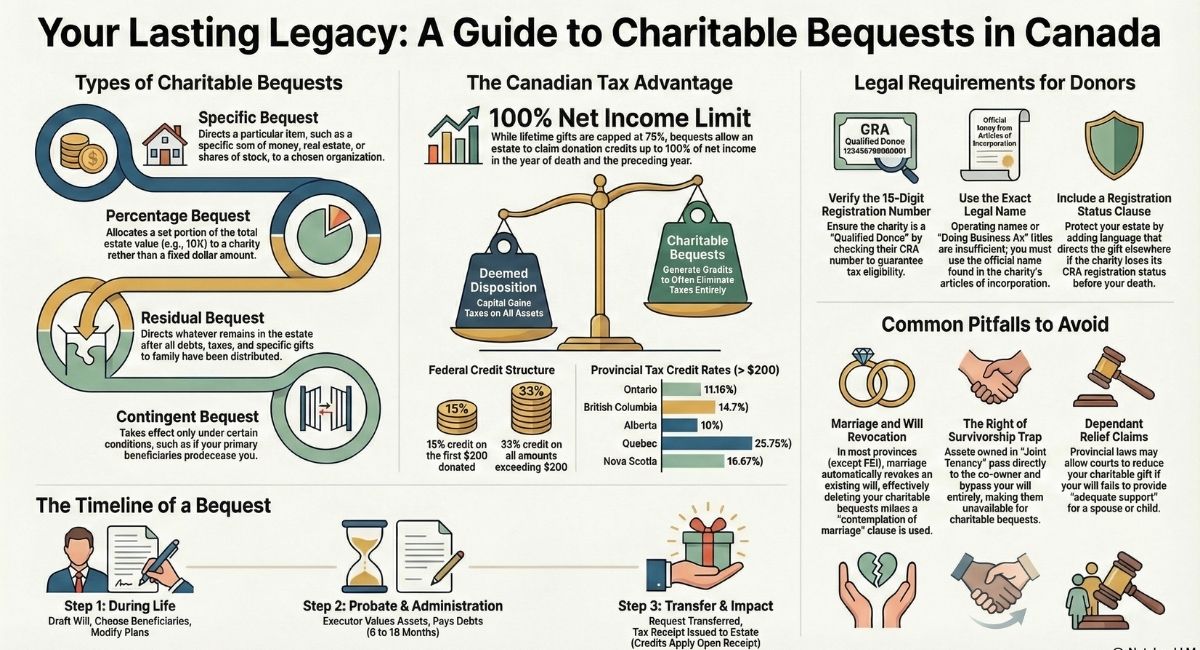
You can structure charitable bequests in several ways. Specific Bequests direct a particular item, like stocks, real estate, or valuable property, to your chosen charity.
Percentage Bequests give a set portion of your total estate to charity. For example, you might leave 10% of your estate value to your favourite organization.
Residual Bequests provide what remains after you distribute specific gifts to family and friends. This ensures charities receive something regardless of your estate’s final value.
Contingent Bequests only take effect under certain conditions. For example, you might specify that a charity receives funds if your primary beneficiaries predecease you.
Canadian Registered Charities Vs. Qualified Donees Vs. Non-Profit Organizations
Not all organizations qualify for charitable tax benefits in Canada. Understanding these distinctions helps you maximize your bequest’s impact.
Registered charities hold official status with the Canada Revenue Agency. These organizations provide full tax benefits for charitable bequests and include most hospitals, religious groups, and community foundations.
Qualified donees include registered charities plus organizations like Canadian municipalities, provincial governments, and certain foreign charities. Bequests to qualified donees generate donation tax credits.
Non-profit organizations without registered charity status don’t provide tax benefits. Your estate receives no tax advantages for bequests to them.
Verify an organization’s status using the Canada Revenue Agency’s list of charities and other qualified donees before including them in your will.
Understanding CRA’s Charitable Registration System
The Canada Revenue Agency sets strict requirements for charitable registration. Organizations must demonstrate charitable purposes, provide public benefit, and maintain detailed financial records.
Registered charities receive a registration number and must file annual information returns. They can issue official donation receipt for income tax purposes and must maintain compliance to keep their status.
The CRA reviews charitable status regularly. Organizations can lose registration for non-compliance, which affects their ability to provide tax benefits for bequests.
Confirm current registration status when drafting your will. Use the organization’s complete legal name to prevent confusion and ensure your bequest reaches the intended recipient.
Tax Advantages Under The Income Tax Act
Canadian tax law provides significant benefits for charitable bequests. Your estate can claim donation tax credits up to 100% of net income in the year of death.
Any unused credits can apply to the previous tax year. This flexibility often eliminates most or all income taxes your estate might owe.
Capital gains taxes typically apply at death, but charitable bequests of appreciated property often qualify for special treatment. The donation credit frequently offsets these taxes entirely.
These benefits apply only to gifts made to qualified donees. Non-registered organizations don’t provide tax advantages.
Donation Tax Credits
Your estate claims charitable bequest credits on the final tax return or the estate’s T3 return. The credit equals 15% of the first $200 donated plus about 29% of amounts over $200.
Higher earners may qualify for enhanced credits in some provinces. Combined federal and provincial benefits can exceed 50% of the donation amount.
Credits apply against taxes owed, not total income. The generous limits for death-year donations usually provide full tax relief for most estates.
Professional tax preparation is essential for estates with significant charitable bequests. The timing and calculation of credits require expertise to maximize benefits.
The Deemed Disposition At Death
Canadian tax law treats death as selling all your assets at fair market value. This creates capital gains taxes on appreciated investments, real estate, and business interests.
Charitable bequests help offset these deemed disposition taxes. The donation credits often equal or exceed the capital gains taxes triggered by death.
Direct bequests of appreciated property to charity can eliminate the capital gains entirely in some cases. The charity receives the full asset value while your estate avoids the related taxes.
This strategy works well for highly appreciated stocks, real estate, or business interests that would otherwise create large tax bills.
Timeline: From Intention To Impact
The charitable bequest process begins when you sign your will but doesn’t complete until months or years after death. Understanding this timeline helps you plan effectively.
During Life: You draft your will, choose beneficiaries, and can modify bequests as circumstances change.
At Death: Your estate’s executor begins probate proceedings and identifies all charitable bequests specified in the will.
Estate Administration: The executor values assets, pays debts, and determines the final bequest amounts. This process typically takes 6-18 months.
Transfer and Tax Benefits: Charitable bequests transfer to organizations after estate settlement. Tax credits apply when the charity receives the gift, not at your death date.
This extended timeline means your chosen charities might wait considerable time before receiving bequests. The tax benefits remain available to your estate.
Before You Begin: Pre-Planning Considerations
Successful charitable bequests require careful planning that balances your financial security, family needs, and philanthropic goals. Understanding tax implications, legal requirements, and professional guidance options will help you make informed decisions about your estate plan.
Assessing Your Estate And Financial Situation
Before adding charitable bequests to your will, you need to understand your complete financial picture. List all assets, debts, and ongoing expenses.
Start by calculating your net worth. Include your home, investments, retirement savings, and personal property. Subtract all debts and liabilities.
Consider your future financial needs. Think about healthcare costs, long-term care, and inflation. These factors affect how much you can comfortably give away.
Key assets to review:
Primary residence and other real estate
Investment accounts and RRSPs
Life insurance policies
Business interests
Personal property with significant value
Review your income sources in retirement, including pensions, government benefits, and investment income. Understanding your cash flow helps you determine if you can afford charitable bequests without financial hardship.
Balancing Family Obligations With Philanthropic Goals
Charitable giving should not come at the expense of family financial security. Ensure your spouse and dependents are properly provided for.
Consider your family’s current and future needs. Young children may need education funding. Adult children might benefit from inheritance to buy homes or start businesses.
Discuss your charitable intentions with family members. Open communication prevents surprises and family conflicts after death.
Some families choose to involve children in selecting charities.
Options for balancing both goals:
Leave a percentage to charity rather than a fixed amount
Set up charitable gifts only after family needs are met
Use residuary bequests for charitable giving
Consider smaller charitable amounts with lifetime giving
Family circumstances change over time. Regular estate plan reviews ensure your will reflects current family needs and charitable goals.
Lifetime Giving Vs. Testamentary Gifts: Tax Implications In Canada
Both lifetime giving and charitable bequests offer tax benefits, but the timing differs.
Lifetime charitable gifts provide immediate tax receipts. You can use these receipts to reduce current income taxes. Any unused credits can be carried forward for up to five years.
Charitable bequests generate tax receipts for your estate. The executor can claim tax credits for up to 100% of your net income in your final tax return. Unused credits can be applied to the previous year’s return.
Tax benefit comparison:
Giving Method
Tax Receipt Timing
Credit Limit
Carryforward Period
Lifetime gifts
Immediate
75% of net income
5 years
Charitable bequests
At death
100% of net income
1 year back
Consider your tax situation when choosing between lifetime and testamentary giving. High-income earners may benefit more from spreading charitable deductions over several years through lifetime giving.
Mental Capacity Requirements Under Canadian Common Law And Provincial Legislation
Creating or changing a will requires testamentary capacity under Canadian law. You must understand the nature and effect of making a will.
You need to know what property you own and its approximate value. You also need to know who might reasonably expect to inherit from your estate.
The capacity requirement is lower for making a will than for other legal decisions. Complex charitable bequests may require higher understanding levels.
Signs of sufficient capacity:
Understanding your assets and their value
Knowing your potential beneficiaries
Comprehending the effects of your will
Making decisions free from undue influence
If you have concerns about future capacity, make your will sooner rather than later. Document your decision-making process with your lawyer to prevent future challenges.
Medical conditions like dementia can affect capacity. Regular capacity assessments may be necessary if cognitive decline is possible.
The Importance Of Canadian Professional Advice
Estate planning with charitable bequests involves complex legal and tax considerations. Professional advice ensures your will achieves your goals and complies with Canadian law.
Lawyers draft clear bequest language and ensure proper charity identification. They also structure gifts to minimize tax and avoid common legal problems.
Tax professionals can model different giving scenarios. They show how charitable bequests affect your estate’s total tax bill and net value to heirs.
Professional team members:
Estate planning lawyer for legal drafting
Accountant for tax planning
Financial planner for overall strategy
Charity representatives for gift structuring
Get multiple opinions for large or complex charitable gifts. The cost of professional advice is small compared to potential problems from poorly planned bequests.
Choose professionals with specific experience in charitable giving and Canadian tax law. General practitioners may miss important opportunities or requirements.
Choosing Your Charitable Beneficiaries
Selecting the right charitable beneficiaries requires careful research and understanding of Canada’s regulatory framework. Verify charity registration status, review financial transparency, and consider qualified donees beyond traditional charities.
Researching Canadian Charities And Qualified Donees
Before including any organization in your will, verify their status as a qualified donee under the Income Tax Act. Only gifts to qualified donees generate tax receipts for your estate.
The Canada Revenue Agency (CRA) maintains strict criteria for charitable registration. Organizations must operate exclusively for charitable purposes: relief of poverty, advancement of education, advancement of religion, or other purposes benefiting the community.
Key research steps include:
Confirming current registration status
Reviewing the organization’s mission and activities
Checking financial statements and annual filings
Verifying the correct legal name
Consider the charity’s longevity and stability. Organizations that have operated successfully for many years may be more likely to continue their work long-term.
Using CRA’s List of charities and other qualified donees
The CRA’s online List of charities and other qualified donees is our main verification tool. We can search by charity name, registration number, or location to confirm an organization’s status.
The database provides essential information, including:
Current registration status
Business number (BN) with registration number
Date of registration
Designated gifts status
Contact information
Active status means the charity is currently registered and can issue tax receipts. Revoked status means the organization cannot operate as a charity or issue receipts.
We must use the exact legal name shown in the database when drafting our will. Informal names or abbreviations may delay or complicate matters for our executor.
Understanding CRA Registration Numbers
Every registered charity receives a unique nine-digit registration number with their Business number (BN) with registration number. This 15-digit combination serves as the official identifier.
The registration number format is 123456789RR0001. “RR” shows registered charity status, and the last four digits identify different programs within larger organizations.
Important considerations:
Always verify the complete 15-digit number
National charities may have separate registration numbers for different branches
Some organizations operate multiple registered charities under one umbrella
We should include both the charity’s legal name and registration number in our will to ensure proper identification.
Reviewing T3010 Filings For Financial Transparency
Registered charities file annual T3010 returns that detail their finances and activities. These public documents help us evaluate how organizations use donations.
Key financial metrics to examine:
Fundraising ratio: Administrative and fundraising costs versus program spending
Revenue sources: Government funding, donations, investment income
Expenditure breakdown: Program delivery versus overhead costs
Asset management: Reserves and long-term sustainability
Most effective charities spend 70-80% of their budget on programs rather than administration. Newer charities or those building infrastructure may spend differently.
We can access T3010 filings through the CRA database or request copies from organizations.
Checking Compliance History And Revocations
The CRA monitors charities for compliance with federal regulations. We should check for any compliance issues or sanctions before making bequest commitments.
Red flags include:
Recent suspension of receipting privileges
Outstanding compliance requirements
History of late filing penalties
Previous revocation and re-registration
The List of charities and other qualified donees shows current status but may not detail historical issues. We can contact the CRA for compliance history or review the organization’s annual filings for disclosed penalties.
Charities with clean compliance records show better governance and lower risk of future problems affecting our gift.
Evaluating Governance Under Canadian Charity Law
Strong governance shows an organization’s ability to manage funds and continue operations long-term. We should assess leadership structure and decision-making processes.
Governance indicators include:
Independent board of directors
Clear conflict of interest policies
Regular board meetings and oversight
Transparent reporting practices
Succession planning
Well-governed charities publish annual reports beyond their required T3010 filings. These reports often include board member information, strategic plans, and detailed program outcomes.
We may request governance documents from organizations or review their websites for transparency indicators.
Qualified Donees Beyond Registered Charities
Canadian tax law recognizes several categories of qualified donees besides registered charities. These organizations can also issue tax receipts for estate gifts.
Qualified donee categories include:
Registered Canadian amateur athletic associations
Registered journalism organizations
Canadian municipalities
Federal, provincial, and territorial governments
Certain foreign charities
United Nations agencies
Each category has specific requirements and limitations. We must verify qualification status through government databases or directly with the CRA.
Some qualified donees may have restrictions on gift types or purposes that affect estate planning.
Registered Canadian Amateur Athletic Associations (RCAAAs)
RCAAAs promote amateur athletics in Canada and qualify for charitable tax treatment. They must register with the CRA and meet specific operational requirements.
RCAAA requirements include:
Exclusive focus on amateur sport
Canadian organization and control
No professional sport activities
Regular filing of annual information returns
We can verify RCAAA status through the CRA database. These organizations receive similar registration numbers with “RR” designation.
RCAAAs may operate locally, provincially, or nationally. We should confirm the organization matches our intended charitable impact.
Registered Journalism Organizations (RJOs)
RJOs are a newer category of qualified donee, created to support independent journalism in Canada. They must meet specific criteria for registration and maintenance.
RJO qualification requirements:
Primary purpose of journalism in the public interest
Canadian organization and control
Independence from government and political parties
Adherence to professional journalism standards
The CRA maintains a separate section in their database for RJOs. We should verify current status as this category faces ongoing regulatory development.
RJOs allow us to support media diversity and democratic discourse through estate giving.
Canadian Municipalities
All Canadian municipalities automatically qualify as donees without separate registration. We can make gifts to cities, towns, counties, or other municipal governments.
Municipal gift considerations:
Gifts typically support specific municipal projects or general operations
No registration number required
May need to specify intended use or department
Local governments may have gift acceptance policies
We should contact municipal offices to discuss estate gift procedures and any restrictions on gift types or purposes.
Municipal gifts often support parks, libraries, recreation facilities, or community programs.
Federal, Provincial, And Territorial Governments
All levels of Canadian government qualify.
Getting The Details Right: Canadian Legal Requirements
Proper identification of charitable recipients and precise legal language are essential for valid charitable bequests in Canada. The charitable registration status, correct legal names, and protective clauses determine if your intended gifts will reach their destinations and provide tax benefits.
Finding The Correct Legal Name
Every registered charity in Canada has an official legal name on their governing documents and CRA registration. This legal name may differ from the name they use in public or marketing materials.
We must use the charity’s exact legal name in our will to ensure proper identification. For example, a charity might be known publicly as “Help Kids Read,” but their legal name could be “The Children’s Literacy Foundation of Ontario.”
The legal name appears on the charity’s letters patent, articles of incorporation, or other founding documents. We can also find it through the CRA’s List of charities and other qualified donees by searching the registration number.
Using an incorrect name can delay or prevent the bequest from reaching the intended charity. Our executor may need to seek court approval to clarify our intentions, which costs time and money from our estate.
Why Operating Names And “Doing Business As” Names Aren’t Sufficient
Many charities operate under trade names or “doing business as” names that are more descriptive than their legal names. These operating names have no legal standing for bequest purposes.
A charity might be legally incorporated as “The Society for Environmental Protection and Education” but operate as “Green Future Canada.” Only the legal name creates a binding obligation in our will.
Operating names can change without notice or legal formality. Multiple organizations might use similar operating names, creating confusion about our intended recipient.
Provincial business registries may list operating names, but these don’t establish the charity’s legal identity. We need the name from incorporation documents or CRA registration records.
CRA Charities Listing: Account Name Vs. Legal Name
The CRA charity database shows both account names and legal names, but these may not always match. The account name is how CRA refers to the charity, while the legal name comes from incorporation documents.
We should cross-reference both names when researching our chosen charity. Sometimes the CRA account name includes abbreviations or slight variations from the legal name.
The registration number provides the most reliable identification method. Even if names change, the registration number stays the same throughout the charity’s existence.
We can verify information by calling CRA’s charities directorate or checking multiple sources. This extra step prevents costly mistakes in our will drafting.
Reviewing Letters Patent, Articles Of Incorporation, Or Governing Documents
Letters patent or articles of incorporation contain the charity’s official legal name as registered with provincial or federal authorities. These documents provide the most authoritative source for proper identification.
We can request copies of these documents from the charity or obtain them through provincial corporate registries. Most provinces maintain online databases where we can search by organization name or number.
The governing documents also show the charity’s stated purposes and powers. This information helps us understand whether our intended gift aligns with their legal mandate.
Changes to legal names require formal amendment processes that create paper trails. We can track name changes through updated articles or supplementary letters patent.
Provincial Vs. Federal Incorporation Considerations
Charities can incorporate provincially or federally, which affects where we find their legal documentation. Federally incorporated charities register with Corporations Canada, while provincial charities register with their home province.
Federal incorporation allows operation across Canada but doesn’t automatically grant charitable status. The charity must still register separately with CRA for tax purposes.
Provincial incorporation limits operations to that province unless the charity registers extra-provincially elsewhere. The legal name reflects the incorporating jurisdiction’s requirements and language laws.
We need to check the correct registry based on the charity’s incorporation type. The CRA database shows whether incorporation was federal or provincial.
Drafting Precise Bequest Language For Canadian Wills
Precise language removes ambiguity about our charitable intentions and reduces the risk of failed bequests. Our will clause should include the charity’s full legal name, registration number, and current address.
A well-drafted charitable bequest clause reads: “I give [$amount/percentage/description of property] to [Full Legal Name of Charity], a registered charity located at [address], bearing registration number [CRA registration number].”
We should specify whether the gift is a general bequest (unrestricted use), specific bequest (particular purpose), or contingent bequest (conditional on certain circumstances).
The clause should state what happens if the charity cannot accept the gift or no longer exists when our estate is distributed.
Charitable Registration Status Clauses
Including charitable registration status language protects our estate’s tax position and clarifies our intent to benefit only registered charities. This clause ensures our gift qualifies for charitable tax credits.
We can add: “provided that at the time of my death, the organization remains a registered charity under the Income Tax Act (Canada).” This condition protects against charities that lose their status.
The clause should specify what happens if the charity loses registration before our death. Options include redirecting the gift to another charity or returning it to the estate.
This language helps our executor avoid making gifts that don’t qualify for tax benefits or that we wouldn’t have intended.
What Happens If A Charity Loses CRA Registration?
When a charity loses CRA registration, it cannot issue tax receipts or legally operate as a charity. Our bequest to such an organization may fail or lose its tax benefits.
CRA revokes registration for reasons like failure to file returns, operating outside charitable purposes, or inadequate governance. The charity can appeal, but the process can take years.
If we don’t include protective language, our executor might still need to make the gift. However, our estate loses the charitable tax credit, which could increase the tax burden on other beneficiaries.
Our will should address this scenario by naming alternative charities or directing that failed charitable gifts return to our estate.
Including Protective Language
Protective clauses help safeguard your charitable intentions if circumstances change between will signing and estate distribution.
These provisions guide your executor in handling unexpected situations.
Key protective elements include naming alternative charities if your first choice cannot receive the gift.
They also provide directions for handling merged or renamed organizations and allow your executor to select similar charities if needed.
You might include this: “If the named charity has ceased to exist or is no longer a registered charity, my executor may direct this gift to a similar registered charity serving comparable purposes.”
This language avoids court applications and gives your executor reasonable discretion while honoring your charitable wishes.
Restricted Vs. Unrestricted Gifts Under Canadian Charity Law
Unrestricted gifts let charities use your donation for any purpose within their mandate.
These gifts provide maximum flexibility and are generally preferred by charities.
Provincial Considerations: How Your Location Matters
Each province and territory in Canada has its own rules for wills and estates.
These differences affect how charitable bequests work and what steps your estate must follow.
Provincial Variations In Estate Law
Estate law varies significantly across Canada.
Each jurisdiction has its own approach to handling wills and charitable gifts.
Common law provinces follow similar principles but have different specific rules.
All provinces except Quebec use common law, but details like witness requirements and executor duties change from place to place.
Some provinces require two witnesses for wills, while others have different age requirements or waiting periods before probate.
Charitable bequest recognition follows different timelines across provinces.
Your estate may need to wait longer in some provinces before the charity receives official donation receipt for income tax purposes, which affects when tax benefits become available.
Wills And Estates Legislation By Province/Territory
Each province has specific laws governing wills and estates:
Province/Territory
Primary Legislation
Ontario
Succession Law Reform Act
British Columbia
Wills, Estates and Succession Act
Alberta
Wills and Succession Act
Saskatchewan
The Wills Act, 1996
Manitoba
The Wills Act
Quebec
Civil Code of Quebec
New Brunswick
Wills Act
Nova Scotia
Wills Act
Prince Edward Island
Wills Act
Newfoundland and Labrador
Wills Act
Key differences include formal requirements for valid wills.
Some provinces allow more flexibility in how you can change or revoke charitable bequests.
Age requirements vary slightly.
Most provinces set the minimum age at 18, but some allow younger people to make wills in certain cases.
Probate Fees And Estate Administration Tax
Probate costs differ between provinces.
These fees directly impact how much your charity receives from your bequest.
Ontario charges estate administration tax on a sliding scale.
Estates under $50,000 pay $5 per $1,000, while larger estates pay $15 per $1,000 on amounts over $50,000.
British Columbia has probate fees of $6 per $1,000 for the first $25,000.
Amounts between $25,000 and $50,000 pay $14 per $1,000, and estates over $50,000 pay $14 per $1,000 on the total value.
Alberta eliminated probate fees in 2020.
This makes Alberta one of the most cost-effective provinces for estate administration.
Quebec has much lower costs because it uses a different legal system.
Notarial wills often avoid probate entirely.
Intestacy Rules If No Valid Will Exists
If someone dies without a valid will, provincial intestacy laws decide who gets the assets.
These rules rarely include charitable gifts.
Spouse and children usually receive priority under intestacy rules.
The exact division depends on your province and family situation.
No automatic charitable giving happens under intestacy.
Your intended charitable bequest will not occur unless you document it in a valid will.
Provincial variations in intestacy can be substantial.
Ontario gives different amounts to surviving spouses than British Columbia or Alberta.
Asset distribution timelines also vary.
Some provinces require longer waiting periods before distributing assets to heirs.
Quebec’s Unique Civil Law System
Quebec uses civil law instead of common law.
This creates significant differences for charitable bequests and estate planning.
Civil Code of Quebec governs all estate matters.
The rules and procedures differ from other Canadian provinces.
Forced heirship concepts do not exist in Quebec, but family members have stronger rights to contest wills.
This can affect charitable bequests if family members object.
Three types of wills are recognized: notarial, holograph, and witnessed wills.
Each has different requirements and probate processes.
Language requirements may apply in Quebec.
Wills written in English might need translation during probate proceedings.
Notarial Wills Vs. Holograph Wills
Different provinces accept different types of wills, which affects how you document charitable bequests.
Notarial wills are only available in Quebec.
A notary prepares these wills with specific legal formalities, and they rarely require probate.
This determines which rules apply to your charitable bequest.
Superior Courts in each province handle probate applications.
The specific court names vary, but the function remains the same.
Jurisdiction rules usually require probate where the deceased lived at death.
If you own property in multiple provinces, you may need to file in more than one court.
Common Pitfalls Under Canadian Law
Life events, asset ownership structures, and beneficiary designations can affect your charitable bequest plans.
Provincial laws can create automatic revocations and tax consequences that many Canadians do not expect.
Life Events That Affect Your Canadian Will
Major life changes can invalidate your will without warning.
Canadian provinces have strict rules about when wills become void.
These laws exist to protect spouses and families, but they can also cancel your charitable bequests.
Marriage automatically revokes most wills in Canada.
Only Prince Edward Island allows married people to keep their old wills.
All other provinces require a new will after marriage.
Your charitable gifts disappear when your will becomes invalid.
The province’s intestacy laws take over instead.
Having children doesn’t revoke your will.
But it can reduce what goes to charity, as some provinces give children automatic rights to your estate.
Adoption creates the same legal relationship as biological children.
Adopted children get the same inheritance rights under provincial law.
Marriage And Remarriage: Automatic Revocation In Most Provinces
Getting married wipes out your existing will in most provinces.
This rule catches many Canadians off guard.
The revocation happens automatically on your wedding day.
You do not need to do anything; the law makes your will void.
British Columbia, Alberta, Saskatchewan, Manitoba, Ontario, New Brunswick, Nova Scotia, Newfoundland and Labrador, Northwest Territories, Nunavut, and Yukon all follow this rule.
Only Prince Edward Island lets you keep your old will after marriage.
Even then, your spouse gets legal rights that might reduce charitable bequests.
Common-law relationships do not trigger automatic revocation, but they can still affect how your estate is divided.
Remarriage after divorce creates the same problem.
Your second marriage voids any will you made after your first marriage ended.
Divorce: Partial Revocation Rules Vary By Province
Divorce does not cancel your entire will like marriage does.
Instead, it removes your ex-spouse from the document.
Most provinces treat divorced spouses as if they died before you.
Any gifts to your ex-spouse go to the backup beneficiaries.
This can accidentally increase your charitable bequests or reduce them if your ex-spouse was supposed to get assets that would later go to charity.
Ontario has special rules about divorced spouses and wills.
The Family Law Act gives divorced spouses some continued rights in certain situations.
Quebec follows civil law, not common law.
Divorce affects wills differently there, so you need Quebec legal advice for accurate information.
Some provinces void appointments of ex-spouses as executors.
Others let the appointment stand unless you change it.
The Importance Of “In Contemplation Of Marriage” Clauses
You can protect your will from marriage revocation with special wording.
This clause tells the court you planned to marry when you signed your will.
The clause must name your future spouse specifically.
General language like “my future husband” will not work in most provinces.
“I make this will in contemplation of my marriage to [full legal name]” is the standard format.
Some provinces require additional specific language.
This protection only works if you actually marry the person you named.
Marrying someone else still revokes your will.
The clause protects your entire will, including charitable bequests.
Without it, you need to make a new will after your wedding.
Not all provinces recognize contemplation of marriage clauses equally.
Check your provincial law before relying on this protection.
Regular Will Reviews
Life changes can happen gradually or suddenly. Regular reviews catch problems before they affect your charitable plans.
We recommend reviewing your will every three to five years. Major life events should trigger immediate reviews.
New grandchildren, deaths in the family, and changes in your financial situation all matter. Changes to the charities you want to support also matter.
Charities can merge, close, or lose their registration. Your bequest might fail if the organization doesn’t exist when you die.
Tax laws change over time. What worked for charitable giving five years ago might not be optimal today.
Keep a list of your will’s key provisions. This makes it easier to spot problems during reviews.
Asset Ownership Issues In Canada
How you own assets affects whether they’re part of your estate. Many Canadians accidentally exclude assets from their charitable bequests.
Assets that pass by right of survivorship bypass your will entirely. Joint bank accounts and jointly owned real estate work this way.
This reduces your estate’s value. Smaller estates mean smaller charitable bequests if you’re giving a percentage.
Different ownership structures have different tax consequences. Some trigger immediate capital gains. Others defer taxes until later.
Understanding these structures helps you plan better charitable gifts. You can avoid accidentally excluding assets you meant to include.
Joint Tenancy With Right Of Survivorship
Joint tenancy means all owners have equal rights to the entire property. When one owner dies, the others automatically get their share.
The deceased owner’s share doesn’t go through their estate. It passes directly to the surviving joint tenants.
This can exclude your house, cottage, or investments from charitable bequests. The assets aren’t available for your will to distribute.
Joint tenancy works well for spouses who want everything to go to each other first. It’s problematic if you want some assets available for charity.
Adding adult children as joint tenants can trigger immediate tax consequences. Canada Revenue Agency might treat this as a gift.
Consider tenancy in common instead if you want more control over how assets pass at death.
Tenancy In Common
Tenants in common own specific percentages of property. Each owner can sell their share or leave it in their will.
Your percentage goes through your estate when you die. This makes it available for charitable bequests.
The percentages don’t have to be equal. You might own 60% while your spouse owns 40%.
This structure gives you more control over charitable planning. But it can complicate things for surviving owners.
Your heirs become co-owners with your spouse or other surviving tenants. This can create family conflicts.
Tenancy in common property still needs to go through probate. Factor probate fees into your planning.
The Pecore Presumption And Resulting Trusts
Canadian courts apply special rules when parents transfer assets to adult children. The Pecore presumption affects how these transfers work.
Adding adult children to bank accounts or property titles creates a legal presumption. Courts assume the child holds the asset for the parent’s benefit.
This means the asset returns to your estate when you die.
Tax Optimization Strategies For Canadians
Canadian taxpayers can maximize charitable giving through strategic tax planning. Donation tax credits, income limits, and timing all matter.
Key strategies include understanding how credits work at death, managing income thresholds, and exploring alternatives like securities donations and RRSP/RRIF gifts.
Understanding How Donation Tax Credits Work At Death
When you make charitable bequests, the donation tax credit works differently than during your lifetime. The estate receives a charitable donation receipt for your final tax return.
You can also use the receipt on the tax return for the year before death. This gives you more flexibility to maximize the tax benefit.
The executor decides how to split the donation between these two years. They should choose the option that provides the greatest tax savings.
Federal Credit: 15% (First $200) + 33% (Amounts Over $200)
The federal donation tax credit starts at 15% for the first $200 you donate each year. For amounts over $200, you get a 33% credit rate (29% for gifts claimed before 2024).
This means a $1,000 donation gives you a federal credit of $294. Calculate this as ($200 × 15%) + ($800 × 33%) = $30 + $264 = $294.
For large charitable bequests, most of the donation receives the higher 33% rate. Bigger gifts become more tax-efficient than smaller ones.
Provincial Credits: Varies By Province
Each province sets its own donation tax credit rates. These rates vary significantly across Canada.
Provincial credit rates for donations over $200:
Ontario: 11.16%
British Columbia: 14.7%
Alberta: 10%
Quebec: 25.75%
Nova Scotia: 16.67%
When you combine federal and provincial credits, your total can reach 44% to 54% depending on where you live. Charitable giving becomes a powerful tax strategy.
The 100% Of Net Income Limit In Year Of Death And Preceding Year
During your lifetime, you can claim donations up to 75% of your net income each year. At death, this limit increases to 100% of net income.
You can use this 100% limit for both the year of death and the preceding year. This gives your estate more room to claim large charitable bequests.
If your bequest exceeds these limits, you can carry forward unused amounts for up to five years. However, this carry-forward happens after death and may create complications.
The Problem Of Insufficient Taxable Income At Death
Many Canadians face a common problem at death. Your charitable bequest may be larger than your taxable income, limiting the tax benefit.
If you have low income in your final years, you cannot fully use large donation receipts. The excess donations get carried forward but may never provide tax savings.
This situation is especially common for retirees with modest pension income. Planning ahead helps avoid this tax trap.
Deemed Disposition Triggering Capital Gains
At death, Canadian tax law treats you as selling all your assets. This “deemed disposition” can create large capital gains on your final tax return.
These capital gains increase your taxable income in the year of death. Higher income gives you more room to claim charitable donation receipts.
You can use this situation strategically. Large charitable bequests can offset the tax from deemed disposition and reduce the overall tax burden on your estate.
When Estates Can’t Fully Utilize Donation Receipts
Sometimes your estate cannot use all the donation receipts, even with the enhanced limits at death. This wastes valuable tax credits.
Common situations include:
Low lifetime income with large bequests
Insufficient capital gains at death
Poor timing of the charitable gift
When this happens, your estate loses the tax benefit permanently. The unused credits cannot help your beneficiaries or the estate.
Strategic Lifetime Giving Approaches
Making charitable gifts during your lifetime often provides better tax results than bequests. You can control the timing and maximize your tax brackets.
Spread large donations over several years to stay within the 75% income limit. This approach uses your donation receipts more efficiently.
Benefits of lifetime giving:
Better control over tax timing
Ability to see the impact of your gifts
More flexibility in tax planning
Guaranteed use of tax credits
Consider making regular donations instead of one large bequest.
Using The Donation Carry-Forward
You can carry forward unused donation amounts for up to five years. This rule helps when your donations exceed the annual income limits.
The carry-forward works during your lifetime and continues after death. Your estate can use carried-forward amounts from previous years.
Strategic timing helps maximize this benefit. You might make a large donation in a high-income year and carry forward the excess.
Income Splitting Opportunities With Family
Spouses can share donation receipts to optimize their combined tax savings. Claim donations against the higher-income spouse’s return.
This strategy works because the higher earner likely pays taxes at a higher rate. The donation tax credit provides greater savings when applied to higher-income tax returns.
You can also time donations to coincide with years when one spouse has unusually high income. This maximizes the tax benefit for your family.
Donating Appreciated Securities
Donating publicly traded securities directly to charity eliminates capital gains tax. This strategy provides double tax benefits.
Example: You own stock worth $10,000 that cost $4,000. If you sell and donate cash, you pay tax on $6,000 in capital gains. If you donate the stock directly, you avoid this tax entirely.
You still receive a donation receipt for the full $10,000 value. This approach works well for long-held investments with large gains.
Donating RRSP/RRIF Assets Directly To Charity
You can name a charity as the beneficiary of your RRSP or RRIF. The charity receives the funds directly, and your estate gets a donation receipt.
This strategy helps offset the income tax from RRSP/RRIF withdrawals at death. These registered accounts become fully taxable when you die.
Tax benefits:
Estate receives charitable donation receipt
Receipt can offset RRSP/RRIF income inclusion
Reduces overall tax burden on the estate
This approach works well for large registered account balances.
Gifts Of Ecologically Sensitive Land
Donating certified ecological property provides enhanced tax benefits. You can claim up to 100% of your net income for these gifts, even during your lifetime.
The property must be certified as ecologically sensitive by Environment and Climate Change Canada. The certification process takes time and requires professional help.
Working With Canadian Estate Planning Professionals
Successful charitable bequest planning requires working with qualified professionals. The right team includes specialized lawyers, executors who understand their duties, and tax advisors familiar with charitable giving rules.
Finding A Qualified Wills And Estates Lawyer
You need a lawyer who specializes in estate planning and charitable giving. General practice lawyers may not know the complex rules around charitable bequests.
Look for lawyers who work regularly with charitable organizations. They know how to structure bequests to maximize tax benefits while avoiding common problems.
Key qualifications to seek:
Active membership in provincial law society
Focus on wills and estates (not just occasional work)
Experience with charitable bequests specifically
Knowledge of both provincial estate law and federal tax rules
Ask potential lawyers about their recent charitable bequest cases. How many have they handled in the past year? What types of charities were involved?
Provincial Law Society Directories
Each province maintains an online directory of licensed lawyers. These directories let you search by location and practice area.
Major provincial law societies:
Ontario: Law Society of Ontario (LSO)
British Columbia: Law Society of British Columbia
Alberta: Law Society of Alberta
Quebec: Barreau du Québec
The directories show lawyer credentials, practice areas, and disciplinary history. You can filter results to find lawyers who list “wills and estates” or “charitable planning” as specialties.
Most directories include lawyer contact information and firm details. Some show years of practice and professional certifications.
Specialization Certifications
Several provinces offer formal certification programs for estate planning lawyers. These certifications require extra training and ongoing education.
Ontario offers certification through the Law Society’s specialist program. Certified specialists prove their expertise through peer review and continuing education.
British Columbia provides similar specialist recognition for estate lawyers. The certification process includes written exams and practice requirements.
Look for lawyers with these formal certifications. They show advanced knowledge beyond basic legal training.
Some lawyers also hold designations from groups like the Canadian Association of Gift Planners (CAGP). These designations show a commitment to staying current with charitable giving practices.
Questions To Ask
Before hiring an estate lawyer, ask specific questions about their experience with charitable bequests.
Essential questions include:
How many charitable bequests have you drafted in the past two years?
What types of charitable gifts do you recommend most often?
How do you handle specific vs. residual bequests?
What’s your fee structure for will preparation?
Ask about their relationships with local charities. Do they work with planned giving officers? How do they verify charity registration status?
Find out how they approach tax planning. Ask how they structure bequests to maximize tax credits for the estate.
Request references from recent clients who made charitable bequests. A qualified lawyer should provide references with client permission.
The Role Of Your Executor/Estate Trustee
The executor (called estate trustee in Ontario) has legal duties when handling charitable bequests. They must follow the will’s instructions and meet all legal requirements.
Key executor responsibilities:
Obtain charity registration numbers
Verify charities are still operating
Calculate exact bequest amounts
Obtain proper tax receipts
File estate tax returns correctly
Discuss charitable bequests with your chosen executor before finalizing the will. They need to understand the extra work involved.
Some executors may not feel comfortable handling complex charitable gifts. Consider appointing a professional executor or trust company for estates with significant charitable components.
The executor is personally liable for mistakes in handling bequests. Beneficiaries or charities can sue if the executor fails to fulfill their duties.
Legal Obligations Under Provincial Law
Provincial laws govern how executors handle charitable bequests. These laws vary across Canada but share common requirements.
Universal obligations include:
Following exact will instructions
Obtaining court approval for major decisions
Keeping detailed records of all transactions
Providing accountings to beneficiaries
Ontario’s Trustee Act requires executors to invest estate funds prudently while settling bequests. They must not delay charitable distributions without good reason.
British Columbia has similar requirements under the Wills, Estates and Succession Act. Executors must distribute charitable bequests within reasonable timeframes.
Most provinces allow courts to modify charitable bequests if the original charity no longer exists. Courts direct funds to similar charitable purposes.
Compensation Guidelines By Province
Executor compensation varies by province and estate complexity. Charitable bequests can increase the work required and justify higher fees.
Typical compensation ranges:
Ontario: 2.5% of estate value plus care and management fees
British Columbia: Up to 5% of gross estate value
Alberta: “Fair and reasonable” compensation based on work performed
Professional executors often charge hourly rates instead of percentage fees. Rates usually range from $200 to $500 per hour depending on complexity and location.
Discuss compensation expectations with potential executors upfront. Some family members may waive fees, but professionals will always charge.
Complex charitable bequests involving multiple charities or ongoing trusts require more work. Agree on higher compensation in advance if needed.
Should You Appoint The Charity As Executor?
Large charities sometimes serve as executors for estates making substantial bequests. This arrangement has both advantages and risks.
Benefits of charity executors:
Deep knowledge of charitable tax rules
Professional estate administration
No conflicts between charitable and family interests
Permanent institution (won’t die or become unavailable)
Potential drawbacks:
May prioritize charity interests over family
Professional fees can be high
Less personal relationship with family
May lack knowledge of specific assets or family dynamics
Only consider charity executors for estates where charitable bequests make up a major portion of total assets. For smaller gifts, family or professional executors usually work better.
Engaging Canadian Tax Advisors
Charitable bequests create complex tax situations. You need tax advisors who understand both estate taxation and charitable giving rules.
Look for Chartered Professional Accountants (CPAs) with estate and trust experience. They should know how charitable donations affect terminal tax returns and estate distributions.
Key tax considerations include:
Timing of charitable donation claims
Capital gains elimination on gifted securities
Interaction with other estate deductions
Provincial tax credit differences
Some tax advisors specialize in charitable sector work. They understand charity operations and can structure gifts for maximum benefit.
Engage tax advisors early in the planning process. Early advice can help you develop effective strategies.
Protecting Your Will Under Canadian Law
Canadian law requires specific steps to make your will legally valid and protect it from challenges. Each province has different rules for signing, witnessing, and storing wills that affect charitable bequests.
Proper Execution Requirements
A valid will in Canada must meet strict legal requirements that vary by province. These requirements protect both the testator and beneficiaries, including charities.
Key execution elements include:
Legal age of majority in your province
Sound mental capacity when signing
Proper witnessing procedures
Clear testator signature
Written document format
Failure to meet these requirements can invalidate your entire will. Your charitable bequests may not reach their intended recipients.
Work with a qualified lawyer to ensure proper execution. Lawyers understand provincial variations and can prevent costly mistakes.
Common Law Provinces: Two Witnesses, Testator Signature
All provinces except Quebec follow common law will requirements. You must sign your will in the presence of two independent witnesses who are at least 18 years old.
Both witnesses must:
Be present when you sign
Sign the will themselves
Not be beneficiaries or spouses of beneficiaries
Have mental capacity to understand what they’re witnessing
Important witness restrictions:
Charity employees cannot witness if that charity receives a bequest
Family members should not witness
Lawyers preparing the will can witness
Witnesses do not need to read your will or know its contents. They only confirm your identity and that you signed willingly.
Quebec: Notarial, Holograph, Or Witnessed Wills
Quebec recognizes three types of valid wills under the Civil Code. Each type has different requirements and protection levels.
Notarial wills offer the strongest protection. A notary prepares and keeps the original document. Two witnesses must be present during signing.
These wills rarely face successful challenges.
Holograph wills must be entirely handwritten and signed by you. No witnesses are required, but these wills are more vulnerable to disputes about authenticity or mental capacity.
Witnessed wills follow rules similar to common law provinces. You sign before two witnesses who also sign the document.
Choose notarial wills for substantial charitable bequests. The extra cost provides significant protection against legal challenges.
Age Of Majority Requirements By Province
You must reach the age of majority in your province to make a valid will. This requirement affects when you can include charitable bequests in your estate planning.
Province/Territory
Age of Majority
Alberta, Manitoba, Ontario, Prince Edward Island, Quebec, Saskatchewan
18 years
British Columbia, New Brunswick, Newfoundland and Labrador, Northwest Territories, Nova Scotia, Nunavut, Yukon
19 years
Married minors can make valid wills in most provinces regardless of age. Military personnel may also have special provisions for earlier will-making.
If you made a will before reaching majority age, it becomes invalid. Create a new will after your 18th or 19th birthday to include charitable bequests.
Storage Options
Proper storage protects your will from loss, damage, or tampering. The location you choose affects how quickly your executor can access the document after your death.
Consider these factors when choosing storage:
Security from theft or damage
Accessibility for your executor
Cost of storage services
Climate control for document preservation
Never store your only copy in a safety deposit box. Bank policies may prevent immediate access after death, delaying charitable distributions.
Keep your will in a fireproof, waterproof location. Inform your executor and family members where to find it.
Lawyer’s Vault
Most law firms offer secure document storage services. This option provides professional-grade security and easy access for your executor.
Advantages include:
Fireproof and waterproof storage
Professional oversight
Direct contact with your executor
Legal advice readily available
Your lawyer maintains detailed records of document location and access procedures. They can guide your executor through the probate process efficiently.
Annual storage fees typically range from $25 to $100. Many lawyers store wills at no charge for existing clients.
Ask about storage policies when preparing your will.
Court Registries
Several provinces allow will registration with court registries. This service creates an official record of your will’s existence and location.
Provinces offering will registries:
British Columbia
Alberta
Saskatchewan
Nova Scotia
Registration fees range from $15 to $50. The registry doesn’t store your actual will but maintains location information for executors.
This system helps prevent lost wills and ensures proper legal procedures. Official registration provides better protection for your charitable beneficiaries.
Home Storage Risks
Storing your will at home creates significant risks for charitable bequests. Family disputes, natural disasters, or simple misplacement can eliminate years of estate planning.
Common home storage problems:
Fire or flood damage
Accidental disposal by family members
Tampering or destruction by disgruntled heirs
Inability to locate the document
Home storage may seem convenient and cost-effective, but the risks often outweigh these benefits for substantial charitable gifts.
If you choose home storage, use a fireproof safe or filing cabinet. Tell multiple trusted people about the location and access methods.
Who Should Have Copies?
Strategic copy distribution helps your will reach the right authorities. It also maintains confidentiality during your lifetime.
Essential copy holders:
Your primary executor
Your lawyer
One trusted family member or friend
Give copies, not originals, to most people. Courts need originals for probate proceedings.
Don’t give copies to all beneficiaries, including charities. This prevents premature expectations and potential family conflicts.
Update all copy holders when you revise your will. Outdated versions can cause confusion and delay charitable distributions.
Digital Estates And Online Assets
Modern estates often include digital assets. These require special planning.
Digital assets can impact charitable bequests if not properly addressed.
Common digital assets:
Online banking and investment accounts
Digital currencies and wallets
Social media accounts
Cloud storage services
Email accounts containing important documents
Create a separate digital asset inventory with access credentials. Store this information securely and update it regularly.
Many online platforms have specific policies for deceased users. Research these policies for accounts holding significant value.
Consider naming a digital executor with technical expertise. This person can work with your primary executor to locate and transfer digital assets to charitable beneficiaries.
Testamentary Capacity Challenges: Avoiding Will
Communicating Your Canadian Legacy
Sharing your charitable intentions requires balancing privacy and practical needs. These choices affect tax benefits, family relationships, and your charitable impact across Canada.
Should You Inform The Charity In Advance?
Informing charities about your planned bequest offers significant advantages. This approach is recommended for most donors, though it remains a personal choice.
Benefits of advance notification include:
Ensuring the charity accepts your specific type of gift
Confirming your bequest aligns with their current mission
Receiving recognition during your lifetime if desired
Building stronger relationships with the organization
Some charities cannot accept certain gifts. Real estate donations may be declined due to environmental concerns.
Complex or burdensome bequests might be refused if the charity lacks resources to manage them. Early communication prevents disappointment.
Your estate executor won’t need to find an alternative beneficiary if your chosen charity declines the gift.
Confidentiality remains an option. You can inform the charity without disclosing specific amounts. This allows for planning discussions while maintaining privacy about your estate’s value.
Benefits Of Legacy Society Membership
Many Canadian charities offer legacy societies for donors who include them in their wills. These groups provide valuable benefits beyond simple recognition.
Typical legacy society benefits include:
Special events and behind-the-scenes access
Regular updates on organizational impact
Estate planning seminars and resources
Priority invitations to major announcements
Networking opportunities with like-minded donors
Legacy societies help charities plan for future funding. They can budget more effectively knowing committed supporters exist.
Membership often includes access to planned giving professionals. These experts can answer questions about optimal gift structures and tax implications in your province.
Some societies offer family benefits. Your children or grandchildren might receive scholarships, mentorship opportunities, or volunteer positions through these connections.
Privacy protection remains paramount. Most legacy societies allow anonymous participation if you prefer confidentiality while still accessing member benefits.
Confidential Vs. Public Recognition
Recognition preferences vary among Canadian donors. Both confidential and public approaches to charitable bequests have valid reasons.
Confidential bequests offer several advantages:
Complete privacy for your family
No pressure from other organizations
Protection from increased solicitations
Flexibility to change plans without explanation
Public recognition can inspire others to give. Your visible commitment might encourage friends, colleagues, or community members to consider similar gifts.
Anonymous options exist within public programs. Many charities list anonymous donors by gift size rather than name. This approach inspires others while protecting your privacy.
Consider your family’s comfort level. Some relatives prefer private philanthropy, while others take pride in public recognition.
Professional advice helps balance these considerations. Estate lawyers can structure gifts to provide the right recognition while protecting your family’s interests.
Discussing Plans With Family Members
Family conversations about charitable bequests require sensitivity and timing. Early discussions help prevent confusion and conflict after your death.
Key family members to include:
Spouse or life partner
Adult children who are potential heirs
Primary beneficiaries of your estate
Anyone serving as executor
Start with your values and motivations. Explain why specific causes matter to you rather than focusing on dollar amounts.
Consider family financial security first. Relatives need assurance that charitable gifts won’t compromise their reasonable expectations or needs.
Address concerns directly. Some family members worry about reduced inheritances. Others may question charity effectiveness or management.
Timing matters. These conversations work best during calm periods, not during family stress or health crises.
Document family discussions. Written records can help executors later if questions arise about your intentions.
Managing Expectations Under Canadian Family Law
Canadian family law provides protections for certain relatives that can override will provisions. Legal requirements must be considered when planning charitable bequests.
Each province has different dependant relief legislation. These laws allow courts to vary will provisions if adequate support wasn’t provided for eligible dependants.
Common dependants include:
Surviving spouses or common-law partners
Minor children
Adult disabled children
Other dependants you supported financially
Courts balance charitable intentions against family obligations. They rarely eliminate charitable bequests but may reduce them to provide adequate family support.
Prevention strategies include:
Providing reasonable support for all dependants
Documenting your decision-making process
Obtaining family acknowledgment of your plans
Structuring gifts to preserve core family support
Legal advice is essential when family situations are complex. Blended families, estranged relationships, or significant wealth require careful planning to achieve your charitable goals and meet legal obligations.
Dependant Relief Claims And Provincial Variation Statutes
Provincial variation statutes create extra complexity for charitable estate planning in Canada. These laws differ between provinces in scope and application.
Ontario’s Succession Law Reform Act allows dependants to apply for support from estates. Courts consider factors like the dependant’s financial needs, their relationship with the deceased, and the estate’s size.
British Columbia’s Wills, Estates and Succession Act includes moral obligations to family members. Courts can vary wills when provisions seem inadequate for people the deceased should have supported.
Alberta and other provinces have similar but distinct legislation. Each province defines eligible dependants differently and uses varying criteria for court decisions.
Time limits apply to these claims. Most provinces allow six months to two years for dependant relief applications after probate is granted.
Risk mitigation strategies include:
Understanding your province’s specific legislation
Providing adequate support for all potential claimants
Creating detailed explanations for your decisions
Considering insurance to fund both family and charitable goals
Creating A Memorandum Of Wishes
A memorandum of wishes gives non-binding guidance to your executor about your charitable intentions. This document complements your formal will with extra context and explanation.
Include specific details about:
Why you chose particular charities
How you want gifts used if possible
Alternative charities if primary choices cannot accept
Your values and philanthropic philosophy
Family considerations that influenced your decisions
This document helps executors understand your priorities. It’s especially valuable for residual bequests where exact amounts aren’t predetermined.
Update memorandums regularly. Your philanthropic interests may change, and charity circumstances evolve over time.
Legal formality isn’t required. Simple, clear language works better than complex legal terms for expressing your wishes and motivations.
Share copies with relevant parties. Your executor, major beneficiary charities, and key family members should receive copies to understand your intentions fully.
Leaving A Statement Of Philanthropic Values
A philanthropic values statement creates lasting meaning beyond the financial impact of your charitable bequests. This document explains
Special Situations In Canadian Estate Planning
Certain charitable bequests require specialized planning due to their complexity or unique tax implications. International donations and gifts of non-traditional assets can significantly affect your estate’s tax position.
Large Estates And Alternative Minimum Tax Considerations
When your estate is large, the alternative minimum tax (AMT) becomes important in charitable planning. The AMT applies when tax preferences reduce regular income tax below the minimum threshold.
Charitable donations can trigger AMT calculations if they create large deductions compared to income. Your estate may need to pay the higher of regular tax or AMT.
Key AMT triggers include:
Charitable donations exceeding 75% of net income
Capital gains donations creating large deductions
Multiple years of carry-forward donations claimed at once
We recommend timing charitable gifts carefully in large estates. Spreading donations across multiple tax years can minimize AMT exposure.
Professional tax planning is essential when estate values exceed $5 million. The interaction between charitable deductions and AMT requires careful analysis to optimize tax savings.
Charitable Remainder Trusts Under Canadian Law
Charitable remainder trusts let you provide income to beneficiaries while ensuring charities receive the remainder. These trusts offer unique tax advantages for high-net-worth individuals.
Under Canadian law, you receive an immediate charitable tax receipt for the present value of the remainder interest. The trust pays income to designated beneficiaries for a set period or their lifetime.
Trust structure benefits:
Immediate charitable tax deduction
Income stream for beneficiaries
Reduced capital gains on donated assets
Estate tax savings
The charitable remainder must be at least 10% of the initial trust value. Income payments cannot exceed 50% annually of the initial fair market value.
These trusts work well with appreciated securities or real estate. Professional administration ensures compliance with trust rules and tax requirements.
Gifts Of Real Property
Donating real property to charity requires special consideration due to valuation and tax issues. Environmental assessments and title issues can complicate these donations.
You must obtain professional appraisals for real property donations exceeding $1,000. The Canada Revenue Agency may challenge valuations that appear excessive.
Important considerations:
Environmental liability assessments
Capital gains implications
Property tax responsibilities until transfer
Zoning and land use restrictions
Consider donating a partial interest in property if a full donation isn’t practical. You can donate a remainder interest while retaining life use of the property.
Some charities cannot accept real property due to management constraints. Verify the charity’s ability to receive and manage real estate before making commitments.
Gifts Of Private Company Shares
Private company shares offer unique opportunities and challenges for charitable giving. These donations can provide significant tax advantages and support your preferred causes.
Professional valuation determines the fair market value, especially for minority interests or restricted shares. Discounts for lack of marketability often apply to private company interests.
Valuation factors include:
Company financial performance
Market conditions in the industry
Restrictions on share transfer
Minority versus controlling interests
Private company donations work well when the charity can sell shares to third parties or back to the company. Some charities prefer cash donations over illiquid securities.
Consider the timing of private company donations carefully. Share values can fluctuate, affecting both tax benefits and charitable impact.
Cultural Property Donations
Cultural property donations receive special treatment under Canadian tax law through the Cultural Property Export and Import Act.
These donations can eliminate capital gains entirely.
The Cultural Property Review Board must certify donations as culturally significant to Canada.
Certified cultural property donations can be claimed at 100% of fair market value with no capital gains.
The donation credit can offset income tax completely in the year of donation.
Museums, galleries, and archives must be designated institutions to receive cultural property.
The certification process takes several months and requires detailed documentation.
Supporting Specific Programs
Directing charitable bequests to specific programs requires careful legal drafting to ensure your intentions are followed.
General charitable purposes provide more flexibility than restricted donations.
Your will should clearly identify the specific program or purpose you wish to support.
Include provisions for alternative uses if the designated program is discontinued.
Drafting considerations:
Clear program identification
Alternative purpose provisions
Sunset clauses for time-limited programs
Charity’s discretion for implementation
Work with both your lawyer and the intended charity when creating restricted bequests.
The charity should confirm its ability to honor your specific intentions.
Consider creating a fund within the charity rather than supporting existing programs.
This approach provides lasting recognition while giving the charity management flexibility.
International Considerations
Cross-border charitable giving involves complex tax rules that vary significantly between countries.
Canadian tax benefits may not be available for foreign charitable donations through your estate.
Gifts To US Charities
US registered charities can qualify for Canadian charitable tax receipts under specific circumstances.
The charity must carry on activities in Canada or receive donations from Canadian residents.
Your estate can claim donations to qualifying US charities up to 75% of US-source income.
This limitation often reduces available tax benefits compared to Canadian charities.
Qualifying criteria:
US charity registration under IRS rules
Activities conducted in Canada
Donations from Canadian residents
Proper documentation requirements
The Income Tax Act provides a specific list of qualifying US charities.
Universities and colleges typically qualify more easily than other organization types.
Consider using donor-advised funds to support US charities.
These vehicles can provide more flexible giving options while maintaining Canadian tax benefits.
Gifts To Other Foreign Charities
Non-US foreign charities generally do not qualify for Canadian charitable tax receipts.
Your estate receives no tax deduction for donations to most international organizations.
Some exceptions exist for charities operating in countries with tax treaties containing charitable provisions.
These situations require careful analysis of treaty language and domestic law.
Alternative approaches:
Canadian charities with international programs
Donor-advised funds supporting global causes
International foundations with Canadian registration
Corporate partnerships facilitating international giving
Canadian charitable organizations often support international causes through their programs.
This approach provides tax benefits while achieving your international charitable goals.
Cross-Border Estates
Estates with assets in multiple countries face complex charitable planning challenges.
Tax benefits may vary significantly depending on asset location and charitable recipient jurisdiction.
US estate tax rules differ substantially from Canadian requirements for charitable bequests.
Professional advice becomes essential for optimizing tax benefits across both jurisdictions.
Planning considerations:
Asset location and tax jurisdiction
Treaty benefits for charitable deductions
Currency exchange impacts
Multiple probate proceedings
International tax compliance requirements
Consider which assets
Keeping Your Bequest Current
Your charitable bequest needs regular updates to stay effective and legally sound.
Life changes, tax law updates, and charity status shifts can affect your planned gifts.
When To Review And Update Your Will
We recommend reviewing your will every three to five years at minimum.
This schedule helps catch changes you might have forgotten about.
Major birthdays like turning 65 or 70 are good reminder dates.
Set a calendar alert to review your charitable bequests during these milestone years.
Your financial situation changes over time.
What seemed like a reasonable donation five years ago might now be too large or too small for your estate.
Annual review checklist:
Current asset values
Family financial needs
Charity performance and reputation
Tax law changes
Provincial estate law updates
If you made your will more than seven years ago, schedule a comprehensive review with your lawyer immediately.
After Major Life Events
Certain life events require immediate will updates.
Don’t wait for your regular review schedule when these happen.
Marriage or divorce changes your legal obligations to family members.
Your charitable giving capacity might increase or decrease significantly.
Birth or adoption of children or grandchildren often shifts your estate priorities.
You may want to reduce charitable bequests to provide more for family.
Death of a spouse or other major beneficiary requires complete estate plan restructuring.
Your charitable giving capacity typically changes dramatically.
Retirement affects your income and asset mix.
The charitable bequest that made sense during your working years might need adjustment.
Serious illness in your family can create unexpected financial needs.
You might need to reduce planned charitable gifts to cover care costs.
When Tax Laws Change
Federal and provincial tax laws affecting charitable donations change periodically.
These updates can make your bequest more or less tax-efficient.
The charitable donation tax credit rates vary by province.
When your province changes these rates, your bequest’s tax impact changes too.
Recent significant changes include:
Enhanced donation tax credits for first-time donors
Changes to capital gains exemptions on donated securities
New rules for donations of private company shares
Your lawyer or tax advisor should notify you of relevant changes.
However, stay informed by checking Canada Revenue Agency updates annually.
Estate tax rules also evolve.
What qualified as tax-efficient planning when you made your will might not work under current rules.
When Charities Merge Or Dissolve
Charities sometimes merge with other organizations or cease operations entirely.
Your bequest language determines what happens to your gift in these situations.
If your chosen charity dissolves, your gift might go to a similar organization or return to your estate.
This depends on your will’s specific wording.
Charity mergers can change the organization’s focus or effectiveness.
The merged charity might not align with your original intentions.
Check your chosen charities’ status every two years.
Look for news about financial troubles, leadership changes, or mission shifts.
The CRA website shows current registration status, but it doesn’t predict future problems.
Follow charity news and annual reports for early warning signs.
Protective will language can direct your gift to similar organizations if your first choice becomes unavailable.
Tracking CRA Registration Status
Only registered charities qualify for donation tax benefits.
Losing registration status makes your bequest less tax-efficient for your estate.
Check each charity’s registration status annually using the CRA’s list of charities and other qualified donees.
Search by registration number rather than name for accuracy.
Registration can be lost for:
Failure to file required annual returns
Misuse of charitable funds
Activities outside charitable purposes
Inadequate record keeping
Warning signs include:
“Revoked” status on CRA website
Missing or late annual filings
Qualified opinions in audited statements
Leadership or governance problems
If your chosen charity loses registration, consult your lawyer about updating your bequest language immediately.
Provincial Law Changes Affecting Estates
Each province has different estate laws that can affect charitable bequests.
These laws change occasionally and impact how your gifts are handled.
Probate fee changes affect the total cost of settling your estate.
Higher fees might make charitable bequests relatively more attractive.
Family property laws in some provinces give family members rights to challenge charitable bequests.
Recent changes in British Columbia and other provinces have strengthened these rights.
Estate administration rules determine how quickly charities receive their bequests.
New streamlined processes can speed up gift transfers.
Your province’s Law Society website usually announces significant estate law changes.
Subscribe to their updates if available.
Work with a local lawyer familiar with your province’s current estate laws.
National firms might miss important provincial updates.
Maintaining Relationships With Chosen Charities
Strong relationships with your chosen charities help ensure your bequest achieves your intended impact.
Regular contact reveals changes in their work or needs.
Annual donor communications show how the charity operates and whether it still matches your values.
Read their reports and newsletters carefully.
Site visits or volunteer work give you direct insight into the charity’s effectiveness and culture.
This firsthand knowledge helps confirm your bequest decisions.
If the charity’s work has shifted significantly from when you made your bequest, consider whether adjustments are needed.
Mission drift is common in charitable organizations.
Key relationship maintenance activities:
Attend annual meetings or events
Meet with development staff periodically
Review audited financial statements
Monitor program effectiveness reports
Some donors inform charities about planned bequests.
This helps the charity plan and may improve your relationship, but it’s not required.
Updating Beneficiary Designations
A codicil is a legal document that makes small changes to your will without rewriting the entire document.
Codicils work well for simple bequest updates.
When to use a codicil:
Changing donation amounts
Updating charity names after mergers
Adding or removing one charitable beneficiary
Correcting registration numbers or addresses
When to rewrite your will completely:
Major changes to multiple bequests
Significant family changes
Complete restructuring of your estate plan
Adding complex charitable giving structures
Your lawyer will recommend the best approach based on your specific situation.
Simple changes through codicils cost less than complete will rewrites.
Proper codicil execution requires the same legal formalities as your original will.
Don’t attempt handwritten changes without legal advice.
Keep your lawyer informed about all changes, even minor ones.
They can advise whether a codicil is sufficient or if broader updates are needed.
Real-World Canadian Case Studies
These cases show how charitable bequests play out in practice across different provinces.
They highlight both successful gifts and common problems that can derail charitable intentions.
The Bequest That Worked Perfectly In Ontario
Margaret Thompson’s will left her $500,000 investment portfolio to the Toronto General Hospital Foundation in 2019.
Her lawyer used precise language that named the charity’s legal entity correctly.
The will specified “Toronto General & Western Hospital Foundation” with its registered charity number.
This avoided confusion with similar hospital foundations in the city.
Key Success Factors:
Clear beneficiary identification
Specific asset designation
Current charity registration verified
Professional legal drafting
The foundation received the full bequest within eight months of probate.
No family members contested the gift because Margaret had discussed her plans openly.
The hospital used the funds to purchase new cardiac equipment.
This case shows how proper planning creates smooth transfers that honour the donor’s wishes.
When Unclear Language Led To A BC Supreme Court Application
Robert Chen’s 2020 will said he wanted to leave money “to help sick children in Vancouver.” His estate executor faced a problem when Robert died in 2022.
Three different children’s charities claimed the $200,000 bequest. BC Children’s Hospital Foundation, Canuck Place, and Make-A-Wish BC all argued they fit the description.
The executor applied to BC Supreme Court for direction. The court process took 18 months and cost $45,000 in legal fees.
Court’s Decision Process:
The judge reviewed Robert’s donation history.
The court examined his volunteer activities.
The judge considered his personal connections.
The judge awarded the bequest to BC Children’s Hospital Foundation. Robert had volunteered there for five years and made yearly donations.
This case cost the estate significant time and money. Naming specific charities avoids these disputes.
How A Flexibility Clause Saved A Legacy Gift In Alberta
Sarah Mitchell’s will left her Calgary home to the Alberta Cancer Foundation in 2021. When she died in 2023, the charity faced closure due to funding cuts.
Her lawyer included a backup provision. If the primary charity could not accept the gift, the bequest would go to the Canadian Cancer Society’s Alberta division.
The Flexibility Clause Read:“Should the Alberta Cancer Foundation cease operations or be unable to accept this bequest, the gift shall transfer to the Canadian Cancer Society, Alberta/NWT Division.”
The Canadian Cancer Society received the $400,000 from the home sale. Sarah’s goal to fund cancer research was still met.
Without this clause, the bequest would have gone back into the residual estate. Her three children would have received the money instead of her chosen cause.
This example shows why backup charity provisions protect donor intentions when organizations change.
A Contested Estate And Dependant Relief Claim
David Wong left $300,000 to Doctors Without Borders in his 2020 will. His adult son filed a dependant relief claim in Ontario court after David died in 2022.
The son argued David had a moral duty to support him. He was unemployed and struggled financially during the pandemic.
Court Considerations:
The court looked at David’s relationship with his son.
The court reviewed the son’s financial needs and circumstances.
The judge considered the estate’s size ($800,000).
The court examined David’s history of charitable giving.
The judge reduced the charitable bequest to $150,000. The son received $150,000 to meet his immediate needs.
The remaining $500,000 went to his son as planned. The charity still received a significant gift, though smaller than intended.
This case shows how family claims can affect charitable bequests even with a valid will.
Cross-Border Complications Resolved
Maria Santos lived in Windsor and wanted to support a Detroit children’s charity where she had volunteered. Her 2019 will left $250,000 to the American organization.
Canadian tax law complicated the bequest. The charity was not registered in Canada, which limited estate tax benefits.
Resolution Steps:
They located the charity’s Canadian affiliate.
They restructured the bequest through a legal amendment.
This maintained Maria’s original charitable intent.
The estate kept full tax benefits.
The Canadian affiliate received the funds and sent them to Detroit. This approach satisfied tax requirements in both countries.
Cross-border charitable giving needs careful planning. Qualified advisors can prevent tax complications that reduce the gift’s value.
Conclusion
Charitable bequests let you create lasting impact and provide tax benefits for your estate. These gifts through your will support causes you care about and reduce your final tax burden.
Planning charitable bequests takes careful attention to legal requirements and tax issues. Experienced professionals can ensure your wishes are clear and legally binding.
At Northfield & Associates, we help Canadians with charitable giving through estate planning. Our team knows charity law and tax rules to maximize your impact.
Schedule a FREE consultation, to make sure your charitable legacy matches your values and meets all legal requirements.
Frequently Asked Questions
Charitable bequests in Canada offer tax benefits and allow you to support causes you care about through your will. Understanding the tax rules, donation limits, and legal requirements helps you make informed choices about leaving charitable gifts.
Are bequests taxable in Canada?
Charitable bequests are not taxable when left to registered charities. The estate can claim these donations on the T3 Trust Income Tax and Information Return.
This can lower the estate’s overall tax burden. Regular bequests to individuals may follow different tax rules depending on the recipient and amount.
What is a charitable bequest?
A charitable bequest is a gift made through your will to a charity or non-profit organization. The charity receives the gift after your death, so your current assets stay the same.
Bequests can include cash, securities, real estate, or personal property. You can leave a percentage of your estate or a specific dollar amount.
What are the rules for charitable status in Canada?
Charities must register with the Canada Revenue Agency to qualify for tax benefits. They must operate only for charitable purposes like relieving poverty, advancing education, or other community benefits.
You can check a charity’s status on the Government of Canada website. Only registered charities can issue official donation receipt for income tax purposes.
How much do you get back for charitable donations in Canada?
The federal charitable tax credit provides 15% on the first $200 donated and 29% on amounts over $200. Provincial tax credits add extra benefits that vary by province.
For large estates, charitable donations can greatly reduce tax liability. The combined credits can return 40-50% of your donation depending on your province.
What is the difference between a donation and a bequest?
A donation is a gift made during your lifetime that provides immediate tax benefits. A bequest is a gift made through your will that takes effect after death.
Donations lower your current year’s taxes. Bequests reduce your estate’s tax burden and do not affect your current finances.
What does the term bequest mean?
A bequest is a gift or transfer of property made through your will. It takes effect after your death as part of your estate distribution.
You can make bequests as specific items, dollar amounts, or percentages of your estate. Bequests let you distribute your assets according to your wishes.
In this evolving economic landscape, collaboration with our firm offers clients a strategic advantage. With Cambodia’s reform-driven investment environment and Canada’s expanding footprint in Southeast Asia, our team of experienced consultants and legal advisors provides tailored guidance to help businesses navigate cross-border opportunities. We focus in developing comprehensive legal strategies, structuring international partnerships, and ensuring compliance in emerging markets.
By leveraging our regional insight and international expertise, you benefit from a trusted partner dedicated to helping you capitalize on growth potential in Cambodia and beyond.
Book a Consultation with Northfield & Associates
Your Trusted Partner in International Bilateral Relations
At Northfield & Associates are focus in Foreign Direct Investment (FDI), international trade missions, and cross-border legal strategy. Our team of experienced consultants and legal advisors offers tailored guidance and strategic insight to help you navigate the complexities of international partnerships and development opportunities.
Whether you choose to meet in person at one of our offices or connect virtually, we provide flexible and accessible consultation options. During your session, we’ll assess your goals, review key documentation, and guide you through every stage of your FDI or trade mission engagement.
Let us help you take the next step with confidence supported by trusted legal and strategic counsel every step of the way.
Take the First Step Today
If you believe you may be eligible for legal relief or simply need sound legal advice, we’re here to help. Contact us today to book your consultation. Let us provide the clarity, strategy, and peace of mind you need to move forward.
We serve our clients in English, Cambodian, Vietnamese, Mandarin and Cantonese, especially in Asian clients.
If you or anybody that you know, think that you meet the requirements and wish to receive further information.
We can help you start the application process and confirm eligibility requirements to participate.
We Offer Consultations & Meetings by Phone & Virtually. Affordable Fees.
Disclaimer:
The information contained in this article is provided for general information purposes only and does not constitute legal or other professional advice. Readers should seek tailored legal advice in relation to their personal circumstances.
Northfield & Associates International Corporation is a global consulting firm serving private enterprises, public institutions, not-for-profit organizations, and institutional capital providers. Operating across Cambodia, Canada, and global markets, the firm supports capital deployment, regulatory navigation, and enterprise decision-making in complex economic and geopolitical environments. Northfield & Associates delivers customized, execution-focused advisory solutions that drive measurable transformation, strengthen competitiveness, and enhance long-term highest value opportunities. The firm incorporates consulting, legal, regulatory, financial, and risk expertise to enable disciplined capital allocation, strong governance, and operational resilience. Northfield & Associates upholds a culture of applied insight and innovation, supporting clients across digital transformation, growth strategy, and organizational capability building. The firm advises individual, leading global corporations, midsize enterprises, government agencies, and mission-driven organizations through long-term partnerships. Enterprise-wide risk management, professional ethics, and fiduciary standards are embedded across all operations. Northfield & Associates’ diverse, globally unified teams are committed to execution certainty and sustainable, risk-adjusted returns aligned with ESG and stakeholder objectives.
Forward-Looking Information
This news release contains forward-looking information. All statements, other than statements of historic fact, that address activities, events or developments that the Company believes, expects or anticipates will or may occur in the future constitute forward-looking information.
This forward-looking information reflects the current expectations or beliefs of the Company based on information currently available to the Company.
Forward-looking information is subject to a number of risks and uncertainties that may cause the actual results of the Company to differ materially from those discussed in the forward-looking information, and even if such actual results are realized or substantially realized, there can be no assurance that they will have the expected consequences to, or effects on the Company. Factors that could cause actual results or events to differ materially from current expectations include, among other things: the failure to finalize negotiations concerning the increase of the Loan or to close such transaction and the failure of the Company to complete the acquisition of the Company Facility; operating performance of facilities; environmental and safety risks; delays in obtaining or failure to obtain necessary permits and approvals from government authorities; unavailability of plant, equipment or labour; inability to retain key management and personnel; changes to regulations or policies affecting the Company’s activities; and the other risks disclosed under the heading “Risk Factors” and elsewhere in the Company’s amended annual information.
Forward-looking information speaks only as of the date on which it is made and, except as may be required by applicable securities laws, the Company disclaims any intent or obligation to update any forward-looking information, whether as a result of new information, future events or results or otherwise. Although the Company believes that the assumptions inherent in the forward-looking information are reasonable, forward-looking information is not a guarantee of future performance and accordingly undue reliance should not be put on such information due to the inherent uncertainty therein.
Questions?
info@northfied.biz
Within Corporate Newsroom
Media Contact:
media@northfied.biz
Press contact
PR consultants press@northfied.biz
NOT LEGAL ADVICE. Information made available on this website in any form is for information purposes only. It is not, and should not be taken as, legal advice. You should not rely on, or take or fail to take any action based upon this information. Never disregard professional legal advice or delay in seeking legal advice because of something you have read on this website. Northfield & Associates professionals will be pleased to discuss resolutions to specific legal concerns you may have.
Charitable Bequests in Canada: Giving Through Your Will
At Northfield & Associates, we help Canadians navigate the complexities of charitable estate planning to ensure your philanthropic goals are realized while maximizing tax benefits for your estate. Understanding charitable bequests is essential for creating a lasting legacy that reflects your values.
Giving back to causes you care about can continue beyond your lifetime. A charitable bequest lets you support important organizations through gifts specified in your will or estate plan.
Charitable bequests provide substantial tax advantages for your estate while ensuring your favourite causes receive meaningful support long after you’re gone. Many Canadians don’t realize how flexible these gifts can be.
You can leave money, property, or a portion of what remains after other bequests are paid. Planning a charitable bequest involves understanding Canadian legal requirements and choosing the right beneficiaries.
Work with qualified professionals to ensure your wishes are met. We’ll walk you through essential considerations, from provincial differences to tax strategies, so you can make informed decisions about your legacy giving in Canada.
Understanding Charitable Bequests: The Canadian Context
Canadian charitable bequests operate within a legal framework that determines which organizations qualify for tax benefits. The Canada Revenue Agency oversees this system through registered charity requirements.
This framework provides substantial tax advantages for estate planning. Understanding these rules helps you maximize your impact.
Definition And Types Of Bequests
A charitable bequest is a gift you specify in your will that directs part of your estate to a charity after you die. This gift becomes available to the chosen organization without reducing your assets during your lifetime.
You can structure charitable bequests in several ways. Specific Bequests direct a particular item, like stocks, real estate, or valuable property, to your chosen charity.
Percentage Bequests give a set portion of your total estate to charity. For example, you might leave 10% of your estate value to your favourite organization.
Residual Bequests provide what remains after you distribute specific gifts to family and friends. This ensures charities receive something regardless of your estate’s final value.
Contingent Bequests only take effect under certain conditions. For example, you might specify that a charity receives funds if your primary beneficiaries predecease you.
Canadian Registered Charities Vs. Qualified Donees Vs. Non-Profit Organizations
Not all organizations qualify for charitable tax benefits in Canada. Understanding these distinctions helps you maximize your bequest’s impact.
Registered charities hold official status with the Canada Revenue Agency. These organizations provide full tax benefits for charitable bequests and include most hospitals, religious groups, and community foundations.
Qualified donees include registered charities plus organizations like Canadian municipalities, provincial governments, and certain foreign charities. Bequests to qualified donees generate donation tax credits.
Non-profit organizations without registered charity status don’t provide tax benefits. Your estate receives no tax advantages for bequests to them.
Verify an organization’s status using the Canada Revenue Agency’s list of charities and other qualified donees before including them in your will.
Understanding CRA’s Charitable Registration System
The Canada Revenue Agency sets strict requirements for charitable registration. Organizations must demonstrate charitable purposes, provide public benefit, and maintain detailed financial records.
Registered charities receive a registration number and must file annual information returns. They can issue official donation receipt for income tax purposes and must maintain compliance to keep their status.
The CRA reviews charitable status regularly. Organizations can lose registration for non-compliance, which affects their ability to provide tax benefits for bequests.
Confirm current registration status when drafting your will. Use the organization’s complete legal name to prevent confusion and ensure your bequest reaches the intended recipient.
Tax Advantages Under The Income Tax Act
Canadian tax law provides significant benefits for charitable bequests. Your estate can claim donation tax credits up to 100% of net income in the year of death.
Any unused credits can apply to the previous tax year. This flexibility often eliminates most or all income taxes your estate might owe.
Capital gains taxes typically apply at death, but charitable bequests of appreciated property often qualify for special treatment. The donation credit frequently offsets these taxes entirely.
These benefits apply only to gifts made to qualified donees. Non-registered organizations don’t provide tax advantages.
Donation Tax Credits
Your estate claims charitable bequest credits on the final tax return or the estate’s T3 return. The credit equals 15% of the first $200 donated plus about 29% of amounts over $200.
Higher earners may qualify for enhanced credits in some provinces. Combined federal and provincial benefits can exceed 50% of the donation amount.
Credits apply against taxes owed, not total income. The generous limits for death-year donations usually provide full tax relief for most estates.
Professional tax preparation is essential for estates with significant charitable bequests. The timing and calculation of credits require expertise to maximize benefits.
The Deemed Disposition At Death
Canadian tax law treats death as selling all your assets at fair market value. This creates capital gains taxes on appreciated investments, real estate, and business interests.
Charitable bequests help offset these deemed disposition taxes. The donation credits often equal or exceed the capital gains taxes triggered by death.
Direct bequests of appreciated property to charity can eliminate the capital gains entirely in some cases. The charity receives the full asset value while your estate avoids the related taxes.
This strategy works well for highly appreciated stocks, real estate, or business interests that would otherwise create large tax bills.
Timeline: From Intention To Impact
The charitable bequest process begins when you sign your will but doesn’t complete until months or years after death. Understanding this timeline helps you plan effectively.
During Life: You draft your will, choose beneficiaries, and can modify bequests as circumstances change.
At Death: Your estate’s executor begins probate proceedings and identifies all charitable bequests specified in the will.
Estate Administration: The executor values assets, pays debts, and determines the final bequest amounts. This process typically takes 6-18 months.
Transfer and Tax Benefits: Charitable bequests transfer to organizations after estate settlement. Tax credits apply when the charity receives the gift, not at your death date.
This extended timeline means your chosen charities might wait considerable time before receiving bequests. The tax benefits remain available to your estate.
Before You Begin: Pre-Planning Considerations
Successful charitable bequests require careful planning that balances your financial security, family needs, and philanthropic goals. Understanding tax implications, legal requirements, and professional guidance options will help you make informed decisions about your estate plan.
Assessing Your Estate And Financial Situation
Before adding charitable bequests to your will, you need to understand your complete financial picture. List all assets, debts, and ongoing expenses.
Start by calculating your net worth. Include your home, investments, retirement savings, and personal property. Subtract all debts and liabilities.
Consider your future financial needs. Think about healthcare costs, long-term care, and inflation. These factors affect how much you can comfortably give away.
Key assets to review:
Primary residence and other real estate
Investment accounts and RRSPs
Life insurance policies
Business interests
Personal property with significant value
Review your income sources in retirement, including pensions, government benefits, and investment income. Understanding your cash flow helps you determine if you can afford charitable bequests without financial hardship.
Balancing Family Obligations With Philanthropic Goals
Charitable giving should not come at the expense of family financial security. Ensure your spouse and dependents are properly provided for.
Consider your family’s current and future needs. Young children may need education funding. Adult children might benefit from inheritance to buy homes or start businesses.
Discuss your charitable intentions with family members. Open communication prevents surprises and family conflicts after death.
Some families choose to involve children in selecting charities.
Options for balancing both goals:
Leave a percentage to charity rather than a fixed amount
Set up charitable gifts only after family needs are met
Use residuary bequests for charitable giving
Consider smaller charitable amounts with lifetime giving
Family circumstances change over time. Regular estate plan reviews ensure your will reflects current family needs and charitable goals.
Lifetime Giving Vs. Testamentary Gifts: Tax Implications In Canada
Both lifetime giving and charitable bequests offer tax benefits, but the timing differs.
Lifetime charitable gifts provide immediate tax receipts. You can use these receipts to reduce current income taxes. Any unused credits can be carried forward for up to five years.
Charitable bequests generate tax receipts for your estate. The executor can claim tax credits for up to 100% of your net income in your final tax return. Unused credits can be applied to the previous year’s return.
Tax benefit comparison:
Giving Method
Tax Receipt Timing
Credit Limit
Carryforward Period
Lifetime gifts
Immediate
75% of net income
5 years
Charitable bequests
At death
100% of net income
1 year back
Consider your tax situation when choosing between lifetime and testamentary giving. High-income earners may benefit more from spreading charitable deductions over several years through lifetime giving.
Mental Capacity Requirements Under Canadian Common Law And Provincial Legislation
Creating or changing a will requires testamentary capacity under Canadian law. You must understand the nature and effect of making a will.
You need to know what property you own and its approximate value. You also need to know who might reasonably expect to inherit from your estate.
The capacity requirement is lower for making a will than for other legal decisions. Complex charitable bequests may require higher understanding levels.
Signs of sufficient capacity:
Understanding your assets and their value
Knowing your potential beneficiaries
Comprehending the effects of your will
Making decisions free from undue influence
If you have concerns about future capacity, make your will sooner rather than later. Document your decision-making process with your lawyer to prevent future challenges.
Medical conditions like dementia can affect capacity. Regular capacity assessments may be necessary if cognitive decline is possible.
The Importance Of Canadian Professional Advice
Estate planning with charitable bequests involves complex legal and tax considerations. Professional advice ensures your will achieves your goals and complies with Canadian law.
Lawyers draft clear bequest language and ensure proper charity identification. They also structure gifts to minimize tax and avoid common legal problems.
Tax professionals can model different giving scenarios. They show how charitable bequests affect your estate’s total tax bill and net value to heirs.
Professional team members:
Estate planning lawyer for legal drafting
Accountant for tax planning
Financial planner for overall strategy
Charity representatives for gift structuring
Get multiple opinions for large or complex charitable gifts. The cost of professional advice is small compared to potential problems from poorly planned bequests.
Choose professionals with specific experience in charitable giving and Canadian tax law. General practitioners may miss important opportunities or requirements.
Choosing Your Charitable Beneficiaries
Selecting the right charitable beneficiaries requires careful research and understanding of Canada’s regulatory framework. Verify charity registration status, review financial transparency, and consider qualified donees beyond traditional charities.
Researching Canadian Charities And Qualified Donees
Before including any organization in your will, verify their status as a qualified donee under the Income Tax Act. Only gifts to qualified donees generate tax receipts for your estate.
The Canada Revenue Agency (CRA) maintains strict criteria for charitable registration. Organizations must operate exclusively for charitable purposes: relief of poverty, advancement of education, advancement of religion, or other purposes benefiting the community.
Key research steps include:
Confirming current registration status
Reviewing the organization’s mission and activities
Checking financial statements and annual filings
Verifying the correct legal name
Consider the charity’s longevity and stability. Organizations that have operated successfully for many years may be more likely to continue their work long-term.
Using CRA’s List of charities and other qualified donees
The CRA’s online List of charities and other qualified donees is our main verification tool. We can search by charity name, registration number, or location to confirm an organization’s status.
The database provides essential information, including:
Current registration status
Business number (BN) with registration number
Date of registration
Designated gifts status
Contact information
Active status means the charity is currently registered and can issue tax receipts. Revoked status means the organization cannot operate as a charity or issue receipts.
We must use the exact legal name shown in the database when drafting our will. Informal names or abbreviations may delay or complicate matters for our executor.
Understanding CRA Registration Numbers
Every registered charity receives a unique nine-digit registration number with their Business number (BN) with registration number. This 15-digit combination serves as the official identifier.
The registration number format is 123456789RR0001. “RR” shows registered charity status, and the last four digits identify different programs within larger organizations.
Important considerations:
Always verify the complete 15-digit number
National charities may have separate registration numbers for different branches
Some organizations operate multiple registered charities under one umbrella
We should include both the charity’s legal name and registration number in our will to ensure proper identification.
Reviewing T3010 Filings For Financial Transparency
Registered charities file annual T3010 returns that detail their finances and activities. These public documents help us evaluate how organizations use donations.
Key financial metrics to examine:
Fundraising ratio: Administrative and fundraising costs versus program spending
Revenue sources: Government funding, donations, investment income
Expenditure breakdown: Program delivery versus overhead costs
Asset management: Reserves and long-term sustainability
Most effective charities spend 70-80% of their budget on programs rather than administration. Newer charities or those building infrastructure may spend differently.
We can access T3010 filings through the CRA database or request copies from organizations.
Checking Compliance History And Revocations
The CRA monitors charities for compliance with federal regulations. We should check for any compliance issues or sanctions before making bequest commitments.
Red flags include:
Recent suspension of receipting privileges
Outstanding compliance requirements
History of late filing penalties
Previous revocation and re-registration
The List of charities and other qualified donees shows current status but may not detail historical issues. We can contact the CRA for compliance history or review the organization’s annual filings for disclosed penalties.
Charities with clean compliance records show better governance and lower risk of future problems affecting our gift.
Evaluating Governance Under Canadian Charity Law
Strong governance shows an organization’s ability to manage funds and continue operations long-term. We should assess leadership structure and decision-making processes.
Governance indicators include:
Independent board of directors
Clear conflict of interest policies
Regular board meetings and oversight
Transparent reporting practices
Succession planning
Well-governed charities publish annual reports beyond their required T3010 filings. These reports often include board member information, strategic plans, and detailed program outcomes.
We may request governance documents from organizations or review their websites for transparency indicators.
Qualified Donees Beyond Registered Charities
Canadian tax law recognizes several categories of qualified donees besides registered charities. These organizations can also issue tax receipts for estate gifts.
Qualified donee categories include:
Registered Canadian amateur athletic associations
Registered journalism organizations
Canadian municipalities
Federal, provincial, and territorial governments
Certain foreign charities
United Nations agencies
Each category has specific requirements and limitations. We must verify qualification status through government databases or directly with the CRA.
Some qualified donees may have restrictions on gift types or purposes that affect estate planning.
Registered Canadian Amateur Athletic Associations (RCAAAs)
RCAAAs promote amateur athletics in Canada and qualify for charitable tax treatment. They must register with the CRA and meet specific operational requirements.
RCAAA requirements include:
Exclusive focus on amateur sport
Canadian organization and control
No professional sport activities
Regular filing of annual information returns
We can verify RCAAA status through the CRA database. These organizations receive similar registration numbers with “RR” designation.
RCAAAs may operate locally, provincially, or nationally. We should confirm the organization matches our intended charitable impact.
Registered Journalism Organizations (RJOs)
RJOs are a newer category of qualified donee, created to support independent journalism in Canada. They must meet specific criteria for registration and maintenance.
RJO qualification requirements:
Primary purpose of journalism in the public interest
Canadian organization and control
Independence from government and political parties
Adherence to professional journalism standards
The CRA maintains a separate section in their database for RJOs. We should verify current status as this category faces ongoing regulatory development.
RJOs allow us to support media diversity and democratic discourse through estate giving.
Canadian Municipalities
All Canadian municipalities automatically qualify as donees without separate registration. We can make gifts to cities, towns, counties, or other municipal governments.
Municipal gift considerations:
Gifts typically support specific municipal projects or general operations
No registration number required
May need to specify intended use or department
Local governments may have gift acceptance policies
We should contact municipal offices to discuss estate gift procedures and any restrictions on gift types or purposes.
Municipal gifts often support parks, libraries, recreation facilities, or community programs.
Federal, Provincial, And Territorial Governments
All levels of Canadian government qualify.
Getting The Details Right: Canadian Legal Requirements
Proper identification of charitable recipients and precise legal language are essential for valid charitable bequests in Canada. The charitable registration status, correct legal names, and protective clauses determine if your intended gifts will reach their destinations and provide tax benefits.
Finding The Correct Legal Name
Every registered charity in Canada has an official legal name on their governing documents and CRA registration. This legal name may differ from the name they use in public or marketing materials.
We must use the charity’s exact legal name in our will to ensure proper identification. For example, a charity might be known publicly as “Help Kids Read,” but their legal name could be “The Children’s Literacy Foundation of Ontario.”
The legal name appears on the charity’s letters patent, articles of incorporation, or other founding documents. We can also find it through the CRA’s List of charities and other qualified donees by searching the registration number.
Using an incorrect name can delay or prevent the bequest from reaching the intended charity. Our executor may need to seek court approval to clarify our intentions, which costs time and money from our estate.
Why Operating Names And “Doing Business As” Names Aren’t Sufficient
Many charities operate under trade names or “doing business as” names that are more descriptive than their legal names. These operating names have no legal standing for bequest purposes.
A charity might be legally incorporated as “The Society for Environmental Protection and Education” but operate as “Green Future Canada.” Only the legal name creates a binding obligation in our will.
Operating names can change without notice or legal formality. Multiple organizations might use similar operating names, creating confusion about our intended recipient.
Provincial business registries may list operating names, but these don’t establish the charity’s legal identity. We need the name from incorporation documents or CRA registration records.
CRA Charities Listing: Account Name Vs. Legal Name
The CRA charity database shows both account names and legal names, but these may not always match. The account name is how CRA refers to the charity, while the legal name comes from incorporation documents.
We should cross-reference both names when researching our chosen charity. Sometimes the CRA account name includes abbreviations or slight variations from the legal name.
The registration number provides the most reliable identification method. Even if names change, the registration number stays the same throughout the charity’s existence.
We can verify information by calling CRA’s charities directorate or checking multiple sources. This extra step prevents costly mistakes in our will drafting.
Reviewing Letters Patent, Articles Of Incorporation, Or Governing Documents
Letters patent or articles of incorporation contain the charity’s official legal name as registered with provincial or federal authorities. These documents provide the most authoritative source for proper identification.
We can request copies of these documents from the charity or obtain them through provincial corporate registries. Most provinces maintain online databases where we can search by organization name or number.
The governing documents also show the charity’s stated purposes and powers. This information helps us understand whether our intended gift aligns with their legal mandate.
Changes to legal names require formal amendment processes that create paper trails. We can track name changes through updated articles or supplementary letters patent.
Provincial Vs. Federal Incorporation Considerations
Charities can incorporate provincially or federally, which affects where we find their legal documentation. Federally incorporated charities register with Corporations Canada, while provincial charities register with their home province.
Federal incorporation allows operation across Canada but doesn’t automatically grant charitable status. The charity must still register separately with CRA for tax purposes.
Provincial incorporation limits operations to that province unless the charity registers extra-provincially elsewhere. The legal name reflects the incorporating jurisdiction’s requirements and language laws.
We need to check the correct registry based on the charity’s incorporation type. The CRA database shows whether incorporation was federal or provincial.
Drafting Precise Bequest Language For Canadian Wills
Precise language removes ambiguity about our charitable intentions and reduces the risk of failed bequests. Our will clause should include the charity’s full legal name, registration number, and current address.
A well-drafted charitable bequest clause reads: “I give [$amount/percentage/description of property] to [Full Legal Name of Charity], a registered charity located at [address], bearing registration number [CRA registration number].”
We should specify whether the gift is a general bequest (unrestricted use), specific bequest (particular purpose), or contingent bequest (conditional on certain circumstances).
The clause should state what happens if the charity cannot accept the gift or no longer exists when our estate is distributed.
Charitable Registration Status Clauses
Including charitable registration status language protects our estate’s tax position and clarifies our intent to benefit only registered charities. This clause ensures our gift qualifies for charitable tax credits.
We can add: “provided that at the time of my death, the organization remains a registered charity under the Income Tax Act (Canada).” This condition protects against charities that lose their status.
The clause should specify what happens if the charity loses registration before our death. Options include redirecting the gift to another charity or returning it to the estate.
This language helps our executor avoid making gifts that don’t qualify for tax benefits or that we wouldn’t have intended.
What Happens If A Charity Loses CRA Registration?
When a charity loses CRA registration, it cannot issue tax receipts or legally operate as a charity. Our bequest to such an organization may fail or lose its tax benefits.
CRA revokes registration for reasons like failure to file returns, operating outside charitable purposes, or inadequate governance. The charity can appeal, but the process can take years.
If we don’t include protective language, our executor might still need to make the gift. However, our estate loses the charitable tax credit, which could increase the tax burden on other beneficiaries.
Our will should address this scenario by naming alternative charities or directing that failed charitable gifts return to our estate.
Including Protective Language
Protective clauses help safeguard your charitable intentions if circumstances change between will signing and estate distribution.
These provisions guide your executor in handling unexpected situations.
Key protective elements include naming alternative charities if your first choice cannot receive the gift.
They also provide directions for handling merged or renamed organizations and allow your executor to select similar charities if needed.
You might include this: “If the named charity has ceased to exist or is no longer a registered charity, my executor may direct this gift to a similar registered charity serving comparable purposes.”
This language avoids court applications and gives your executor reasonable discretion while honoring your charitable wishes.
Restricted Vs. Unrestricted Gifts Under Canadian Charity Law
Unrestricted gifts let charities use your donation for any purpose within their mandate.
These gifts provide maximum flexibility and are generally preferred by charities.
Provincial Considerations: How Your Location Matters
Each province and territory in Canada has its own rules for wills and estates.
These differences affect how charitable bequests work and what steps your estate must follow.
Provincial Variations In Estate Law
Estate law varies significantly across Canada.
Each jurisdiction has its own approach to handling wills and charitable gifts.
Common law provinces follow similar principles but have different specific rules.
All provinces except Quebec use common law, but details like witness requirements and executor duties change from place to place.
Some provinces require two witnesses for wills, while others have different age requirements or waiting periods before probate.
Charitable bequest recognition follows different timelines across provinces.
Your estate may need to wait longer in some provinces before the charity receives official donation receipt for income tax purposes, which affects when tax benefits become available.
Wills And Estates Legislation By Province/Territory
Each province has specific laws governing wills and estates:
Province/Territory
Primary Legislation
Ontario
Succession Law Reform Act
British Columbia
Wills, Estates and Succession Act
Alberta
Wills and Succession Act
Saskatchewan
The Wills Act, 1996
Manitoba
The Wills Act
Quebec
Civil Code of Quebec
New Brunswick
Wills Act
Nova Scotia
Wills Act
Prince Edward Island
Wills Act
Newfoundland and Labrador
Wills Act
Key differences include formal requirements for valid wills.
Some provinces allow more flexibility in how you can change or revoke charitable bequests.
Age requirements vary slightly.
Most provinces set the minimum age at 18, but some allow younger people to make wills in certain cases.
Probate Fees And Estate Administration Tax
Probate costs differ between provinces.
These fees directly impact how much your charity receives from your bequest.
Ontario charges estate administration tax on a sliding scale.
Estates under $50,000 pay $5 per $1,000, while larger estates pay $15 per $1,000 on amounts over $50,000.
British Columbia has probate fees of $6 per $1,000 for the first $25,000.
Amounts between $25,000 and $50,000 pay $14 per $1,000, and estates over $50,000 pay $14 per $1,000 on the total value.
Alberta eliminated probate fees in 2020.
This makes Alberta one of the most cost-effective provinces for estate administration.
Quebec has much lower costs because it uses a different legal system.
Notarial wills often avoid probate entirely.
Intestacy Rules If No Valid Will Exists
If someone dies without a valid will, provincial intestacy laws decide who gets the assets.
These rules rarely include charitable gifts.
Spouse and children usually receive priority under intestacy rules.
The exact division depends on your province and family situation.
No automatic charitable giving happens under intestacy.
Your intended charitable bequest will not occur unless you document it in a valid will.
Provincial variations in intestacy can be substantial.
Ontario gives different amounts to surviving spouses than British Columbia or Alberta.
Asset distribution timelines also vary.
Some provinces require longer waiting periods before distributing assets to heirs.
Quebec’s Unique Civil Law System
Quebec uses civil law instead of common law.
This creates significant differences for charitable bequests and estate planning.
Civil Code of Quebec governs all estate matters.
The rules and procedures differ from other Canadian provinces.
Forced heirship concepts do not exist in Quebec, but family members have stronger rights to contest wills.
This can affect charitable bequests if family members object.
Three types of wills are recognized: notarial, holograph, and witnessed wills.
Each has different requirements and probate processes.
Language requirements may apply in Quebec.
Wills written in English might need translation during probate proceedings.
Notarial Wills Vs. Holograph Wills
Different provinces accept different types of wills, which affects how you document charitable bequests.
Notarial wills are only available in Quebec.
A notary prepares these wills with specific legal formalities, and they rarely require probate.
This determines which rules apply to your charitable bequest.
Superior Courts in each province handle probate applications.
The specific court names vary, but the function remains the same.
Jurisdiction rules usually require probate where the deceased lived at death.
If you own property in multiple provinces, you may need to file in more than one court.
Common Pitfalls Under Canadian Law
Life events, asset ownership structures, and beneficiary designations can affect your charitable bequest plans.
Provincial laws can create automatic revocations and tax consequences that many Canadians do not expect.
Life Events That Affect Your Canadian Will
Major life changes can invalidate your will without warning.
Canadian provinces have strict rules about when wills become void.
These laws exist to protect spouses and families, but they can also cancel your charitable bequests.
Marriage automatically revokes most wills in Canada.
Only Prince Edward Island allows married people to keep their old wills.
All other provinces require a new will after marriage.
Your charitable gifts disappear when your will becomes invalid.
The province’s intestacy laws take over instead.
Having children doesn’t revoke your will.
But it can reduce what goes to charity, as some provinces give children automatic rights to your estate.
Adoption creates the same legal relationship as biological children.
Adopted children get the same inheritance rights under provincial law.
Marriage And Remarriage: Automatic Revocation In Most Provinces
Getting married wipes out your existing will in most provinces.
This rule catches many Canadians off guard.
The revocation happens automatically on your wedding day.
You do not need to do anything; the law makes your will void.
British Columbia, Alberta, Saskatchewan, Manitoba, Ontario, New Brunswick, Nova Scotia, Newfoundland and Labrador, Northwest Territories, Nunavut, and Yukon all follow this rule.
Only Prince Edward Island lets you keep your old will after marriage.
Even then, your spouse gets legal rights that might reduce charitable bequests.
Common-law relationships do not trigger automatic revocation, but they can still affect how your estate is divided.
Remarriage after divorce creates the same problem.
Your second marriage voids any will you made after your first marriage ended.
Divorce: Partial Revocation Rules Vary By Province
Divorce does not cancel your entire will like marriage does.
Instead, it removes your ex-spouse from the document.
Most provinces treat divorced spouses as if they died before you.
Any gifts to your ex-spouse go to the backup beneficiaries.
This can accidentally increase your charitable bequests or reduce them if your ex-spouse was supposed to get assets that would later go to charity.
Ontario has special rules about divorced spouses and wills.
The Family Law Act gives divorced spouses some continued rights in certain situations.
Quebec follows civil law, not common law.
Divorce affects wills differently there, so you need Quebec legal advice for accurate information.
Some provinces void appointments of ex-spouses as executors.
Others let the appointment stand unless you change it.
The Importance Of “In Contemplation Of Marriage” Clauses
You can protect your will from marriage revocation with special wording.
This clause tells the court you planned to marry when you signed your will.
The clause must name your future spouse specifically.
General language like “my future husband” will not work in most provinces.
“I make this will in contemplation of my marriage to [full legal name]” is the standard format.
Some provinces require additional specific language.
This protection only works if you actually marry the person you named.
Marrying someone else still revokes your will.
The clause protects your entire will, including charitable bequests.
Without it, you need to make a new will after your wedding.
Not all provinces recognize contemplation of marriage clauses equally.
Check your provincial law before relying on this protection.
Regular Will Reviews
Life changes can happen gradually or suddenly. Regular reviews catch problems before they affect your charitable plans.
We recommend reviewing your will every three to five years. Major life events should trigger immediate reviews.
New grandchildren, deaths in the family, and changes in your financial situation all matter. Changes to the charities you want to support also matter.
Charities can merge, close, or lose their registration. Your bequest might fail if the organization doesn’t exist when you die.
Tax laws change over time. What worked for charitable giving five years ago might not be optimal today.
Keep a list of your will’s key provisions. This makes it easier to spot problems during reviews.
Asset Ownership Issues In Canada
How you own assets affects whether they’re part of your estate. Many Canadians accidentally exclude assets from their charitable bequests.
Assets that pass by right of survivorship bypass your will entirely. Joint bank accounts and jointly owned real estate work this way.
This reduces your estate’s value. Smaller estates mean smaller charitable bequests if you’re giving a percentage.
Different ownership structures have different tax consequences. Some trigger immediate capital gains. Others defer taxes until later.
Understanding these structures helps you plan better charitable gifts. You can avoid accidentally excluding assets you meant to include.
Joint Tenancy With Right Of Survivorship
Joint tenancy means all owners have equal rights to the entire property. When one owner dies, the others automatically get their share.
The deceased owner’s share doesn’t go through their estate. It passes directly to the surviving joint tenants.
This can exclude your house, cottage, or investments from charitable bequests. The assets aren’t available for your will to distribute.
Joint tenancy works well for spouses who want everything to go to each other first. It’s problematic if you want some assets available for charity.
Adding adult children as joint tenants can trigger immediate tax consequences. Canada Revenue Agency might treat this as a gift.
Consider tenancy in common instead if you want more control over how assets pass at death.
Tenancy In Common
Tenants in common own specific percentages of property. Each owner can sell their share or leave it in their will.
Your percentage goes through your estate when you die. This makes it available for charitable bequests.
The percentages don’t have to be equal. You might own 60% while your spouse owns 40%.
This structure gives you more control over charitable planning. But it can complicate things for surviving owners.
Your heirs become co-owners with your spouse or other surviving tenants. This can create family conflicts.
Tenancy in common property still needs to go through probate. Factor probate fees into your planning.
The Pecore Presumption And Resulting Trusts
Canadian courts apply special rules when parents transfer assets to adult children. The Pecore presumption affects how these transfers work.
Adding adult children to bank accounts or property titles creates a legal presumption. Courts assume the child holds the asset for the parent’s benefit.
This means the asset returns to your estate when you die.
Tax Optimization Strategies For Canadians
Canadian taxpayers can maximize charitable giving through strategic tax planning. Donation tax credits, income limits, and timing all matter.
Key strategies include understanding how credits work at death, managing income thresholds, and exploring alternatives like securities donations and RRSP/RRIF gifts.
Understanding How Donation Tax Credits Work At Death
When you make charitable bequests, the donation tax credit works differently than during your lifetime. The estate receives a charitable donation receipt for your final tax return.
You can also use the receipt on the tax return for the year before death. This gives you more flexibility to maximize the tax benefit.
The executor decides how to split the donation between these two years. They should choose the option that provides the greatest tax savings.
Federal Credit: 15% (First $200) + 33% (Amounts Over $200)
The federal donation tax credit starts at 15% for the first $200 you donate each year. For amounts over $200, you get a 33% credit rate (29% for gifts claimed before 2024).
This means a $1,000 donation gives you a federal credit of $294. Calculate this as ($200 × 15%) + ($800 × 33%) = $30 + $264 = $294.
For large charitable bequests, most of the donation receives the higher 33% rate. Bigger gifts become more tax-efficient than smaller ones.
Provincial Credits: Varies By Province
Each province sets its own donation tax credit rates. These rates vary significantly across Canada.
Provincial credit rates for donations over $200:
Ontario: 11.16%
British Columbia: 14.7%
Alberta: 10%
Quebec: 25.75%
Nova Scotia: 16.67%
When you combine federal and provincial credits, your total can reach 44% to 54% depending on where you live. Charitable giving becomes a powerful tax strategy.
The 100% Of Net Income Limit In Year Of Death And Preceding Year
During your lifetime, you can claim donations up to 75% of your net income each year. At death, this limit increases to 100% of net income.
You can use this 100% limit for both the year of death and the preceding year. This gives your estate more room to claim large charitable bequests.
If your bequest exceeds these limits, you can carry forward unused amounts for up to five years. However, this carry-forward happens after death and may create complications.
The Problem Of Insufficient Taxable Income At Death
Many Canadians face a common problem at death. Your charitable bequest may be larger than your taxable income, limiting the tax benefit.
If you have low income in your final years, you cannot fully use large donation receipts. The excess donations get carried forward but may never provide tax savings.
This situation is especially common for retirees with modest pension income. Planning ahead helps avoid this tax trap.
Deemed Disposition Triggering Capital Gains
At death, Canadian tax law treats you as selling all your assets. This “deemed disposition” can create large capital gains on your final tax return.
These capital gains increase your taxable income in the year of death. Higher income gives you more room to claim charitable donation receipts.
You can use this situation strategically. Large charitable bequests can offset the tax from deemed disposition and reduce the overall tax burden on your estate.
When Estates Can’t Fully Utilize Donation Receipts
Sometimes your estate cannot use all the donation receipts, even with the enhanced limits at death. This wastes valuable tax credits.
Common situations include:
Low lifetime income with large bequests
Insufficient capital gains at death
Poor timing of the charitable gift
When this happens, your estate loses the tax benefit permanently. The unused credits cannot help your beneficiaries or the estate.
Strategic Lifetime Giving Approaches
Making charitable gifts during your lifetime often provides better tax results than bequests. You can control the timing and maximize your tax brackets.
Spread large donations over several years to stay within the 75% income limit. This approach uses your donation receipts more efficiently.
Benefits of lifetime giving:
Better control over tax timing
Ability to see the impact of your gifts
More flexibility in tax planning
Guaranteed use of tax credits
Consider making regular donations instead of one large bequest.
Using The Donation Carry-Forward
You can carry forward unused donation amounts for up to five years. This rule helps when your donations exceed the annual income limits.
The carry-forward works during your lifetime and continues after death. Your estate can use carried-forward amounts from previous years.
Strategic timing helps maximize this benefit. You might make a large donation in a high-income year and carry forward the excess.
Income Splitting Opportunities With Family
Spouses can share donation receipts to optimize their combined tax savings. Claim donations against the higher-income spouse’s return.
This strategy works because the higher earner likely pays taxes at a higher rate. The donation tax credit provides greater savings when applied to higher-income tax returns.
You can also time donations to coincide with years when one spouse has unusually high income. This maximizes the tax benefit for your family.
Donating Appreciated Securities
Donating publicly traded securities directly to charity eliminates capital gains tax. This strategy provides double tax benefits.
Example: You own stock worth $10,000 that cost $4,000. If you sell and donate cash, you pay tax on $6,000 in capital gains. If you donate the stock directly, you avoid this tax entirely.
You still receive a donation receipt for the full $10,000 value. This approach works well for long-held investments with large gains.
Donating RRSP/RRIF Assets Directly To Charity
You can name a charity as the beneficiary of your RRSP or RRIF. The charity receives the funds directly, and your estate gets a donation receipt.
This strategy helps offset the income tax from RRSP/RRIF withdrawals at death. These registered accounts become fully taxable when you die.
Tax benefits:
Estate receives charitable donation receipt
Receipt can offset RRSP/RRIF income inclusion
Reduces overall tax burden on the estate
This approach works well for large registered account balances.
Gifts Of Ecologically Sensitive Land
Donating certified ecological property provides enhanced tax benefits. You can claim up to 100% of your net income for these gifts, even during your lifetime.
The property must be certified as ecologically sensitive by Environment and Climate Change Canada. The certification process takes time and requires professional help.
Working With Canadian Estate Planning Professionals
Successful charitable bequest planning requires working with qualified professionals. The right team includes specialized lawyers, executors who understand their duties, and tax advisors familiar with charitable giving rules.
Finding A Qualified Wills And Estates Lawyer
You need a lawyer who specializes in estate planning and charitable giving. General practice lawyers may not know the complex rules around charitable bequests.
Look for lawyers who work regularly with charitable organizations. They know how to structure bequests to maximize tax benefits while avoiding common problems.
Key qualifications to seek:
Active membership in provincial law society
Focus on wills and estates (not just occasional work)
Experience with charitable bequests specifically
Knowledge of both provincial estate law and federal tax rules
Ask potential lawyers about their recent charitable bequest cases. How many have they handled in the past year? What types of charities were involved?
Provincial Law Society Directories
Each province maintains an online directory of licensed lawyers. These directories let you search by location and practice area.
Major provincial law societies:
Ontario: Law Society of Ontario (LSO)
British Columbia: Law Society of British Columbia
Alberta: Law Society of Alberta
Quebec: Barreau du Québec
The directories show lawyer credentials, practice areas, and disciplinary history. You can filter results to find lawyers who list “wills and estates” or “charitable planning” as specialties.
Most directories include lawyer contact information and firm details. Some show years of practice and professional certifications.
Specialization Certifications
Several provinces offer formal certification programs for estate planning lawyers. These certifications require extra training and ongoing education.
Ontario offers certification through the Law Society’s specialist program. Certified specialists prove their expertise through peer review and continuing education.
British Columbia provides similar specialist recognition for estate lawyers. The certification process includes written exams and practice requirements.
Look for lawyers with these formal certifications. They show advanced knowledge beyond basic legal training.
Some lawyers also hold designations from groups like the Canadian Association of Gift Planners (CAGP). These designations show a commitment to staying current with charitable giving practices.
Questions To Ask
Before hiring an estate lawyer, ask specific questions about their experience with charitable bequests.
Essential questions include:
How many charitable bequests have you drafted in the past two years?
What types of charitable gifts do you recommend most often?
How do you handle specific vs. residual bequests?
What’s your fee structure for will preparation?
Ask about their relationships with local charities. Do they work with planned giving officers? How do they verify charity registration status?
Find out how they approach tax planning. Ask how they structure bequests to maximize tax credits for the estate.
Request references from recent clients who made charitable bequests. A qualified lawyer should provide references with client permission.
The Role Of Your Executor/Estate Trustee
The executor (called estate trustee in Ontario) has legal duties when handling charitable bequests. They must follow the will’s instructions and meet all legal requirements.
Key executor responsibilities:
Obtain charity registration numbers
Verify charities are still operating
Calculate exact bequest amounts
Obtain proper tax receipts
File estate tax returns correctly
Discuss charitable bequests with your chosen executor before finalizing the will. They need to understand the extra work involved.
Some executors may not feel comfortable handling complex charitable gifts. Consider appointing a professional executor or trust company for estates with significant charitable components.
The executor is personally liable for mistakes in handling bequests. Beneficiaries or charities can sue if the executor fails to fulfill their duties.
Legal Obligations Under Provincial Law
Provincial laws govern how executors handle charitable bequests. These laws vary across Canada but share common requirements.
Universal obligations include:
Following exact will instructions
Obtaining court approval for major decisions
Keeping detailed records of all transactions
Providing accountings to beneficiaries
Ontario’s Trustee Act requires executors to invest estate funds prudently while settling bequests. They must not delay charitable distributions without good reason.
British Columbia has similar requirements under the Wills, Estates and Succession Act. Executors must distribute charitable bequests within reasonable timeframes.
Most provinces allow courts to modify charitable bequests if the original charity no longer exists. Courts direct funds to similar charitable purposes.
Compensation Guidelines By Province
Executor compensation varies by province and estate complexity. Charitable bequests can increase the work required and justify higher fees.
Typical compensation ranges:
Ontario: 2.5% of estate value plus care and management fees
British Columbia: Up to 5% of gross estate value
Alberta: “Fair and reasonable” compensation based on work performed
Professional executors often charge hourly rates instead of percentage fees. Rates usually range from $200 to $500 per hour depending on complexity and location.
Discuss compensation expectations with potential executors upfront. Some family members may waive fees, but professionals will always charge.
Complex charitable bequests involving multiple charities or ongoing trusts require more work. Agree on higher compensation in advance if needed.
Should You Appoint The Charity As Executor?
Large charities sometimes serve as executors for estates making substantial bequests. This arrangement has both advantages and risks.
Benefits of charity executors:
Deep knowledge of charitable tax rules
Professional estate administration
No conflicts between charitable and family interests
Permanent institution (won’t die or become unavailable)
Potential drawbacks:
May prioritize charity interests over family
Professional fees can be high
Less personal relationship with family
May lack knowledge of specific assets or family dynamics
Only consider charity executors for estates where charitable bequests make up a major portion of total assets. For smaller gifts, family or professional executors usually work better.
Engaging Canadian Tax Advisors
Charitable bequests create complex tax situations. You need tax advisors who understand both estate taxation and charitable giving rules.
Look for Chartered Professional Accountants (CPAs) with estate and trust experience. They should know how charitable donations affect terminal tax returns and estate distributions.
Key tax considerations include:
Timing of charitable donation claims
Capital gains elimination on gifted securities
Interaction with other estate deductions
Provincial tax credit differences
Some tax advisors specialize in charitable sector work. They understand charity operations and can structure gifts for maximum benefit.
Engage tax advisors early in the planning process. Early advice can help you develop effective strategies.
Protecting Your Will Under Canadian Law
Canadian law requires specific steps to make your will legally valid and protect it from challenges. Each province has different rules for signing, witnessing, and storing wills that affect charitable bequests.
Proper Execution Requirements
A valid will in Canada must meet strict legal requirements that vary by province. These requirements protect both the testator and beneficiaries, including charities.
Key execution elements include:
Legal age of majority in your province
Sound mental capacity when signing
Proper witnessing procedures
Clear testator signature
Written document format
Failure to meet these requirements can invalidate your entire will. Your charitable bequests may not reach their intended recipients.
Work with a qualified lawyer to ensure proper execution. Lawyers understand provincial variations and can prevent costly mistakes.
Common Law Provinces: Two Witnesses, Testator Signature
All provinces except Quebec follow common law will requirements. You must sign your will in the presence of two independent witnesses who are at least 18 years old.
Both witnesses must:
Be present when you sign
Sign the will themselves
Not be beneficiaries or spouses of beneficiaries
Have mental capacity to understand what they’re witnessing
Important witness restrictions:
Charity employees cannot witness if that charity receives a bequest
Family members should not witness
Lawyers preparing the will can witness
Witnesses do not need to read your will or know its contents. They only confirm your identity and that you signed willingly.
Quebec: Notarial, Holograph, Or Witnessed Wills
Quebec recognizes three types of valid wills under the Civil Code. Each type has different requirements and protection levels.
Notarial wills offer the strongest protection. A notary prepares and keeps the original document. Two witnesses must be present during signing.
These wills rarely face successful challenges.
Holograph wills must be entirely handwritten and signed by you. No witnesses are required, but these wills are more vulnerable to disputes about authenticity or mental capacity.
Witnessed wills follow rules similar to common law provinces. You sign before two witnesses who also sign the document.
Choose notarial wills for substantial charitable bequests. The extra cost provides significant protection against legal challenges.
Age Of Majority Requirements By Province
You must reach the age of majority in your province to make a valid will. This requirement affects when you can include charitable bequests in your estate planning.
Province/Territory
Age of Majority
Alberta, Manitoba, Ontario, Prince Edward Island, Quebec, Saskatchewan
18 years
British Columbia, New Brunswick, Newfoundland and Labrador, Northwest Territories, Nova Scotia, Nunavut, Yukon
19 years
Married minors can make valid wills in most provinces regardless of age. Military personnel may also have special provisions for earlier will-making.
If you made a will before reaching majority age, it becomes invalid. Create a new will after your 18th or 19th birthday to include charitable bequests.
Storage Options
Proper storage protects your will from loss, damage, or tampering. The location you choose affects how quickly your executor can access the document after your death.
Consider these factors when choosing storage:
Security from theft or damage
Accessibility for your executor
Cost of storage services
Climate control for document preservation
Never store your only copy in a safety deposit box. Bank policies may prevent immediate access after death, delaying charitable distributions.
Keep your will in a fireproof, waterproof location. Inform your executor and family members where to find it.
Lawyer’s Vault
Most law firms offer secure document storage services. This option provides professional-grade security and easy access for your executor.
Advantages include:
Fireproof and waterproof storage
Professional oversight
Direct contact with your executor
Legal advice readily available
Your lawyer maintains detailed records of document location and access procedures. They can guide your executor through the probate process efficiently.
Annual storage fees typically range from $25 to $100. Many lawyers store wills at no charge for existing clients.
Ask about storage policies when preparing your will.
Court Registries
Several provinces allow will registration with court registries. This service creates an official record of your will’s existence and location.
Provinces offering will registries:
British Columbia
Alberta
Saskatchewan
Nova Scotia
Registration fees range from $15 to $50. The registry doesn’t store your actual will but maintains location information for executors.
This system helps prevent lost wills and ensures proper legal procedures. Official registration provides better protection for your charitable beneficiaries.
Home Storage Risks
Storing your will at home creates significant risks for charitable bequests. Family disputes, natural disasters, or simple misplacement can eliminate years of estate planning.
Common home storage problems:
Fire or flood damage
Accidental disposal by family members
Tampering or destruction by disgruntled heirs
Inability to locate the document
Home storage may seem convenient and cost-effective, but the risks often outweigh these benefits for substantial charitable gifts.
If you choose home storage, use a fireproof safe or filing cabinet. Tell multiple trusted people about the location and access methods.
Who Should Have Copies?
Strategic copy distribution helps your will reach the right authorities. It also maintains confidentiality during your lifetime.
Essential copy holders:
Your primary executor
Your lawyer
One trusted family member or friend
Give copies, not originals, to most people. Courts need originals for probate proceedings.
Don’t give copies to all beneficiaries, including charities. This prevents premature expectations and potential family conflicts.
Update all copy holders when you revise your will. Outdated versions can cause confusion and delay charitable distributions.
Digital Estates And Online Assets
Modern estates often include digital assets. These require special planning.
Digital assets can impact charitable bequests if not properly addressed.
Common digital assets:
Online banking and investment accounts
Digital currencies and wallets
Social media accounts
Cloud storage services
Email accounts containing important documents
Create a separate digital asset inventory with access credentials. Store this information securely and update it regularly.
Many online platforms have specific policies for deceased users. Research these policies for accounts holding significant value.
Consider naming a digital executor with technical expertise. This person can work with your primary executor to locate and transfer digital assets to charitable beneficiaries.
Testamentary Capacity Challenges: Avoiding Will
Communicating Your Canadian Legacy
Sharing your charitable intentions requires balancing privacy and practical needs. These choices affect tax benefits, family relationships, and your charitable impact across Canada.
Should You Inform The Charity In Advance?
Informing charities about your planned bequest offers significant advantages. This approach is recommended for most donors, though it remains a personal choice.
Benefits of advance notification include:
Ensuring the charity accepts your specific type of gift
Confirming your bequest aligns with their current mission
Receiving recognition during your lifetime if desired
Building stronger relationships with the organization
Some charities cannot accept certain gifts. Real estate donations may be declined due to environmental concerns.
Complex or burdensome bequests might be refused if the charity lacks resources to manage them. Early communication prevents disappointment.
Your estate executor won’t need to find an alternative beneficiary if your chosen charity declines the gift.
Confidentiality remains an option. You can inform the charity without disclosing specific amounts. This allows for planning discussions while maintaining privacy about your estate’s value.
Benefits Of Legacy Society Membership
Many Canadian charities offer legacy societies for donors who include them in their wills. These groups provide valuable benefits beyond simple recognition.
Typical legacy society benefits include:
Special events and behind-the-scenes access
Regular updates on organizational impact
Estate planning seminars and resources
Priority invitations to major announcements
Networking opportunities with like-minded donors
Legacy societies help charities plan for future funding. They can budget more effectively knowing committed supporters exist.
Membership often includes access to planned giving professionals. These experts can answer questions about optimal gift structures and tax implications in your province.
Some societies offer family benefits. Your children or grandchildren might receive scholarships, mentorship opportunities, or volunteer positions through these connections.
Privacy protection remains paramount. Most legacy societies allow anonymous participation if you prefer confidentiality while still accessing member benefits.
Confidential Vs. Public Recognition
Recognition preferences vary among Canadian donors. Both confidential and public approaches to charitable bequests have valid reasons.
Confidential bequests offer several advantages:
Complete privacy for your family
No pressure from other organizations
Protection from increased solicitations
Flexibility to change plans without explanation
Public recognition can inspire others to give. Your visible commitment might encourage friends, colleagues, or community members to consider similar gifts.
Anonymous options exist within public programs. Many charities list anonymous donors by gift size rather than name. This approach inspires others while protecting your privacy.
Consider your family’s comfort level. Some relatives prefer private philanthropy, while others take pride in public recognition.
Professional advice helps balance these considerations. Estate lawyers can structure gifts to provide the right recognition while protecting your family’s interests.
Discussing Plans With Family Members
Family conversations about charitable bequests require sensitivity and timing. Early discussions help prevent confusion and conflict after your death.
Key family members to include:
Spouse or life partner
Adult children who are potential heirs
Primary beneficiaries of your estate
Anyone serving as executor
Start with your values and motivations. Explain why specific causes matter to you rather than focusing on dollar amounts.
Consider family financial security first. Relatives need assurance that charitable gifts won’t compromise their reasonable expectations or needs.
Address concerns directly. Some family members worry about reduced inheritances. Others may question charity effectiveness or management.
Timing matters. These conversations work best during calm periods, not during family stress or health crises.
Document family discussions. Written records can help executors later if questions arise about your intentions.
Managing Expectations Under Canadian Family Law
Canadian family law provides protections for certain relatives that can override will provisions. Legal requirements must be considered when planning charitable bequests.
Each province has different dependant relief legislation. These laws allow courts to vary will provisions if adequate support wasn’t provided for eligible dependants.
Common dependants include:
Surviving spouses or common-law partners
Minor children
Adult disabled children
Other dependants you supported financially
Courts balance charitable intentions against family obligations. They rarely eliminate charitable bequests but may reduce them to provide adequate family support.
Prevention strategies include:
Providing reasonable support for all dependants
Documenting your decision-making process
Obtaining family acknowledgment of your plans
Structuring gifts to preserve core family support
Legal advice is essential when family situations are complex. Blended families, estranged relationships, or significant wealth require careful planning to achieve your charitable goals and meet legal obligations.
Dependant Relief Claims And Provincial Variation Statutes
Provincial variation statutes create extra complexity for charitable estate planning in Canada. These laws differ between provinces in scope and application.
Ontario’s Succession Law Reform Act allows dependants to apply for support from estates. Courts consider factors like the dependant’s financial needs, their relationship with the deceased, and the estate’s size.
British Columbia’s Wills, Estates and Succession Act includes moral obligations to family members. Courts can vary wills when provisions seem inadequate for people the deceased should have supported.
Alberta and other provinces have similar but distinct legislation. Each province defines eligible dependants differently and uses varying criteria for court decisions.
Time limits apply to these claims. Most provinces allow six months to two years for dependant relief applications after probate is granted.
Risk mitigation strategies include:
Understanding your province’s specific legislation
Providing adequate support for all potential claimants
Creating detailed explanations for your decisions
Considering insurance to fund both family and charitable goals
Creating A Memorandum Of Wishes
A memorandum of wishes gives non-binding guidance to your executor about your charitable intentions. This document complements your formal will with extra context and explanation.
Include specific details about:
Why you chose particular charities
How you want gifts used if possible
Alternative charities if primary choices cannot accept
Your values and philanthropic philosophy
Family considerations that influenced your decisions
This document helps executors understand your priorities. It’s especially valuable for residual bequests where exact amounts aren’t predetermined.
Update memorandums regularly. Your philanthropic interests may change, and charity circumstances evolve over time.
Legal formality isn’t required. Simple, clear language works better than complex legal terms for expressing your wishes and motivations.
Share copies with relevant parties. Your executor, major beneficiary charities, and key family members should receive copies to understand your intentions fully.
Leaving A Statement Of Philanthropic Values
A philanthropic values statement creates lasting meaning beyond the financial impact of your charitable bequests. This document explains
Special Situations In Canadian Estate Planning
Certain charitable bequests require specialized planning due to their complexity or unique tax implications. International donations and gifts of non-traditional assets can significantly affect your estate’s tax position.
Large Estates And Alternative Minimum Tax Considerations
When your estate is large, the alternative minimum tax (AMT) becomes important in charitable planning. The AMT applies when tax preferences reduce regular income tax below the minimum threshold.
Charitable donations can trigger AMT calculations if they create large deductions compared to income. Your estate may need to pay the higher of regular tax or AMT.
Key AMT triggers include:
Charitable donations exceeding 75% of net income
Capital gains donations creating large deductions
Multiple years of carry-forward donations claimed at once
We recommend timing charitable gifts carefully in large estates. Spreading donations across multiple tax years can minimize AMT exposure.
Professional tax planning is essential when estate values exceed $5 million. The interaction between charitable deductions and AMT requires careful analysis to optimize tax savings.
Charitable Remainder Trusts Under Canadian Law
Charitable remainder trusts let you provide income to beneficiaries while ensuring charities receive the remainder. These trusts offer unique tax advantages for high-net-worth individuals.
Under Canadian law, you receive an immediate charitable tax receipt for the present value of the remainder interest. The trust pays income to designated beneficiaries for a set period or their lifetime.
Trust structure benefits:
Immediate charitable tax deduction
Income stream for beneficiaries
Reduced capital gains on donated assets
Estate tax savings
The charitable remainder must be at least 10% of the initial trust value. Income payments cannot exceed 50% annually of the initial fair market value.
These trusts work well with appreciated securities or real estate. Professional administration ensures compliance with trust rules and tax requirements.
Gifts Of Real Property
Donating real property to charity requires special consideration due to valuation and tax issues. Environmental assessments and title issues can complicate these donations.
You must obtain professional appraisals for real property donations exceeding $1,000. The Canada Revenue Agency may challenge valuations that appear excessive.
Important considerations:
Environmental liability assessments
Capital gains implications
Property tax responsibilities until transfer
Zoning and land use restrictions
Consider donating a partial interest in property if a full donation isn’t practical. You can donate a remainder interest while retaining life use of the property.
Some charities cannot accept real property due to management constraints. Verify the charity’s ability to receive and manage real estate before making commitments.
Gifts Of Private Company Shares
Private company shares offer unique opportunities and challenges for charitable giving. These donations can provide significant tax advantages and support your preferred causes.
Professional valuation determines the fair market value, especially for minority interests or restricted shares. Discounts for lack of marketability often apply to private company interests.
Valuation factors include:
Company financial performance
Market conditions in the industry
Restrictions on share transfer
Minority versus controlling interests
Private company donations work well when the charity can sell shares to third parties or back to the company. Some charities prefer cash donations over illiquid securities.
Consider the timing of private company donations carefully. Share values can fluctuate, affecting both tax benefits and charitable impact.
Cultural Property Donations
Cultural property donations receive special treatment under Canadian tax law through the Cultural Property Export and Import Act.
These donations can eliminate capital gains entirely.
The Cultural Property Review Board must certify donations as culturally significant to Canada.
Certified cultural property donations can be claimed at 100% of fair market value with no capital gains.
The donation credit can offset income tax completely in the year of donation.
Museums, galleries, and archives must be designated institutions to receive cultural property.
The certification process takes several months and requires detailed documentation.
Supporting Specific Programs
Directing charitable bequests to specific programs requires careful legal drafting to ensure your intentions are followed.
General charitable purposes provide more flexibility than restricted donations.
Your will should clearly identify the specific program or purpose you wish to support.
Include provisions for alternative uses if the designated program is discontinued.
Drafting considerations:
Clear program identification
Alternative purpose provisions
Sunset clauses for time-limited programs
Charity’s discretion for implementation
Work with both your lawyer and the intended charity when creating restricted bequests.
The charity should confirm its ability to honor your specific intentions.
Consider creating a fund within the charity rather than supporting existing programs.
This approach provides lasting recognition while giving the charity management flexibility.
International Considerations
Cross-border charitable giving involves complex tax rules that vary significantly between countries.
Canadian tax benefits may not be available for foreign charitable donations through your estate.
Gifts To US Charities
US registered charities can qualify for Canadian charitable tax receipts under specific circumstances.
The charity must carry on activities in Canada or receive donations from Canadian residents.
Your estate can claim donations to qualifying US charities up to 75% of US-source income.
This limitation often reduces available tax benefits compared to Canadian charities.
Qualifying criteria:
US charity registration under IRS rules
Activities conducted in Canada
Donations from Canadian residents
Proper documentation requirements
The Income Tax Act provides a specific list of qualifying US charities.
Universities and colleges typically qualify more easily than other organization types.
Consider using donor-advised funds to support US charities.
These vehicles can provide more flexible giving options while maintaining Canadian tax benefits.
Gifts To Other Foreign Charities
Non-US foreign charities generally do not qualify for Canadian charitable tax receipts.
Your estate receives no tax deduction for donations to most international organizations.
Some exceptions exist for charities operating in countries with tax treaties containing charitable provisions.
These situations require careful analysis of treaty language and domestic law.
Alternative approaches:
Canadian charities with international programs
Donor-advised funds supporting global causes
International foundations with Canadian registration
Corporate partnerships facilitating international giving
Canadian charitable organizations often support international causes through their programs.
This approach provides tax benefits while achieving your international charitable goals.
Cross-Border Estates
Estates with assets in multiple countries face complex charitable planning challenges.
Tax benefits may vary significantly depending on asset location and charitable recipient jurisdiction.
US estate tax rules differ substantially from Canadian requirements for charitable bequests.
Professional advice becomes essential for optimizing tax benefits across both jurisdictions.
Planning considerations:
Asset location and tax jurisdiction
Treaty benefits for charitable deductions
Currency exchange impacts
Multiple probate proceedings
International tax compliance requirements
Consider which assets
Keeping Your Bequest Current
Your charitable bequest needs regular updates to stay effective and legally sound.
Life changes, tax law updates, and charity status shifts can affect your planned gifts.
When To Review And Update Your Will
We recommend reviewing your will every three to five years at minimum.
This schedule helps catch changes you might have forgotten about.
Major birthdays like turning 65 or 70 are good reminder dates.
Set a calendar alert to review your charitable bequests during these milestone years.
Your financial situation changes over time.
What seemed like a reasonable donation five years ago might now be too large or too small for your estate.
Annual review checklist:
Current asset values
Family financial needs
Charity performance and reputation
Tax law changes
Provincial estate law updates
If you made your will more than seven years ago, schedule a comprehensive review with your lawyer immediately.
After Major Life Events
Certain life events require immediate will updates.
Don’t wait for your regular review schedule when these happen.
Marriage or divorce changes your legal obligations to family members.
Your charitable giving capacity might increase or decrease significantly.
Birth or adoption of children or grandchildren often shifts your estate priorities.
You may want to reduce charitable bequests to provide more for family.
Death of a spouse or other major beneficiary requires complete estate plan restructuring.
Your charitable giving capacity typically changes dramatically.
Retirement affects your income and asset mix.
The charitable bequest that made sense during your working years might need adjustment.
Serious illness in your family can create unexpected financial needs.
You might need to reduce planned charitable gifts to cover care costs.
When Tax Laws Change
Federal and provincial tax laws affecting charitable donations change periodically.
These updates can make your bequest more or less tax-efficient.
The charitable donation tax credit rates vary by province.
When your province changes these rates, your bequest’s tax impact changes too.
Recent significant changes include:
Enhanced donation tax credits for first-time donors
Changes to capital gains exemptions on donated securities
New rules for donations of private company shares
Your lawyer or tax advisor should notify you of relevant changes.
However, stay informed by checking Canada Revenue Agency updates annually.
Estate tax rules also evolve.
What qualified as tax-efficient planning when you made your will might not work under current rules.
When Charities Merge Or Dissolve
Charities sometimes merge with other organizations or cease operations entirely.
Your bequest language determines what happens to your gift in these situations.
If your chosen charity dissolves, your gift might go to a similar organization or return to your estate.
This depends on your will’s specific wording.
Charity mergers can change the organization’s focus or effectiveness.
The merged charity might not align with your original intentions.
Check your chosen charities’ status every two years.
Look for news about financial troubles, leadership changes, or mission shifts.
The CRA website shows current registration status, but it doesn’t predict future problems.
Follow charity news and annual reports for early warning signs.
Protective will language can direct your gift to similar organizations if your first choice becomes unavailable.
Tracking CRA Registration Status
Only registered charities qualify for donation tax benefits.
Losing registration status makes your bequest less tax-efficient for your estate.
Check each charity’s registration status annually using the CRA’s list of charities and other qualified donees.
Search by registration number rather than name for accuracy.
Registration can be lost for:
Failure to file required annual returns
Misuse of charitable funds
Activities outside charitable purposes
Inadequate record keeping
Warning signs include:
“Revoked” status on CRA website
Missing or late annual filings
Qualified opinions in audited statements
Leadership or governance problems
If your chosen charity loses registration, consult your lawyer about updating your bequest language immediately.
Provincial Law Changes Affecting Estates
Each province has different estate laws that can affect charitable bequests.
These laws change occasionally and impact how your gifts are handled.
Probate fee changes affect the total cost of settling your estate.
Higher fees might make charitable bequests relatively more attractive.
Family property laws in some provinces give family members rights to challenge charitable bequests.
Recent changes in British Columbia and other provinces have strengthened these rights.
Estate administration rules determine how quickly charities receive their bequests.
New streamlined processes can speed up gift transfers.
Your province’s Law Society website usually announces significant estate law changes.
Subscribe to their updates if available.
Work with a local lawyer familiar with your province’s current estate laws.
National firms might miss important provincial updates.
Maintaining Relationships With Chosen Charities
Strong relationships with your chosen charities help ensure your bequest achieves your intended impact.
Regular contact reveals changes in their work or needs.
Annual donor communications show how the charity operates and whether it still matches your values.
Read their reports and newsletters carefully.
Site visits or volunteer work give you direct insight into the charity’s effectiveness and culture.
This firsthand knowledge helps confirm your bequest decisions.
If the charity’s work has shifted significantly from when you made your bequest, consider whether adjustments are needed.
Mission drift is common in charitable organizations.
Key relationship maintenance activities:
Attend annual meetings or events
Meet with development staff periodically
Review audited financial statements
Monitor program effectiveness reports
Some donors inform charities about planned bequests.
This helps the charity plan and may improve your relationship, but it’s not required.
Updating Beneficiary Designations
A codicil is a legal document that makes small changes to your will without rewriting the entire document.
Codicils work well for simple bequest updates.
When to use a codicil:
Changing donation amounts
Updating charity names after mergers
Adding or removing one charitable beneficiary
Correcting registration numbers or addresses
When to rewrite your will completely:
Major changes to multiple bequests
Significant family changes
Complete restructuring of your estate plan
Adding complex charitable giving structures
Your lawyer will recommend the best approach based on your specific situation.
Simple changes through codicils cost less than complete will rewrites.
Proper codicil execution requires the same legal formalities as your original will.
Don’t attempt handwritten changes without legal advice.
Keep your lawyer informed about all changes, even minor ones.
They can advise whether a codicil is sufficient or if broader updates are needed.
Real-World Canadian Case Studies
These cases show how charitable bequests play out in practice across different provinces.
They highlight both successful gifts and common problems that can derail charitable intentions.
The Bequest That Worked Perfectly In Ontario
Margaret Thompson’s will left her $500,000 investment portfolio to the Toronto General Hospital Foundation in 2019.
Her lawyer used precise language that named the charity’s legal entity correctly.
The will specified “Toronto General & Western Hospital Foundation” with its registered charity number.
This avoided confusion with similar hospital foundations in the city.
Key Success Factors:
Clear beneficiary identification
Specific asset designation
Current charity registration verified
Professional legal drafting
The foundation received the full bequest within eight months of probate.
No family members contested the gift because Margaret had discussed her plans openly.
The hospital used the funds to purchase new cardiac equipment.
This case shows how proper planning creates smooth transfers that honour the donor’s wishes.
When Unclear Language Led To A BC Supreme Court Application
Robert Chen’s 2020 will said he wanted to leave money “to help sick children in Vancouver.” His estate executor faced a problem when Robert died in 2022.
Three different children’s charities claimed the $200,000 bequest. BC Children’s Hospital Foundation, Canuck Place, and Make-A-Wish BC all argued they fit the description.
The executor applied to BC Supreme Court for direction. The court process took 18 months and cost $45,000 in legal fees.
Court’s Decision Process:
The judge reviewed Robert’s donation history.
The court examined his volunteer activities.
The judge considered his personal connections.
The judge awarded the bequest to BC Children’s Hospital Foundation. Robert had volunteered there for five years and made yearly donations.
This case cost the estate significant time and money. Naming specific charities avoids these disputes.
How A Flexibility Clause Saved A Legacy Gift In Alberta
Sarah Mitchell’s will left her Calgary home to the Alberta Cancer Foundation in 2021. When she died in 2023, the charity faced closure due to funding cuts.
Her lawyer included a backup provision. If the primary charity could not accept the gift, the bequest would go to the Canadian Cancer Society’s Alberta division.
The Flexibility Clause Read:“Should the Alberta Cancer Foundation cease operations or be unable to accept this bequest, the gift shall transfer to the Canadian Cancer Society, Alberta/NWT Division.”
The Canadian Cancer Society received the $400,000 from the home sale. Sarah’s goal to fund cancer research was still met.
Without this clause, the bequest would have gone back into the residual estate. Her three children would have received the money instead of her chosen cause.
This example shows why backup charity provisions protect donor intentions when organizations change.
A Contested Estate And Dependant Relief Claim
David Wong left $300,000 to Doctors Without Borders in his 2020 will. His adult son filed a dependant relief claim in Ontario court after David died in 2022.
The son argued David had a moral duty to support him. He was unemployed and struggled financially during the pandemic.
Court Considerations:
The court looked at David’s relationship with his son.
The court reviewed the son’s financial needs and circumstances.
The judge considered the estate’s size ($800,000).
The court examined David’s history of charitable giving.
The judge reduced the charitable bequest to $150,000. The son received $150,000 to meet his immediate needs.
The remaining $500,000 went to his son as planned. The charity still received a significant gift, though smaller than intended.
This case shows how family claims can affect charitable bequests even with a valid will.
Cross-Border Complications Resolved
Maria Santos lived in Windsor and wanted to support a Detroit children’s charity where she had volunteered. Her 2019 will left $250,000 to the American organization.
Canadian tax law complicated the bequest. The charity was not registered in Canada, which limited estate tax benefits.
Resolution Steps:
They located the charity’s Canadian affiliate.
They restructured the bequest through a legal amendment.
This maintained Maria’s original charitable intent.
The estate kept full tax benefits.
The Canadian affiliate received the funds and sent them to Detroit. This approach satisfied tax requirements in both countries.
Cross-border charitable giving needs careful planning. Qualified advisors can prevent tax complications that reduce the gift’s value.
Conclusion
Charitable bequests let you create lasting impact and provide tax benefits for your estate. These gifts through your will support causes you care about and reduce your final tax burden.
Planning charitable bequests takes careful attention to legal requirements and tax issues. Experienced professionals can ensure your wishes are clear and legally binding.
At Northfield & Associates, we help Canadians with charitable giving through estate planning. Our team knows charity law and tax rules to maximize your impact.
to make sure your charitable legacy matches your values and meets all legal requirements.
Frequently Asked Questions
Charitable bequests in Canada offer tax benefits and allow you to support causes you care about through your will. Understanding the tax rules, donation limits, and legal requirements helps you make informed choices about leaving charitable gifts.
Are bequests taxable in Canada?
Charitable bequests are not taxable when left to registered charities. The estate can claim these donations on the T3 Trust Income Tax and Information Return.
This can lower the estate’s overall tax burden. Regular bequests to individuals may follow different tax rules depending on the recipient and amount.
What is a charitable bequest?
A charitable bequest is a gift made through your will to a charity or non-profit organization. The charity receives the gift after your death, so your current assets stay the same.
Bequests can include cash, securities, real estate, or personal property. You can leave a percentage of your estate or a specific dollar amount.
What are the rules for charitable status in Canada?
Charities must register with the Canada Revenue Agency to qualify for tax benefits. They must operate only for charitable purposes like relieving poverty, advancing education, or other community benefits.
You can check a charity’s status on the Government of Canada website. Only registered charities can issue official donation receipt for income tax purposes.
How much do you get back for charitable donations in Canada?
The federal charitable tax credit provides 15% on the first $200 donated and 29% on amounts over $200. Provincial tax credits add extra benefits that vary by province.
For large estates, charitable donations can greatly reduce tax liability. The combined credits can return 40-50% of your donation depending on your province.
What is the difference between a donation and a bequest?
A donation is a gift made during your lifetime that provides immediate tax benefits. A bequest is a gift made through your will that takes effect after death.
Donations lower your current year’s taxes. Bequests reduce your estate’s tax burden and do not affect your current finances.
What does the term bequest mean?
A bequest is a gift or transfer of property made through your will. It takes effect after your death as part of your estate distribution.
You can make bequests as specific items, dollar amounts, or percentages of your estate. Bequests let you distribute your assets according to your wishes.
In this evolving economic landscape, collaboration with our firm offers clients a strategic advantage. With Cambodia’s reform-driven investment environment and Canada’s expanding footprint in Southeast Asia, our team of experienced consultants and legal advisors provides tailored guidance to help businesses navigate cross-border opportunities. We focus in developing comprehensive legal strategies, structuring international partnerships, and ensuring compliance in emerging markets.
By leveraging our regional insight and international expertise, you benefit from a trusted partner dedicated to helping you capitalize on growth potential in Cambodia and beyond.
Book a Consultation with Northfield & Associates
Your Trusted Partner in International Bilateral Relations
At Northfield & Associates are focus in Foreign Direct Investment (FDI), international trade missions, and cross-border legal strategy. Our team of experienced consultants and legal advisors offers tailored guidance and strategic insight to help you navigate the complexities of international partnerships and development opportunities.
Whether you choose to meet in person at one of our offices or connect virtually, we provide flexible and accessible consultation options. During your session, we’ll assess your goals, review key documentation, and guide you through every stage of your FDI or trade mission engagement.
Let us help you take the next step with confidence supported by trusted legal and strategic counsel every step of the way.
Take the First Step Today
If you believe you may be eligible for legal relief or simply need sound legal advice, we’re here to help. Contact us today to book your consultation. Let us provide the clarity, strategy, and peace of mind you need to move forward.
We serve our clients in English, Cambodian, Vietnamese, Mandarin and Cantonese, especially in Asian clients.
If you or anybody that you know, think that you meet the requirements and wish to receive further information.
We can help you start the application process and confirm eligibility requirements to participate.
We Offer Consultations & Meetings by Phone & Virtually. Affordable Fees.
Disclaimer:
The information contained in this article is provided for general information purposes only and does not constitute legal or other professional advice. Readers should seek tailored legal advice in relation to their personal circumstances.
Northfield & Associates International Corporation is a global consulting firm serving private enterprises, public institutions, not-for-profit organizations, and institutional capital providers. Operating across Cambodia, Canada, and global markets, the firm supports capital deployment, regulatory navigation, and enterprise decision-making in complex economic and geopolitical environments. Northfield & Associates delivers customized, execution-focused advisory solutions that drive measurable transformation, strengthen competitiveness, and enhance long-term highest value opportunities. The firm incorporates consulting, legal, regulatory, financial, and risk expertise to enable disciplined capital allocation, strong governance, and operational resilience. Northfield & Associates upholds a culture of applied insight and innovation, supporting clients across digital transformation, growth strategy, and organizational capability building. The firm advises individual, leading global corporations, midsize enterprises, government agencies, and mission-driven organizations through long-term partnerships. Enterprise-wide risk management, professional ethics, and fiduciary standards are embedded across all operations. Northfield & Associates’ diverse, globally unified teams are committed to execution certainty and sustainable, risk-adjusted returns aligned with ESG and stakeholder objectives.
Forward-Looking Information
This news release contains forward-looking information. All statements, other than statements of historic fact, that address activities, events or developments that the Company believes, expects or anticipates will or may occur in the future constitute forward-looking information.
This forward-looking information reflects the current expectations or beliefs of the Company based on information currently available to the Company.
Forward-looking information is subject to a number of risks and uncertainties that may cause the actual results of the Company to differ materially from those discussed in the forward-looking information, and even if such actual results are realized or substantially realized, there can be no assurance that they will have the expected consequences to, or effects on the Company. Factors that could cause actual results or events to differ materially from current expectations include, among other things: the failure to finalize negotiations concerning the increase of the Loan or to close such transaction and the failure of the Company to complete the acquisition of the Company Facility; operating performance of facilities; environmental and safety risks; delays in obtaining or failure to obtain necessary permits and approvals from government authorities; unavailability of plant, equipment or labour; inability to retain key management and personnel; changes to regulations or policies affecting the Company’s activities; and the other risks disclosed under the heading “Risk Factors” and elsewhere in the Company’s amended annual information.
Forward-looking information speaks only as of the date on which it is made and, except as may be required by applicable securities laws, the Company disclaims any intent or obligation to update any forward-looking information, whether as a result of new information, future events or results or otherwise. Although the Company believes that the assumptions inherent in the forward-looking information are reasonable, forward-looking information is not a guarantee of future performance and accordingly undue reliance should not be put on such information due to the inherent uncertainty therein.
Questions?
info@northfied.biz
Within Corporate Newsroom
Media Contact:
media@northfied.biz
Press contact
PR consultants press@northfied.biz
NOT LEGAL ADVICE. Information made available on this website in any form is for information purposes only. It is not, and should not be taken as, legal advice. You should not rely on, or take or fail to take any action based upon this information. Never disregard professional legal advice or delay in seeking legal advice because of something you have read on this website. Northfield & Associates professionals will be pleased to discuss resolutions to specific legal concerns you may have.
December 20, 2024 — Phnom Penh — Canada has announced that it will upgrade its current office in Phnom Penh to a fully operational embassy, complete with a resident ambassador. This decision follows Prime Minister Justin Trudeau’s recent statement at the 2024 ASEAN Leaders’ Summit in Vientiane, Laos, reaffirming Canada’s commitment to strengthening its diplomatic presence in the region.
The news was formally communicated through a diplomatic note delivered by David Verbiwski, Chargé d’Affaires of the Office of the Embassy of Canada in Phnom Penh, to Chum Sounry, Secretary of State for the Ministry of Foreign Affairs and International Cooperation, during their meeting on December 20. Both sides expressed their satisfaction with the ongoing development of bilateral relations and outlined a shared vision for future cooperation, particularly in the areas of trade and capacity-building.
The conversation also covered the upcoming visit of Canada’s trade delegation to Cambodia, which aims to explore new avenues for enhancing trade relations between the two countries. This visit signifies a growing interest in Cambodia’s emerging market and will further cement the robust commercial ties between Canada and Cambodia.
Additionally, Katherine North, Senior Project Manager of Global Affairs Canada’s Anti-Crime Capacity Building Programme, was in Cambodia to discuss Canada’s support in combating transnational crime in the region. Her briefing to Secretary of State Chum Sounry highlighted Canada’s ongoing efforts in anti-money laundering, human trafficking, and drug trafficking prevention, underscoring Canada’s broader commitment to the Indo-Pacific region.
Chum Sounry reiterated Cambodia’s dedication to addressing pressing issues like human trafficking and cybercrime, noting the country’s substantial progress in tackling these challenges. Cambodia’s efforts to combat cybercrime, particularly online scams, are in line with regional and international initiatives. Notably, Cambodia has also made significant strides in anti-money laundering, with the removal of its name from the Financial Action Task Force (FATF) ‘Grey List’ in early 2023. Cambodia’s ongoing efforts to block illicit cryptocurrency exchanges and online gambling websites further emphasize its commitment to preventing illegal activities.
Northfield & Associates: Opportunities and Strategic Benefits: For Northfield & Associates, this diplomatic upgrade presents key opportunities to further deepen its engagement in the growing relationship between Cambodia and Canada. As Canada increases its diplomatic and trade presence in Cambodia, Northfield & Associates is well-positioned to leverage its expertise in international legal and regulatory matters to support Canadian businesses operating in the region.
The firm stands to benefit significantly from the expanded trade relations between Canada and Cambodia, particularly with Canadian business leaders preparing to visit Cambodia as part of the trade mission. These enhanced bilateral ties open doors for Northfield & Associates to advise on trade agreements, investments, and navigating Cambodia’s regulatory environment.
Moreover, the firm’s established presence in both countries uniquely positions it to facilitate cross-border collaboration and play a key role in ensuring that Canadian businesses are well-equipped to engage with Cambodia’s evolving market. Northfield & Associates’ strategic insight into Cambodia’s legal framework, especially with regard to anti-money laundering, cybercrime, and the broader regulatory landscape, will be crucial as Canadian firms seek to expand their operations in this dynamic and promising market.
The elevation of Canada’s office to a full embassy in Phnom Penh represents a significant step forward in the bilateral relations between Canada and Cambodia. For Northfield & Associates, this development promises not only to strengthen its role in supporting Canadian business interests in Cambodia but also to contribute to the ongoing efforts of both nations to enhance trade, capacity-building, and regional security.
Working With Our Firm
In this evolving economic landscape, collaboration with our firm offers clients a strategic advantage. With Cambodia’s reform-driven investment environment and Canada’s expanding footprint in Southeast Asia, our team of experienced consultants and legal advisors provides tailored guidance to help businesses navigate cross-border opportunities. We specialize in developing comprehensive legal strategies, structuring international partnerships, and ensuring compliance in emerging markets.
By leveraging our regional insight and international expertise, you benefit from a trusted partner dedicated to helping you capitalize on growth potential in Cambodia and beyond.
Book a Consultation with Northfield & Associates Your Trusted Partner in International Bilateral Relations
At Northfield & Associates, we specialize in Foreign Direct Investment (FDI), international trade missions, and cross-border legal strategy. Our team of experienced consultants and legal advisors offers tailored guidance and strategic insight to help you navigate the complexities of international partnerships and development opportunities.
Whether you choose to meet in person at one of our offices or connect virtually, we provide flexible and accessible consultation options. During your session, we’ll assess your goals, review key documentation, and guide you through every stage of your FDI or trade mission engagement.
Let us help you take the next step with confidence—supported by trusted legal and strategic counsel every step of the way.
Contact us today to schedule your consultation. Northfield & Associates – Advancing Global Partnerships, Together.
Book a Consultation with Northfield & Associates — Your Trusted Partner in Immigration and Legal Services
At Northfield & Associates, we understand that legal challenges—whether related to immigration, family matters, business contracts, or criminal defence—can be complex and deeply personal. That’s why our experienced lawyers and immigration consultants are committed to providing clear, practical, and results-driven guidance tailored to your unique needs.
Spousal Sponsorship: Bring Your Loved One Home
Sponsoring a spouse or partner is a meaningful commitment—and navigating the legal process can be overwhelming without the right support. At Northfield & Associates, we specialize in spousal sponsorship and family class immigration. Our team will:
Assess your eligibility
Review and prepare your documentation
Identify and avoid common pitfalls
Guide you through every stage of the application
We offer consultations both in person and remotely to suit your needs and schedule. Let us help you reunite with your spouse and start the next chapter of your life—with trusted legal expertise by your side.
Contract Disputes: Strategic Legal Support You Can Rely On
Facing a contract dispute? Whether you’re in Cambodia or anywhere across Canada, Northfield & Associates provides knowledgeable and effective legal counsel in contract law. During your consultation, we will:
Review your contract
Evaluate your legal options
Offer strategic advice to protect your interests
We aim to resolve disputes efficiently and with minimal disruption, empowering you to move forward with clarity and confidence.
Considering Immigration to Canada?
We’re Here to Help.
Immigrating to Canada is a life-changing opportunity, but the legal process can be complex. Our team has extensive experience in Canadian immigration law, particularly in family sponsorships. Whether you’re just starting or need help with a specific aspect of the process, we provide:
Tailored immigration strategies
Step-by-step application support
Honest, reliable legal advice
Let Northfield & Associates be your trusted guide to a new beginning in Canada.
Comprehensive Legal Services Across Canada and Beyond
Northfield & Associates proudly serves clients across Canada and internationally. Our legal and consulting services include:
Immigration and sponsorship
Family law and disputes
Criminal defence
Contract and business law
Every case is approached with integrity, diligence, and a commitment to achieving the best possible outcome. We combine legal insight with compassion to deliver client-centered solutions that work.
Convenient Consultations, Wherever You Are
We offer flexible consultation options, including in-person meetings and secure virtual appointments. Whether you’re local or abroad, you’ll receive the same high standard of personalized service.
We are proud to serve clients in English, French, Cambodian, Vietnamese, Mandarin, and Cantonese, particularly with a strong focus on supporting members of the Asian community.
Take the First Step Today
If you believe you may be eligible for legal relief or simply need sound legal advice, we’re here to help. Contact Northfield & Associates today to book your consultation. Let us provide the clarity, strategy, and peace of mind you need to move forward.
Disclaimer: The information contained in this article is provided for general information purposes only and does not constitute legal or other professional advice. Readers should seek tailored legal advice in relation to their personal circumstances.
We serve our clients in English, Cambodian, Vietnamese, Mandarin and Cantonese, especially in Asian clients.
If you or anybody that you know, think that you meet the requirements and wish to receive further information.
We can help you start the application process and confirm eligibility requirements to participate.
We Offer Consultations & Meetings by Phone & Virtually. Affordable Fees.
Book a Consultation Today
Contact Northfield & Associates today to schedule a consultation with an experienced Consultant.
Northfield & Associates International Corporation is a global strategic advisory and consulting firm partnering with private equity, sovereign, and institutional investors to deploy capital, manage regulatory, supporting senior leadership, boards, and capital providers across Cambodia, Canada, and international markets operating in complex regulatory, economic, and geopolitical environments, and drive enterprise value creation across complex global markets.
We advise boards, executives, entrepreneurs, and public-sector decision-makers on business strategy, institutional transformation, and high-stakes market challenges requiring disciplined judgment, capital efficiency, and execution certainty. Our work is concentrated across priority global sectors, including agribusiness, aviation and automotive, energy and natural resources, financial services, healthcare, infrastructure, real estate, immigration, education, and information technology.
Our platform integrates sector-specific intelligence with multidisciplinary advisory capabilities. Clients benefit from coordinated access to consulting, legal and regulatory counsel, financial management, risk assessment, real estate advisory, immigration, education, and technology expertise. This integrated model supports informed capital allocation, regulatory-compliant investment structuring, and execution-ready strategies designed to optimise returns, preserve downside protection, and enhance risk-adjusted performance.
Northfield combines consulting rigor with legal and regulatory judgment to support capital markets-aligned decision-making in complex, regulated, and rapidly evolving environments. We partner with private enterprises, institutional investors, family offices, and public-sector entities to structure, deploy, and manage capital effectively; strengthen governance; mitigate regulatory and geopolitical risk; and drive sustainable enterprise value creation.
Our engagements span strategy formulation, operational optimisation, organisational design, and change execution. We deliver measurable outcomes that improve financial performance, support disciplined growth, enhance valuation, and generate durable returns on investment for investors, shareholders, and institutional stakeholders. We operate with independence, precision, and accountability, aligned with long-term value creation and fiduciary standards.
Forward-Looking Information
This news release contains forward-looking information. All statements, other than statements of historic fact, that address activities, events or developments that the Company believes, expects or anticipates will or may occur in the future constitute forward-looking information.
This forward-looking information reflects the current expectations or beliefs of the Company based on information currently available to the Company.
Forward-looking information is subject to a number of risks and uncertainties that may cause the actual results of the Company to differ materially from those discussed in the forward-looking information, and even if such actual results are realized or substantially realized, there can be no assurance that they will have the expected consequences to, or effects on the Company. Factors that could cause actual results or events to differ materially from current expectations include, among other things: the failure to finalize negotiations concerning the increase of the Loan or to close such transaction and the failure of the Company to complete the acquisition of the Company Facility; operating performance of facilities; environmental and safety risks; delays in obtaining or failure to obtain necessary permits and approvals from government authorities; unavailability of plant, equipment or labour; inability to retain key management and personnel; changes to regulations or policies affecting the Company’s activities; and the other risks disclosed under the heading “Risk Factors” and elsewhere in the Company’s amended annual information.
Forward-looking information speaks only as of the date on which it is made and, except as may be required by applicable securities laws, the Company disclaims any intent or obligation to update any forward-looking information, whether as a result of new information, future events or results or otherwise. Although the Company believes that the assumptions inherent in the forward-looking information are reasonable, forward-looking information is not a guarantee of future performance and accordingly undue reliance should not be put on such information due to the inherent uncertainty therein.
Questions?
info@northfied.biz
Within Corporate Newsroom
Media Contact:
media@northfied.biz
Press contact
PR consultants press@northfied.biz
NOT LEGAL ADVICE. Information made available on this website in any form is for information purposes only. It is not, and should not be taken as, legal advice. You should not rely on, or take or fail to take any action based upon this information. Never disregard professional legal advice or delay in seeking legal advice because of something you have read on this website. Northfield & Associates professionals will be pleased to discuss resolutions to specific legal concerns you may have.
Charity organizations in Canada are not fully exempt from sales tax. The rules can be confusing.
While registered charities do not pay income tax, they must still deal with GST/HST on many goods and services they buy and sell. The federal government provides some tax breaks and rebates.
Charities need to understand when they must charge tax, when they can claim refunds, and when certain activities qualify for exemptions. The relationship between charities and sales tax involves multiple factors.
Registration requirements depend on the organization’s revenue and activities. Some supplies that charities make are exempt from GST/HST, while others are taxable.
Charities may also qualify for rebates that recover part of the tax they pay on purchases. Understanding these rules helps charity organizations stay compliant and avoid unexpected tax bills.
This article breaks down how GST/HST applies to charities, what exemptions exist, and how to handle registration and reporting. It also covers common situations like fundraising events, donations, and property transactions.
Charity Organizations and Sales Tax Exemption in Canada
Registered charities in Canada face specific rules regarding GST and HST. Some activities qualify for exemption while others remain taxable.
The Canada Revenue Agency administers these tax requirements. These rules differ from income tax exemptions.
Overview of GST and HST for Charities
The Goods and Services Tax (GST) and Harmonized Sales Tax (HST) apply to most transactions in Canada, including those involving registered charities. The Canada Revenue Agency does not provide blanket sales tax exemptions to charities just because they are registered.
Charities must pay GST/HST on most purchases they make, though they can claim rebates on eligible expenses. Registered charities may need to register for GST/HST if their taxable supplies exceed specific thresholds.
The small supplier limit for charities uses a gross revenue test with a threshold of $250,000 per fiscal year. Charities that remain below this limit in either of their two previous fiscal years do not need to register.
When charities do register, they must collect and remit GST/HST on taxable supplies they provide. They can claim input tax credits on business-related purchases and access a public service bodies’ rebate of 50% on eligible non-creditable GST/HST paid.
Criteria for Sales Tax Exemption
Registered charities receive tax-exempt status for specific types of supplies, not a complete exemption from all sales tax. The exemptions apply to particular activities and revenue sources defined by the Excise Tax Act.
Donations and gifts to charities are not subject to GST/HST because they are not considered supplies under tax law. The donor receives nothing of value in exchange for the donation.
Grants and subsidies received by charities also fall outside the scope of GST/HST. Government funding to charities typically does not attract GST/HST.
Sponsorship arrangements may involve taxable supplies if the sponsor receives advertising or promotional benefits in return. These require careful analysis.
Definition of Taxable and Exempt Supplies
Charities deal with three types of supplies under GST/HST law: exempt supplies, taxable supplies, and zero-rated supplies. Understanding the differences helps organizations manage their tax obligations and maximize savings.
Exempt supplies are goods and services that charities provide without charging GST/HST. Common exempt supplies for charities include:
Most charitable programme services delivered directly to beneficiaries
Certain educational services
Healthcare services provided by qualifying organizations
Supplies of used donated goods
Taxable supplies require charities to collect and remit GST/HST at applicable rates. These include:
Commercial activities such as retail sales of new merchandise
Rental income from commercial properties
Admission fees to certain events
Sales of goods or services in competition with commercial businesses
Zero-rated supplies are a special category that many charities overlook. Zero-rated supplies are technically taxable, but the tax rate is 0%. This distinction creates a significant financial advantage.
Zero-rated supplies include:
Basic groceries
Prescription drugs and certain medical devices
Exports of goods and services
Certain agricultural and fishing products
Why zero-rated supplies matter for charities: When a charity makes exempt supplies, it cannot claim input tax credits on related purchases. The charity pays GST/HST on those expenses without recovery, though the public service bodies’ rebate may provide 50% relief.
However, when a charity makes zero-rated supplies, it charges 0% tax AND can claim full input tax credits on all related purchases. This means the charity recovers 100% of the GST/HST it paid on expenses tied to zero-rated activities.
Example: A charity runs a food bank that distributes basic groceries (zero-rated supplies). The charity can claim full input tax credits on the GST/HST it pays for warehouse rent, delivery vehicles, and other operating costs. This creates substantial savings compared to exempt activities.
Many charity treasurers miss this opportunity because zero-rated and exempt supplies seem similar—neither requires charging tax to customers. The key difference lies in the ability to recover input tax credits.
Charities cannot claim input tax credits on purchases related to exempt supplies. They pay GST/HST on these expenses without recovery, though the public service bodies’ rebate may provide partial relief.
GST/HST Rules for Charities and Non-Profit Organizations
Charities and non-profit organizations in Canada face specific GST/HST obligations. These differ from regular businesses and include special exemptions, rebates, and registration thresholds based on revenue and activities.
The CRA treats registered charities and qualifying NPOs differently under tax law. Relief is offered through PSB rebates and small supplier provisions.
GST/HST Obligations for Registered Charities
Registered charities must charge GST/HST on taxable supplies they make, even though they are exempt from income tax. They collect tax on goods and services sold in commercial activities.
Many charity activities qualify as exempt supplies, meaning no GST/HST applies to these transactions. Charities cannot claim input tax credits on purchases related to exempt supplies.
When they buy goods or services to support exempt activities, the GST/HST paid becomes a cost to the organization. The CRA defines commercial activity as business operations that generate taxable revenue, excluding exempt supplies and activities without a reasonable expectation of profit.
Registered charities must register for GST/HST if they exceed the small supplier threshold. Once registered, they charge 5% GST in most provinces or the HST rate in participating provinces.
The HST rate varies from 13% to 15% depending on the province.
GST/HST Rules for NPOs Versus Charities
The CRA applies different rules to NPOs compared to registered charities. NPOs that are not registered charities face stricter exemption rules and may qualify for fewer tax benefits.
Both groups can access exempt supply provisions, but the scope differs based on their activities and registration status. Qualifying NPOs receive certain exemptions on supplies like membership fees, meal services to members, and fundraising activities.
These exemptions reduce their GST/HST burden. NPOs must still charge GST/HST on taxable supplies outside these exemptions.
Registered charities benefit from broader exemptions than non-registered NPOs. They can issue official donation receipts for income tax purposes, which NPOs cannot do unless they hold charity status.
This distinction affects how each organization handles donations and gifts under GST/HST rules.
PSB Rebates and Tax Credits
The public service bodies (PSB) rebate allows charities to recover a portion of GST/HST paid on eligible purchases. Registered charities can claim a 50% rebate on GST/HST paid for goods and services used in non-commercial activities.
This rebate helps offset costs when organizations cannot claim full input tax credits. Charities that are GST/HST registrants can claim input tax credits for purchases related to commercial activities.
They use the PSB rebate for expenses tied to exempt activities. Organizations cannot claim both an input tax credit and a PSB rebate on the same expense.
The rebate calculation requires charities to track expenses carefully. They must separate costs between commercial and non-commercial activities.
The CRA provides specific forms and reporting requirements for claiming PSB rebates. Charities file these based on their reporting period.
Small Supplier Threshold and GST/HST Registration
Charities qualify as small suppliers if their gross revenue from taxable supplies does not exceed $50,000 over four consecutive calendar quarters. A separate test applies based on total gross revenue of $250,000 or less in either of the two previous fiscal years.
Understanding whether your charity needs to register requires a two-step evaluation:
Step 1: Taxable Supplies Test
Calculate your taxable supplies (excluding exempt and zero-rated supplies) over the past four calendar quarters
If this amount is $50,000 or less, you pass this test
If it exceeds $50,000, you must register within 29 days
Step 2: Gross Revenue Test
Calculate your total gross revenue (all revenue from any source, including donations, grants, investment income, and property income) for each of your two previous fiscal years
If both years are $250,000 or less, you pass this test
If either year exceeds $250,000, you must register within 29 days
Your charity qualifies as a small supplier only if it passes BOTH tests. If you exceed either threshold, registration becomes mandatory.
Small Supplier Threshold Decision Process
START: Does Your Charity Need to Register for GST/HST?
↓
STEP 1: Taxable Supplies Test Calculate your taxable supplies over the past 4 consecutive calendar quarters
↓
Is it $50,000 or less?
NO (Exceeds $50,000)
⚠️ Must Register Within 29 Days
───────────────────
YES ($50,000 or less)
↓
STEP 2: Gross Revenue Test Calculate your total gross revenue for each of the 2 previous fiscal years (Include all revenue: donations, grants, business income, investments, property income)
↓
Are BOTH years $250,000 or less?
YES
NO
↓
↓
✓ Small Supplier No Registration Required (Voluntary registration available)
⚠️ Must Register Within 29 Days
Important: Your charity qualifies as a small supplier only if it passes BOTH tests. If you exceed either threshold, GST/HST registration becomes mandatory within 29 days.
Small suppliers do not have to register for GST/HST, though they can register voluntarily. The gross revenue test includes business income, donations, grants, gifts, property income, and investment income.
Charities in their first fiscal year do not need to register. In the second fiscal year, they calculate revenue from the first year to determine small supplier status.
Once a charity exceeds these thresholds, it must register for GST/HST within 29 days. Registration requires the organisation to start charging and remitting GST/HST on taxable supplies.
The CRA assigns a GST/HST account number that appears on all tax documents and invoices.
Registration, Reporting, and Compliance Requirements
Charitable organizations and non-profits in Canada must meet specific registration standards with the Canada Revenue Agency. They must also fulfill ongoing reporting obligations.
These requirements include tax filing, financial reporting, and detailed record-keeping to maintain tax-exempt status.
Registering as a Charity or NPO with the CRA
Organizations seeking tax-exempt status must register with the Canada Revenue Agency. Registered charities apply through the CRA’s Charities Directorate.
They must show they operate exclusively for charitable purposes such as relieving poverty, advancing education, or benefiting the community. The application process requires detailed documentation about the organization’s activities, governance structure, and financial plans.
Organizations must show they will devote their resources to charitable activities and meet specific legal requirements under the Income Tax Act.
Key registration requirements include:
Written governing documents outlining charitable purposes
Details about directors and organizational structure
Description of planned activities and programs
Financial information and funding sources
Non-profit organizations that do not register as charities can still qualify for income tax exemptions. They must operate exclusively for non-profit purposes without distributing income to members.
The CRA evaluates each organization based on its structure and activities.
Tax Filing and Information Returns
Registered charities must file a T3010 Registered Charity Information Return annually within six months of their fiscal year-end. This form requires detailed financial information, program descriptions, and information about directors and key personnel.
Missing the filing deadline triggers automatic penalties and can lead to revocation of charitable status. Non-profit organizations file a T1044 Non-Profit Organization Information Return within six months of their fiscal year-end.
This applies even when the organization qualifies for income tax exemption. The information return includes total revenues and expenses, assets and liabilities, and details about activities and programs.
Organizations registered for GST/HST must file separate tax returns based on their annual taxable revenue. Those with revenue under $500,000 typically file annually, while larger organizations file quarterly or monthly.
Charities use Form GST34-2 or Form GST62 for these filings.
Financial Reporting Obligations
The Canada Revenue Agency requires charities and non-profits to maintain accurate financial records that reflect their operations. Organizations must report all revenues by source, including donations, grants, membership fees, and program income.
They must also detail expenditures on charitable activities, administration, and fundraising. Registered charities must meet specific disbursement requirements by spending a minimum amount on charitable activities each year.
They report these expenditures on the T3010 return along with explanations of programs and services provided. Organizations with both exempt and taxable activities must track these separately for proper GST/HST reporting.
This separation helps calculate partial rebates and input tax credits accurately. Provincial reporting requirements may also apply depending on where the organization operates or solicits donations.
Some provinces require separate registration and annual filings for organizations conducting fundraising activities.
Record-Keeping and CRA Compliance
Organizations must keep detailed records for all transactions, including receipts, invoices, bank statements, and donation records. The Canada Revenue Agency requires records to be retained for at least six years from the end of the tax year they relate to.
Proper documentation supports tax filings and demonstrates compliance with CRA regulations. Essential records include:
Official donation receipts and donor information
Financial statements and accounting records
Minutes of board meetings and governance documents
Contracts, agreements, and supporting documentation
The CRA conducts audits and reviews to verify compliance with tax rules and charitable activities. Organizations must provide requested documentation promptly during these reviews.
Non-compliance can result in penalties, loss of tax-exempt status, or revocation of charitable registration for serious violations. Charities must also maintain books of account showing GST/HST collected and paid, along with calculations for rebate claims.
These records support the 50% rebate on eligible purchases and help determine net tax obligations.
Fundraising, Donations, and Tax Implications
Charitable organizations handle different types of revenue that receive varying tax treatment under Canadian law. Fundraising activities, donation receipts, and commercial operations each follow specific GST/HST rules.
These rules affect how charities manage their finances and issue tax documentation.
GST/HST Treatment of Fundraising Activities
Most fundraising activities conducted by registered charities are exempt from GST/HST. This exemption covers typical fundraising events like charity dinners, auctions, and donation campaigns where the main purpose is to raise funds for charitable work.
Certain fundraising activities may be taxable. When a charity sells goods or services at fair market value without a clear donative intent, these transactions become taxable supplies.
The distinction depends on whether the transaction is primarily a sale or a donation. Government funding and grants received by charities are not subject to GST/HST.
These funds are considered outside the scope of GST/HST legislation because they do not constitute consideration for a taxable supply. Charities should track their fundraising activities separately from commercial operations.
This separation helps determine which revenues qualify for tax exemptions and which require GST/HST collection and remittance.
Donation Receipts and Sales Tax
Registered charities can issue official donation receipts for eligible gifts. These receipts relate to income tax, not sales tax.
The receipt allows donors to claim income tax deductions. It does not affect GST/HST obligations.
Split receipting applies when donors receive benefits in exchange for their contributions. The charity must calculate the value of the benefit and deduct it from the donation amount.
Only the eligible portion appears on the official receipt.
Sponsorships require careful evaluation. When a business receives advertising or promotional benefits in exchange for payment, the transaction may be a taxable supply instead of a donation.
The charity cannot issue a donation receipt for the portion that represents payment for advertising services.
Charities must distinguish between donations and payments for goods or services. This distinction determines both the ability to issue tax receipts and the GST/HST treatment of the transaction.
Commercial Activities and Taxable Revenue
Charities that engage in commercial activities may generate taxable income subject to GST/HST. These activities include operating retail stores or selling products that compete with commercial businesses.
Related business activities receive different treatment than unrelated businesses. A related business directly supports the charity’s purposes or relies on volunteer labour.
These activities may qualify for preferential tax treatment.
Taxable commercial activities require:
GST/HST registration if annual taxable revenue exceeds $50,000
Collection of appropriate GST/HST on taxable supplies
Regular filing of GST/HST returns
Proper documentation of all commercial transactions
Charities can claim Input Tax Credits (ITCs) on expenses related to commercial activities. They cannot claim ITCs for expenses used only in exempt activities.
Mixed-use expenses require allocation between taxable and exempt activities to determine the eligible ITC amount.
Payroll, Investments, and Other Revenue Sources
Charities must handle payroll obligations, investment earnings, and asset-based revenue according to specific tax rules. These income sources face different tax treatments than donation revenue.
Payroll Deductions and Employment Compliance
Charities must make payroll deductions for all employees. This includes Canada Pension Plan (CPP) contributions and Employment Insurance (EI) premiums from employee wages.
The charity acts as an employer and must remit both the employee and employer portions to the Canada Revenue Agency.
Charities cannot avoid payroll taxes even when they qualify for income tax exemptions. They must register for a payroll account if they pay salaries or wages.
This requirement applies whether the charity is registered or operates as a non-profit organization.
Employment compliance includes issuing T4 slips to employees and filing information returns. Charities face the same payroll deadlines and penalties as for-profit businesses.
Religious organizations and faith-based charities follow identical payroll rules.
Investment Income, Dividends, Interest, and Rentals
Investment income earned by charities is generally tax-exempt when the funds support the organization’s charitable purpose. This includes dividends, interest, and capital gains from selling investments.
The charity must use these earnings to advance its mission, not distribute them to members or directors.
Rental income from property owned by a charity usually qualifies as exempt income. The property must support the charitable purpose or generate funds for charitable activities.
Charities cannot use rental properties mainly for private benefit.
The tax exemption on investment income applies only to registered charities. Non-profit organizations that are not registered charities may face tax on some investment earnings.
Charities must track all investment revenue and include it in their gross revenue calculations for GST/HST small supplier status.
Royalties, Assets, and Financial Management
Charities can earn royalties from intellectual property, publications, or other assets without losing tax-exempt status. These revenues must support the organization’s charitable work.
The charity should manage royalty agreements to ensure they align with its mission and comply with Canada Revenue Agency requirements.
Asset management is important for maintaining tax exemptions. Charities must use their assets to further charitable purposes rather than generate excessive commercial income.
Unrelated business activities may create taxable income even for registered charities.
Financial management requires charities to keep detailed records of all revenue sources. Organizations must distinguish between different types of income for reporting purposes.
Proper asset tracking helps charities demonstrate compliance during Canada Revenue Agency audits and maintain their registered status.
Tax Planning, Best Practices, and Avoiding Common Pitfalls
Charity organizations must balance tax exemptions with GST/HST obligations while maintaining accurate records. Strong financial management protects tax-exempt status and ensures resources serve charitable purposes instead of covering penalties or compliance costs.
Strategies for Effective Tax Planning
Effective tax planning starts with understanding which activities generate taxable or exempt supplies. Charities should document each revenue stream and classify it correctly to calculate net tax obligations accurately.
Organizations need to track GST/HST paid on all purchases throughout the year. This documentation supports input tax credit claims and the 50% rebate available to registered charities.
Without proper records, charities lose money they could recover.
Key planning strategies include:
Reviewing supply classifications annually as programs change
Timing major purchases to align with filing periods
Separating accounts for taxable and exempt activities
Consulting with tax professionals before launching commercial ventures
Many charities benefit from voluntary GST/HST registration even below the $50,000 threshold. This allows them to claim input tax credits on purchases when exempt supplies dominate their revenue mix.
Organizations making substantial taxable purchases should calculate whether registration reduces their overall tax burden.
The net tax calculation becomes simpler when organizations maintain separate accounting for different activity types. Clear financial management systems prevent confusion during filing periods and support accurate rebate claims.
Common Tax Mistakes and How to Avoid Them
The most frequent mistake is misclassifying supplies as exempt when they are actually taxable. Fundraising event tickets, facility rentals, and merchandise sales often require GST/HST collection.
Charities that treat these as exempt may face penalties and back taxes.
Poor record-keeping creates serious tax challenges. Organizations must keep receipts, invoices, and documentation for at least six years.
Missing records prevent rebate claims and make audits difficult.
Common errors to avoid:
Missing registration deadlines after exceeding the $50,000 threshold
Claiming rebates on ineligible expenses like meals and entertainment
Mixing personal and organizational expenses
Failing to file returns on time even when no tax is owing
Not updating CRA when contact information or signing authorities change
Many charities incorrectly assume all their activities qualify for tax exemptions. Commercial activities and unrelated business income remain taxable even for registered charities.
Organizations need to assess each revenue source separately.
Late filing creates unnecessary costs. The CRA charges penalties starting at $25 monthly for small organizations, with higher amounts for larger groups.
Setting calendar reminders prevents these avoidable expenses.
Ensuring Long-Term Financial Sustainability
Long-term sustainability requires charities to build tax compliance into their operational planning. Organizations should budget for professional accounting services when internal expertise is limited.
The cost of proper guidance is far less than penalties for errors.
Boards of directors need basic understanding of tax rules affecting their organization. Regular training helps leadership make informed decisions about new programs or revenue sources.
Directors should review GST/HST procedures annually.
Financial management systems must grow with the organization. As charities expand beyond the small supplier threshold, they need more robust accounting processes.
Investing in proper software and training protects against future compliance problems.
Sustainability practices include:
Conducting annual reviews of tax exemptions and filing requirements
Building compliance costs into program budgets
Creating written procedures for GST/HST collection and remittance
Maintaining adequate financial reserves for unexpected tax obligations
Organizations should assess their tax position before adding new revenue streams. A simple analysis determines whether a proposed activity is taxable and how it affects overall compliance requirements.
This planning prevents surprises during tax season.
Conclusion
Charity organizations in Canada face specific GST/HST rules that differ from regular businesses. Most supplies made by registered charities are exempt from GST/HST, including donations, fundraising events where part qualifies as a charitable donation, and many donated goods sales.
However, charities must charge GST/HST on certain taxable supplies like admissions to events, recreational activities, and sales of goods in charity stores.
Registered charities can claim the Public Service Bodies’ Rebate to recover a portion of GST/HST paid on purchases, even when they don’t charge tax on their supplies.
Whether a charity needs to register for GST/HST depends on meeting small supplier limits, which use either a gross revenue test ($250,000 threshold) or taxable supplies test ($50,000 threshold).
The rules around real property, input tax credits, and determining which supplies are exempt versus taxable can become complex quickly.
Northfield & Associates, Global consulting firm helps charitable organizations navigate these GST/HST requirements and ensure compliance with Canada Revenue Agency regulations.
Our team understands the unique challenges charities face when managing tax obligations while focusing on their mission.
Charities in Canada face specific rules about tax exemptions, sales tax collection, and rebate claims. The answers below clarify common questions about how GST/HST applies to charitable organizations.
Are charities tax exempt in Canada?
Registered charities do not pay income tax on their earnings in Canada. The Canada Revenue Agency grants this exemption to organizations that hold registered charity status under the Income Tax Act.
However, tax-exempt status for income tax does not automatically mean exemption from all other taxes. Charities must still follow GST/HST rules when they buy or sell goods and services.
They may need to collect and remit sales tax depending on what they sell.
What is the tax exemption for donations?
Donations given to registered charities are not subject to GST/HST. The Canada Revenue Agency treats genuine donations as transfers of money without consideration, which means no goods or services are provided in exchange.
When a donor receives something of value in return, the transaction may not qualify as a true donation. If part of a payment is a donation and part is payment for goods or services, only the donation portion remains tax-exempt.
The remaining amount may be subject to GST/HST.
What is the most overlooked tax deduction in Canada?
Many charitable organizations overlook claiming Input Tax Credits on their business expenses. Registered charities that are also registered for GST/HST can claim ITCs to recover the sales tax they paid on eligible purchases.
The Public Service Bodies’ Rebate is another commonly missed opportunity. Eligible charities can claim a rebate of 50% of the GST/HST they paid on purchases that relate to exempt activities.
Some charities qualify for both ITCs and rebates on different types of expenses.
Are registered charities exempt from paying sales tax in Canada?
Registered charities must pay GST/HST on most purchases they make. Being a charity does not exempt an organization from paying sales tax to suppliers.
Charities can recover some of this tax through Input Tax Credits if they are registered for GST/HST. They can also claim the Public Service Bodies’ Rebate on eligible expenses.
The rebate amount is 50% of the GST paid and varies for the HST portion depending on the province.
Can charities avoid charging sales tax on goods or services they sell?
Most supplies made by charities are exempt from GST/HST. Exempt supplies include donation-based revenue, most fundraising activities where admission qualifies as a charitable donation, and sales of real property by charities.
Some supplies made by charities are taxable and require GST/HST collection. Taxable supplies include commercial sales of goods, certain services, and admission to events where no part qualifies as a charitable donation.
Charities must determine the tax status of each type of supply they make.
How can a charity claim a GST/HST rebate in Canada?
Charities claim rebates by filing the appropriate forms with the Canada Revenue Agency. The Public Service Bodies’ Rebate application requires documentation of eligible expenses and the GST/HST paid on those purchases.
Registered charities can claim a rebate of 50% of the GST paid on eligible purchases. They can also claim a portion of the HST paid, which varies by province.
Charities must track their expenses carefully. They should separate costs related to taxable activities from those related to exempt activities to calculate the correct rebate amount.
Legal Sources & References
Exempt Supplies Excise Tax Act, Schedule V (Lists healthcare, educational, and charity exemptions).
Zero-Rated Supplies Excise Tax Act, Schedule VI (Lists groceries, medical devices, exports).
CRA Guide RC4022 General Information for GST/HST Registrants (The official guide on how the $250k vs $50k thresholds work).
In this evolving economic landscape, collaboration with our firm offers clients a strategic advantage. With Cambodia’s reform-driven investment environment and Canada’s expanding footprint in Southeast Asia, our team of experienced consultants and legal advisors provides tailored guidance to help businesses navigate cross-border opportunities. We specialize in developing comprehensive legal strategies, structuring international partnerships, and ensuring compliance in emerging markets.
By leveraging our regional insight and international expertise, you benefit from a trusted partner dedicated to helping you capitalize on growth potential in Cambodia and beyond.
Your Trusted Partner in International Bilateral Relations
At Northfield & Associates, we specialize in Foreign Direct Investment (FDI), international trade missions, and cross-border legal strategy. Our team of experienced consultants and legal advisors offers tailored guidance and strategic insight to help you navigate the complexities of international partnerships and development opportunities.
Whether you choose to meet in person at one of our offices or connect virtually, we provide flexible and accessible consultation options. During your session, we’ll assess your goals, review key documentation, and guide you through every stage of your FDI or trade mission engagement.
Let us help you take the next step with confidence supported by trusted legal and strategic counsel every step of the way.
Northfield & Associates
Advancing Global Partnerships, Together.
Take the First Step Today
If you believe you may be eligible for legal relief or simply need sound legal advice, we’re here to help. Contact us today to book your consultation. Let us provide the clarity, strategy, and peace of mind you need to move forward.
Disclaimer: The information contained in this article is provided for general information purposes only and does not constitute legal or other professional advice. Readers should seek tailored legal advice in relation to their personal circumstances.
We serve our clients in English, Cambodian, Vietnamese, Mandarin and Cantonese, especially in Asian clients.
If you or anybody that you know, think that you meet the requirements and wish to receive further information.
We can help you start the application process and confirm eligibility requirements to participate.
We Offer Consultations & Meetings by Phone & Virtually. Affordable Fees.
Book a Consultation Today
Contact Northfield & Associates today to schedule a consultation with an experienced Consultant.
Northfield & Associates International Corporation is a global strategic advisory and consulting firm partnering with private equity, sovereign, and institutional investors to deploy capital, manage regulatory, supporting senior leadership, boards, and capital providers across Cambodia, Canada, and international markets operating in complex regulatory, economic, and geopolitical environments, and drive enterprise value creation across complex global markets.
We advise boards, executives, entrepreneurs, and public-sector decision-makers on business strategy, institutional transformation, and high-stakes market challenges requiring disciplined judgment, capital efficiency, and execution certainty. Our work is concentrated across priority global sectors, including agribusiness, aviation and automotive, energy and natural resources, financial services, healthcare, infrastructure, real estate, immigration, education, and information technology.
Our platform integrates sector-specific intelligence with multidisciplinary advisory capabilities. Clients benefit from coordinated access to consulting, legal and regulatory counsel, financial management, risk assessment, real estate advisory, immigration, education, and technology expertise. This integrated model supports informed capital allocation, regulatory-compliant investment structuring, and execution-ready strategies designed to optimise returns, preserve downside protection, and enhance risk-adjusted performance.
Northfield combines consulting rigor with legal and regulatory judgment to support capital markets-aligned decision-making in complex, regulated, and rapidly evolving environments. We partner with private enterprises, institutional investors, family offices, and public-sector entities to structure, deploy, and manage capital effectively; strengthen governance; mitigate regulatory and geopolitical risk; and drive sustainable enterprise value creation.
Our engagements span strategy formulation, operational optimisation, organisational design, and change execution. We deliver measurable outcomes that improve financial performance, support disciplined growth, enhance valuation, and generate durable returns on investment for investors, shareholders, and institutional stakeholders. We operate with independence, precision, and accountability, aligned with long-term value creation and fiduciary standards.
Forward-Looking Information
This news release contains forward-looking information. All statements, other than statements of historic fact, that address activities, events or developments that the Company believes, expects or anticipates will or may occur in the future constitute forward-looking information.
This forward-looking information reflects the current expectations or beliefs of the Company based on information currently available to the Company.
Forward-looking information is subject to a number of risks and uncertainties that may cause the actual results of the Company to differ materially from those discussed in the forward-looking information, and even if such actual results are realized or substantially realized, there can be no assurance that they will have the expected consequences to, or effects on the Company. Factors that could cause actual results or events to differ materially from current expectations include, among other things: the failure to finalize negotiations concerning the increase of the Loan or to close such transaction and the failure of the Company to complete the acquisition of the Company Facility; operating performance of facilities; environmental and safety risks; delays in obtaining or failure to obtain necessary permits and approvals from government authorities; unavailability of plant, equipment or labour; inability to retain key management and personnel; changes to regulations or policies affecting the Company’s activities; and the other risks disclosed under the heading “Risk Factors” and elsewhere in the Company’s amended annual information.
Forward-looking information speaks only as of the date on which it is made and, except as may be required by applicable securities laws, the Company disclaims any intent or obligation to update any forward-looking information, whether as a result of new information, future events or results or otherwise. Although the Company believes that the assumptions inherent in the forward-looking information are reasonable, forward-looking information is not a guarantee of future performance and accordingly undue reliance should not be put on such information due to the inherent uncertainty therein.
Questions?
info@northfied.biz
Within Corporate Newsroom
Media Contact:
media@northfied.biz
Press contact
PR consultants press@northfied.biz
NOT LEGAL ADVICE. Information made available on this website in any form is for information purposes only. It is not, and should not be taken as, legal advice. You should not rely on, or take or fail to take any action based upon this information. Never disregard professional legal advice or delay in seeking legal advice because of something you have read on this website. Northfield & Associates professionals will be pleased to discuss resolutions to specific legal concerns you may have.
Churches in Canada do not pay taxes because they operate as registered charities under Canadian law.
This allows them to avoid income tax, and their active church properties are usually exempt from property tax.
Most religious organizations in Canada qualify as registered charities, which exempts them from paying income tax and property tax on their main church buildings and related facilities.
This tax-free status has existed for decades and allows churches to focus resources on community programs and religious activities.
However, this arrangement faces growing scrutiny across the country.
Recent polls show Canadians are split on whether churches should keep these tax benefits, with debate intensifying over lost government revenue versus community benefits.
Understanding how these exemptions work, their impact on communities, and the ongoing controversies helps explain this complex issue affecting thousands of religious buildings nationwide.
Church Property Tax Exemptions and Their Local Impact
Churches across Canada receive significant property tax exemptions that reduce municipal revenue but support religious communities.
These exemptions vary by province and municipality, with some cities like Montreal implementing partial taxation systems for religious properties.
Municipal Property Tax Exemption Policies
Most Canadian municipalities exempt church properties from property taxes under provincial legislation.
However, some cities have begun charging partial taxes to religious institutions.
Iqaluit’s Partial Tax System:
Religious institutions pay 25% of their property tax
Exemptions must be renewed every three years
The local Catholic church pays approximately $40,000 annually
Montreal has implemented similar policies for certain religious properties.
The Anglican Church and other denominations now face partial taxation on some buildings.
Some municipalities require churches to demonstrate active worship use.
Properties used mainly for private meditation or non-religious activities may lose exemptions.
Key Requirements:
Active worship must be the primary purpose
Properties cannot be underutilized or vacant
Some cities require community benefit programs
Heritage Religious Buildings and Taxation
Historic churches face unique taxation challenges due to their heritage status and maintenance costs.
St. James the Apostle and similar heritage buildings often qualify for special considerations.
Heritage religious properties may receive:
Additional tax relief for restoration projects
Special assessment categories
Reduced rates for properties with historic designation
Maintenance Obligations:
Heritage churches must maintain their buildings to specific standards.
This creates financial pressure when combined with reduced exemptions.
Some provinces offer grants for heritage religious building preservation.
These programs help offset taxation increases and maintenance costs.
Municipal heritage committees work with religious organizations to balance tax revenue needs with preservation goals.
Church-Owned Land and Real Estate Assets
Churches owning multiple properties face varying tax treatment depending on property use.
Only land used directly for worship typically receives full exemption.
Exemption Categories:
Full exemption: Active worship spaces and connected land
Partial exemption: Church halls, administrative offices
No exemption: Rental properties, retail spaces, unused land
The Fung Loy Kok Institute case in Ontario established strict criteria for exemptions.
Courts rejected exemptions for properties used for:
Retail sales areas
Overflow camping areas
Private meditation spaces
Churches must carefully document how they use each property.
Volunteer-led activities may not qualify for the same exemptions as clergy-led worship.
Documentation Requirements:
Detailed usage records
Evidence of religious activities
Proof of community worship functions
Some churches now face reassessment of previously exempt properties.
Municipal assessors apply stricter standards to determine qualifying religious use.
Financial and Social Benefits of Tax-Exempt Churches
Churches in Canada provide financial value through housing programs, community support, and economic activity.
Research shows these contributions far exceed the tax revenue governments would collect from religious institutions.
Church Contributions to Affordable Housing and Social Services
Churches across Canada address the affordability crisis through direct housing programs and social services.
Many congregations operate affordable housing projects that provide below-market rent to low-income families and seniors.
Religious organizations run food banks, homeless shelters, and addiction recovery programs.
These services help communities during economic hardship and reduce pressure on government resources.
Churches also provide childcare services at reduced rates, helping working families manage costs.
Mental health counselling and refugee sponsorship programs represent other areas where churches fill service gaps.
These programs often operate with volunteer support, reducing costs compared to government-run alternatives.
Rent Subsidies and Support for Community Groups
Churches offer their facilities to community groups at below-market rates or free of charge.
This practice provides savings for local organizations and cultural groups.
Community centres, schools, and arts organizations use church spaces for meetings, events, and programs.
The rent subsidies help non-profit groups stretch their budgets.
Youth sports leagues and recreational programs use church gymnasiums and meeting rooms, reducing facility costs for families and organizations.
Churches also host voting stations, community forums, and emergency shelter spaces during disasters.
This civic support reduces municipal facility costs.
Economic “Halo Effect” of Churches
The “Halo Effect” measures the total economic value churches provide to their communities.
Research by Cardus found that Canadian religious congregations contribute $18.2 billion annually through various activities.
Churches generate economic activity through weddings, funerals, and community events.
These ceremonies bring visitors who spend money at local hotels, restaurants, and businesses.
Direct spending by churches on utilities, maintenance, and staff wages supports local economies.
Many churches employ administrative staff, custodians, and program coordinators.
The Cardus study showed churches provide 10.47 times more economic value than they receive in tax exemptions.
Every dollar in tax exemption generates over $10 in community benefits.
Controversies and Criticisms of Church Tax Exemptions
Church tax exemptions face growing criticism from concerns about lost municipal revenue, unequal treatment of religious groups, and the role of churches in Canada’s colonial history.
These debates have led some cities to change their tax policies and sparked nationwide discussions about fairness.
Debates About Public Revenue and Wealth Imbalance
Critics argue that church tax exemptions cost Canadian cities millions in lost revenue each year.
In Montreal, exempted taxes total approximately $110 million annually.
This lost revenue could address urgent social issues like affordable housing.
Many point to what Rev. Graham Singh calls the “Christian wealth imbalance” the fact that Christian churches own more land than any other charitable sector in North America.
Some religious leaders acknowledge this disparity.
Singh notes that if multiple charities owned a building, they might pay taxes, but churches remain exempt even when buildings sit empty.
The criticism extends beyond property taxes.
Atheists and humanists in British Columbia and Alberta argue that non-religious people shouldn’t subsidize churches through tax exemptions.
Supporters counter with the “halo effect” argument.
Research suggests churches contribute 10.4 times more to the economy than their assessed property taxes through community services and local spending.
Concerns Around Discrimination and Access
Tax exemption policies often favour established Christian denominations over newer religious groups.
Regulatory restrictions limit newer religious communities from accessing the same tax privileges.
In Montreal, St. James Anglican Church pays no property taxes on its $10 million property.
The nearby Al-Madinah mosque occupies a building not zoned for religious worship and pays approximately $100,000 yearly in property taxes.
These disparities highlight how zoning laws and historical establishment can create unequal treatment.
Newer religious groups face barriers to obtaining tax-exempt status that established churches do not encounter.
The system also raises questions about fairness to secular charitable organizations.
Non-religious charities providing similar community services may face tax burdens that religious organizations avoid.
Impact of Historic and Political Events on Tax Exemption
The discovery of unmarked graves at residential schools significantly impacted church tax exemptions.
Iqaluit became the first Canadian city to partially rescind exemptions in response to these findings.
MP Lori Idlout supported this change, stating it’s unfair for municipalities to carry the burden of faith-based groups connected to colonialism’s history.
Religious institutions in Iqaluit now pay 25% of their property taxes and must reapply for exemptions every three years.
In Quebec, the debate intensified after Bill 21 banned religious symbols in public spaces.
Media coverage questioned how the government justifies church tax exemptions while promoting state secularism.
The Catholic Church faces additional scrutiny due to sex abuse scandals.
Critics argue these institutions shouldn’t receive public subsidies through tax exemptions given their controversial history.
These events have shifted public opinion.
Recent polls show Canadians are evenly split: about one-third support exemptions, one-third oppose them, and one-third remain unsure.
Provincial and Federal Differences in Church Taxation
Church tax exemptions operate differently across Canada’s federal and provincial systems.
While federal tax policy remains consistent nationwide, each province sets its own rules for property tax exemptions and religious organization treatment.
How Provincial Laws Vary Across Canada
Every provincial and territorial government in Canada exempts churches from paying property taxes.
The scope of these exemptions varies significantly between provinces.
Most provinces extend church tax exemptions beyond the main worship building.
These additional exemptions often cover clerical residences and cemeteries owned by religious organizations.
Some provinces have stricter requirements for maintaining tax-exempt status.
Churches must prove they actively use their properties for religious purposes instead of leaving buildings vacant.
Provincial variations include:
Different definitions of qualifying religious property
Varying requirements for annual exemption applications
Different treatment of rental income from church properties
Separate rules for heritage religious buildings
British Columbia and Alberta have faced challenges from atheist and humanist groups.
These organizations argue that non-religious citizens should not subsidize church operations through tax exemptions.
Quebec presents a unique case due to its secular policies.
The province maintains church tax exemptions despite Bill 21, which banned religious symbols in public spaces.
Recent Government Reviews and Policy Changes
The federal government has considered changes to church tax policies in recent years.
A 2019 Senate committee inquiry into the charitable sector maintained existing exemptions but left future changes open.
In 2022, Iqaluit became the first Canadian city to partially eliminate church tax exemptions.
The decision followed discoveries of unmarked graves at residential schools.
Religious institutions in Iqaluit now pay 25 percent of their property taxes.
They must reapply for their reduced exemption every three years, creating ongoing administrative requirements.
The Standing Committee on Finance has proposed recommendations that could affect faith-based charities.
These proposals have raised concerns among religious organizations about potential broader policy changes.
Churches across Canada worry about losing tax-exempt status.
Many congregations operate with limited liquid assets despite owning valuable property, making tax payments financially challenging.
Key Figures, Case Studies, and Future Outlook
Several church leaders and politicians are shaping Canada’s debate about religious tax exemptions.
Real-world examples show how churches adapt to financial pressures while communities consider policy changes.
Rev. Graham Singh and the Transformation of St. Jax
Rev. Graham Singh leads St. James the Apostle, a 160-year-old Anglican church in downtown Montreal that he has rebranded as St. Jax.
Singh serves as CEO of Relèven, a non-profit that helps churches become financially stable by transforming them into community hubs.
St. Jax houses dozens of secular community groups and activities.
Singh uses the building’s property tax exemption to provide rent subsidies for social organizations facing high real estate costs.
Financial Reality:
Property value: $10 million
Potential annual tax bill: $150,000
Current tax payment: $0
Singh acknowledges the wealth imbalance in religious property ownership.
He argues that churches should not “hoard” property for exclusive use but must put buildings to good public use to justify tax exemptions.
The congregation struggles financially despite the tax break.
Singh says they are “just crunching along, like every other church, which is why they’re all closing.”
Notable Churches and Community Initiatives
Mike Wood Daly, CEO of Sphaera Research, calculated that Canadian churches contribute 10.4 times more to the economy than their assessed property taxes.
His research supports arguments for maintaining tax exemptions based on economic impact.
Montreal has over 400 historic churches, with 25 per cent facing serious financial problems.
The city still values these buildings as cultural symbols and tourist attractions despite maintenance costs exceeding $100,000 annually per church.
Iqaluit’s Historic Change:
MP Lori Idlout supported Iqaluit’s decision to become Canada’s first city to partially rescind church tax exemptions in 2022.
Religious institutions now pay 25 per cent of their property taxes.
The local Catholic church faces about $40,000 in annual taxes, which members say they cannot afford.
This demonstrates the financial pressure many congregations face when losing full exemptions.
Potential Changes to Church Taxation in Canada
Recent polls show Canadians are evenly divided on church tax exemptions.
Just over one-third approve of exemptions, one-third oppose them, and one-third remain unsure.
Crisis looms as 9,000 historic churches across Canada will likely close soon.
This massive closure threat adds urgency to tax exemption debates.
Current Challenges:
Religious property represents the largest single landowning category in the charitable sector
Many churches have valuable property but limited liquid assets
Heritage building maintenance costs strain small congregations
Newer religious groups face regulatory restrictions limiting tax privileges
A 2019 Senate committee inquiry into the charitable sector maintained the status quo.
Growing affordability crises in Canadian cities and declining religious participation continue to fuel debate about whether tax exemptions should change.
Conclusion
Churches in Canada currently operate as registered charities and do not pay income tax or property tax on their active religious properties.
This tax exemption generates significant debate, with Canadians split roughly into thirds between those who support, oppose, or remain unsure about these exemptions.
The financial impact is substantial, with some estimates suggesting religious tax exemptions cost Canadian governments millions in lost revenue annually.
Supporters argue that churches contribute far more to communities through social services and economic activity than they would generate in tax revenue.
Historic churches face particular challenges, as many struggle with maintenance costs while serving important heritage and community functions.
For religious organizations navigating these complex tax obligations and exemptions, professional guidance proves essential.
Our experienced team today to provides expert support and offers detailed consultations to ensure religious organizations maximize their benefits while meeting all regulatory requirements.
Churches in Canada receive tax exemptions as registered charities, but many people have questions about how these rules work.
The tax system treats religious organizations differently from regular businesses in several important ways.
Do churches have to pay taxes in Canada?
Churches don’t pay income tax when registered as charities. They receive property tax exemptions on active church properties including buildings, halls, and minister housing. However, some cities are changing this—Iqaluit now charges churches 25% of property taxes and requires exemption renewal every three years.
What organizations are tax exempt in Canada?
Registered charities (churches, mosques, temples), qualifying non-profit organizations, educational institutions, hospitals, and government organizations are tax-exempt. Organizations must serve a charitable purpose as defined by the Canada Revenue Agency.
How do churches make money in Canada?
Churches primarily rely on tax-deductible member donations. Additional income comes from space rentals, government grants, funding from larger religious organizations, fundraising events, and small revenue from bookstores or cafeterias.
Are churches subject to income tax?
No, registered charities don’t pay income tax. Churches must use income for charitable purposes only and cannot distribute profits. If they lose charitable status, they’d pay income tax. Church employees pay personal income tax on their wages.
Do local churches pay taxes?
Most don’t pay property taxes on main buildings and worship-related structures. However, some municipalities are reconsidering exemptions—Montreal loses an estimated $110 million annually. Churches may pay taxes on non-worship properties like rentals or unused buildings.
What is the tax imposed by the church?
Churches don’t impose taxes—only governments can. Some request voluntary tithes (a percentage of income) or charge fees for services like weddings. All contributions are voluntary donations, not legal requirements.
In this evolving economic landscape, collaboration with our firm offers clients a strategic advantage. With Cambodia’s reform-driven investment environment and Canada’s expanding footprint in Southeast Asia, our team of experienced consultants and legal advisors provides tailored guidance to help businesses navigate cross-border opportunities. We specialize in developing comprehensive legal strategies, structuring international partnerships, and ensuring compliance in emerging markets.
By leveraging our regional insight and international expertise, you benefit from a trusted partner dedicated to helping you capitalize on growth potential in Cambodia and beyond.
Your Trusted Partner in International Bilateral Relations
At Northfield & Associates, we specialize in Foreign Direct Investment (FDI), international trade missions, and cross-border legal strategy. Our team of experienced consultants and legal advisors offers tailored guidance and strategic insight to help you navigate the complexities of international partnerships and development opportunities.
Whether you choose to meet in person at one of our offices or connect virtually, we provide flexible and accessible consultation options. During your session, we’ll assess your goals, review key documentation, and guide you through every stage of your FDI or trade mission engagement.
Let us help you take the next step with confidence supported by trusted legal and strategic counsel every step of the way.
Northfield & Associates
Advancing Global Partnerships, Together.
Take the First Step Today
If you believe you may be eligible for legal relief or simply need sound legal advice, we’re here to help. Contact us today to book your consultation. Let us provide the clarity, strategy, and peace of mind you need to move forward.
Disclaimer: The information contained in this article is provided for general information purposes only and does not constitute legal or other professional advice. Readers should seek tailored legal advice in relation to their personal circumstances.
We serve our clients in English, Cambodian, Vietnamese, Mandarin and Cantonese, especially in Asian clients.
If you or anybody that you know, think that you meet the requirements and wish to receive further information.
We can help you start the application process and confirm eligibility requirements to participate.
We Offer Consultations & Meetings by Phone & Virtually. Affordable Fees.
Book a Consultation Today
Contact Northfield & Associates today to schedule a consultation with an experienced Consultant.
Northfield & Associates International Corporation is a global strategic advisory and consulting firm partnering with private equity, sovereign, and institutional investors to deploy capital, manage regulatory, supporting senior leadership, boards, and capital providers across Cambodia, Canada, and international markets operating in complex regulatory, economic, and geopolitical environments, and drive enterprise value creation across complex global markets.
We advise boards, executives, entrepreneurs, and public-sector decision-makers on business strategy, institutional transformation, and high-stakes market challenges requiring disciplined judgment, capital efficiency, and execution certainty. Our work is concentrated across priority global sectors, including agribusiness, aviation and automotive, energy and natural resources, financial services, healthcare, infrastructure, real estate, immigration, education, and information technology.
Our platform integrates sector-specific intelligence with multidisciplinary advisory capabilities. Clients benefit from coordinated access to consulting, legal and regulatory counsel, financial management, risk assessment, real estate advisory, immigration, education, and technology expertise. This integrated model supports informed capital allocation, regulatory-compliant investment structuring, and execution-ready strategies designed to optimise returns, preserve downside protection, and enhance risk-adjusted performance.
Northfield combines consulting rigor with legal and regulatory judgment to support capital markets-aligned decision-making in complex, regulated, and rapidly evolving environments. We partner with private enterprises, institutional investors, family offices, and public-sector entities to structure, deploy, and manage capital effectively; strengthen governance; mitigate regulatory and geopolitical risk; and drive sustainable enterprise value creation.
Our engagements span strategy formulation, operational optimisation, organisational design, and change execution. We deliver measurable outcomes that improve financial performance, support disciplined growth, enhance valuation, and generate durable returns on investment for investors, shareholders, and institutional stakeholders. We operate with independence, precision, and accountability, aligned with long-term value creation and fiduciary standards.
Forward-Looking Information
This news release contains forward-looking information. All statements, other than statements of historic fact, that address activities, events or developments that the Company believes, expects or anticipates will or may occur in the future constitute forward-looking information.
This forward-looking information reflects the current expectations or beliefs of the Company based on information currently available to the Company.
Forward-looking information is subject to a number of risks and uncertainties that may cause the actual results of the Company to differ materially from those discussed in the forward-looking information, and even if such actual results are realized or substantially realized, there can be no assurance that they will have the expected consequences to, or effects on the Company. Factors that could cause actual results or events to differ materially from current expectations include, among other things: the failure to finalize negotiations concerning the increase of the Loan or to close such transaction and the failure of the Company to complete the acquisition of the Company Facility; operating performance of facilities; environmental and safety risks; delays in obtaining or failure to obtain necessary permits and approvals from government authorities; unavailability of plant, equipment or labour; inability to retain key management and personnel; changes to regulations or policies affecting the Company’s activities; and the other risks disclosed under the heading “Risk Factors” and elsewhere in the Company’s amended annual information.
Forward-looking information speaks only as of the date on which it is made and, except as may be required by applicable securities laws, the Company disclaims any intent or obligation to update any forward-looking information, whether as a result of new information, future events or results or otherwise. Although the Company believes that the assumptions inherent in the forward-looking information are reasonable, forward-looking information is not a guarantee of future performance and accordingly undue reliance should not be put on such information due to the inherent uncertainty therein.
Questions?
info@northfied.biz
Within Corporate Newsroom
Media Contact:
media@northfied.biz
Press contact
PR consultants press@northfied.biz
NOT LEGAL ADVICE. Information made available on this website in any form is for information purposes only. It is not, and should not be taken as, legal advice. You should not rely on, or take or fail to take any action based upon this information. Never disregard professional legal advice or delay in seeking legal advice because of something you have read on this website. Northfield & Associates professionals will be pleased to discuss resolutions to specific legal concerns you may have.
NorthfieldAssistant
Northfield
Welcome to Our Chat!
Let's get started. Enter your email to begin chatting with us.